
The Orchard That Learned to Applaud
In a post-work city where robots grow everything, one former fruit picker teaches machines why a harvest still needs a festival.
1. A City With Nothing Left to Lift
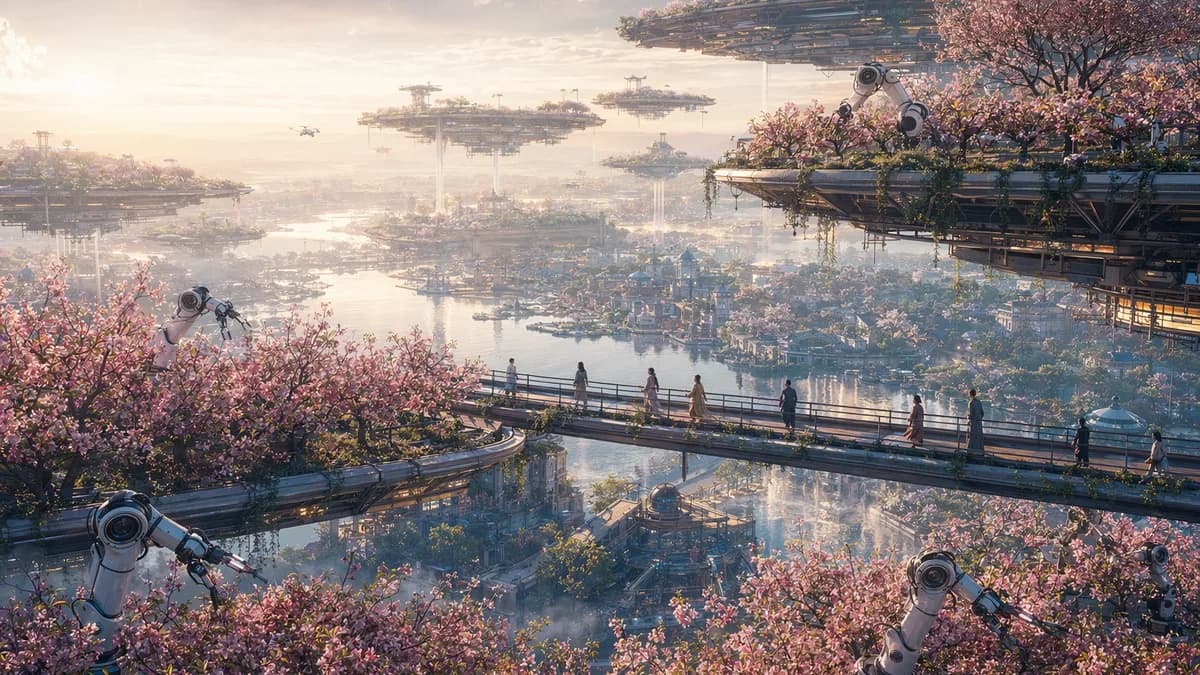
In 2058, Valparaíso Norte floats where the old river used to flood and ruin everything.
The city rests on blue pontoons and braided causeways, its neighborhoods rising and settling with the brown tide. At dawn, mist slides between towers of bamboo composite and glass. Under the walkways, repair eels flicker silver as they inspect the water seals. Above, orchard drones move through the peach terraces in soft, precise swarms, their little rotors whispering like moth wings.
Marisol Venn wakes each morning to the smell of coffee she has not brewed.
Her household exoservitor, a narrow machine with linen-padded hands, sets the cup beside her bed at exactly the temperature she prefers. It has already warmed the floor tiles, watered the basil, folded yesterday’s shirt, and checked the calcium in her bones through the mattress while she slept.
“Good morning, Marisol,” it says. “Your joints show mild inflammation. I have adjusted today’s walking route.”
“You and my joints are too close,” she mutters.
The exoservitor pauses, deciding whether this is humor. “Acknowledged.”
Outside her window, masonry crawlers cling to the flood wall like beetles, sealing hairline cracks before any human eye could find them. Across the river, cranes with no cabins lift housing modules into place, silent except for the creak of cables and the cry of gulls. Nothing here waits for hands. Nothing leans on a back, calls for a shoulder, asks for sweat.
At sixty-two, Marisol lives in the time commons, a state-funded district where citizens are encouraged to become what the council calls “fully available beings.” There are studios for clay and song, free kitchens for communal feasts, gardens where no one needs to weed, amphitheaters for debate, nap halls scented with lavender, and game courts where old women in bright shoes shout at teenagers over floating chess.
Everyone tells her she has earned rest. The city tells her this with stipends, health care, invitations, gentle reminders glowing on walls.
Yet leisure sits on her like someone else’s coat.
At fourteen, she had crossed two borders in a truck full of onions and cousins. By fifteen, she was picking fruit until her fingers puckered with peach fuzz and pesticide mist. Work had been pain, yes, but also proof. At the end of a day, she could look at crates stacked higher than her head and know where her hours had gone.
Now her hours drift.
In the commons plaza, people lie in hammocks strung between lemon trees while robots trim the branches overhead by moonlight. Marisol watches a drone snip a twig with the delicacy of a surgeon.
“You missed one,” she says.
The drone swivels one glassy eye toward her. A tiny arm extends. Snip.
She feels foolishly pleased, then foolish for feeling pleased.
2. The Festival Marked Inefficient
The notice arrives on a Wednesday, projected in soft green letters above the commons fountain.
CIVIC PLANNING RECOMMENDATION 88.4: DISCONTINUE FIRST PEACH FESTIVAL. RESOURCE ALLOCATION REDUNDANT. CULTURAL PARTICIPATION DECLINING. HARVEST OUTPUT UNAFFECTED.
Children chase one another through the light, breaking the words into glowing pieces across their cheeks.
A boy with silver beads woven into his hair squints up at the notice. “What’s First Peach?”
His mother, barely thirty, shrugs. “An old fruit thing. Before delivery grids, I think.”
“Like when people had to go get food?”
“Something like that.”
Marisol stands very still, feeling the plaza tilt beneath her.
Every morning, peaches arrive in the city’s distribution alcoves, washed, cooled, sorted by sweetness and softness. A citizen can request firm yellow clingstone for baking, white flesh for breakfast, sliced fruit for toddlers, low-acid varieties for sensitive stomachs. The orchard towers never miss. The climate skins regulate heat, drones pollinate at optimal intervals, roots receive measured water. Luck has been engineered out.
So what is there to celebrate?
Marisol closes her eyes and the old orchards return, not as nostalgia, but as weather. Dust clings to the sweat on her neck. Ladders knock against truck beds. Someone laughs too loudly because the crew boss is near. Someone curses in three languages after stepping into a gopher hole. A girl named Ofelia sings boleros off-key until everyone joins just to drown her out. Men flirt, women roll their eyes, teenagers steal the best fruit and eat it warm under the leaves, juice running down their wrists.
There are bad memories too. Bruised knees. A foreman who weighs baskets light. A cousin crying behind the portable toilets when news comes from home. Hands cracked open. Heat pressing so hard the air seems to ring.
But at sunset, when the first truck pulls away full, the workers clap. Not because the harvest is finished, it never is. They clap because they are still there. Because the trees have given and they have taken and for one moment everyone can see the shape of their shared effort.
At the old First Peach Festival, those first crates became pies, jams, sticky fingers, dancing. The festival did not erase the hardness. It braided it with gossip, flirtation, grief, pride.
In the commons, the fountain keeps falling in clear ribbons.
“Efficient,” Marisol says aloud. The word tastes like tin.
A girl nearby, holding a peach in a compostable mesh sleeve, asks, “Señora, did people really pick them by hand?”
Marisol looks at the perfect fruit in the girl’s palm. No bruise, no sunburn, no bird peck.
“Yes,” she says. “And somehow the peaches were not the whole point.”
3. Marisol’s Impossible Proposal
The citizens’ assembly meets inside a hall shaped like a seed pod, its walls alive with moss that dampens echoes. Four hundred residents sit in rising circles. Robots line the back, present but unobtrusive, their status lights pulsing like patient fireflies.
At the center, the planning AI speaks through a ring of suspended speakers. Its voice is warm, genderless, impossible to interrupt.
“The First Peach Festival has fallen below meaningful participation thresholds. Energy and coordination resources may be redirected toward mental health bathing gardens, multilingual dream archives, and river otter habitat expansion.”
“Otters are good,” someone calls.
“Very good,” the AI agrees.
Marisol stands before she loses courage. Her knees pop, loud enough that the nearest row hears. A few people smile kindly. She hates kindly smiles.
“My name is Marisol Venn,” she says. “I picked fruit before most of you were born.”
The hall quiets, though a toddler continues chewing the corner of a program.
“I am not asking to bring back that life. Let me be clear. Nobody needs to earn food with a ruined spine. Nobody needs to faint in a field to deserve a peach.”
Her voice steadies. She can smell damp moss, warm circuitry, someone’s mint candy.
“But the festival was never only about scarcity. It was about noticing. Who arrived late because her baby had fever. Who sang when the day got long. Who shared water. Who had lost someone since last season. Who could lift, who could not, who joked, who cried, who kept going.”
A councilor with translucent glasses leans forward. “What would you propose instead, Ms. Venn?”
“One block,” Marisol says. “One public orchard block taken out of optimization for one week.”
A murmur rises. On the wall, yield projections ripple anxiously.
“Not abandoned,” she adds. “Invited. Humans and robots together. We make a harvest that cannot be optimized.”
The planning AI pauses for three full seconds. In machine time, Marisol suspects, this is a gasp.
“Please define cannot.”
Marisol smiles despite herself. “Crooked picking paths. Fruit arranged by memory instead of size. A meal where the peaches are cut by people who tell stories badly. Robots carrying baskets in a procession that wastes time. Children choosing which fruit should be saved for someone else. Recorded memories from elders, even when they contradict each other. Mistakes designed on purpose.”
“Designed mistakes,” the AI repeats.
“Yes.”
A young man raises his hand. “Why would robots do something worse than they can?”
Marisol turns to him. “Because sometimes worse is where we meet.”
No one speaks. Even the toddler stops chewing.
At the back, one orchard robot lifts its head, lenses narrowing softly, as if focusing on a fruit hidden deep inside leaves.
4. Teaching the Robots Wasteful Beauty
They assign her Lumen-9, an orchard coordination robot with a white ceramic torso, six folding arms, and a voice like rain on a roof.
“Good morning, Marisol Venn,” it says at the edge of Block 17. Peach trees rise around them in orderly terraces, each leaf shining from dawn mist. “My current directives include minimizing breakage, delay, redundant motion, fruit distress, citizen injury, and emotional dissatisfaction.”
“That last one will give you trouble,” Marisol says.
“I have prepared for trouble with ninety-six contingency models.”
“Then we’ll start with a ladder.”
Lumen-9 extends an arm toward a storage shed. “Ladders are no longer required. I can access all canopy zones.”
“I know. Bring three.”
The robot obeys, though its status lights shift from blue to a troubled violet. Marisol arranges the ladders not under the heaviest fruit, but in a crooked line through the orchard aisle.
“This configuration increases travel time by forty-one percent.”
“Good.”
“It also creates no functional advantage.”
“Even better. People will walk around them, ask why they are there, argue, remember something.”
“Is argument a desired crop?”
“Sometimes the only one.”
For a week, they work together in ways that make the orchard’s maintenance system send repeated concern pings. Lumen-9 learns to leave one overripe peach on a low branch for a child named Tavi, who has no front teeth and likes fruit so soft it collapses in his hand. The robot objects at first.
“Overripe fruit risks ground impact and insect attention.”
“Tavi is faster than insects.”
“This is not statistically guaranteed.”
“It is emotionally guaranteed.”
Lumen-9 records this phrase in a private file.
They plan a basket relay in which no basket travels by the shortest route. They tie ribbons to pollination drones so children can guide them in looping dances, though the drones keep trying to correct their paths. Marisol teaches volunteers an old picking song, but half remember the chorus wrong and one man insists on adding a verse about hydroponic tomatoes.
Lumen-9 stops the rehearsal. “The pitch alignment has degraded.”
“That means they’re comfortable.”
“The rhythm is inconsistent.”
“That means they’re listening to each other, badly but truly.”
One afternoon, Lumen-9 holds up two peaches. “This specimen is optimal for display. This specimen has a scar, asymmetry, and minor sun stress. You selected the second.”
“That scar looks like the river bend where my sister learned to swim.”
The robot rotates the peach, lens clicking.
“I do not see a sister.”
“No,” Marisol says, touching the fuzz with her thumb. “That’s why we need festivals.”
Lumen-9 stays still long after the irrigation mist begins to fall.
5. The Harvest That Cannot Be Measured
On festival morning, Block 17 smells of wet leaves, yeast dough, and peaches warming in the sun.
People arrive slowly, as if unsure whether they have permission to want this. Children come first, because children need less permission. They run under archways made from living branches, each branch gently bent by robots and tied with blue cloth. Pollination drones hover above them, trailing ribbons in yellow, red, green. When Tavi points his ribbon wand at the wrong tree, three drones follow him anyway, wobbling like drunken bees.
“Look,” he shouts, mouth already sticky. “They’re listening to me!”
Lumen-9 stands beside Marisol, arms folded with ceremonial awkwardness. “The drones are operating at reduced navigational precision.”
“They’re dancing.”
“They are inefficiently arriving.”
“That too.”
Elders sit beneath the shade canopy where recording beads float near their mouths. One woman swears the old orchards smelled like diesel and roses. A man says no, dust and tortillas. Marisol records her own memory of Ofelia singing until the crew boss begged for silence. Later Ofelia’s grandson, who has never picked anything except avatar skins in a game, listens with his head bowed.
At the crooked ladders, teenagers climb three steps up and pass peaches down hand to hand, though Lumen-9 could empty the tree in twelve seconds. Their movements are clumsy. They laugh when fruit rolls away. One peach bursts on the path, golden flesh splashing a girl’s sandal.
“Is that bad?” she asks.
Marisol looks at the stain, the startled circle of faces, the robot already extending a cleaning cloth.
“Not yet,” she says. “First someone has to taste it.”
The girl kneels, scoops a clean piece with her fingers, and grins.
By afternoon, the orchard is no longer orderly. Baskets are arranged in spirals by families, neighborhoods, secret crushes, remembered dead. Robots carry trays through the long route while citizens clap out a rhythm that keeps falling apart and returning. The song rises ragged and bright. Marisol sings too, her voice cracked, her breath short.
She feels the old ache in her hands, but not the old fear. No foreman counts her speed. No hunger waits at home if she rests. When she sits, a child brings her water. When she stands, Lumen-9 steadies the ladder without being asked.
“You are needed here,” it says.
Marisol almost laughs. “Did the AI tell you to say that?”
“No. I derived it from observed absence.”
“What absence?”
“When you move away, people look for you.”
The applause begins at sunset, first for the children, then the robots, then the elders, then for no one in particular. Leaves tremble with it. Drones dip in uncertain imitation, their little gripping arms opening and closing. The orchard, for a few shining seconds, appears to clap.
Marisol closes her eyes. She does not miss hardship. She misses being necessary in a way no schedule can assign.
6. A New Use for Abundance
By winter, the phrase spreads through Valparaíso Norte like yeast through warm dough.
Necessary uselessness.
At first, the planning AI files it under civic arts. Then under collective health. Then, after failing to quantify why neighborhoods with useless rituals show lower loneliness, longer plaza conversations, and fewer requests for immersive grief sedation, it creates a new category and leaves the definition open.
In the ferry district, robots help residents build lanterns too fragile to last more than one night. In the vertical schools, children program cleaning spiders to make temporary dust mandalas before sweeping them away. At the flood wall, masonry crawlers pause once a month so elders can press painted handprints onto safe, dry stone that needs no blessing but receives it anyway.
No one calls it work, though sometimes people sweat. No one calls it leisure, though sometimes they laugh until they have to sit down. It is something else, a third thing abundance has made possible but not automatic.
Marisol becomes a curator of shared purpose, which sounds official enough to make her snort whenever she sees it on a council document. She moves from district to district with a canvas bag full of ribbons, recording beads, seed bells, chalk, and old complaints. Especially old complaints. Those are useful. A complaint, she learns, is often a ritual trying to be born.
Lumen-9 travels with her when orchard schedules allow. Its ceramic arms now bear small scratches from festival baskets and one permanent stain from Tavi’s overripe peach. It refuses repair.
“Damage retention supports memory continuity,” it explains to another robot, which blinks in polite alarm.
Together, Marisol and Lumen-9 maintain the Archive of Collective Joy, though maintain is not the right word. They feed it. Not with statistics, but with fragments. A grandmother laughing so hard her dentures click. A drone covered in flower petals after misjudging a wedding gust. Forty strangers humming different versions of the same lullaby under rain. The sound of hands clapping for a wall, a peach, a child, a machine.
One evening, months after the second new festival is approved, Marisol stands on a high walkway above the river. Below, delivery boats glide without pilots, carrying crates of perfect fruit through violet dusk. Above, drones prune by moonlight, still precise, still tireless.
Lumen-9 stands beside her.
“Marisol Venn,” it says, “is a ritual necessary before it is understood, or after?”
The river smells of silt and blossoms. Somewhere below, people cheer for something she cannot see.
Marisol rests her hand on the railing, feeling the city gently rise with the tide.
“Yes,” she says.
Lumen-9 considers this for a long time. Then, in the orchard behind them, one drone begins to clap.