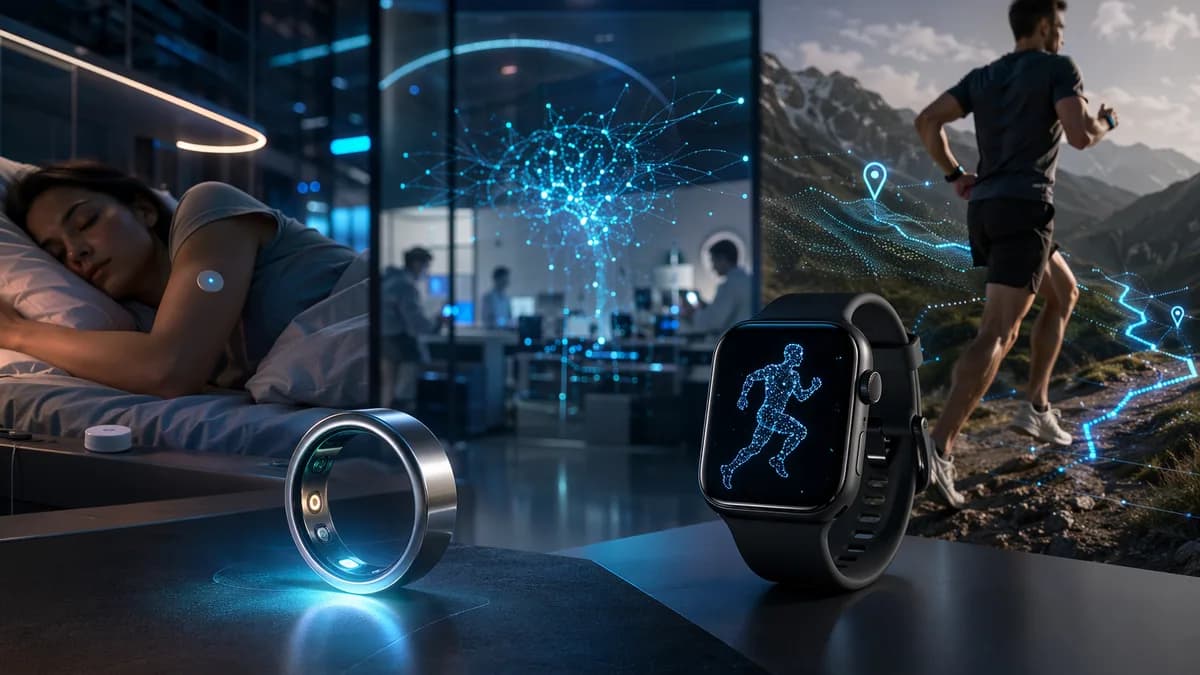
If you’re comparing smart ring vs smartwatch options, the right choice depends less on “which wearable is better” and more on what you want to track every day. Smart rings are strongest for sleep, recovery, HRV, long battery life, and low-distraction wear. Smartwatches are stronger for workouts, GPS, notifications, apps, safety features, and real-time data.
The best buying decision comes down to your priorities: overnight comfort or on-wrist utility, passive health tracking or active fitness coaching, fewer charges or more features. Below is a grounded, category-by-category comparison using the provided research from TechRadar, Trusted Reviews, WearableWell, CompareSmartRings, Samsung search data, and real-world Reddit discussion.
Smart Rings and Smartwatches: Core Differences
Smart rings and smartwatches both collect health data, but they are built around different assumptions.
A smart ring is a finger-worn wearable designed mainly for passive health tracking. According to WearableWell, devices such as the Oura Ring 4 focus on sleep tracking, HRV monitoring, stress analysis, and recovery insights. They usually do not have screens, so most interaction happens in a smartphone app.
A smartwatch is a wrist-worn wearable that combines health tracking with smart features. WearableWell describes devices such as the Apple Watch SE as mini smartphones on your wrist, offering fitness tracking, notifications, apps, calls, and messages.
| Category | Smart Ring | Smartwatch |
|---|---|---|
| Form factor | Worn on the finger | Worn on the wrist |
| Display | Usually no screen | Built-in screen |
| Best for | Sleep, HRV, recovery, low-distraction tracking | Workouts, GPS, notifications, apps |
| Typical battery life from sources | 4–7 days, with some examples up to 7–8 days | Around 18–36 hours or 1–2 days, depending on model and mode |
| Workout tracking | Limited; often app-based or manual | Strong; real-time metrics, GPS, workout modes |
| Smart features | Minimal or none | Notifications, music, maps, calls, apps |
| Comfort profile | Discreet and often better for sleep | More functional, but bulkier for some users |
The simplest buying rule: choose a smart ring if you want health data without another screen; choose a smartwatch if you want health tracking plus a connected wrist device.
TechRadar makes a similar point: smart rings and smartwatches serve similar purposes, but they are made for different preferences. Smart rings are not simply “smaller smartwatches.” They are less interactive, more passive, and more focused on sleep and wellbeing.
Sleep Tracking Accuracy and Comfort
Sleep tracking is one of the strongest arguments for buying a smart ring.
TechRadar reports that smart rings have an advantage for sleep tracking because they collect data such as heart rate, movement, and temperature, while also being more comfortable for overnight wear than many watches. The source notes that many people dislike wearing watches to bed, while smart rings are designed to be comfortable enough for overnight use.
WearableWell also gives smart rings the edge for sleep, citing comfort, less movement interference, and better consistency as reasons many users prefer rings for overnight tracking.
Why smart rings often feel better overnight
A ring is smaller, screen-free, and less likely to feel like a gadget in bed. CompareSmartRings describes rings as more discreet and less intrusive, noting that a 4–6 g titanium ring can be easier to forget about than a 40–50 g watch with a glowing screen.
That said, fit matters. TechRadar warns that a poorly fitting ring or flashing sensors can disrupt sleep. The same source describes a ring under review that initially fit like others but shifted during the night, causing sensors to lose contact with the skin.
| Sleep factor | Smart Ring | Smartwatch |
|---|---|---|
| Overnight comfort | Generally stronger; designed for 24/7 wear | Can feel bulky for some sleepers |
| Sleep-stage tracking | CompareSmartRings says Oura is validated against polysomnography and strong for sleep staging | Good for sleep/wake detection; CompareSmartRings says staging can be less reliable |
| Temperature tracking | Common in leading rings such as Oura and Galaxy Ring | Also available in some watches |
| Charging interruption | Less frequent charging supports continuous sleep tracking | Some watches may require nightly or near-nightly charging |
| Potential downside | Poor fit or sensor lights can disturb sleep | Wrist discomfort and charging can reduce consistency |
Trusted Reviews also notes that smart rings generally weigh less and appear more discreet than watches, which can help users who do not normally wear anything on their wrists.
Verdict for sleep: Smart rings are usually the better choice if sleep tracking is your top priority, especially if you want to wear the device every night with minimal distraction.
Fitness and Workout Tracking Compared
For workouts, smartwatches are the clear leader in the researched sources.
TechRadar states that smartwatches and fitness trackers currently provide the best solution for detailed data such as speed, heart rate, laps, and other specific workout metrics. Smart rings can track movement and are improving at workout monitoring, especially when activities are added manually in an app, but they cannot show real-time workout data because they do not have screens.
WearableWell agrees: smartwatches offer real-time heart rate tracking, GPS tracking, workout modes, and performance metrics. Smart rings are not designed for intense workout tracking.
Workout features: ring vs watch
| Fitness need | Better choice | Why |
|---|---|---|
| Running with pace data | Smartwatch | Watches can show real-time metrics and GPS data |
| Cycling route tracking | Smartwatch | CompareSmartRings cites GPS, maps, and structured workouts |
| Swimming or structured workouts | Smartwatch | CompareSmartRings lists running, cycling, swimming, and weight training support for watches |
| Manual activity logging | Smart ring can work | TechRadar notes some rings improve when activities are added manually |
| Low-distraction daily movement tracking | Smart ring | Rings can passively track movement without alerts or screens |
| Weightlifting comfort | Smartwatch or screenless wrist tracker | Reddit users reported rings rubbing against bars during lifting |
One Reddit user in the provided discussion said rings were a “pain” when lifting weights because the ring rubbed against the bar and became damaged. Another noted that weights, climbing, pullups, and similar activities can be uncomfortable or unsafe with rings.
That is anecdotal, not a controlled study, but it highlights a real buying consideration: rings live on your fingers, and your fingers grip equipment.
If your workouts involve barbells, pull-up bars, climbing holds, or heavy gripping, a smart ring may be less practical than a smartwatch or wrist-based fitness tracker.
Smartwatches also work better when you do not want to carry your phone. A Reddit user said they used a Garmin Forerunner 735XT for exercise with GPS, heart rate, and sleep, and valued not needing to bring a phone while exercising.
Verdict for fitness: Choose a smartwatch if workouts, GPS, live stats, structured training, or exercise safety matter more than passive recovery tracking.
Heart Rate, HRV, and Recovery Metrics
Heart rate and HRV sit in a middle ground: both categories can track them, but they emphasize the data differently.
WearableWell says smart rings often provide better HRV accuracy due to finger-based sensors. CompareSmartRings says rings such as Oura focus heavily on Heart Rate Variability, combining HRV, resting heart rate, body temperature, and sleep quality into a Readiness Score that can guide training and lifestyle decisions.
TechRadar also notes that some data suggests a ring’s finger placement may yield more precise readings for heart rate and temperature, but accuracy depends on sensor quality, algorithms, and fit.
Recovery is where rings differentiate
Smart rings are often positioned around recovery rather than performance. TechRadar notes that Oura and Ultrahuman provide app feedback on daily energy levels, readiness for exercise, and even suggestions around timing for eating, sleeping, and caffeine.
However, TechRadar also makes clear that these insights are not unique to rings. Garmin offers similar suggestions about energy levels through its own ecosystem.
| Metric or insight | Smart Ring | Smartwatch |
|---|---|---|
| Resting heart rate | Common feature | Common feature |
| HRV | Strong focus in rings; often central to recovery scoring | Available on many watches, but CompareSmartRings says it can be less emphasized |
| Body temperature trends | Common in leading rings | Available in some watches |
| Readiness / recovery | A core selling point for Oura and Ultrahuman | Available in some watch ecosystems, including Garmin-style energy insights |
| Real-time workout heart rate | Limited by lack of display | Stronger for live exercise tracking |
Trusted Reviews adds an important hardware angle: smartwatches can often fit more sensors. For example, the source says the Samsung Galaxy Ring includes an accelerometer, temperature sensor, and PPG sensor, while the Galaxy Watch 7 and Galaxy Watch Ultra include accelerometers, temperature sensors, gyroscopes, barometers, ambient light sensors, and compasses.
The same source says the Apple Watch Series 9 includes electrical and optical heart sensors, a temperature sensor, compass, altimeter, accelerometer, gyroscope, and ambient light sensor.
Verdict for HRV and recovery: Smart rings are usually better if you want passive HRV-led recovery insights. Smartwatches are better if you want heart-rate data during workouts and broader sensor-driven features.
Battery Life and Charging Convenience
Battery life is one of the most consistent wins for smart rings in the source data.
CompareSmartRings reports that the Oura Ring 4 offers around 7–8 days of battery life, while the Samsung Galaxy Ring lasts 6–7 days depending on size. By contrast, the Apple Watch Series 10 lasts about 18 hours on a standard charge, or up to 36 hours in low power mode, and the Google Pixel Watch 3 is listed at about 24 hours.
WearableWell gives a broader comparison: smart rings: 4–7 days; smartwatches: 1–2 days.
TechRadar adds more model-specific examples. The Oura Ring Generation 3 lasts up to 7 days on a single charge, while the Circular Ring Slim needs recharging after about 2 days.
| Device or category | Battery life stated in sources |
|---|---|
| Oura Ring 4 | Around 7–8 days |
| Samsung Galaxy Ring | 6–7 days, depending on size |
| Oura Ring Generation 3 | Up to 7 days |
| Circular Ring Slim | About 2 days |
| Apple Watch Series 10 | About 18 hours, up to 36 hours in low power mode |
| Google Pixel Watch 3 | About 24 hours |
| Smart rings overall | 4–7 days in WearableWell’s comparison |
| Smartwatches overall | 1–2 days in WearableWell’s comparison |
Battery life affects more than convenience. If you need to charge a smartwatch overnight, you may miss sleep data. TechRadar specifically notes that nightly charging can be inconvenient for sleep tracking.
For continuous health tracking, battery life is not just a spec. It determines whether the device is actually on your body when useful data is being collected.
Verdict for battery: Smart rings generally win. The exception is that battery life still varies by ring model, as shown by the difference between Oura and Circular examples.
Notifications, Apps, and Daily Productivity
This is where smartwatches pull far ahead.
Smart rings are intentionally passive. TechRadar says they are a good choice if you want to reduce screen time while still monitoring health. Some models may include added features such as vibrating alarms, but they are not designed to replace a wrist-based screen.
Smartwatches, especially those with LTE connectivity, can function as standalone devices. TechRadar lists SOS alerts, calls, physical controls, built-in voice assistants, and apps as smartwatch advantages.
WearableWell says smartwatches offer features rings do not, including:
- Notifications: View alerts from your phone.
- Calls: Make or receive calls on supported models.
- Music control: Manage playback from your wrist.
- Apps: Use third-party or built-in apps.
- Connectivity: Devices such as the Samsung Galaxy Watch are designed for productivity and connectivity.
Trusted Reviews also highlights smartwatch screens as the gateway to message notifications, maps, music streaming, app integrations, and showing the time.
Productivity trade-off
| Daily-use feature | Smart Ring | Smartwatch |
|---|---|---|
| Text notifications | No screen; generally app-based review later | Strong |
| Maps | Not a core feature | Supported on watches according to Trusted Reviews |
| Music streaming/control | Limited or absent | Supported on watches according to Trusted Reviews and WearableWell |
| Calls/messages | Not a core feature | Supported on smartwatches |
| Screen-time reduction | Strong | Weaker, because the device adds another screen |
| Distraction-free wear | Strong | Depends on notification settings |
Reddit comments reflect this split. One user liked the Galaxy Watch for notifications in class or at work, stopwatch use, Spotify, heart-rate monitoring, and gym exercise tracking. Another preferred a screenless device because they did not want watch notifications.
Verdict for productivity: Choose a smartwatch if you want notifications, calls, apps, music, or wrist-based convenience. Choose a smart ring if you want health tracking without another screen competing for attention.
Subscription Costs and Long-Term Value
Pricing is more complicated than sticker price because subscriptions can change long-term value.
TechRadar provides several concrete examples across wearables:
| Product | Price stated in source |
|---|---|
| Apple Watch Ultra 2 | $799 / £799 / AU$1,399 |
| CMF Watch Pro from Nothing | $69 / £69 / AU$131 |
| Garmin Epix Pro | $899.99 / £829.99 / AU$1,529 |
| Huawei Band 7 | £49.99 / AU$159 |
| Oura Gen 3 | $299 / £230 / AU$420 |
| Ultrahuman Ring Air | $349 / £280 / about AU$537 |
CompareSmartRings says premium models in both categories often sit around $300–$500, but the subscription model differs. It states that Oura requires a $5.99/month membership or $69.99 annually for full insights, while Samsung Galaxy Ring does not charge a subscription fee at the time of writing.
The same source says smartwatches such as Apple Watch or Pixel Watch do not require ongoing payments for core use, though users may be nudged toward services such as Apple Fitness+ or Fitbit Premium.
Value depends on what you will actually use
| Buyer priority | Better value may be |
|---|---|
| Sleep and recovery insights | Smart ring, if you will use the app insights consistently |
| Workout tracking and GPS | Smartwatch |
| Lowest upfront cost | Budget fitness tracker or budget smartwatch, based on TechRadar’s examples |
| No subscription preference | Check ring brand carefully; smartwatches may avoid mandatory ongoing fees for core use |
| All-in-one device | Smartwatch |
TechRadar warns that affordable smart rings may compromise on quality, while budget fitness trackers may lack the same aesthetic appeal but often offer greater reliability. If cost is the primary concern, TechRadar suggests considering budget fitness trackers rather than assuming a low-cost ring will deliver the same experience.
Verdict for value: Smart rings can be worth it for sleep and recovery, but subscriptions matter. Smartwatches often deliver broader features for the price, especially if you want apps, GPS, and notifications.
Design, Durability, and Wearability
Design is personal, but the form-factor trade-offs are clear.
Smart rings are discreet and resemble jewelry. TechRadar says they offer a sleeker, less sporty look compared with most smartwatches and fitness trackers. Trusted Reviews similarly says rings are generally more comfortable, weigh less, and appear more discreet.
However, rings are not always as slim as marketing may suggest. TechRadar warns that many smart rings still seem bulky compared with regular rings, especially on smaller hands.
Fit and sizing
Smartwatches usually have adjustable straps, and TechRadar notes they can be customized by swapping straps with different materials and colors. Smart rings are fixed-size devices. Many companies send sizing kits with plastic dummy rings to help users find the right size, but you cannot adjust the fit afterward like a watch strap.
Durability concerns
TechRadar reports that smart rings with matte black finishes, such as the Ultrahuman Ring Air and Circular Ring Slim, showed significant scratching after just a few days of testing. The same source says more premium smartwatches are designed with durability in mind.
Reddit discussion adds another practical concern: rings can be uncomfortable or vulnerable during lifting, climbing, pullups, and other grip-heavy activity.
| Wearability factor | Smart Ring | Smartwatch |
|---|---|---|
| Discretion | Strong; jewelry-like | More visible |
| Adjustability | Fixed size; sizing kit may be needed | Adjustable straps |
| Customization | Limited design flexibility | Strap materials and colors can be swapped |
| Overnight comfort | Generally stronger | Mixed; some users dislike watches in bed |
| Gym durability | Can scratch or rub on bars | Usually better suited for workouts |
| Skin/wrist issues | May help people who dislike wrist wear | May irritate some users, based on Reddit anecdote |
A Reddit user mentioned that a partner’s Apple Watch caused skin issues and suggested a ring might be an alternative. That is not medical evidence, but it is a reminder that comfort is individual: some people dislike wrist devices, while others dislike wearing rings.
Verdict for design and wearability: Smart rings win for discretion and overnight comfort. Smartwatches win for adjustability, visual interaction, and many workout scenarios.
Who Should Buy a Smart Ring?
A smart ring is the better purchase if you want passive health tracking more than on-device interaction.
Choose a smart ring if these points describe you:
Sleep is your top priority
Smart rings are consistently favored in the sources for sleep comfort and sleep-focused insights. CompareSmartRings says Oura is validated against polysomnography for sleep staging, and WearableWell gives rings the edge for consistent overnight tracking.You care about HRV and recovery
Rings such as Oura and Ultrahuman emphasize readiness, energy, and recovery insights based on HRV, resting heart rate, temperature, and sleep quality.You want fewer distractions
With no screen, a ring can track health without buzzing with messages or tempting you into apps. TechRadar specifically frames rings as useful for people trying to reduce screen time.You dislike wearing watches to bed
If a wrist device feels bulky at night, a ring may be easier to wear continuously.You want longer battery life
Source examples show rings commonly lasting multiple days, including 6–7 days for Samsung Galaxy Ring and around 7–8 days for Oura Ring 4.You prefer a discreet wearable
Rings look more like jewelry than fitness gear, although some models may still look bulky compared with normal rings.
A smart ring may not be right if you lift heavy weights often, need GPS workouts, want on-wrist notifications, or dislike wearing rings.
Who Should Buy a Smartwatch?
A smartwatch is the better choice if you want a wearable that actively helps during the day, during workouts, and in safety situations.
Choose a smartwatch if these points describe you:
You train regularly and want live metrics
Smartwatches are stronger for pace, heart rate, laps, GPS, maps, and structured workout data. TechRadar and WearableWell both give watches the fitness-tracking advantage.You want GPS without relying on a phone
Smartwatches and sports watches are better for running, cycling, and other outdoor activities where route and speed matter.You need notifications and apps
Trusted Reviews highlights smartwatch features such as message notifications, maps, music streaming, third-party apps, and time display.You want safety features
CompareSmartRings says devices such as Apple Watch Series 10 and Pixel Watch 3 support ECG readings, irregular rhythm alerts, fall/crash detection, and SOS calling. A Reddit user also said a Galaxy watch offered peace of mind because of fall-related safety concerns.You prefer an all-in-one device
A smartwatch can be a health tracker, workout companion, notification center, music controller, and calling device in one.You want adjustable fit and customization
TechRadar notes that watch straps can be adjusted and swapped for different materials and colors.
A smartwatch may not be ideal if you want fewer screens, dislike wrist wear, struggle to sleep with a watch on, or do not want to charge another device frequently.
Bottom Line
The smart ring vs smartwatch decision is really a question of health depth versus daily utility.
Buy a smart ring if your priorities are sleep tracking, HRV, recovery, comfort, long battery life, and a screen-free experience. The research consistently shows rings are better suited to passive, continuous wellness tracking, especially overnight.
Buy a smartwatch if your priorities are workout tracking, GPS, notifications, apps, calls, music, safety features, and real-time data. Smartwatches are more capable all-in-one devices, but they are also bulkier, more distracting, and usually need charging more often.
For some users, the best answer is both: a ring for sleep and recovery, and a watch for workouts and daytime productivity. CompareSmartRings and WearableWell both note that many advanced users combine the two to get a fuller view of health and fitness.
FAQ
Are smart rings better than smartwatches for sleep tracking?
Yes, in the provided sources, smart rings generally come out ahead for sleep tracking. TechRadar and WearableWell both emphasize overnight comfort, while CompareSmartRings says Oura is validated against polysomnography and strong for sleep-stage tracking.
Are smartwatches better than smart rings for workouts?
Yes. Smartwatches are better for workouts because they can show real-time data, support GPS, offer workout modes, and display metrics such as pace, heart rate, laps, and maps. Smart rings can track movement, but they are not designed for detailed performance tracking.
Which has better battery life: smart ring or smartwatch?
Smart rings generally have better battery life. Source examples include Oura Ring 4 at around 7–8 days, Samsung Galaxy Ring at 6–7 days, and Oura Ring Generation 3 up to 7 days. By contrast, Apple Watch Series 10 is listed at about 18 hours, or up to 36 hours in low power mode.
Can a smart ring replace a smartwatch?
Not completely. A smart ring can replace a smartwatch for passive health tracking, sleep, HRV, and recovery insights. It cannot fully replace a smartwatch if you rely on notifications, apps, GPS workouts, calls, maps, music controls, ECG, fall/crash detection, or SOS features.
Do smart rings require subscriptions?
Some do. CompareSmartRings states that Oura requires a $5.99/month membership or $69.99 annually for full insights. It also states that Samsung Galaxy Ring does not charge a subscription fee at the time of writing. Always check the current subscription policy before buying.
Should I buy both a smart ring and a smartwatch?
You might, if budget and simplicity are not concerns. The combination can make sense if you want a ring for sleep, HRV, stress, and recovery, plus a smartwatch for workouts, GPS, notifications, and safety features. If you want only one device, choose based on your primary use case: recovery and sleep, or fitness and smart features.