
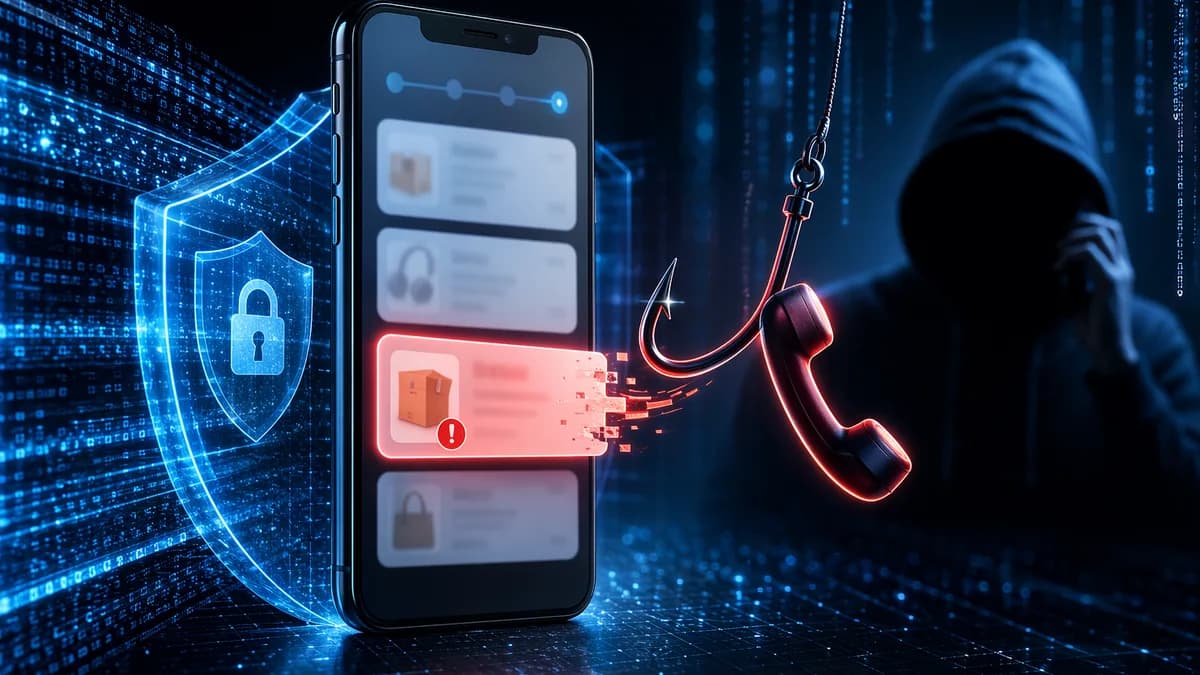
Shop callback phishing has turned a trusted order-tracking app into the bait, putting fake receipts beside real purchases where users are least likely to treat them as hostile.
CybersecurityJune 26, 2026· 7 min read· By XOOMAR Insights Team
Fake Receipts Hijack Shop App in Callback Phishing Trap
Updated on June 26, 2026
XOOMAR Intelligence
Analyst Take
57/ 100
4 sources analyzedLow confidenceTrend10Freshness96Source Trust88Factual Grounding88Signal Cluster20
The tactic, detailed by BleepingComputer, targets Shop, Shopify’s order-tracking and shopping app, by inserting bogus purchase receipts into users’ order histories. Gen Digital says the fake orders impersonate brands including Norton, McAfee, Apple, and PayPal, then push users to call a phone number controlled by scammers.
The tension is simple. Shop exists to reduce ecommerce uncertainty. Attackers are abusing that certainty.
Shop callback phishing turns the order history into the lure
The visible lure is not a random email. It’s an entry inside Shop, a legitimate app where users already expect receipts, shipping updates, and order records from multiple retailers.
That makes this campaign sharper than a standard fake invoice email. A suspicious message in an inbox has to survive spam filters, sender scrutiny, link checks, and user distrust. A fake purchase receipt inside an order history starts with a different assumption: “This app knows what I bought.”
According to BleepingComputer, Shop is especially relevant in North America, where its support and purchasing options are more substantial. It has 50 million downloads on Google Play and 7 million ratings in Apple’s App Store. That scale gives scammers a high-trust surface with consumer habits already built in.
XOOMAR analysis: the abuse works because it hijacks post-purchase behavior, not because it introduces a new malware trick. A user who sees an unfamiliar receipt for a large purchase is likely to think about stopping a charge first and verifying the source second. That short gap is the attack window.
Fake receipts move shoppers from purchase panic to a phone scam
The fake Shop receipt includes a phone number for disputing the alleged purchase. Calling that number moves the victim out of the app and into callback phishing, where the attacker waits for the target to initiate contact.
Once on the call, the scammer poses as support staff. Gen Digital researchers say the fraudster then uses social engineering to obtain:
- Account credentials: Usernames, passwords, or recovery details.
- Payment card details: Card information under the cover of refund or cancellation support.
- Temporary authentication codes: OTPs that can defeat account protections if handed over in real time.
- Remote access software: In some cases, victims are pushed to install tools that give the attacker access to the device.
That last step is the most dangerous escalation. A fake receipt starts as a consumer fraud problem. Remote access can turn it into device compromise.
XOOMAR analysis: phone-based phishing also weakens many automated defenses. The receipt may be visible in an app, but the meaningful attack happens during a human conversation. There may be no malicious link to scan, no attachment to detonate, and no email sender to block once the victim is already talking to the scammer.
Shop’s scale gives fake receipts room to work
The available numbers explain why Shop is attractive. 50 million Google Play downloads and 7 million App Store ratings do not tell us how many active users saw fake receipts, but they do show why criminals would test this surface.
The economics differ from classic phishing links:
| Attack style | User trigger | Attacker cost | Potential payoff |
|---|---|---|---|
| Fake invoice email | Inbox alert | Lower, more automated | Credentials, card data, malware clicks |
| Shop fake receipt | Order history entry | Higher if phone operators are involved | Credentials, OTPs, card data, remote access |
| Callback phishing | Victim calls attacker | Labor-heavy | Higher-value social engineering outcomes |
The missing data matters. BleepingComputer does not report how many Shop users received fake receipts, how long those receipts stayed visible, or what specific controls Shopify uses to detect repeat abuse.
Gen Digital also could not confirm how the false receipts entered Shop. Researchers noted that Shop can populate orders from multiple sources, including email parsing, account association, and order workflows, but no single delivery channel was confirmed.
That uncertainty is the hard part. If defenders don’t know which ingestion path was abused, they can’t assess whether this is a narrow workflow issue, a merchant identity problem, an email-parsing artifact, or something else.
No confirmed breach, but four parties see four different failures
Gen Digital found no evidence that Shop, Shopify, or the impersonated companies were compromised. BleepingComputer also said it contacted Shopify with related questions and had not received a response as of publication.
That distinction matters. This is not a breach story in the same category as incidents like 1.4 Million Exposed as Xsolis Data Breach Leaks SSNs or Tata Electronics Data Breach Exposes Apple, Tesla Risk. The reported issue is abuse of trust and order presentation, not confirmed theft from Shopify’s systems.
Still, users won’t parse the technical layer. If a fake Norton, McAfee, Apple, or PayPal receipt appears in Shop, the user sees the app as part of the problem.
Each party experiences the failure differently:
- Shopify: Must protect trust in Shop without breaking legitimate order tracking.
- Consumers: Need a clear signal that an order is authentic, not just formatted like one.
- Impersonated brands: Their names are used to make the scam believable, even with no reported compromise.
- Banks and card issuers: Become the fallback verification point once users suspect a charge.
BleepingComputer’s advice is direct: don’t call the number in the suspicious receipt. Verify any alleged charge directly with the bank instead.
Fake invoice scams now sit closer to the transaction
Fake purchase notices have long used familiar names like Norton, PayPal, and other subscription brands to create urgency. The Shop abuse keeps the same psychological trigger but moves the lure closer to where real transactions are managed.
That shift matters. Security training often tells users to distrust strange emails and texts. It does not always prepare them for a malicious-looking receipt inside a legitimate app.
The red flags still exist. Gen Digital says many of the false receipts contain poor grammar, which should raise suspicion. But a sloppy receipt can still work if the alleged purchase amount looks large enough to trigger panic.
XOOMAR analysis: this campaign shows why “check the app instead of the email” is no longer complete advice. The app may be legitimate, yet the record shown inside it may still be untrusted until its source is clear.
Receipt trust needs controls, not just user suspicion
For everyday buyers, the safe response is boring and effective:
- Don’t call phone numbers shown in unexpected receipts.
- Check your bank or card account directly for the alleged charge.
- Use official merchant channels rather than receipt-provided contact details.
- Never install remote access tools during a refund, cancellation, or fraud call.
- Reset passwords and contact the card issuer if credentials, OTPs, or card data were shared.
Shop also has its own guidance for suspected fraud in its Shop Help Center, which is the right place to start instead of trusting contact details embedded in a questionable receipt.
For ecommerce and app security teams, the lesson is broader. Receipts and order histories are high-trust surfaces. They should be treated like active fraud channels, not passive records.
XOOMAR analysis: stronger defenses would likely need to focus on provenance labels, suspicious phone-number patterns, urgent cancellation language, merchant identity signals, velocity limits, and faster reporting loops for users who see orders they didn’t place. The source does not confirm Shopify’s current controls, so the open question is whether the platform can identify which order-ingestion path is being abused.
The next test is whether platforms can prove where orders came from
Attackers benefit when a user can’t quickly answer one question: who put this receipt here?
If Shopify can show clear origin signals for Shop orders, users get a better chance to separate real purchases from planted bait. If the insertion path remains unclear, Shop callback phishing will remain attractive because it exploits a place where shoppers already expect money, shipping, refunds, and mistakes to collide.
The evidence to watch is specific: confirmation of the delivery channel, Shopify’s response, any new in-app warnings, and whether fake receipts continue appearing beside legitimate orders. Until then, the safest assumption is blunt. A receipt inside a trusted app is not proof of a real purchase.
Impact Analysis
- Scammers are exploiting trust in a legitimate shopping app rather than relying on suspicious emails.
- Fake receipts can push users into calling scam-controlled numbers before they verify the charge.
- Shop’s large user base gives attackers a broad, high-trust surface for callback phishing.
Callback phishing lure placement
| Attack surface | Why it works | User reaction targeted |
|---|---|---|
| Fake receipt inside Shop order history | Appears in a trusted order-tracking app beside legitimate purchases | Panic over an unfamiliar charge prompts a phone call |
| Standard fake invoice email | Must survive spam filters, sender checks, and inbox skepticism | User may scrutinize the message before acting |
Shop app scale cited in report
Google Play downloads
count50,000,000
Apple App Store ratings
count7,000,000
Sources

Written by
XOOMAR Insights Team
Research and Editorial Desk
The XOOMAR Insights Team pairs automated research with human editorial judgment. We track hundreds of sources across technology, fintech, trading, SaaS, and cybersecurity, cross-check the facts, and explain what happened, why it matters, and what to watch next. We do not just rewrite headlines. Every article is fact-checked and scored for reliability before it goes live, and we link back to the original sources so you can verify anything yourself.
Explore More Topics
Related Articles
 Cybersecurity
Security Chaos Floods Apple Bug Bounties With AI Slop
A flood of AI-generated reports is overwhelming companies like Apple, forcing them to cap bug bounties as attacks swamp ports, banks, and infrastructure in a se
Aug 8, 20267 min
 Cybersecurity
AI Phishing Threat Sends $36M Into AegisAI's Agents
AegisAI raised $36M to push autonomous inbox agents against AI-crafted phishing, bringing total funding to $49M.
Jul 24, 20266 min
 Cybersecurity
Evil Twin Apps Slip Past macOS Gatekeeper Warnings
Researchers say macOS can let malicious app replacements inherit Gatekeeper trust after first launch. Apple isn't calling it a major flaw.
Jul 23, 20268 min
 Cybersecurity
Ransomware Groups Slip the Net With Serial Rebrands
Ransomware crews are rebranding faster as attacks rise, forcing defenders to track operators, not names.
Jul 13, 20268 min
 Cybersecurity
42 US Attacks Pull Russian Cybercrime Hosts Into Court
DOJ says Russian bulletproof hosts enabled attacks on 42 US entities, shifting pressure from hackers to infrastructure sellers.
Jul 19, 20267 min
 Technology
Sonos Fires Direct Shot at Apple AirPods With Ace Ultra Headphones
Sonos is preparing a flagship 'Ace Ultra' headphone, revealed in FCC filings, to attack giants like Apple and Sony just two years after its first headphone laun
Aug 11, 20266 min
 SaaS & Tools
ApartmentIQ Seals $25 Million Bet on Real-Time Rental Data
ApartmentIQ raised $25 million in growth funding led by Susquehanna Growth Equity to scale its AI-driven, real-time data platform, which now covers over 8 milli
Aug 12, 20267 min
 Technology
Automattic Deploys Android CRM to Slash Clunky Legacies
Automattic's free, AI-enhanced Mesh CRM has launched on Android, targeting a massive user base to directly challenge clunky, legacy customer relationship softwa
Aug 12, 20265 min
 Global Trends
Drones Cripple Russian Grain Hub In Black Sea Attack
Ukrainian drone strikes have knocked major Russian grain export terminals offline at the Novorossiysk port, escalating a campaign of economic sabotage that thre
Aug 12, 20266 min
 Global Trends
Gen X Most At Risk as Grocery Bills Trap Tipping-Point Households
A majority of U.S. households remain stuck in a 'cutback economy,' where falling gas prices are no match for the relentless rise in essential costs like rent an
Aug 12, 20266 min
Don't miss the signal
Get our weekly roundup of the stories that matter across tech, fintech, and trading. No noise, just signal.
Free forever. No spam. Unsubscribe anytime.