
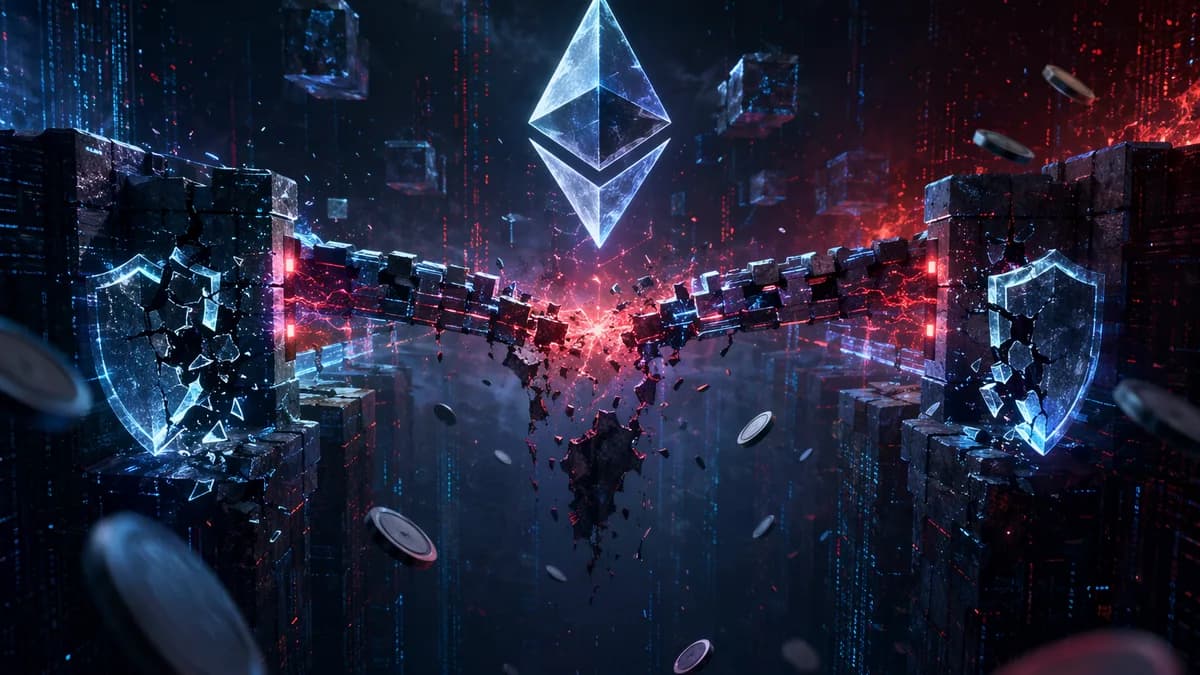
On Monday, Taiko stopped producing blocks because its bridge could no longer be trusted, a fast containment move that limited losses but exposed the softest part of the Ethereum layer 2 pitch: users still depend on bridge verification holding under pressure.
CybersecurityJune 22, 2026· 7 min read· By XOOMAR Insights Team
Forged Proofs Trigger $1.7M Taiko Bridge Exploit Halt
Updated on June 22, 2026
XOOMAR Intelligence
Analyst Take
61/ 100
4 sources analyzedLow confidenceTrend20Freshness98Source Trust88Factual Grounding92Signal Cluster20
The Taiko bridge exploit drained about $1.7 million after an attacker forged withdrawal proofs, according to CoinDesk. Taiko urged users to withdraw funds, asked centralized exchanges to suspend TAIKO deposits, and had block producers stop making new blocks while it investigated.
That sequence matters. A rollup can promise Ethereum alignment, faster execution, and lower-cost activity, but when the bridge fails, the emergency brake becomes the most important feature in the stack.
Monday's Taiko bridge exploit forced the network to choose containment over uptime
The first hard decision was not technical elegance. It was triage.
Taiko halted block production after the attacker used forged cross-chain proofs to make fake withdrawal requests look valid on Ethereum. Those requests had no matching deposits on Taiko’s own chain, but they were accepted, allowing the attacker to drain the bridge and token vault before the team froze activity.
XOOMAR analysis: That is the right choice in a live exploit. Uptime is not a virtue if the system keeps processing fraudulent exits. The cost is reputational. A layer 2 that stops block production reminds users that some scaling systems still rely on emergency coordination when core assumptions fail.
Taiko said by about 2 a.m. ET that the exploit had been contained and withdrawals through the main bridge and token vault were fully stopped. The speed of that response appears to be why this remained a contained incident rather than a much larger bridge drain.
The forged withdrawal proof attack turned verification into the attack surface
A bridge withdrawal proof is supposed to convince Ethereum that a valid event happened elsewhere. In this case, the attacker allegedly convinced Ethereum to release real assets without a real Taiko-side transaction behind the withdrawal.
That is why the Taiko bridge exploit is more serious than the dollar figure alone suggests. The bridge did not merely lose funds through a bad trade, a price oracle issue, or user error. It accepted an invalid instruction as valid.
Security firm BlockSec pointed to a possible operational failure around Raiko, Taiko’s proof system.
“Our initial investigation suggests the likely root cause was an exposed Raiko SGX enclave signing key on GitHub.”
CoinDesk reported that the key was meant to remain sealed inside secure hardware. With it exposed, the attacker could enroll their own provers as legitimate and sign fraudulent proofs that Taiko’s verifier accepted.
The open questions now matter more than the headline loss:
- Verification flaw: Did the proof validation logic accept something it should have rejected?
- Key exposure: Was the critical failure an operational lapse around the Raiko signing key?
- Permissioning: Did prover registration allow a malicious prover to gain trust too easily?
- Monitoring: How quickly did alerts detect fake withdrawals versus actual fund movement?
- Recovery: Which contracts, bridges, and vaults need redeployment or re-verification?
Taiko’s halt likely achieved three things at once: it stopped further bridge withdrawals, bought investigators time, and prevented uncertainty from cascading across every bridge deployed on the network.
The numbers show a small loss by bridge standards, but a real confidence shock
The reported damage was about $1.7 million. The TAIKO token dropped roughly 10% after the incident. The exploiter had already moved about 2 million TAIKO, worth roughly $170,000, to an account on MEXC, according to CoinDesk.
That is not a catastrophic bridge hack by 2026 standards. It is still meaningful for a network that launched on Ethereum in May 2024 and is trying to earn liquidity, developer confidence, and user trust.
| Metric | Reported figure | Why it matters |
|---|---|---|
| Estimated loss | About $1.7 million | Small versus major bridge hacks, but large enough to test response credibility |
| Token move | TAIKO down roughly 10% | Markets priced more than the direct loss, including uncertainty over controls |
| Moved to MEXC-linked account | About 2 million TAIKO, worth roughly $170,000 | Shows the attacker had already shifted part of the haul before full containment |
| Containment time marker | About 2 a.m. ET | Speed appears central to the limited blast radius |
XOOMAR analysis: The token reaction is not just about $1.7 million leaving a vault. It reflects a broader question: if the bridge verification layer failed once, what else depends on the same assumption?
Bridge hacks keep rhyming because proof systems fail at the edges
CoinDesk tied Taiko’s exploit class to a wider 2026 pattern. Forged cross-chain messages drained $292 million from Kelp DAO’s bridge in April and $11.4 million from the Verus-Ethereum bridge in May. Bridges have produced more than $340 million in losses across at least 14 exploits in 2026, making them the costliest crypto target cited in the source material.
The common thread is not that every exploit used identical code. It is that one chain was tricked into trusting an instruction from another.
That is the chronic bridge problem. Sophisticated cryptography can sit on top of fragile implementation choices, signer assumptions, source-signal validation, upgrade paths, or operational key management. If the wrong message gets treated as authoritative, the bridge releases real funds.
For readers tracking similar infrastructure-risk dynamics outside crypto, XOOMAR has covered pressure points in Attackers Hit Cisco SD-WAN Flaw Cisco Says It Found First and emergency response timing in 3-Day CISA Deadline Throws cPanel Plugin Flaw into Crisis. The shared lesson is narrow but important: once trusted infrastructure becomes the attack path, containment speed becomes part of security.
Users, traders, developers, and Taiko now have clashing incentives
Users want access. During a halt, that access narrows. But most users would rather face delayed withdrawals than watch a bridge keep honoring fake exits.
Traders move faster. The roughly 10% token decline shows how quickly uncertainty gets priced when the market lacks a full incident report. Token holders may also start asking whether compensation, lower network activity, or contract changes could affect future value. Those are not confirmed outcomes, but they are rational concerns after a verification breach.
Developers have a different problem. If they build on Taiko, they need to know whether emergency controls are a safety feature or a dependency risk. A pause can prove discipline. It can also reveal that normal operations depend on a small set of actors coordinating under stress.
Taiko’s task is to prove the halt was controlled defense, not chaos. That means clear sequencing: explain the exploit, identify the failed assumption, patch or replace the affected components, and tell users when bridges can be trusted again.
The next decision point is Taiko's postmortem, not the price chart
Taiko said it would release a full incident report on Monday in Asian hours. That document now carries the recovery trade.
A credible postmortem should answer whether the root cause was an exposed Raiko SGX enclave signing key, a source-signal proof validation flaw, prover registration weakness, or some combination. It should also say what funds were affected, whether any recovery is possible, which contracts remain paused, and what conditions must be met before deposits resume.
XOOMAR analysis: The competitive edge for rollups is shifting. Lower fees and faster execution still matter, but visible security discipline now matters just as much. Users can forgive a contained exploit. They are less forgiving when teams hide behind vague language after the fact.
If Taiko turns the Taiko bridge exploit into a transparent hardening process, the damage may stay reputational and repairable. If the incident report is thin, delayed, or evasive, the $1.7 million loss could become the smaller part of the story.
Impact Analysis
- The exploit highlights that Ethereum layer 2 security still depends heavily on bridge verification.
- Taiko's fast halt likely limited losses, but it exposed the reputational cost of emergency coordination.
- The 10% TAIKO token drop shows how quickly security incidents can hit market confidence.
Taiko's Emergency Trade-Off
| Option | Benefit | Cost |
|---|---|---|
| Halt block production | Contained the bridge exploit and stopped further fraudulent exits | Damaged confidence in Taiko's uptime and decentralization assumptions |
| Keep network running | Preserved normal operations for users | Risked allowing more forged withdrawals and larger losses |
Reported Taiko Bridge Exploit Loss
Funds drained
$M1.7
Sources

Written by
XOOMAR Insights Team
Research and Editorial Desk
The XOOMAR Insights Team pairs automated research with human editorial judgment. We track hundreds of sources across technology, fintech, trading, SaaS, and cybersecurity, cross-check the facts, and explain what happened, why it matters, and what to watch next. We do not just rewrite headlines. Every article is fact-checked and scored for reliability before it goes live, and we link back to the original sources so you can verify anything yourself.
Explore More Topics
Related Articles
 Cybersecurity
Bank Heist Exposes North Korea Crypto Laundering Bust
Reported arrests suggest Pyongyang fears its own hackers are turning state cyber skills into private crypto escape routes.
Jul 25, 20268 min
 Fintech
Monad Buys Back $60M in Tokens, Investors Refuse Exit
Almost all of Monad's early investors refused a $60 million buyback offer months before their tokens unlock, a rare vote of confidence that raises the stakes fo
Aug 18, 20265 min
 Global Trends
Navy’s Record Carrier Deployments Burn Out Sailors
U.S. Navy carriers are pushing past 300-day deployments, leaving sailors on ships like the USS Abraham Lincoln physically depleted and mentally broken in a stra
Aug 18, 20266 min
 Fintech
Fireblocks Hires SEC Veteran As Crypto Rulemaker
Fireblocks hiring ex-SEC Commissioner Elad Roisman signals a pivotal shift: major crypto infrastructure is moving from protesting regulation to directly writing
Aug 18, 20266 min
 Fintech
Labour Suspends MP Over Pandemic Loan Eligibility Probe
Labour MP Bayo Alaba is suspended as his party investigates the eligibility and attempted winding-up of a company that received pandemic loans.
Aug 18, 20265 min
 Technology
Indonesia Quake Paralyzes Island As Death Toll Climbs
A powerful shallow earthquake on Flores Island has killed at least 53 people and overwhelmed local response capabilities, highlighting Indonesia's persistent vu
Aug 18, 20269 min
 Trading
Yen Ignores 80% Bank of Japan Rate Hike Odds
Despite an 80% market probability of a September rate hike, the yen remains weak, highlighting the limited power of domestic policy against overwhelming global
Aug 18, 20267 min
 Trading
Gold Soars Past $4,400 As US Dollar Weakening Continues
Gold surged over 1% to $4,422 as a weakening US Dollar, driven by expectations of a more dovish Federal Reserve, ignited a sharp rally in the precious metal.
Aug 18, 20267 min
 Fintech
Ebanx Plants Executives in Foreign Markets for Growth
Payments giant Ebanx is decentralizing its leadership, placing senior executives directly in high-growth markets to address local complexity and drive its next
Aug 18, 20266 min
 Global Trends
Zambia Reelection Cemented Amid Austerity and Turmoil
Zambia’s President Hakainde Hichilema secures a second term with over 61% of the vote, a mandate to continue economic austerity and debt restructuring despite a
Aug 18, 20265 min
Don't miss the signal
Get our weekly roundup of the stories that matter across tech, fintech, and trading. No noise, just signal.
Free forever. No spam. Unsubscribe anytime.