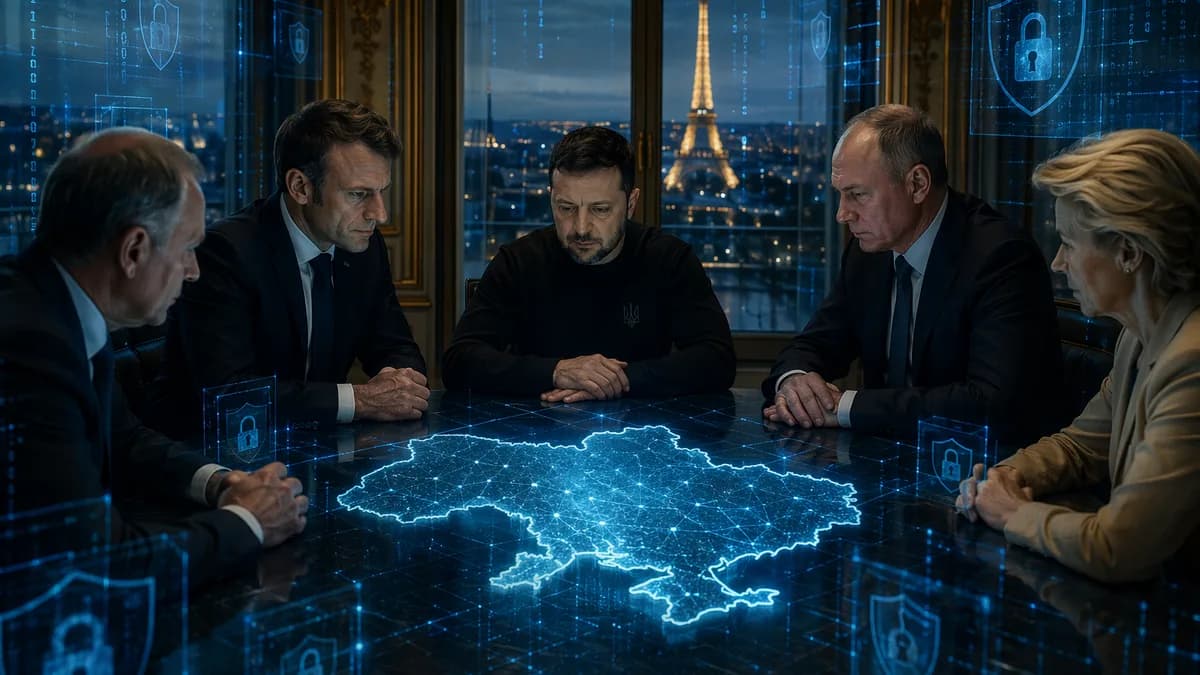
Emmanuel Macron is bringing Volodymyr Zelenskyy, Keir Starmer and Friedrich Merz to Paris today for Ukraine talks aimed at tightening European support for Kyiv while pressure builds on Moscow.
XOOMAR Intelligence
Analyst Take
The Macron Zelenskyy Starmer Merz Ukraine talks will take place around a wider Coalition of the Willing meeting at the Hôtel des Invalides, with more than 20 European leaders expected, according to Guardian World. The gathering comes amid allied hopes that Ukraine’s recent advances in strikes on Russia could push Vladimir Putin closer to negotiations.
Macron gathers Zelenskyy, Starmer and Merz as Kyiv’s backers test pressure on Moscow
Macron will meet Zelenskyy before the broader Paris session, then appear at a late-afternoon press conference with Zelenskyy, Germany’s Friedrich Merz and Britain’s outgoing prime minister, Keir Starmer.
The four leaders also met in December in London, according to the source material. This Paris round is timed just before Bastille Day, giving Macron a high-profile stage for a message that Europe still intends to shape the war’s next phase.
The question hanging over the Ukraine talks in Paris is blunt: can European leaders turn Kyiv’s recent operational momentum into a stronger diplomatic position?
For Zelenskyy, the meeting is about keeping military and political backing concentrated at a moment when Russia is also being hit with a new wave of cyber-related accusations. For Macron, Starmer and Merz, it is a test of whether Europe can act as a coordinated bloc rather than a collection of national responses.
The immediate agenda is pressure, not ceremony
The Paris meeting sits alongside a second track in Brussels, where EU foreign ministers are discussing the bloc’s proposed 21st package of sanctions against Russia.
Kaja Kallas, the EU foreign policy chief, told reporters that “there are still some open questions” and that the package had not yet been signed off, though she hoped an agreement could be reached later today.
Kęstutis Budrys, Lithuania’s foreign minister, said EU countries had not reached a decision on a proposed maritime services ban or on tightening restrictions on Russian liquefied natural gas.
“So I’m looking to see whether we are serious enough. We cannot put economic interests above security interests … that is a very dangerous trend,” Budrys told reporters.
That comment captures the central friction in Europe’s Russia policy. Leaders want more pressure on Moscow, but the details still collide with national economic interests.
UK expands Russia sanctions over GRU-linked cyberattacks on European infrastructure
The UK has updated its Russia sanctions, listing 24 individuals and entities accused of backing “the destructive and hybrid operations” in Europe, including an attempt to disrupt Poland’s electricity grid last year.
London’s action targets cybercriminals and proxy networks linked to the Russian Intelligence Services, according to the supplied material. The sanctions include Vyacheslav Stafeyev, Ivan Senin and Ivan Kasyanenko, identified as senior GRU leadership figures accused of directing cyber and hybrid threat operations.
The UK says GRU Unit 29155 worked with cybercriminals, including the company IMPULS, to recruit hackers and cyber specialists from universities and academies across Russia. The alleged activity included infiltration of government networks and sabotage of critical infrastructure.
“These activities have included infiltration of governmental networks and sabotage of critical infrastructure. Among others, France, Germany, Poland, Cyprus, the Netherlands, Austria, Slovakia, Romania and Finland have been targeted.”
That makes the cyber file more than a parallel issue. It puts civilian services, energy systems and government networks inside the same strategic frame as military aid and sanctions.
One question now matters for infrastructure operators across Europe: will naming specific GRU-linked figures and support networks deter activity, or simply expose how wide the campaign has already become?
France prepares its own cyber response
France is also moving. Foreign minister Jean-Noël Barrot said France will summon the Russian ambassador in Paris in the coming days over an alleged Russian cyberhacking campaign against European countries, including France, Reuters reported via the Guardian live feed.
“We are going to publicly condemn a widespread cyber campaign carried out by Russia against at least 10 European countries,” Barrot told BFM TV.
Barrot said France would impose sanctions on nine individuals and four entities responsible for the campaign, which he said was orchestrated by the FSB security service.
The source material also says that in France, the 16th Centre has conducted cyber espionage against strategic governmental entities since 2010 and against the defence industry in 2025.
For readers tracking related infrastructure and cyber-risk coverage, XOOMAR has separately reported on Heatwave Forces Neso Power Warning as Grid Runs Tight and China, India-Linked Hackers Raid Balochistan Police.
Paris talks test whether European pressure can push Putin toward negotiations
The Macron Zelenskyy Starmer Merz Ukraine talks are now carrying two linked messages: Europe wants to keep arming Kyiv, and it wants to raise the cost of Russia’s campaign beyond the front line.
That second message is where cyber sanctions matter. By targeting alleged Russian intelligence-linked cyber networks, European governments are trying to define sabotage, espionage and infrastructure disruption as part of the same pressure campaign they attribute to Moscow.
The affected countries named in the UK-linked material include France, Germany, Poland, Cyprus, the Netherlands, Austria, Slovakia, Romania and Finland. That list gives the Paris meeting a wider constituency than Ukraine alone.
For Moscow, the signal from Paris and Brussels is that European pressure may arrive through several channels at once: military support, diplomatic staging, cyber attribution and sanctions.
The unanswered question is whether those channels move together fast enough to change the Kremlin’s calculation.
Analysis: The strongest outcome for Kyiv would be visible alignment between the Paris leaders and EU ministers in Brussels, especially if new pledges or sanctions emerge quickly. The weaker scenario is a familiar split, strong language in Paris, unresolved details in Brussels, and no immediate change in Moscow’s behavior.
The next markers are concrete. Watch for any new commitments from the Paris press conference, whether the EU lands the 21st sanctions package, how Russia responds to the cyber accusations, and whether Ukraine’s strikes on Russia continue to shape the diplomatic pace.
Impact Analysis
- The Paris talks signal an effort by major European powers to coordinate support for Ukraine as the war enters a critical phase.
- Kyiv’s recent operational momentum could strengthen its position if allies can convert battlefield pressure into diplomatic leverage.
- The meeting also ties into wider EU sanction discussions, showing Europe is pursuing both military and economic pressure on Moscow.
Primary Sources & Disclosures

Written by
XOOMAR Insights Team
Research and Editorial Desk
The XOOMAR Insights Team pairs automated research with human editorial judgment. We track hundreds of sources across technology, fintech, trading, SaaS, and cybersecurity, cross-check the facts, and explain what happened, why it matters, and what to watch next. We do not just rewrite headlines. Every article is fact-checked and scored for reliability before it goes live, and we link back to the original sources so you can verify anything yourself.