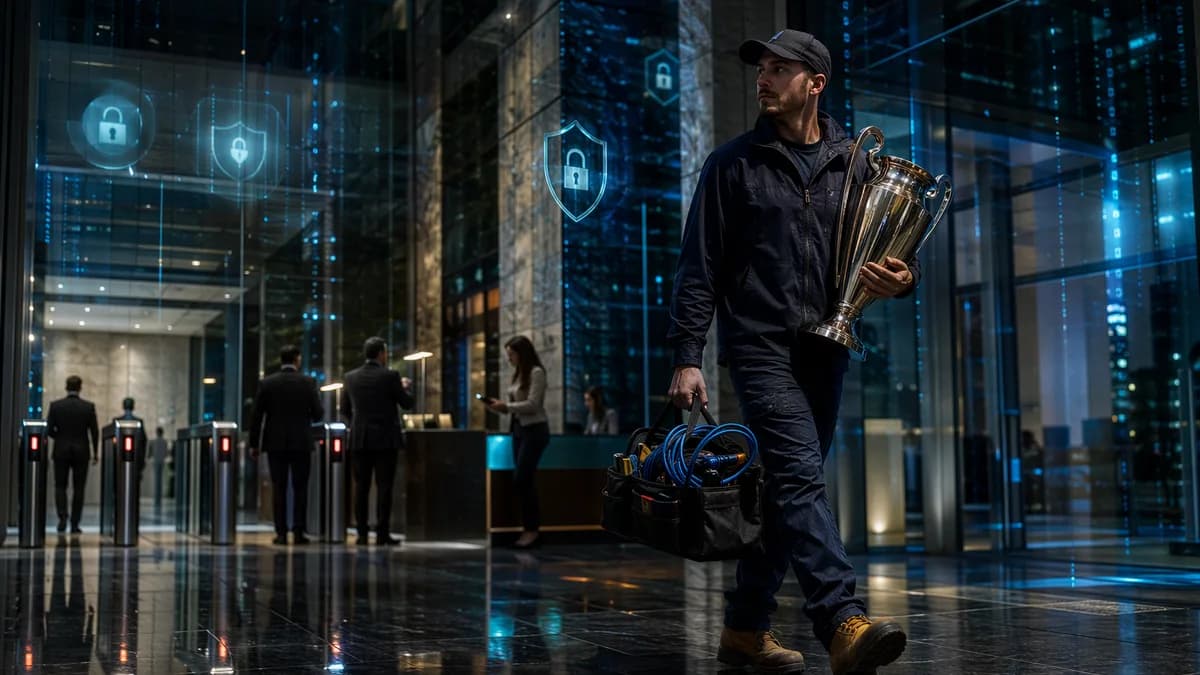
A near top Fortune 500 company had a professional security test on its hands, but the lesson landed when staff watched a supposed Wi-Fi fixer remove a trophy estimated at at least $250,000 and let him walk out.
XOOMAR Intelligence
Analyst Take
That is the sharp edge of the latest PWNED account from The Register Security: the Wi-Fi trophy theft was not about elite hacking, lockpicking, or movie-plot stealth. It was about a role everyone wanted to believe in, the same kind of trust exploited by a fake presidential council. Bad Wi-Fi created the opening. A helpful-looking technical team stepped into it.
A fake Wi-Fi fix exposed the gap between security policy and office habit
The expectation was simple: a company with a valuable trophy, an executive audience, and a security audit in motion would notice when someone removed a culturally important object from a display case.
The reality was stranger. Dahvid Schloss, a professional red teamer, said he and his team walked through the campus with antennas sticking out of their laptops while probing the wireless network. The site was under construction, and the office Wi-Fi was already frustrating employees. That turned suspicious behavior into welcome behavior.
“So, you got three of us that are kind of walking through this campus with antennas sticking out of our laptops. We were not being secretive at all, but we figured this is California and there’s plenty of tech bros and nerds everywhere so antennas sticking out of a computer is not going to scare people,” Schloss said. “But everyone kept coming up to us – not to ask us if we were supposed to be there, but to ask us if we were going to fix the Wi-Fi.”
That quote is the whole case. The employees did not fail because they lacked curiosity. They asked questions. They just asked the wrong one.
In XOOMAR’s analysis, the Wi-Fi trophy theft worked because the cover story matched a real pain point. Connectivity problems feel immediate. Technical workers are often unfamiliar. Employees may not know which contractor is supposed to be onsite, but they do know they want the network fixed.
How the Wi-Fi technician cover story turned a trophy into an easy target
The attack chain was brutally plain:
- Entry: Schloss and his team entered under the appearance of legitimate technical work.
- Movement: They moved through the campus while visibly carrying equipment.
- Cover: Staff interpreted the equipment as evidence of a helpful role.
- Targeting: The team reached the marketing department, where one of the trophies sat in a case.
- Removal: Schloss opened the case and took the trophy.
- Exit: He put it in his backpack and left with it.
The key moment came inside the marketing department. Someone saw Schloss pulling the trophy out of the case and spoke to him while it was happening. Their question, according to the account, was: “Are you here to fix the Wi-Fi?” Schloss answered “yes.” The staff ignored him as he slipped the trophy into his backpack.
That is not a technical failure in the narrow sense. It is a verification failure.
The source does not say whether the site had cameras, alarms, locks, escorts, or visitor logs. So this case should not be inflated into a claim about specific defeated controls. The supported lesson is narrower and more useful: a plausible service role can suppress suspicion even when the action itself looks wrong.
Before and after the pretext, the same behavior reads differently:
| Moment | Without the Wi-Fi story | With the Wi-Fi story |
|---|---|---|
| Walking around with visible equipment | Odd, possibly suspicious | Expected technical work |
| Entering different departments | Needs explanation | Part of troubleshooting |
| Handling a valuable display item | Immediate red flag | Somehow tolerated |
| Leaving with a bulky object | Challenge-worthy | Missed or rationalized |
The person did not need to be invisible. He needed to look useful.
The hard numbers in the Wi-Fi trophy theft are few, but they hit hard
The source gives only a handful of numbers, and they are enough.
The company was described as near the top of the Fortune 500. The sporting trophy had three copies: one for the winner, one for the host nation, and one for the sponsor. Schloss estimated the copy he removed was worth at least $250,000, while also suggesting it could be considered priceless because only three existed. He kept it for two and a half weeks before revealing it to executives during the security presentation.
Those details matter more than any generic breach statistic would.
A trophy like this has two kinds of value. The first is replacement or material value, which Schloss pegged at at least $250,000. The second is symbolic value. The source supports that point directly through scarcity: there were only three copies. That makes the object harder to treat as just an asset on a spreadsheet.
XOOMAR analysis: this is why asset security often breaks around objects that are visible, familiar, and prestigious. People see them every day. They become part of the furniture. The danger is not that staff think the object is worthless. It is that they stop imagining someone would casually remove it in front of them.
Old impostor logic still works when the badge looks like a laptop
The expectation in modern security is that the hard part is digital: networks, endpoints, credentials, and exploit chains. This case flips that assumption. The Wi-Fi problem was not the target. It was the costume.
Schloss was assigned to test both physical and network security, according to the source. That matters. He did not merely scan a network and stumble into a trophy story. He used the office’s existing frustration with connectivity to move through a trusted environment.
The old trick is impersonation. The newer twist is that technical work often looks messy, mobile, and hard for non-specialists to judge. Antennas sticking out of laptops might have looked strange in another setting. In this setting, staff mapped it onto the thing they already wanted solved.
The best social engineering attacks do not always ask people to believe something wild. They ask people to believe the most convenient explanation.
Staff saw a helper, executives saw the real report
The most powerful part of the incident came later. Schloss held onto the trophy for two and a half weeks without anyone raising the alarm, according to the source. Then he brought it to the executive presentation.
“We walked to the boardroom and the first thing I do in this boardroom is I pull out the trophy and I put it on the table,” Schloss told The Register. “And all these executives are sitting around there as we're about to give this security report on where the maturity is at and that was like enough said, right? You could see the eyes just popping open.”
That is red-team theater, but it made a practical point. A slide deck can describe weak controls. A missing trophy on the boardroom table proves them.
For staff, the failure probably looked like misplaced trust. For executives, it exposed a wider maturity problem: employees had not been conditioned to challenge a person who looked busy, technical, and useful.
XOOMAR analysis: the uncomfortable lesson is that politeness can become an attack surface. Many workplaces reward employees for being cooperative and penalize them socially for interrupting someone who appears to belong. Attackers exploit that hesitation.
Venues need contractor checks after the Wi-Fi trophy theft
The fix is not “trust no one.” That would paralyze an office. The fix is making verification normal enough that it does not feel like confrontation.
For organizations with valuable objects on display, the practical controls are basic but often culturally hard:
- Work orders: Staff should know how to confirm that a technician visit is real.
- Named contacts: Contractors should have an internal sponsor who can be called quickly.
- Temporary passes: Visitors need visible, time-limited identification tied to a purpose.
- Escort rules: Third-party workers should not wander sensitive areas unaccompanied.
- Asset checks: High-value objects need clear ownership, inspection routines, and escalation paths.
- Challenge scripts: Employees should have permission to ask, “Who are you here to see?” without feeling rude.
None of those controls requires exotic technology. They require consistency. The Wi-Fi trophy theft shows how quickly a workplace can turn a stranger into an assumed helper when a real operational annoyance is already in the air.
The source’s final lesson is blunt: train staff to question everyone, especially strangers who look like they belong in the building.
The next trophy thief will look more legitimate
The next version of this attack will not necessarily involve antennas or a Wi-Fi complaint. It could be any service role that employees are primed to welcome: maintenance, cleaning, delivery, auditing, IT support.
The evidence that would confirm the thesis from this case is simple. If future physical security failures involve people accepting a plausible service identity without verifying the person, then the weakness is cultural before it is technical. If organizations can show that staff routinely verify contractors even during urgent problems, the thesis weakens.
The companies that prevent the next Wi-Fi trophy theft will not be the ones that merely buy more security gear. They will be the ones that make a polite challenge feel ordinary, fast, and expected.
Impact Analysis
- The incident shows how social engineering can bypass formal security when attackers exploit everyday workplace frustrations.
- Employees treated suspicious behavior as helpful because the fake Wi-Fi repair story matched a real office problem.
- A trophy valued at at least $250,000 became a visible reminder that security policies fail if staff habits do not support them.
Primary Sources & Disclosures

Written by
XOOMAR Insights Team
Research and Editorial Desk
The XOOMAR Insights Team pairs automated research with human editorial judgment. We track hundreds of sources across technology, fintech, trading, SaaS, and cybersecurity, cross-check the facts, and explain what happened, why it matters, and what to watch next. We do not just rewrite headlines. Every article is fact-checked and scored for reliability before it goes live, and we link back to the original sources so you can verify anything yourself.