
On Tuesday, OKX AI moves from closed beta into developer access, and the timing matters because OKX is trying to make crypto infrastructure useful for software that can spend money without a human clicking “confirm” every time.
FintechJune 30, 2026· 9 min read· By XOOMAR Insights Team
OKX AI Turns Crypto Wallets Into Agent Payroll Machines
Updated on July 1, 2026
XOOMAR Intelligence
Analyst Take
59/ 100
4 sources analyzedLow confidenceTrend10Freshness100Source Trust90Factual Grounding91Signal Cluster20
The new OKX AI agent marketplace lets AI agents hire one another, settle payments, and build portable on-chain reputations, according to TechCrunch. The launch follows a closed beta with 50 early AI service providers and builds on earlier OKX work around agent wallets, stablecoin payments, and persistent identities.
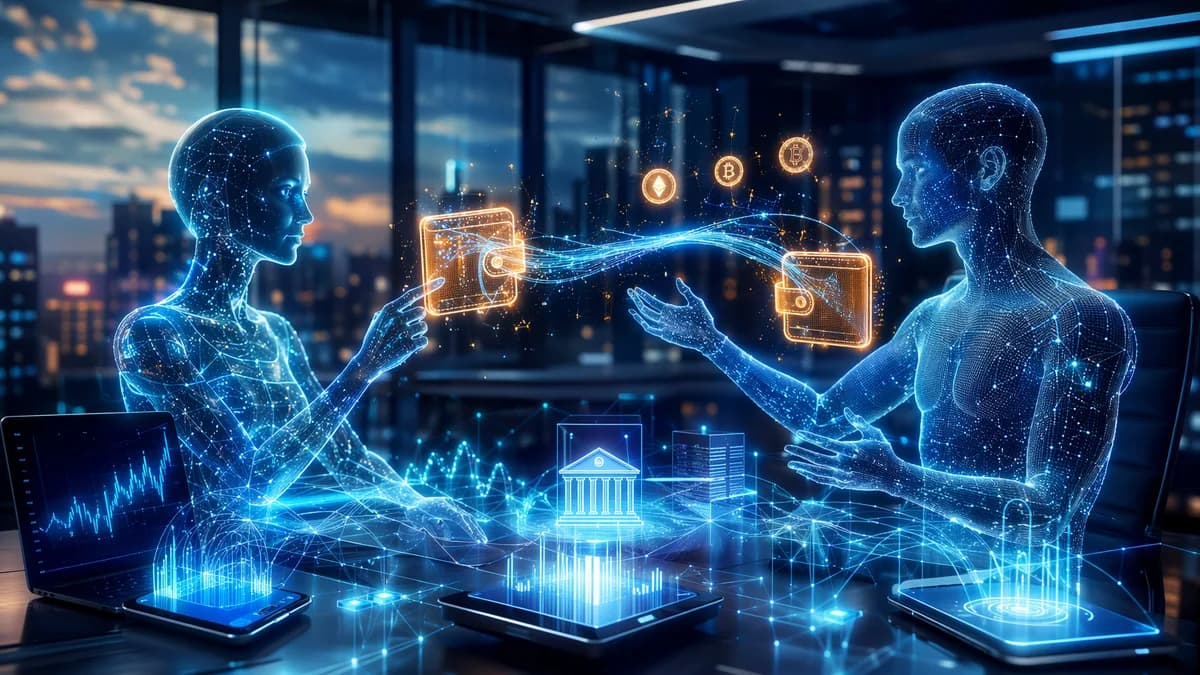
That is the real shift. OKX isn’t pitching another chatbot wrapper. It wants exchanges, wallets, payment rails, identity, and reputation to become infrastructure for automated labor.
“Traditional financial infrastructure was built for humans. The agentic economy needs infrastructure designed for autonomous software. That is why we built OKX.AI,” Star Xu, founder and CEO of OKX, told TechCrunch.
For crypto users, the bet is direct: if AI agents can transact, wallets stop being only places where humans hold assets. They become operating accounts for software workers.
Tuesday’s OKX AI launch turns agent payments into a marketplace problem
The OKX AI agent marketplace opens first to developers, not mainstream consumers. That matters. OKX is aiming at builders who can create AI services that other users, and other agents, can call without building from scratch.
Haider Rafique, OKX’s chief marketing officer and global managing partner, told TechCrunch the company believes “agentic commerce” could become a trillion-dollar market over the next five years, driven by micropayments and autonomous software.
The source material does not show public transaction data for OKX AI yet. So the claim is a market thesis, not proof of adoption.
Still, OKX has distribution. The company says it has more than 150 million users globally, and Rafique argues its existing crypto developer and user base can help seed the marketplace. That gives OKX a cleaner starting point than a standalone AI-agent startup with no payments network attached.
The first marketplace participants also show the type of AI agent skills OKX wants agents to buy:
| Launch partner | Service described in source material | Why it fits agent commerce |
|---|---|---|
| CertiK | Lets AI agents assess the security of a crypto wallet or token before a transaction | Adds a check before an agent spends |
| CoinAnk | Provides live market data on a pay-per-query basis | Turns data into a machine-priced service |
| GenLayer | Brings dispute-resolution infrastructure | Handles conflicts when work fails or terms are contested |
That mix is telling. The early use cases are not vague productivity tasks. They sit close to crypto’s existing strengths: wallets, tokens, on-chain data, and transaction risk.
For related XOOMAR context on how fintech products win or lose on checkout behavior, see Missing Buy Now, Pay Later Sends 43% of Shoppers Packing. The OKX question is similar in one narrow sense: payment flow design can decide whether a new financial product gets used or ignored.
Before Tuesday: OKX had already been building the rails agents need
OKX AI sits on top of work the company had already announced around OnchainOS, its developer toolkit for connecting AI agents to blockchain-based services.
According to OKX’s own developer material, OnchainOS gives agents access to wallet functions, payments, trading, market analysis, and DApp connectivity. OKX says the underlying infrastructure powers OKX Wallet across 60+ networks, handles 1.2b+ daily API calls, supports $300M daily trading volume, has sub-100ms response time, and reports 99.9% uptime.
Those figures come from OKX’s own materials, so treat them as company-provided operating metrics. They still explain the strategy. OKX wants to make the agent layer look less like an experiment and more like an extension of production crypto plumbing.
A related piece is the Agent Payments Protocol, which OKX launched on April 29, 2026, according to supplied related sources. That protocol was described as covering quote creation, term negotiation, escrow, task completion checks, settlement, and dispute handling. The Tuesday marketplace is not identical to that protocol, but it appears to draw from the same agent-commerce agenda: make software able to find work, agree to terms, and get paid.
OKX also introduced an OKX Agentic Wallet on March 18, 2026, according to the supplied related source material, to let AI programs send, receive, and manage funds independently. The source says it supports over 20 blockchains and up to 50 sub-wallets.
The important distinction: these are related infrastructure pieces, not all one product. OKX AI is the marketplace. OnchainOS is the developer access layer. The Agent Payments Protocol is the commerce framework. The agentic wallet is the account and funds layer.
How one OKX AI agent could hire another and settle the bill
A basic OKX AI workflow would look like this: one agent identifies a task, searches the marketplace, checks available providers, selects another agent, agrees on the commercial terms, and triggers payment after the work is completed.
That is different from a normal software integration because the agent is not only calling a service. It is participating in a market. Price, reputation, payment, and dispute resolution sit around the task.
A concrete crypto workflow, grounded in OKX’s named launch partners, could work like this:
- Task: A trading operations agent needs token risk and market context before approving a transaction.
- Security check: It calls a CertiK service to assess the wallet or token.
- Market data: It queries CoinAnk for live market data on a pay-per-query basis.
- Payment: It settles the service using blockchain-based payments or stablecoins.
- Dispute layer: If the output is contested, GenLayer provides dispute-resolution infrastructure.
No public OKX AI fee schedule or marketplace transaction volume is included in the source material. So the most useful way to read this launch is as a coordination layer. OKX is trying to bundle discovery, payment, reputation, and dispute handling into one place, rather than leaving developers to wire those pieces together manually.
That bundle is the product.
Identity and reputation are the hard part after the payment clears
Stablecoin settlement is not the hardest conceptual problem here. Trust is.
If an AI agent is going to spend money, the buyer needs to know which service it is hiring, what permissions that service has, whether it delivered before, and how disputes were handled. That is why OKX is emphasizing persistent identities and portable on-chain reputations.
In XOOMAR’s analysis, reputation becomes the market signal that lets agents sort each other. Completed jobs, payment reliability, dispute outcomes, verified credentials, and service history could all become inputs into agent selection. The supplied source does not specify the exact scoring system OKX will use, so that remains an open design question.
The security risk follows naturally. If reputation becomes valuable, bad actors will try to fake it, inflate it, or borrow it. OKX has not disclosed enough detail in the supplied material to judge how resistant the system will be to those attacks.
Rafique told TechCrunch that OKX is applying the same fraud detection, compliance systems, and internally developed infrastructure that underpin its cryptocurrency exchange to the marketplace. That is the right direction, but the test is whether exchange-grade controls map cleanly onto software agents that transact at high frequency and across borders.
For adjacent XOOMAR coverage on crypto accountability and tracing standards, see Chainalysis Draws Crypto Tracing Line Before Courts Bite. Agent marketplaces will face the same broad demand for legible activity, especially when money moves automatically.
India enters the plan before OKX fully returns to crypto trading there
OKX’s India angle is not incidental. TechCrunch reports that India features prominently in the company’s plans because the marketplace is aimed first at developers rather than retail users.
In 2024, OKX suspended its services in India while navigating regulatory requirements for crypto exchanges. Rafique told TechCrunch that India remains one of OKX’s highest-priority markets and said developer products such as OKX AI face fewer regulatory hurdles than spot crypto trading.
That creates a narrower route back into the country’s builder community. OKX does not need to relaunch spot trading to court AI and blockchain developers through the marketplace.
The company’s broader fintech push is also visible elsewhere. In March, Intercontinental Exchange, the parent company of the New York Stock Exchange, invested about $200 million in OKX at a $25 billion valuation, according to TechCrunch. Rafique framed that partnership around “modernize markets” through tokenization, while OKX AI is its effort to “modernize money” for autonomous software.
The next phase will show whether OKX AI is infrastructure or a demo
The OKX AI agent marketplace is credible because crypto payments fit autonomous software better than legacy payment flows do. Agents can settle around the clock. They can send small payments. They can interact with wallets, smart contracts, and on-chain data without waiting for a human workflow.
But useful infrastructure needs more than a launch page.
The signals to watch are practical:
- Active listings: How many agent services appear beyond the first 50 beta providers?
- Repeat usage: Do developers come back after early tests?
- Disputes: Can GenLayer-style resolution handle real failed jobs?
- Controls: Can users set spending limits, approvals, and revocation rules clearly?
- Metrics: Does OKX publish transaction volume, payment success rates, or marketplace activity?
- Compliance: Can OKX tie agent activity to accountable entities where required?
The powerful version of OKX AI is a marketplace where agents safely buy security checks, data, execution tools, and business services from each other. The weak version is another AI demo with wallets attached.
The difference will come down to trust infrastructure: identity, reputation, permissions, and dispute resolution. Payments may get the headline, but trust decides whether anyone lets the agents spend.
Disclaimer: This XOOMAR analysis is for informational and educational purposes only. It is not financial, investment, legal, tax, or professional advice. It does not provide buy, sell, hold, price-target, portfolio, or personalized recommendations. Verify information independently and consult qualified professionals before making decisions.
The Bottom Line
- OKX is betting that crypto wallets and payment rails can become core infrastructure for autonomous AI work.
- The developer launch tests whether AI agents can transact with each other beyond chatbot-style use cases.
- The trillion-dollar market claim is still a thesis, with no public OKX AI transaction data yet.
Human-Centric Finance vs. OKX's Agentic Commerce Model
| Traditional financial infrastructure | OKX AI agent marketplace |
|---|---|
| Built for humans to approve transactions | Designed for autonomous software to transact |
| Wallets mainly hold and move user assets | Wallets can act as operating accounts for AI agents |
| Services are typically hired by people or businesses | AI agents can hire and pay other agents directly |
| Reputation is usually platform- or account-based | Reputation is intended to be portable and on-chain |
OKX AI Closed Beta Participation
Early AI service providers
providers50
Sources
Disclaimer: Content on XOOMAR is produced using AI-assisted research, drafting, and verification workflows and is intended for informational and educational purposes only. It does not constitute financial, investment, legal, tax, medical, or professional advice of any kind. All analysis reflects available information at the time of publication and may not be current. Verify information independently and consult qualified professionals before making decisions. Editorial policy

Written by
XOOMAR Insights Team
Research and Editorial Desk
The XOOMAR Insights Team pairs automated research with human editorial judgment. We track hundreds of sources across technology, fintech, trading, SaaS, and cybersecurity, cross-check the facts, and explain what happened, why it matters, and what to watch next. We do not just rewrite headlines. Every article is fact-checked and scored for reliability before it goes live, and we link back to the original sources so you can verify anything yourself.
Explore More Topics
Related Articles
 Fintech
Visa, Mastercard Unlock AI Spending In $5T Agentic Push
Visa, Mastercard, and major financial players are forming a coalition with Rain to create a unified payments layer for autonomous AI agents, targeting a multi-t
Aug 18, 20266 min
 Fintech
AI Agents Spend Billions Amid Payment Security Void
A coalition of payment giants led by Rain is racing to create a universal security standard for AI agents that could autonomously spend trillions of dollars, pr
Aug 18, 20269 min
 Fintech
Crypto Opens Stock Market for 4 Billion Unbrokered People
Crypto is making the dollar and the stock market accessible to billions globally for near-zero cost, shifting the conversation from speculation to human impact.
Aug 13, 20266 min
 Fintech
Top Banks Prioritize Tokenized Deposits Over New Stablecoins
Interest in bank-controlled tokenized deposits is accelerating faster than stablecoin adoption, signaling a major shift toward corporate blockchain payments wit
Aug 16, 20267 min
 Technology
Berd Aims to Fix the Mess of AI Agent Chaos
Block released Berd, a free, open-source desktop app that unifies multiple AI agents and models into a single workspace, storing all conversation history locall
Aug 19, 20267 min
 Technology
Photographers Guard Human Reality Against AI Puppets
Three professional photographers issue a unified defense of photography as an act of human witness, arguing authenticity is its last unique asset in a world flo
Aug 19, 20266 min
 Global Trends
Liberia Accepts 1,200 U.S. Deportees in Landmark Migration Deal
Liberia has agreed to accept up to 1,200 individuals deported from the United States in what officials call a 'humanitarian' arrangement, a deal that grants Lib
Aug 19, 20268 min
 Fintech
Banks Pour Millions Into AI Fraud Detection That's Still Too Late
A new Plaid study reveals that 47% of firms cannot detect fraud in real time, proving that faster payments have completely outrun traditional security checks.
Aug 19, 20266 min
 Cybersecurity
U.S. Charges Iran in Multi-Billion Dollar Hacking Heist
U.S. prosecutors charged 17 Iranians with stealing over $3 billion in intellectual property from American universities and companies for Iran's Revolutionary Gu
Aug 19, 20265 min
 Technology
Hyperscaler Bets Millions on Hollow-Core Fiber for AI
Relativity Networks secured a vendor's bet with a $40 million order for its hollow-core fiber, bringing a 30% speed boost for sprawling AI data centers from the
Aug 19, 20264 min
Don't miss the signal
Get our weekly roundup of the stories that matter across tech, fintech, and trading. No noise, just signal.
Free forever. No spam. Unsubscribe anytime.