
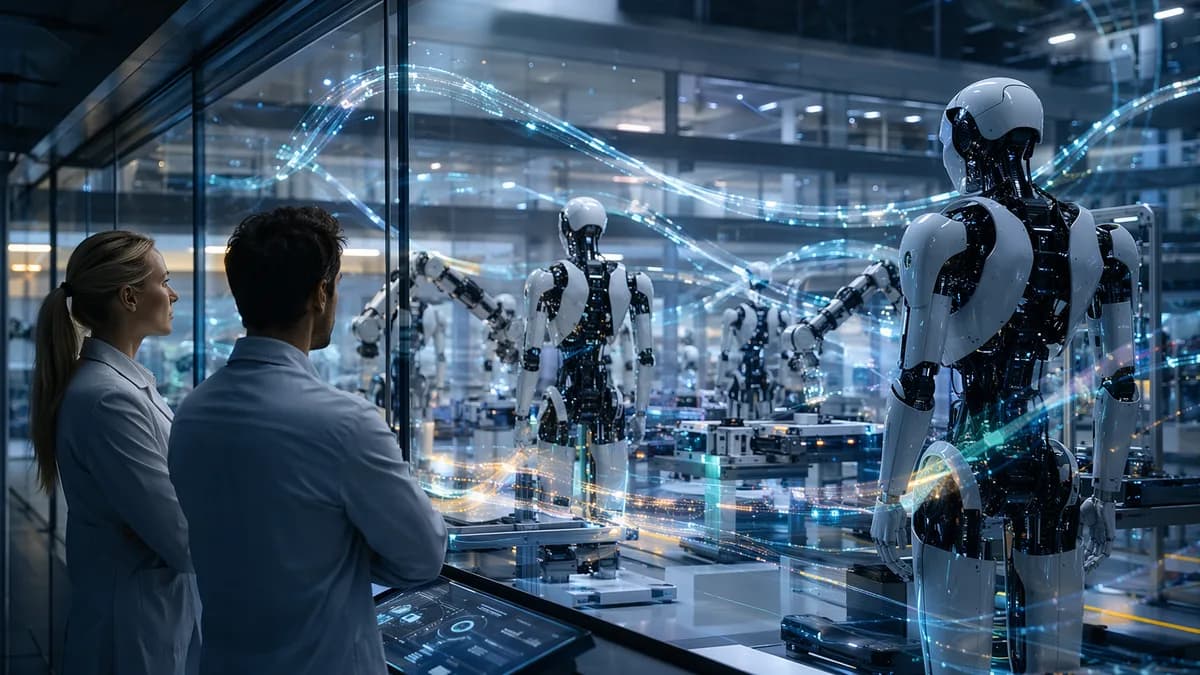
A $1.4 billion robotics round led by Tether Investments puts the issuer behind USDT inside a very different business: humanoid robots that may one day hold digital wallets and pay other machines. The round for Germany’s Neura Robotics was reported by CoinDesk, which said Tether described it as one of the largest investments in physical AI to date.
FintechJune 13, 2026· 8 min read· By XOOMAR Insights Team
Tether Bets $1.4B to Win Neura’s Robot Wallet Race
Updated on June 14, 2026
XOOMAR Intelligence
Analyst Take
57/ 100
3 sources analyzedLow confidenceTrend10Freshness97Source Trust88Factual Grounding91Signal Cluster20
The headline is not just that Tether is diversifying outside crypto. The sharper signal is that a stablecoin company is trying to plant financial infrastructure inside robots before those robots reach mass deployment.
Physical AI, in this context, means AI embedded in machines that perceive, decide, move, and work in real environments. Neura wants to take that from factory demos to millions of deployed systems.
$1.4 billion pushes Tether from stablecoin issuer into physical AI
Neura Robotics, based in Germany, raised the round with participation from Qualcomm Technologies, Amazon, and NVIDIA, according to the source material. Related company materials also list investors including Bosch, Schaeffler, the European Investment Bank, imec.xpand, Lingotto Horizon, and InterAlpen Partners.
The round was expected to value Neura between $9 billion and nearly $12 billion when it first became public last November. That is a striking number for a robotics company still trying to scale a difficult hardware business.
Neura has set a bold production target: 5 million AI-powered humanoid robots by 2030. It also said it has about $1.2 billion in orders already. Those two figures explain why Tether’s move matters. This is not a passive bet on another software layer. It is a bet on robots, data, production, chips, edge computing, and machine payments arriving together.
“AI is moving from the digital world into the physical world," David Reger, founder and CEO of Neura Robotics, said in a statement.
XOOMAR analysis: Tether is not just buying exposure to robotics. It is trying to make payments part of the robot stack.
The deal’s most important number may not be the valuation
The $1.4 billion round is large enough to change Neura’s execution runway, but readers should avoid one common mistake: leading a round does not mean Tether supplied the full amount. The source material says Tether led the round and that other investors participated. It does not break down individual check sizes.
CoinDesk also reported that Tether made over $10 billion in profit in the first nine months of 2025. The supplied material does not say those profits funded the Neura investment, so that link should not be assumed. What can be said is narrower and still important: Tether has the financial capacity to act like a strategic technology investor, not just a crypto-native issuer.
Here is the deal in plain terms:
| Element | Reported detail |
|---|---|
| Lead investor | Tether Investments |
| Company funded | Neura Robotics, German robotics startup |
| Round size | $1.4 billion |
| Expected valuation range | About $9 billion to nearly $12 billion |
| Other named participants | Qualcomm Technologies, Amazon, NVIDIA |
| Neura production target | 5 million AI-powered humanoid robots by 2030 |
| Reported orders | About $1.2 billion |
| Tether integration | Robot digital wallets and autonomous electronic payments |
Tether’s broader investment pattern is also relevant. Under CEO Paolo Ardoino, the company has been spending in areas outside immediate crypto, with CoinDesk citing agriculture, brain tech, and sports. Neura adds a more industrial category: cognitive robotics.
For readers following the broader tension between crypto networks and AI infrastructure, this sits near the debate we covered in Anthropic Mythos Cutoff Sparks Crypto's AI Escape Bet, though Neura is a physical hardware story rather than a model access fight.
Neura gives Tether a route into robots that can transact
Neura is pitching itself as more than a humanoid robot maker. Its platform, Neuraverse, is described as a unified architecture combining robotics, AI, sensor technology, edge computing, and learning infrastructure. Its NEURA Gyms are training environments for cognitive robots in real-world deployment scenarios.
The company says the new capital will support global deployment of cognitive and humanoid robots, expansion of Neuraverse, rollout of NEURA Gyms, and production scale-up.
That matters because humanoid robotics is not only about building a machine that can walk. The harder challenge is making robots useful, teachable, safe, serviceable, and economically rational in factories, logistics centers, healthcare facilities, and private homes. Neura’s thesis is that robots need shared learning infrastructure, not isolated programming for every use case.
Tether’s part is more radical. The robots are expected to receive independent digital wallets linked to Tether infrastructure, allowing them to be paid automatically when they complete a job and to make electronic payments to other machines.
“Autonomous machines need the ability to process information locally, make decisions, and execute transactions without relying on centralized intermediaries,” Ardoino said, according to the supplied related source material.
XOOMAR analysis: this is the “machine economy” idea in a concrete form. If robots can earn, pay, and settle tasks directly, stablecoin infrastructure becomes part of industrial automation rather than just crypto trading. That is the strategic leap Tether is making.
The premise also contrasts with consumer-facing crypto access disputes, such as those in 286,000 Crypto Users Take on UK Banks Over Blocked Cash. Neura’s model points at machine-to-machine payments, not retail banking friction.
A giant round does not erase robotics execution risk
Neura’s ambitions are huge, but robotics has a brutal constraint that software investors can underestimate: machines have to work in the real world.
The supplied material says Neura wants to scale serial production to several million robots by 2030. It also says the company is building real-world training infrastructure. That focus is telling. Robots need data from physical settings because simulation alone cannot capture every object, surface, lighting condition, human movement, maintenance issue, or safety edge case.
A related source also noted that a NEURA 4NE-1 humanoid suffered a public hardware failure at Computex 2026, collapsing during a Qualcomm presentation. That incident does not invalidate the company’s technology, but it underscores the gap between a funding round and dependable deployment.
The hard questions are practical:
- Reliability: Can Neura robots run long enough in real settings to justify buyer commitments?
- Production: Can the company move from prototypes and early deployments to millions of units?
- Integration: Can customers fit humanoid robots into existing operations without costly disruption?
- Payments: Can autonomous wallets add value without creating operational complexity?
- Learning loop: Can NEURA Gyms and Neuraverse reduce the time needed to teach robots new tasks?
XOOMAR analysis: Tether is walking into a sector where capital helps, but capital does not solve physics, manufacturing, safety, or service networks by itself.
Europe gets a rare scale bet in robotics infrastructure
Neura’s location matters because the company is being framed as a European contender in physical AI. Reger put the point directly.
“Many have believed that globally relevant AI infrastructure companies could only emerge in Silicon Valley. We believe that the next generation of AI market leaders can emerge anywhere in the world, wherever vision, engineering talent, and execution speed come together.”
That statement is positioning, but it is backed by investor composition. With industrial names such as Bosch and Schaeffler appearing in the supplied material, Neura’s cap table connects chips, cloud, manufacturing, and industrial deployment.
For European technology, a round of this size can buy time. Robotics needs hardware development, tooling, testing sites, supply chain depth, and customer pilots. Smaller rounds can vanish into engineering cycles before commercial scale arrives.
For industrial automation buyers, better-funded suppliers can be attractive. They may have more resources for support, product development, and deployment. Still, purchase decisions will come down to the dull but decisive metrics: uptime, safety, task performance, integration cost, and return on investment.
XOOMAR analysis: if Neura converts this capital into shipped robots and repeat customers, Tether’s role will look less like crypto diversification and more like early control over payment rails for autonomous machines.
The next test is shipped robots, not louder funding headlines
The Neura round signals that stablecoin issuers can become major capital allocators beyond crypto. Tether is not only backing another financial product. It is backing machines that may use its financial infrastructure as part of their operating system.
That raises a clear watch item. The success test is not whether Neura can announce more partners or larger ambitions. The evidence to track is whether it can ship robots at scale, grow beyond its reported $1.2 billion order base, prove reliability in real deployments, and show that robot wallets solve an actual operating problem.
Evidence that would strengthen the thesis: visible production scale-up, repeat orders, successful NEURA Gym expansion, and real customers using autonomous payments in machine workflows.
Evidence that would weaken it: delays in serial production, safety or reliability setbacks, unclear wallet use cases, or order numbers that do not convert into deployed robots.
If Neura scales, Tether will look early, aggressive, and strategically coherent. If it stumbles, the deal will become a case study in crypto capital chasing one of hardware’s hardest problems.
Disclaimer: This XOOMAR analysis is for informational and educational purposes only. It is not financial, investment, legal, tax, or professional advice. It does not provide buy, sell, hold, price-target, portfolio, or personalized recommendations. Verify information independently and consult qualified professionals before making decisions.
The Bottom Line
- Tether is moving beyond stablecoins into physical AI and robotics infrastructure.
- Neura’s $1.4 billion round signals growing investor appetite for humanoid robots.
- The bet points toward a future where robots may use digital wallets and machine-to-machine payments.
Neura Robotics reported funding and orders
Funding round
$B1.4
Orders
$B1.2
Sources
Disclaimer: Content on XOOMAR is produced using AI-assisted research, drafting, and verification workflows and is intended for informational and educational purposes only. It does not constitute financial, investment, legal, tax, medical, or professional advice of any kind. All analysis reflects available information at the time of publication and may not be current. Verify information independently and consult qualified professionals before making decisions. Editorial policy

Written by
XOOMAR Insights Team
Research and Editorial Desk
The XOOMAR Insights Team pairs automated research with human editorial judgment. We track hundreds of sources across technology, fintech, trading, SaaS, and cybersecurity, cross-check the facts, and explain what happened, why it matters, and what to watch next. We do not just rewrite headlines. Every article is fact-checked and scored for reliability before it goes live, and we link back to the original sources so you can verify anything yourself.
Explore More Topics
Related Articles
 Fintech
Buffer Halves as Tether Q2 Profit Hits $1.5 Billion
Tether earned $1.5B in Q2, but its excess reserve cushion was cut in half to $4.11B, putting USDT backing back in focus.
Aug 1, 20268 min
 Fintech
Samsung Wallet Stablecoin Push Puts Banks on Notice
Samsung wants stablecoins inside Samsung Wallet, turning Galaxy phones into a mobile finance test with major details still missing.
Jul 25, 20266 min
 Fintech
Amazon Walmart Deal Events Lure 244M as Baskets Shrink
Amazon and Walmart drew massive deal traffic, but shoppers spent less per retailer as overlapping events sharpened price comparisons.
Jul 24, 20268 min
 Fintech
U.S. Banking Giants Build Instant Settlement Rail
Major U.S. banks, using The Clearing House's infrastructure, are building a shared network to settle tokenized deposits instantly and challenge the stablecoin m
Aug 6, 20266 min
 Fintech
Wells Fargo Deploys Tokenized Deposits to Fight Stablecoin Invasion
Wells Fargo is launching tokenized deposits to keep corporate clients' money on its own ledger, a direct counterattack against the competitive threat of stablec
Aug 4, 20265 min
 Technology
DeepSeek Demands $8bn as China's AI Plays Catch-Up
DeepSeek is pushing to close an $8 billion funding round at a $74 billion valuation, a massive jump just weeks after its last raise, underscoring China's aggres
Aug 6, 20264 min
 Technology
AirPods Pro Plunge to $189 in Rare $60 Sale
The AirPods Pro have dropped to $189.99, their lowest price since June, in a coordinated sale across Amazon, Walmart, and Best Buy signaling a final pre-holiday
Aug 6, 20266 min
 Technology
Betting Half Its Cash, Mirendil Locks $100M Cloud Deal
AI startup Mirendil spent over $100 million on Google Cloud compute weeks after its seed round, signaling that AI's new frontier is locked-in infrastructure, no
Aug 6, 20267 min
 Technology
TechCrunch Dangles $400 Discount as Disrupt Loyalty Test
TechCrunch's $400 flash sale for Disrupt 2026 is a high-pressure tactic to lock in founders and investors early, testing their confidence in the event's future
Aug 6, 20266 min
 Global Trends
Watch Every NFL Preseason Game Free Legally
A complete guide to legally watching the entire 2026 NFL preseason for free using official trials, the DAZN platform, and VPNs, covering every game without a ca
Aug 6, 20266 min
Don't miss the signal
Get our weekly roundup of the stories that matter across tech, fintech, and trading. No noise, just signal.
Free forever. No spam. Unsubscribe anytime.