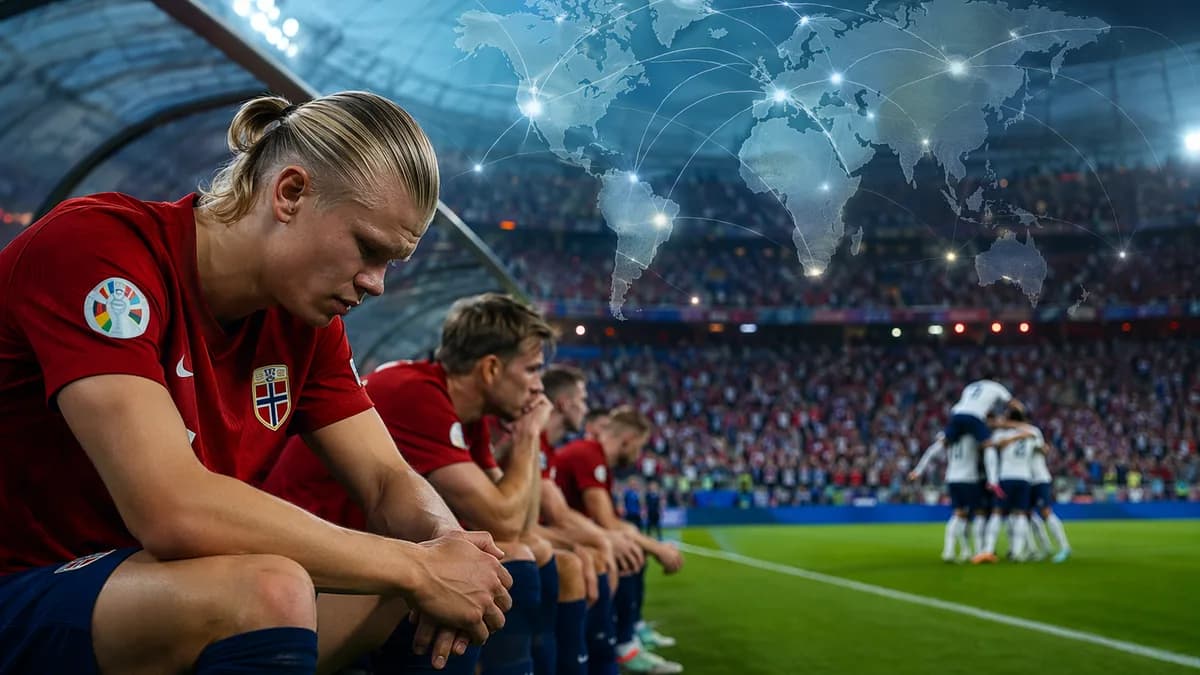
Did the Erling Haaland World Cup really end because England stopped him, or because the tournament finally exposed the limits of building a fairytale around one striker? My answer is blunt: Haaland’s bench finish wasn’t a strange footnote. It was the defining image of how quickly football can humble even its most terrifying star.
XOOMAR Intelligence
Analyst Take
The shock came because Erling Haaland had spent this World Cup swallowing the screen. He entered Norway’s quarterfinal against England as the tournament’s breakout icon in the United States, where he played all his games, according to Time. Then, with Norway down 2-1 in extra time, with 15 minutes left, he was pulled.
That ending shouldn’t erase his brilliance. It should puncture the lazy idea that one elite striker can bend an entire World Cup to his will.
How did Haaland’s bench finish turn a coronation into a warning?
Haaland’s tournament had the shape of a coronation until it didn’t.
He had scored in 14 straight competitive games for Norway before the England match, including seven goals in four World Cup games. Norway had beaten Brazil, the five-time World Cup champion, in the Round of 16. A year earlier, Haaland had put Norway’s World Cup chances at 0.5%. By Miami, that number felt less like humility and more like ancient history.
Then the match turned.
Jude Bellingham scored twice. His winner came in the third minute of extra time, after Norway goalkeeper Orjan Nyland failed to hold a Morgan Rogers shot and Bellingham buried the rebound. England won 2-1, reached the World Cup semifinals for the fourth time in its history, and Haaland finished his tournament on the bench.
The image matters because it cut against everything the event had sold us. Haaland was supposed to be the force that made normal match logic irrelevant. Instead, he became proof that superstar gravity doesn’t guarantee control when the game state, tactics, fatigue, and pressure move against you at once.
"It was not a tough decision to take him out," Norway head coach Stale Solbakken said. "He was finished. Maybe I should have taken him out 10 minutes before... He also got a dead leg in the second half, so that combined with the fatigue. He did everything he could."
That quote is colder than any tactical board. It says the myth ran out before the clock did.
Why did the World Cup make Haaland a global symbol before it made him a winner?
Because Haaland didn’t just score. He traveled well.
He dapped up kids before Norway beat Brazil. He went shopping for cowboy hats in Texas. He leaned into the American audience with the kind of awkward charm that tends to travel faster than highlight clips.
“I like the Americans,” Haaland said. “I think they are kind of hilarious.”
That mattered because this Erling Haaland World Cup became bigger than goals. His physical style, ruthless finishing, and cinematic presence made him feel like the face of a new generation arriving on the biggest stage. He was already a Manchester City star who had led the Premier League in goals three of the last four seasons. But this summer turned him into something broader: a global symbol, especially for American viewers seeing every Norway game on U.S. soil.
There’s a trap in that kind of rise. Once a player becomes a symbol, every quiet spell becomes evidence in a trial. A missed run is no longer a missed run. A denied pass becomes a referendum. A substitution becomes a cultural event.
That’s why this ending feels so sharp. Haaland’s public image suggested inevitability. Tournament football answers with margins.
Readers who track how sport, power, and national identity collide will recognize the pattern from other global stories, including our look at Sheikh Hamad's Death Ends Modern Qatar's First Act. Football is never only football once nations, brands, and screens start attaching meaning to every gesture.
How did England starve Haaland of the moments he needs?
The football explanation is less romantic and more useful: Haaland is devastating when service arrives early, cleanly, and in the spaces where defenders are already losing balance. When those routes close, he can look stranded.
Against England, the available evidence is brutal. According to StatMuse, Haaland did not create any chances, commit any fouls, or dribble the ball once during the match. That doesn’t mean he was lazy. It means England managed the areas where he does the most damage, and Norway failed to feed him in the few moments when the match opened.
The best example came late in the first half. Norway led 1-0. Alexander Sorloth carried the ball toward goal on a 2-on-1, with Haaland open to his left. A pass might have given Norway a chance to break England’s nerve. Sorloth kept it. England killed the attack. Minutes later, Bellingham equalized.
That sequence is the whole argument in miniature.
| Player | Quarterfinal role | Defining fact from the match |
|---|---|---|
| Erling Haaland | Striker Norway needed for one decisive moment | No chances created, no fouls, no dribbles recorded by StatMuse |
| Jude Bellingham | Midfielder who drove England’s comeback | Scored both England goals, including the extra-time winner |
| Stale Solbakken | Coach forced into the brutal call | Said Haaland was “finished” and had a dead leg |
Haaland’s game depends on timing and supply as much as individual power. That’s not an insult. It’s the nature of being a penalty-box destroyer. If the match refuses to give him the moments he needs, his threat becomes theoretical.
When does a superstar striker become the tactical problem?
Keeping Haaland on the pitch is usually the easiest decision in football. That’s exactly why the substitution felt so violent.
But knockout football doesn’t care about celebrity hierarchy. It asks colder questions. Can the player press? Can he still sprint? Can he combine in tight spaces? Can he force defenders into new decisions? Can he do any of that in Miami heat that Time reported felt like 100 degrees Fahrenheit on the field?
Solbakken’s answer was no.
The counterfactual is seductive: leave him on, wait for one ball, trust the monster. But Norway’s manager saw a player drained by fatigue and a dead leg. He also saw a team chasing the game with only 15 minutes left. Fresh legs, different movement, and a changed pressing profile can matter more than the name on the shirt.
This controversy says as much about modern football’s obsession with celebrity as it does about the substitution itself. Fans see Haaland and think inevitability. Coaches see oxygen debt, spacing, pressure angles, and whether a player can still make the next run.
England’s own manager didn’t dress the win up as a masterpiece.
“We got lucky today,” Thomas Tuchel said. “We need to play better.”
Bellingham pushed back.
“Maybe he doesn't know what it's like to play in those kind of conditions,” Bellingham said.
Both statements can be true. England may have been fortunate, and the conditions may have dragged the match into survival mode. That’s precisely where reputations become less useful than legs.
Why does the case for leaving Haaland on still have force?
Because one chance is all he needs.
That’s the best counterargument, and it deserves respect. Defenders never relax when Haaland is present. Even a quiet Haaland pins center backs. He alters spacing. He creates fear that can help teammates, even when he isn’t touching the ball.
Fans also have a legitimate emotional case. They don’t tune into a decisive World Cup quarterfinal to watch the tournament’s most dangerous finisher sit while Norway hunts an equalizer. They want the final swing. The impossible header. The broken defensive line. The ending that feels scripted because the biggest player refused to leave.
There was also controversy around the match itself. Norway protested that a goal kick before England’s equalizer had hit a sky cam wire, but FIFA said no evidence indicated it had hit a wire. Norway also thought it had retaken the lead in the 55th minute, when Torbjorn Heggem scored off a corner, but video review ruled that Haaland pushed Elliot Anderson, nullifying the goal. Critics accused Anderson of flopping.
Alfie Haaland, Erling’s father, wrote on X:
“Well done Bellingham and referee,”
So yes, the case for leaving Haaland on has force. It just doesn’t prove Solbakken was irrational. It proves the decision carried enormous risk.
Which version of Haaland comes out of this scar?
The useful question now isn’t whether Haaland failed. That’s too crude. He scored seven goals, dragged Norway to the quarterfinals in its first World Cup appearance in 28 years, and helped eliminate Brazil. Falling to England does not stain that run.
Haaland said as much after the match.
“How is it to be Erling Haaland right now after being in the quarterfinals with Norway and going straight to holiday? It's quite nice,” Haaland said. “I think this changes Norway. I think it changes me. I've said it many times, we're building on something in Norway.”
He also framed the run as bigger than himself.
"How we put Norway on the map is maybe one thing that touches me the most," Haaland said.
That’s the right public posture. The private work should be harsher.
Haaland doesn’t need reinvention. He does need more answers for matches that deny him obvious routes to goal. That means deeper link play when service dries up. More varied movement when center backs sit in his lap. Stronger influence when the rhythm turns ugly. A louder leadership presence when Norway’s best chance arrives and the pass never comes.
The broader sports lesson echoes beyond Norway, just as national ambition and global image ran through Sheikh Hamad's Death Ends Modern Qatar's First Act. Stars can lift a country’s story. They can’t guarantee the ending.
England moves on to face Argentina in Atlanta. France meets Spain in Dallas. For the first time, the top four teams in the FIFA rankings reached the men’s World Cup semifinals. Haaland is gone, while Bellingham, Kylian Mbappé, Lamine Yamal, Lionel Messi, and Harry Kane remain.
That should sting him. Good. Great players often carry one public humiliation that sharpens the next version of themselves.
The image of Haaland on the bench should not be softened. It should sit there, uncomfortable and useful. If he uses it properly, the next Erling Haaland World Cup story may be remembered for the moment he made sure it never happened again.
The Bottom Line
- Haaland’s exit showed that even elite strikers cannot carry a World Cup run alone.
- England’s win reinforced the value of depth, timing, and midfield impact in knockout football.
- Norway’s defeat turns a breakout tournament into a cautionary story about building expectations around one star.
Norway’s Haaland Story vs England’s Quarterfinal Reality
| Factor | Norway / Haaland | England |
|---|---|---|
| Match result | Lost 2-1 in extra time | Won 2-1 in extra time |
| Defining player | Erling Haaland finished on the bench | Jude Bellingham scored twice |
| Tournament context | Haaland had seven goals in four World Cup games | Reached the World Cup semifinals for the fourth time |
| Key turning point | Haaland was pulled with 15 minutes left | Bellingham scored the winner in the third minute of extra time |
Key Goal Totals Mentioned
Primary Sources & Disclosures

Written by
XOOMAR Insights Team
Research and Editorial Desk
The XOOMAR Insights Team pairs automated research with human editorial judgment. We track hundreds of sources across technology, fintech, trading, SaaS, and cybersecurity, cross-check the facts, and explain what happened, why it matters, and what to watch next. We do not just rewrite headlines. Every article is fact-checked and scored for reliability before it goes live, and we link back to the original sources so you can verify anything yourself.