
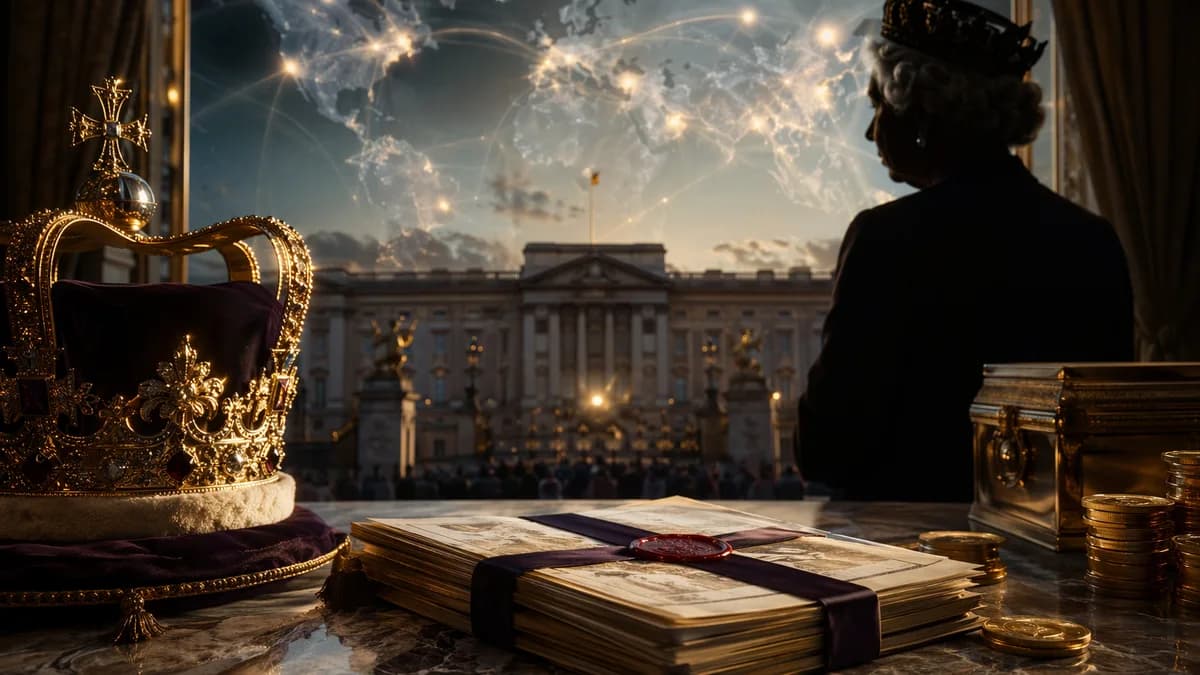
£12.9m sounds enormous until you set it beside at least £1.8bn of estimated royal private wealth. That is the problem with the King Charles tax bill disclosure: it doesn't prove transparency. It proves how little the public can still see, and how lightly the monarchy is treated compared with the scale of wealth attached to it, according to Guardian World.
Global TrendsJune 26, 2026· 8 min read· By XOOMAR Insights Team
£12.9m King Charles Tax Bill Masks £1.8bn Fortune
Updated on June 26, 2026
XOOMAR Intelligence
Analyst Take
72/ 100
4 sources analyzedMedium confidenceTrend10Freshness98Source Trust90Factual Grounding93Signal Cluster40
The king’s tax payable was £12.9m in 2024-25, with a slightly smaller sum the year before. His total tax payable since accession comes to £30m. Large numbers, yes. But the disclosure was not a full tax return. It was a two-sentence declaration from an institution whose finances remain wrapped in convention, exemption, and selective disclosure.
King Charles’s £12.9m tax bill exposes a royal bargain the public never approved
The central fact is not that King Charles III pays tax. The central fact is that he does so voluntarily because, unlike other citizens, the monarch is not liable for tax.
That arrangement began in 1993, when the king and his mother before him started paying tax voluntarily. The palace can frame that as duty. Fine. But voluntary tax is not the same thing as statutory tax, and a cheque written by choice is not the same thing as a tax system applying equally.
The Guardian’s earlier cost of the crown work estimated the king’s private wealth, known as the privy purse, at at least £1.8bn. That includes the Duchy of Lancaster, described as a £690m land and property portfolio that passes from one monarch to the next and provides income of £25m a year. It also includes assets such as cars, jewels, art, Balmoral, and Sandringham.
The public still does not know the total value of the king’s private fortune. It does not know his total income. It does not know how much tax was reduced by expenses linked to royal duties.
That is not disclosure. It is a peephole.
A two-sentence royal tax declaration is not real financial transparency
The new disclosure gives the public one number, not the machinery behind it.
We do not get a full tax return. We do not get taxable income. We do not get deductions. We do not get the treatment of capital gains in usable detail. We do not get an effective tax rate. We do not get a breakdown between personal and official expenditure.
Dan Neidle of Tax Policy Associates put the problem bluntly in his analysis of the figures:
“This looks like transparency. It isn’t. We get three numbers for the King and three numbers for the Prince. We don’t get the calculations, the income figures, the deductions, the expenses, the treatment of private investments, or any explanation of how ‘official’ and ‘personal’ expenditure are separated.”
That is the right criticism. A single tax figure tells voters almost nothing if the income base is hidden.
The palace says the king voluntarily pays capital gains tax on privately held wealth, and that the accounts are externally audited each year. That matters. It is better than silence. But the useful question is not whether accountants have seen more than the public. It is whether citizens can understand how a monarch with vast inherited and private resources ends up with this particular bill.
They cannot.
The monarchy’s tax exemptions make the king’s bill look smaller than his fortune
The strongest evidence that the King Charles tax bill is low comes from comparison.
The Guardian points to this year’s Sunday Times tax list. Suneil Setiya, the hedge fund boss estimated to be worth £1.8bn, paid £114m in annual tax. That is ten times the sum the king paid in 2023-24. Ed Sheeran, with an estimated fortune of £410m, paid £20m to HMRC. JK Rowling, estimated at £975m, was billed £47m on earnings and gains. Erling Haaland paid £17m.
| Person | Estimated fortune cited | Tax bill cited |
|---|---|---|
| King Charles III | At least £1.8bn | £12.9m in 2024-25 |
| Suneil Setiya | £1.8bn | £114m |
| Ed Sheeran | £410m | £20m |
| JK Rowling | £975m | £47m |
| Erling Haaland | Not cited in source | £17m |
The Haaland comparison will jump out to readers of our sports coverage, including Erling Haaland Hijacks the World Cup Before Knockouts. The point is not that a footballer and a monarch have identical income profiles. They do not. The point is that the king’s number looks modest when set beside people with smaller cited fortunes.
The reason may sit inside the tax treatment itself. The Duchy of Lancaster is not liable for the kinds of taxes a company or trust might pay. The Guardian says capital gains from buying and selling property, and rents received from tenants, can accumulate and be reinvested tax free.
That matters because wealth compounds fastest where tax does not interrupt it. The privy purse, as the Guardian puts it, can be described as operating like a mini-tax haven: Duchy assets are untaxed, while the king’s other holdings remain undeclared.
British households don’t get to pay tax by royal convention
Ordinary taxpayers do not negotiate their own tax status through convention. Workers, pensioners, small business owners, landlords, and homeowners meet obligations imposed by law. They may dispute a bill, claim reliefs, or hire advisers. They do not get to begin from the position that tax is optional.
That is why the voluntary nature of royal taxation is the whole story.
Supporters of the current arrangement can say the king pays income tax and capital gains tax voluntarily. They can point out that official duties cost money. They can argue that the monarchy operates within rules agreed with governments. All true, as far as it goes.
But it does not go far enough. Legality is not legitimacy. A system can be formally authorized and still fail a basic fairness test.
Tax fights are always fights about who gets special treatment. We have covered that theme in a different setting with California Billionaire Tax Puts Tech Fortunes on Trial and 5% Wealth Fight Forces California Billionaire Tax Vote. Britain’s royal version is stranger because the privilege is not just financial. It is constitutional, inherited, and partly hidden from the citizens expected to accept it.
The defence of royal taxes misses the point about democratic accountability
Buckingham Palace has tried to present the disclosure as part of modernization. Town & Country reported that James Chalmers, Keeper of the Privy Purse, told reporters:
“Preserving our traditions, delivering for today and driving change for the future is a delicate balance but one we are determined to get right,”
A Buckingham Palace spokesperson also said:
“The decision to do so as Sovereign has come at the express wish of the King himself, as part of the adaptations carried across since Accession.”
That is the best defence of the king’s position: he did not have to publish the number, yet he did. He did not have to pay voluntary tax, yet he does. In a monarchy built on inherited status, voluntary disclosure may look like progress.
Still, selective progress is not accountability. Tourism, tradition, and continuity do not justify a separate tax lane for one family, especially when taxpayers also fund the institution through the Sovereign Grant, which stood at £86.3m in 2024-25, according to the additional royal finance reporting provided in the source material.
The public does not need royal finances turned into spectacle. It needs the same standards expected elsewhere: income, gains, deductions, exemptions, and the treatment of inherited assets set out clearly enough for scrutiny.
Parliament should make royal wealth subject to the same scrutiny as everyone else’s
The next step should not be another symbolic number. Parliament should require either full publication of royal tax returns or a detailed audited statement covering income, capital gains, deductions, Duchy revenues, private investments, official expenses, and inheritance treatment.
The sovereign’s tax status should also be reviewed openly. Any exemption that cannot survive a plain fairness test should go.
This is not an argument about whether King Charles is personally generous or personally frugal. It is about whether a modern state can keep asking ordinary taxpayers to accept compulsory obligations while its head of state pays by convention.
The next royal finance disclosure should answer the question this one avoided: not how much the king chose to pay, but what he would owe if the rules applied to him like everyone else. A modern monarchy cannot ask for public loyalty while hiding behind private accounting.
Impact Analysis
- The disclosure highlights that the monarch pays tax voluntarily rather than under the same legal obligation as citizens.
- The tax figures are small compared with estimated royal private wealth of at least £1.8bn.
- Limited disclosure leaves the public unable to assess the king’s total income, fortune, or deductions.
King Charles tax disclosure versus estimated royal wealth
| Item | Amount | Context |
|---|---|---|
| Tax payable in 2024-25 | £12.9m | Disclosed as a brief declaration, not a full tax return |
| Total tax payable since accession | £30m | Paid voluntarily because the monarch is not legally liable for tax |
| Estimated private wealth | At least £1.8bn | Guardian estimate of the privy purse and related assets |
| Duchy of Lancaster portfolio | £690m | Land and property portfolio passing from monarch to monarch |
| Duchy of Lancaster annual income | £25m | Income generated for the monarch |
Royal tax payments and estimated wealth
2024-25 tax payable
£m12.9
Tax payable since accession
£m30
Estimated private wealth
£m1,800
Duchy of Lancaster portfolio
£m690
Duchy annual income
£m25
Sources

Written by
XOOMAR Insights Team
Research and Editorial Desk
The XOOMAR Insights Team pairs automated research with human editorial judgment. We track hundreds of sources across technology, fintech, trading, SaaS, and cybersecurity, cross-check the facts, and explain what happened, why it matters, and what to watch next. We do not just rewrite headlines. Every article is fact-checked and scored for reliability before it goes live, and we link back to the original sources so you can verify anything yourself.
Explore More Topics
Related Articles
 Global Trends
Met Police Chooses Victims Who Matter, Mother Says
Mina Smallman, a mother who lost two daughters to murder and witnessed police corruption, declares the Metropolitan Police incapable of reform after seeing how
Aug 17, 20265 min
 Global Trends
Channel 4 Secretly Hosts Free ‘Everybody Lies’ Stream
The gritty French crime drama 'Everybody Lies' streams free exclusively on the UK's Channel 4, but viewers worldwide can bypass geo-blocks with a VPN.
Aug 13, 20267 min
 Global Trends
Putin Warns of Retaliation for Commercial Ship Seizures
President Vladimir Putin has threatened direct retaliation against Western nations for seizing Russian commercial ships, calling the actions 'piracy' and riskin
Aug 12, 20265 min
 Global Trends
Britain Calls Cobra Crisis Meeting For Fifth Heatwave
Prime Minister Andy Burnham has activated the national emergency Cobra committee over the UK's fifth heatwave, treating extreme heat as a direct threat to publi
Aug 12, 20266 min
 Global Trends
UK General Warns: Russia’s Next War Targets Britons at Home
The UK's former head of Defence Intelligence reveals why the next major conflict will be fought at home, targeting the public with disinformation long before tr
Aug 10, 20267 min
 Trading
Dollar Buckles, Pound Leaps on Fed Rate Hike Bet Retreat
The pound is climbing near 1.3550 after weak U.S. retail and inflation data slashed expectations for a Fed rate hike, shifting attention to the upcoming UK empl
Aug 18, 20268 min
 Technology
Reform UK Welfare Ban Targets 1.5 Million Vulnerable Residents
Reform UK proposes a sweeping ban on nearly all non-UK nationals claiming core benefits, a move requiring the UK to break its treaty with the EU and targeting s
Aug 17, 20266 min
 Future Fiction
Stream Hit Point Free Legally From Any Country
You can legally stream the entire 'Hit Point' box set for free from anywhere by accessing UK-based ad-supported platforms, using a simple method to bypass geogr
Aug 17, 20266 min
 Global Trends
Major Parties Cut Weak Gambling Deal Gutting Reforms
Labor and the Coalition have struck a deal to pass a watered-down gambling ad bill, directly rejecting core recommendations from a landmark parliamentary review
Aug 18, 20267 min
 Fintech
Monad Buys Back $60M in Tokens, Investors Refuse Exit
Almost all of Monad's early investors refused a $60 million buyback offer months before their tokens unlock, a rare vote of confidence that raises the stakes fo
Aug 18, 20265 min
Don't miss the signal
Get our weekly roundup of the stories that matter across tech, fintech, and trading. No noise, just signal.
Free forever. No spam. Unsubscribe anytime.