Updated: This article has been revised to include the latest official casualty figures and context regarding the international response.
XOOMAR Intelligence
Analyst Take
Nine people were killed overnight as Russian strikes across Ukraine set fire to the Kyiv Pechersk Lavra, a 1,000-year-old Orthodox monastery and UNESCO World Heritage site in the heart of Kyiv. The attacks killed four people in the capital and five rescue workers in Kharkiv, officials said early Monday, according to NBC World.
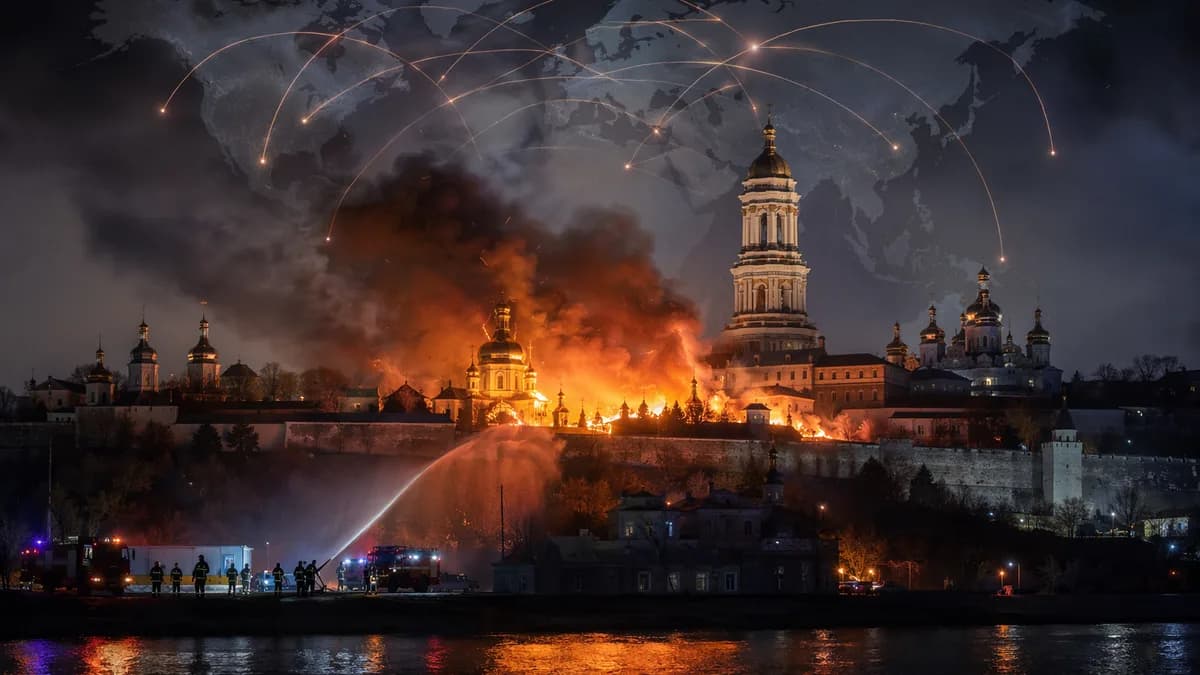
The Kyiv Pechersk Lavra fire turned a deadly air assault into a cultural crisis for Ukraine. Flames and smoke rose around one of the country’s most important religious landmarks, founded in 1051 and known for its churches, bell towers and underground caves.
Russian overnight strikes ignite blaze at Kyiv's 1,000-year-old monastery
Firefighters worked beneath the towers and golden domes of the monastery’s Dormition Cathedral after the overnight strikes. Tymur Tkachenko, head of Kyiv’s military administration, said on Telegram that damage at the complex was substantial and that a serious fire had broken out, impacting the cathedral's roof and interior.
Kyiv Mayor Vitali Klitschko said Russian drones and missiles struck every district of the capital, damaging apartment buildings and electricity infrastructure. At least 23 people were injured in Kyiv and around 140,000 residents were left without power, according to NBC’s reporting of local officials. Power was later restored to most districts.
In Kharkiv, officials said five State Emergency Service workers were killed by a second strike while responding to an earlier Russian attack on a residential area—a tactic known as a "double-tap" strike. Another five people were injured there.
The scale of the overnight barrage was significant. Ukraine’s Air Force said Russia launched 611 long-range strike UAVs and 70 missiles, according to CNN. The same reporting said emergency services described the fire affecting approximately 800 square meters of the Dormition Cathedral.
| Location | Reported impact | Confirmed figures from officials |
|---|---|---|
| Kyiv | Strikes hit every district, monastery fire, homes and power infrastructure damaged | 4 killed, 23+ injured, about 140,000 initially without power |
| Kharkiv | Rescue workers hit in a "double-tap" strike while responding to an earlier attack | 5 rescue workers killed, 5 injured |
| Kyiv Pechersk Lavra | Fire at UNESCO-listed monastery complex | Substantial damage to the Dormition Cathedral reported; fire extinguished |
Russia’s defense ministry denied responsibility for the monastery damage. It claimed the site was damaged by debris from “a missile from a U.S.-made Patriot” missile system, which Ukraine uses for air defense.
Ukraine disputed that account. Yuriy Ihnat, a spokesperson for Ukraine’s Air Force, stated a Russian drone directly hit the monastery. UNESCO has since announced it will send a mission to assess the damage.
Kyiv Pechersk Lavra fire turns a military barrage into a cultural shock
The fire at the Kyiv Pechersk Lavra carries weight beyond the immediate damage. The monastery is a major Orthodox pilgrimage site and one of Ukraine’s most recognizable cultural symbols.
UNESCO has described the complex as a “masterpiece of Ukrainian art.” It placed the site on the World Heritage in Danger list after Russia’s full-scale invasion, citing “the threat of destruction the Russian offensive poses.”
President Volodymyr Zelenskyy called the strike on the monastery “one of Russia’s most serious crimes against Christian culture to date.”
“This is how Russia shows the world its intention to continue the war,” Zelenskyy wrote on X.
Ukrainian Foreign Minister Dmytro Kuleba stated the attack "proves that Russian terror is all-encompassing and knows no bounds." The head of the Orthodox Church of Ukraine asked for prayers for the site’s salvation.
Russia said its forces carried out large-scale strikes against military-industrial facilities and military airfields in Kyiv, Kharkiv and Dnipro, adding that all intended targets had been hit. That claim does not resolve the central dispute over the monastery fire, where Ukrainian officials and Russian officials offered directly conflicting explanations.
XOOMAR analysis: The Kyiv Pechersk Lavra fire provides Ukraine with a potent diplomatic argument at a sensitive moment. Civilian casualties already made the overnight strikes a political flashpoint. Damage to a UNESCO-listed religious site adds a profound cultural dimension, aimed at governments weighing increased air defense support and further pressure on Moscow. The attack has already triggered statements of condemnation from multiple Western capitals, framing it as an assault on shared heritage.
Impact Analysis
- The strikes killed nine people, including five rescue workers in a "double-tap" attack, highlighting the dangers to first responders.
- Significant damage to the 1,000-year-old Kyiv Pechersk Lavra turns the assault into both a human tragedy and a deep cultural loss, escalating the narrative of the war as an attack on Ukrainian identity.
- The reported massive barrage of 611 UAVs and 70 missiles demonstrates the continued scale and intensity of Russia’s air assault campaign, testing the limits of Ukrainian air defenses.
- The incident has immediately been leveraged in diplomatic channels to bolster calls for accelerated and increased military aid, particularly advanced air defense systems like Patriots.
Reported Impact by Location
| Location | Reported impact | Confirmed figures |
|---|---|---|
| Kyiv | Strikes hit every district; fire damaged Kyiv Pechersk Lavra and the Dormition Cathedral roof | 4 killed; 23 injured; about 140,000 without power |
| Kharkiv | Rescue workers were hit while responding to an earlier Russian strike | 5 rescue workers killed; 5 injured |
Confirmed Deaths by Location
Primary Sources & Disclosures

Written by
XOOMAR
Data desk
XOOMAR is a capital markets software and data company. Every brief on this site starts from a dataset the company collects itself from primary sources (CFTC, SEC EDGAR, FINRA, the Federal Reserve, exchange APIs) and names the numbers it is built on, with a link to the data page so you can check them. Briefs are reviewed before they go out and corrected in place when the data is revised.