
Myanmar's rebels looked as if they had cracked the junta's momentum. Now the army is clawing ground back by forcing more men into uniform.
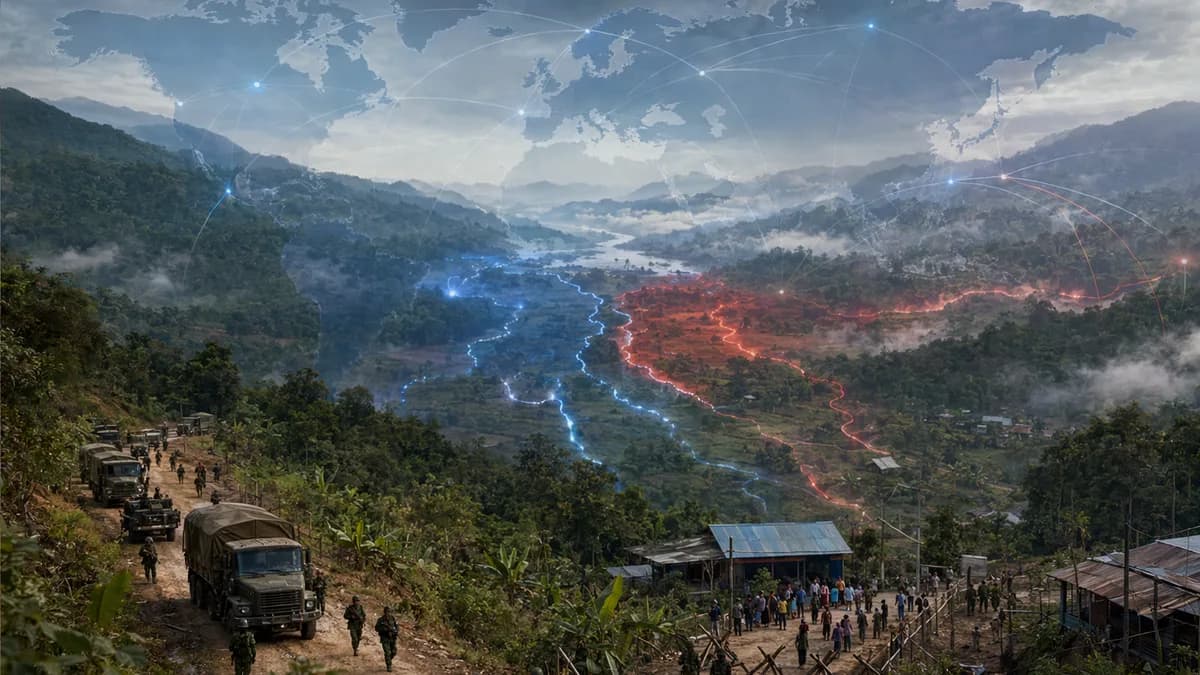
Global TrendsJune 9, 2026· 9 min read· By XOOMAR Insights Team
Forced Recruits Let Myanmar Junta Claw Back Ground
Updated on June 9, 2026
XOOMAR Intelligence
Analyst Take
57/ 100
4 sources analyzedLow confidenceTrend10Freshness95Source Trust92Factual Grounding90Signal Cluster20
Myanmar's junta has found a brutal way to slow the rebel advance: drag more men into the war
The central shift in Myanmar's civil war is not that the junta has solved its political crisis. It hasn't. The shift is narrower and more dangerous: forced recruitment is giving the military enough manpower to blunt rebel advances in several areas, according to BBC World.
The BBC's reporting from rebel-held areas in Bago and Karen state captures the contradiction. Four young men, aged 19 to 25, say they never wanted to fight. One was a chef grabbed off the street after failing to show ID. Another was taken after karaoke. A third worked for the forestry department. A fourth says drugs were planted in his shoe before he was forced to enlist.
"Before we even understood what was happening, we were sent straight to the front lines," one of the men told the BBC.
They spent four months in basic training, were sent to the front, escaped, and then ran into a patrol from the People's Defence Force, or PDF. They now say they are treated "like brothers, not strangers" by the rebels.
That story is morally clear. The battlefield picture is not. Men like them are helping the military recover from earlier rebel gains. The junta still fully controls less than half the country, according to the BBC, but it has retaken key areas and is pushing toward border regions including Kachin, Chin, and Karen states.
The battlefield picture in Myanmar: rebel gains are stalling as army manpower rises
After the military seized power in 2021, jailed Aung San Suu Kyi, and triggered nationwide resistance, armed groups began making gains that raised expectations of a weakened junta. More than two years ago, an alliance of ethnic and rebel groups won a string of victories. In many areas, that phase has stalled.
The BBC's frontline reporting shows a war moving from breakthrough offensives to attrition. That favors the side with more bodies, more aircraft, more drones, and more ammunition.
Ko Kaung, a PDF battalion commander, puts the change bluntly:
"Military forced conscription became the main challenging factor for us on the battlefield as it enabled the military with limitless manpower."
His unit took Hpapun, a town in Karen state, and a sprawling military base two years ago. Now junta drones hover overhead, and as many as 2,000 soldiers are advancing toward the town.
The rebels still have advantages. They know the terrain. They have committed fighters. They can exploit local networks the military often lacks. But those strengths are harder to convert into territorial gains when ammunition is short and the army keeps feeding new men into the fight.
A simple before-and-after frame explains the shift:
| Phase | Resistance position | Junta position |
|---|---|---|
| Earlier rebel surge | Offensive momentum after sweeping gains | Low morale and territorial losses |
| Current phase | Defensive pressure in many areas | More manpower through forced conscription |
| Battlefield constraint | Weapons, ammunition, funds, drone defenses | Morale, legitimacy, reliability of forced recruits |
XOOMAR analysis: More soldiers do not have to be elite to change a battlefield. They only have to absorb pressure, hold positions long enough for artillery and air power to matter, and raise the cost of every rebel attack. The BBC's reporting supports that narrower conclusion. It does not show a stable junta victory. It shows a harsher war.
By the numbers: conscription, displacement, territory, and the cost of Myanmar's civil war
The available numbers point to a conflict that is widening in human cost while narrowing in strategic options.
Key figures from the BBC reporting:
- 2021: The military seized power from Myanmar's elected government.
- 2024: The junta began enforcing a conscription law requiring men to serve a minimum of two years.
- Less than half: The share of Myanmar the military fully controls, according to the BBC.
- 10 days: The time BBC journalists spent in rebel-held areas, traveling to hospitals and frontline positions.
- 2,000 soldiers: The force Ko Kaung says is advancing toward Hpapun.
- 400 soldiers: The force PDF commander Da Wa says is headed toward his area.
- 745 people: The number killed or injured by landmines last year, with a quarter of them children.
- Thousands killed, millions displaced: The broader toll described in the BBC report.
Some figures the outline would normally demand are not available in the supplied source. The BBC report does not provide verified troop-loss totals, national conscription targets, inflation figures, trade-loss estimates, or a full humanitarian-needs count. Those gaps matter. Without them, the safest conclusion is not that the junta is “winning” nationally. It is that the resistance is under heavier pressure in key places.
A related BBC account of the war's military balance says Operation 1027, launched in October 2023, overran around 180 military bases in northern Shan State. It also reports that the army later retook Kyaukme in three weeks, after earlier opposition gains there. That tracks with the same pattern: fast rebel advances followed by a more punishing junta counteroffensive.
Soldiers, rebels, civilians, and neighbors: four views of Myanmar's forced recruitment war
For the junta, conscription is a survival mechanism. It lets the military replace depleted units and signal coercive reach, even in a country where it does not fully control most territory. That is not legitimacy. It is compulsion.
For the rebels, the manpower surge changes the math. Ko Kaung says his side has "technology and intellectual advantages" but limited funds and difficulty sourcing components. Da Wa, another PDF commander, says junta troops are improving because they "are getting better at following orders." He also says the military has more air power since signing a security pact with Russia.
"We see pairs of aircraft now, before it would be a single fixed wing," Da Wa told the BBC.
For civilians, the pressure is intimate. The four deserters fear returning home because "the military could still track us." The BBC also hid their identities to protect their families from retribution. That detail says more than any slogan. Forced recruitment does not stop at the recruit. It reaches parents, spouses, and villages.
For neighboring actors, the source material gives one especially important player: China. The BBC reports that China has invested billions in Myanmar, is mining rare earth minerals in Karen and Kachin states, has brokered ceasefires with several rebel groups, and has throttled supplies of weapons and ammunition to resistance forces. That does not make China the only outside factor. It does make China central to the battlefield environment described here.
From the 2021 coup to today's frontlines: how Myanmar's war became a test of endurance
Myanmar's post-coup war fused two struggles. One came from the cities, where anger at the 2021 coup drove activists and civilians into resistance. The other came from border regions, where ethnic armed organizations had fought the central military for decades.
That mix helped produce the rebel gains that once made the junta look brittle. But fragmentation remains a weakness. The related BBC analysis notes that the opposition includes hundreds of often poorly armed PDFs, local villagers, young activists, and more experienced ethnic armed groups with their own agendas.
The junta's forced recruitment drive fits the military's long-standing pattern as described by the current reporting: when consent fails, coercion expands. The BBC's field hospital scene shows the other side of that endurance test. Dr Saung, who once served in the army and spent 19 years at a military academy, now runs a jungle clinic on a tight budget, with solar power or a backup generator.
His message to young rebels is ideological and generational:
"We are fighting this revolution now because the generations before us failed to fulfil that responsibility."
That is why manpower alone may not settle the war. The junta can force men into uniform. It cannot easily force belief.
What rebel setbacks and forced conscription mean for Myanmar's civilians, resistance networks, and the region
The immediate civilian impact is already visible in the BBC's reporting: arrests, forced enlistment, fear of family retaliation, destroyed towns, landmines, and hospitals operating with scarce supplies.
In Hpapun, the welcome sign, school, monastery, and abandoned homes bear the marks of bombing. In a hidden clinic, Kyar Soe, a rebel platoon commander, underwent surgery after stepping on a landmine. Most of his right heel was gone. He still said:
"I'll return to the fight."
For resistance networks, the implication is grim. Ambitious offensives become harder when the military has more manpower, more drones, and more air support. Kyar Soe's battlefield video, where he tells a fighter to "save your bullets, easy, easy!", captures the constraint better than any abstract analysis.
XOOMAR analysis: The resistance may need to prioritize survival, ammunition discipline, drone defense, and selective attacks over holding every captured position. That is an inference from the reported shortages and battlefield reversals, not a confirmed rebel strategy.
For readers tracking how institutions behave under stress in other domains, XOOMAR has also examined pressure responses in Chrome Zero-Day Forces Google Into a 74-Bug Patch Race and ChatGPT vs Claude Forces a 2026 Team Writing Split. The Myanmar case is far more severe, but the analytical frame is similar: stress exposes what a system can actually sustain.
The next phase of Myanmar's war: more forced recruits, fragmented frontlines, and no quick victory
The strongest reading of the BBC's reporting is that Myanmar's war is entering a more grinding phase. The rebels are losing ground in places. The junta is gaining time. Neither fact proves that the military has rebuilt durable authority.
Forced conscription can increase manpower. It can also increase desertion risk, deepen public anger, and push more young men to flee, hide, or defect when they can. The four deserters in the BBC report are evidence of that weakness.
The next evidence to watch is concrete: whether the junta can hold Hpapun if its advancing force reaches the town, whether rebel units can counter drones and airstrikes, whether China-backed ceasefires continue to restrict resistance supply lines, and whether more conscripts surrender or defect after reaching the front.
If forced recruitment keeps delivering numbers without triggering wider breakdowns, the junta's battlefield recovery may continue. If unwilling recruits desert in larger waves, or if rebels adapt to the army's drone and air advantage, the current momentum could stall again.
For now, the clearest judgment is this: Myanmar's military is buying time through coercion, while the resistance is being forced into a longer, costlier test of endurance.
The Stakes
- Forced recruitment is giving Myanmar's junta fresh manpower despite its deep political crisis.
- Rebel momentum appears to be slowing after earlier gains raised hopes of weakening military rule.
- Renewed fighting toward border regions such as Kachin, Chin, and Karen could worsen instability and civilian suffering.
Myanmar Civil War: Junta vs Rebels
| Side | Current Position | Key Dynamic |
|---|---|---|
| Myanmar military junta | Still controls less than half the country but has retaken key areas | Using forced recruitment to rebuild manpower and slow rebel advances |
| Rebel forces / People's Defence Force | Earlier gains are stalling in several areas | Still holding territory in places such as Bago and Karen state but facing renewed pressure |
Sources

Written by
XOOMAR Insights Team
Research and Editorial Desk
The XOOMAR Insights Team pairs automated research with human editorial judgment. We track hundreds of sources across technology, fintech, trading, SaaS, and cybersecurity, cross-check the facts, and explain what happened, why it matters, and what to watch next. We do not just rewrite headlines. Every article is fact-checked and scored for reliability before it goes live, and we link back to the original sources so you can verify anything yourself.
Explore More Topics
Related Articles
 Technology
RT6 Fleet Storms London Robotaxi Race for Lyft, Baidu
Baidu's RT6 test cars put Lyft into London's robotaxi fight, turning a 2027 launch plan into a regulatory and trust test.
Jul 28, 202611 min
 Global Trends
Oil Shock Exposes Germany Energy Drag Behind Ifo Jump
Germany’s Ifo jump may be stale. Commerzbank sees oil costs capping 2026 growth at just 0.6%.
Jul 28, 20267 min
 Trading
GBP/USD Price Forecast Wobbles Before Fed-BoE Showdown
GBP/USD is stuck near 1.3300. Fed and BoE signals may decide whether sterling holds or slides toward 1.3000.
Jul 28, 202612 min
 Trading
War Risk Bet Unwinds as Brent Crude Crashes 8.7% in a Day
Brent crude’s 8.7% plunge shows traders dumping war-risk premium, not proof that Gulf energy flows are out of danger.
Jul 28, 20265 min
 Technology
$150 Price Cut Sends Nanoleaf Blocks to New Low for Dorms
Nanoleaf Blocks Combo XL just fell to $99.99, a new low for a smart light kit that also adds pegboard and shelf storage.
Jul 28, 20266 min
 Trading
Cheaper Oil Hands Indian Rupee a Rare USD/INR Win Today
Cheaper crude lifted the Indian Rupee for a third day, but USD/INR's pullback still looks tactical while Fed risk lingers.
Jul 28, 20268 min
 Cybersecurity
Origin Energy Hack Exposes 900,000 After Weeks of Silence
Origin Energy says 900,000 customers were hit, but its delayed disclosure turned a data breach into a trust crisis.
Jul 28, 20267 min
 Global Trends
35-Year High in Measles Cases Exposes Vaccine Trust Crisis
U.S. measles cases hit 2,318, the worst total in 35 years, exposing vaccine trust gaps and new pressure on outbreak control.
Jul 28, 20267 min
 Fintech
Payment Glitch Traps UK Banking Transfers Across Banks
Over 900 reports flagged failed transfers and payment uncertainty across Barclays, Lloyds, Halifax, Revolut and more.
Jul 28, 20266 min
 Cybersecurity
Google Exposed Claude Chats Users Thought Were Private
Shared Claude chats were indexed by Google, exposing sensitive transcripts and forcing Anthropic to confront a messy privacy gap.
Jul 28, 20267 min
Don't miss the signal
Get our weekly roundup of the stories that matter across tech, fintech, and trading. No noise, just signal.
Free forever. No spam. Unsubscribe anytime.