One nearly hour-long Pauline Hanson National Press Club speech did something months of polling chatter could not: it turned the protest appeal of One Nation into a visible governing program.
XOOMAR Intelligence
Analyst Take
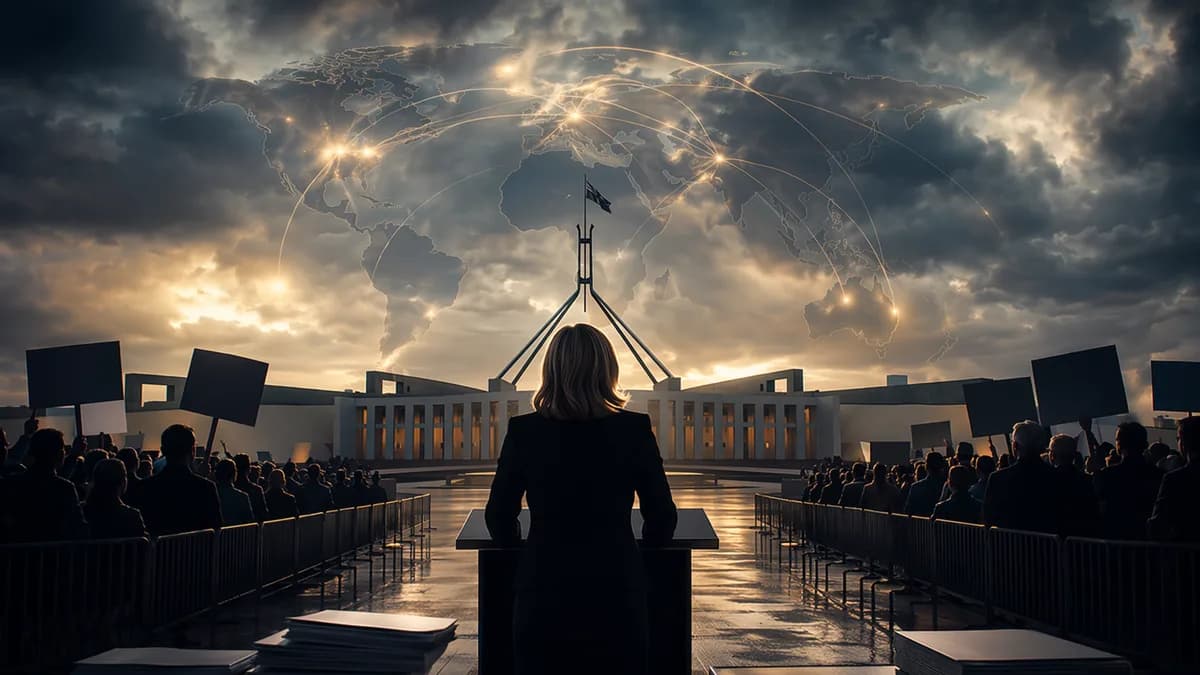
The Pauline Hanson National Press Club speech in Canberra on Wednesday showed voters more than a familiar anti-establishment performance. Hanson said Australia should be “monocultural”, attacked multiculturalism, Islam, transgender rights, climate action and public media, and argued One Nation should be treated as a contender for government, according to Guardian World.
That matters because the pitch to voters has shifted. Hanson is no longer just asking to be heard from the margins. She is describing what power would look like.
One nearly hour-long speech turned protest politics into a governing offer
For months, the political signal has been clear enough: voters angry with the major parties are giving Hanson another look. The Guardian’s Tom McIlroy writes that “pollsters, journalists and the (current) political establishment” have heard voters say the major parties are failing and One Nation is the answer.
The Press Club appearance tested that mood against the actual content of Hansonism.
Hanson’s proposals, as reported, included:
- Migration: slash migration and reject multiculturalism.
- Energy: back nuclear energy and “double down on coal and gas.”
- Public media: shut down SBS and gut ABC.
- Government machinery: cut the climate change and Indigenous affairs departments.
- Workplace policy: scale back workers’ rights to help small business.
- Family policy: scale back or abolish paid parental leave.
- AI regulation: apply heavy-handed regulation to AI.
“In many respects, I haven’t changed, and neither has One Nation,” Hanson told the packed club. “Thankfully, Australians have woken up, for which I am grateful.”
XOOMAR analysis: that quote is the clearest signal in the speech. Hanson is not presenting a moderated version of One Nation for a larger electorate. She is arguing the electorate has moved toward her.
The Pauline Hanson National Press Club speech put “monocultural” Australia on the table
The sharpest line was Hanson’s argument that Australia should be monocultural. ABC reported she said multiculturalism was an “utterly flawed” policy and that while Australia was multiracial, it must be monocultural.
Her framing followed a familiar pattern: describe social change as national loss, cast minority groups or migrants as threats, then present One Nation as the only party willing to say what others supposedly hide.
ABC reported Hanson said:
“Under the failed policy of multiculturalism, all cultures are allowed equivalence to ours. Surely opposing that is not racist, it’s common sense.”
She also said Australia opposed people coming here and “bringing with them the troubles they have left behind,” and ignoring “our values, our language, our traditions, our dress and the fact that we are predominantly a Judaeo-Christian society.”
The line between performance and policy is thin here. The speech was clearly built to energise One Nation loyalists. But inflammatory language also forces opponents, journalists and institutions to respond on Hanson’s chosen ground: migration, identity, Islam, media bias and national decline.
Treating the comments as mere provocation would be a mistake. Hanson used the platform to name departments she would cut, broadcasters she would target and rights she would weaken. That is not just rhetoric. It is a rough map.
20% in South Australia shows why the major parties are watching
The political opening is real, even if the path to forming government is not established by the supplied sources.
The BBC reported that on 21 March, One Nation won the second-highest number of votes in the South Australian state election, with more than 20%. It said the party would get at least three candidates elected, mostly at the expense of the Liberal Party. BBC also reported that One Nation’s federal vote share grew to 6.4% at last year’s federal election, and that national opinion polls this year showed it in second place to Labor.
That is why the Pauline Hanson National Press Club speech lands differently now than it might have during one of One Nation’s weaker cycles. The party is not just a media spectacle. It has fresh electoral evidence that its message can convert frustration into votes.
| Measure from supplied sources | What it shows |
|---|---|
| More than 20% in South Australia | One Nation can break out beyond Queensland |
| At least three candidates elected in that poll | The vote translated into seats |
| 6.4% at last year’s federal election | The party improved its federal vote share |
| National polls showed second place to Labor | The anti-major-party opening is broader than one state |
But the motives behind that support should not be flattened. A voter telling a pollster they want Hanson may be expressing economic anger, cultural alignment, protest, punishment of the Coalition, or a mix of all four.
That distinction matters. Broad dissatisfaction with the major parties is not the same thing as direct endorsement of a monocultural Australia.
For XOOMAR readers tracking how economic pressure collides with political risk, see our separate coverage of Zero Voter Chats Expose Victorian Labor MPs' Election Risk. The daily-life pressure point also appears outside electoral politics, including in Cash Deposits Crown the Best Digital Banks for Real Life.
From 1996 to 2026, One Nation keeps converting economic pain into cultural blame
BBC’s historical account places the speech in a long arc. Hanson entered parliament after winning a seat in 1996. In that first speech, she said Australia was “in danger of being swamped by Asians” and attacked Aboriginal and Torres Strait Islander people.
Two years later, One Nation won 11 seats in Queensland’s state election and 8.4% of primary votes in the federal election, according to BBC. The party then spent years unable to repeat that early surge, with Hanson losing races before returning to the Senate in 2016.
What has changed is the level of political opportunity. BBC attributed the latest opening to cost-of-living pressure, Liberal and National Coalition infighting, and voter frustration with mainstream parties. In South Australia, the party campaigned with former Liberal senator Cory Bernardi leading its ticket and promised to boost housing supply and cap immigration, though BBC noted immigration is not up to states.
What has not changed is Hanson’s method. Economic pressure is redirected toward migration, Islam, Indigenous policy, public institutions and cultural identity. The target list shifts with the moment. The structure stays the same.
ABC also reported that in 2024, Hanson was found to have breached the Racial Discrimination Act over a social media post telling Greens senator Mehreen Faruqi to “piss off back to Pakistan.” BBC reported she is appealing a federal court finding that she racially vilified a fellow senator, and that she was censured this month for saying there were no “good” Muslims.
Those details are not side issues. They show why many Australians hear the monocultural message as a threat rather than a policy preference.
Supporters, minorities and major parties heard three different speeches
For loyal One Nation supporters, Hanson’s address likely sounded like plain speaking: fewer migrants, less multicultural language, tougher treatment of Islam, less deference to public broadcasters, and more attention to small business frustration.
For migrants, Muslims, Indigenous Australians and multicultural communities, the same speech carries a different message. It questions belonging. It suggests some Australians are conditional members of the national community, tolerated only if they fit a narrow cultural frame.
For the major parties, the speech creates a trap. Condemn Hanson too broadly and risk sounding dismissive of voters who are genuinely angry about housing, wages, energy bills and services. Chase her language and legitimise the frame that national problems flow mainly from outsiders and minorities. Ignore her and let One Nation define the grievance vote alone.
Hanson’s treatment of journalists sharpened the picture. The Guardian reported that when senior correspondent Sarah Martin asked about Hanson’s daughter, Lee Hanson, and her job with a New South Wales One Nation senator while working in Tasmania, Hanson threatened Martin would be banned from press conferences and interviews. ABC reported Hanson called Martin “trashy” over reports on party finances.
ABC also reported that when SBS political editor Anna Henderson asked a question, Hanson pointed out Henderson would be out of a job if One Nation came to power.
XOOMAR analysis: this is where the free-speech branding breaks down. A party can criticise media coverage. But threatening access while proposing to abolish or gut public broadcasters signals a harsher view of scrutiny itself.
The next test is whether anger stays economic or hardens into cultural mandate
A stronger One Nation would push Australian politics toward tougher language on migration, multicultural funding, Indigenous affairs, public broadcasting and national identity. The supplied sources do not establish that One Nation can form government. They do establish that Hanson wants the party taken seriously as a governing contender, and that its vote is no longer easy to dismiss.
The risk for Australian politics is not only that One Nation wins more seats. It is that other politicians decide Hanson’s framing is where the votes are, then soften the language while adopting parts of the premise.
The evidence that would strengthen that thesis is clear: One Nation holds or improves its polling position, repeats the South Australian breakthrough elsewhere, and keeps forcing major parties to answer identity questions on its terms. The evidence that would weaken it would be equally concrete: voters punish the monocultural pitch, economic concerns move back to the major parties, and Hanson’s media confrontations start looking less like strength and more like intolerance of scrutiny.
The counter to Hanson will not be moral scolding alone. It will need credible answers on living standards, plus a confident defence of a multicultural Australia that does not sound embarrassed by itself.
Impact Analysis
- Hanson’s speech framed One Nation not just as a protest vote but as a potential governing force.
- The agenda outlined major shifts on migration, energy, public media, workplace rights and family policy.
- The remarks sharpen the political choice for voters dissatisfied with the major parties.
Primary Sources & Disclosures

Written by
XOOMAR
Data desk
XOOMAR is a capital markets software and data company. Every brief on this site starts from a dataset the company collects itself from primary sources (CFTC, SEC EDGAR, FINRA, the Federal Reserve, exchange APIs) and names the numbers it is built on, with a link to the data page so you can check them. Briefs are reviewed before they go out and corrected in place when the data is revised.