
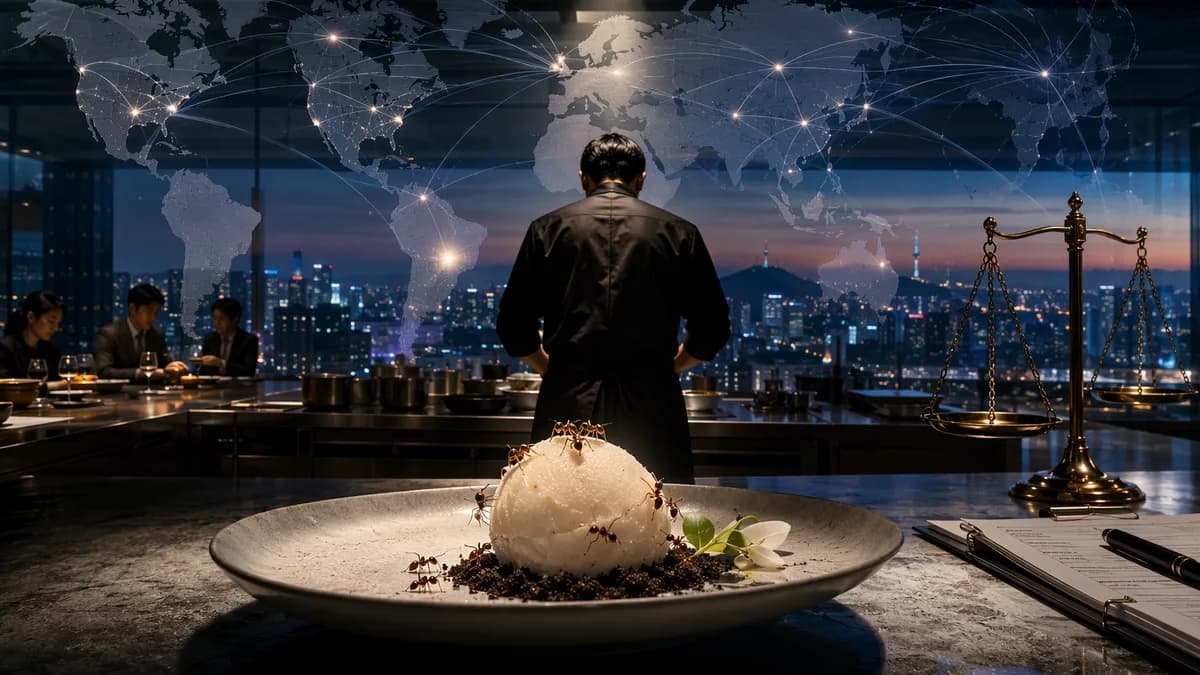
A Seoul two-Michelin-star restaurant has turned an ant-topped sorbet into a criminal test of how far fine dining can push unapproved ingredients before regulators step in. The South Korea ant dessert case matters most for chefs, restaurant operators, and investors backing high-end food concepts built around novelty.
Global TrendsJuly 22, 2026· 8 min read· By XOOMAR Insights Team
South Korea Ant Dessert Could Put Michelin Owner in Jail
Updated on July 22, 2026
XOOMAR Intelligence
Analyst Take
67/ 100
4 sources analyzedMedium confidenceTrend20Freshness90Source Trust90Factual Grounding91Signal Cluster20
Prosecutors asked a court to sentence the restaurant’s owner to one year in prison and fine the operating company 20m won (£10,108) for serving ants that are not approved for consumption under local food safety law, according to Guardian World. Sentencing is scheduled for 2 September.
The sharp question is proportionality. This was not reported as a mass food poisoning case. It was a premium plated dessert. But prosecutors are treating it as a food sanitation breach, not culinary theater.
A Michelin dessert with ants puts South Korea's food law in the spotlight
The core legal issue is narrow: ants are not on South Korea’s approved list of edible insects. Under local law, only 10 insect species, including grasshoppers, mealworms, and silkworm pupae, are approved for use as food ingredients. Ants are outside that list.
That matters because this case is not about whether ants are eaten elsewhere. The defense reportedly pointed to restaurants in Denmark, the UK, and Australia using ants as an ingredient. That may help explain the chef’s mindset, but it doesn’t answer the South Korean legal question: did the restaurant have approval to serve them?
The ministry of food and drug safety said businesses that want to use an unapproved insect must first obtain temporary approval. The restaurant did not follow that process, the ministry said.
For chefs, the warning is blunt. Prestige does not substitute for permission. A Michelin star may signal quality to diners, but regulators are looking at ingredient status, import history, and compliance paperwork.
The numbers behind the ant dessert prosecution: one year in jail, 20m won, and Michelin pressure
Prosecutors allege the restaurant imported dried ants from the United States and Thailand from 2021 and served them for around four years. The ant-topped dessert was allegedly sold roughly 12,200 times, generating about 120m won (£60,647) in revenue. Prosecutors estimated about 49,000 ants were used in total.
The requested fine, 20m won (£10,108), is modest beside the reputational cost. The bigger sanction is the proposed one-year prison sentence for the owner. Under the law cited in the source material, violations carry a maximum penalty of five years in prison or a 50m won fine.
The Michelin factor cuts both ways
The restaurant is in Gangnam, Seoul’s upmarket district, and holds two Michelin stars. That makes the case harder to dismiss as an obscure compliance miss. Elite restaurants influence food trends and customer expectations. If one of them normalizes a novel ingredient, others may follow.
But Michelin status also raises the duty of care. A diner at a two-star venue can reasonably assume the kitchen has vetted the legal and safety status of what lands on the plate.
The defense disputes the prosecution’s count. It argued in court that only about 60% of customers accepted the ant topping when offered, so the estimate based on all customers was too high. It also said only a small number of dishes on the restaurant’s 15-course menu included ants.
"In practice, about 60 percent of customers said they would eat the ants," the attorney said, according to reporting in the supplied source material.
South Korea's food approval system leaves little room for chef-led experimentation
South Korea’s system, as described in the case, works like a positive list. If an insect species is approved, it can be used. If it is not approved, a business needs temporary approval before serving it.
That structure clashes with the creative logic of tasting menus. High-end kitchens often use surprise, fermentation, foraging, unusual textures, and niche ingredients to stand apart. But a tasting menu is still a commercial food product. The plating may be artistic. The legal exposure is not.
Regulators treat unapproved insects differently from familiar ingredients because the risk profile is not self-evident to diners. The source material points to official concern over food safety law, and related reporting says authorities assess insects for issues including safety risks, toxicity, nutritional value, and hygienic breeding and processing.
The Korea Herald also reported that prosecutors cited heavy metals above permissible levels in the ants used as grounds for the sentencing request. If accepted by the court, that detail would shift the case from paperwork failure toward a more concrete safety concern.
For restaurant operators, the compliance lesson is practical:
- Ingredient status: Confirm whether every unusual ingredient is approved under local law.
- Supplier records: Keep import and sourcing documentation ready before service begins.
- Menu controls: Treat optional garnishes as regulated ingredients, not decoration.
- Diner consent: Disclosure helps, but it does not legalize an unapproved item.
From survival food to sustainable protein: insects have never had a simple place on the menu
The defense’s cultural point is not irrelevant. Ants are used as ingredients in some countries, and related reporting notes examples including Thai and Cambodian cooking and queen ants as a delicacy in Colombia. Food norms differ by place, law, and history.
Still, this argument has limits in court. South Korea’s law does not appear to ask whether an ingredient is accepted somewhere else. It asks whether that ingredient is approved in South Korea.
Fine dining often repackages unfamiliar foods as luxury experiences. That can make diners more open to ingredients they might reject in another setting. But it can also make regulators more suspicious when culinary ambition runs ahead of formal approval.
Ants are especially charged. To one diner, they may signal acidity, technique, and global dining fluency. To another, they may read as contamination or shock value. The restaurant reportedly served a sorbet dessert sprinkled with ants for customers who wanted the flavour, and RTE cited local media saying they were used "to add a sour taste".
That sensory rationale may explain the dish. It does not settle the legal question.
Chefs, regulators, diners, and rival restaurants all read the ant case differently
For chefs, the strongest defense is intent and context. The restaurant reportedly explained to prosecutors that the chef had used ants while working in the US and Europe and had not realized doing so was illegal in South Korea. The defendant also reportedly said:
"I apologise for this incident, which arose from my failure to fully understand the relevant regulations."
That apology may matter in mitigation. It does not erase the alleged breach.
For regulators, the case is about enforceability. The ministry launched its investigation after seeing mentions of ant dishes in blog posts and social media, not through a routine inspection. That detail should worry operators. Public-facing novelty now creates its own audit trail.
For diners, consent is central but incomplete. The defense says customers were asked in advance and could decline. Gulf News, citing related reports, said alternatives included fermented vinegar or edible flowers. Consent may reduce the sense of deception. It does not answer whether customers were told the ingredient lacked approval under South Korean law.
For rival restaurants, the message is simple: check first, plate later. Experimental ingredients need legal review before they reach guests. XOOMAR has covered how court processes can reshape business decisions in other regulated settings, including Creditors Plot Court Fight Over Thames Water Nationalisation and Court Freezes $110B Paramount Warner Bros Merger Deal. The sectors differ, but the operating lesson is familiar: legal uncertainty can become the story faster than the product itself.
The ant dessert case could reshape risk checks in South Korea's fine-dining kitchens
The South Korea ant dessert trial turns compliance into a front-of-house issue. When a restaurant’s identity depends on unusual ingredients, legal review cannot sit in a back-office checklist.
Operationally, high-end kitchens are likely to tighten controls around novel ingredients. That could mean ingredient audits, supplier files, legal sign-off, lab testing where relevant, clearer menu disclosures, and staff training on what can and cannot be served.
The reputational risk is sharper for Michelin-level restaurants. A legal case travels more widely than a menu note. It can affect bookings, partnerships, and how international diners read the restaurant’s judgment.
The case also matters for food-tech and alternative protein businesses. A sustainability pitch does not bypass approval rules. If an insect is not authorized for human consumption in a jurisdiction, the story starts and stops there until approval changes.
Expect tighter novel-food enforcement and more cautious tasting menus after the Michelin ant trial
Until the 2 September ruling, South Korean restaurants have little reason to test the edges of insect-based ingredients. The immediate incentive is caution.
A prison sentence would confirm prosecutors can seek personal penalties for chefs or owners when unapproved ingredients are served over time. A lighter sentence, or a ruling that focuses more on corrective action than punishment, would still leave the approval rule intact.
The evidence to watch is specific: how the court weighs customer consent, the disputed sales count, the alleged duration from 2021, the temporary approval failure, and any accepted findings about contamination or heavy metals.
The broader signal will be whether South Korea channels culinary experimentation through clearer approval pathways, or polices it mainly through punishment after the fact. For now, the safest reading is harsh but useful: in fine dining, novelty is not a defense if the ingredient was never cleared for the plate.
Impact Analysis
- The case tests how strictly South Korea will enforce food safety rules against high-end restaurants using novel ingredients.
- Chefs and restaurant operators face legal risk if prestige dining concepts rely on ingredients without regulatory approval.
- The requested prison sentence and company fine signal that regulators may treat culinary experimentation as a serious compliance issue.
Legal status of insects in South Korean food service
| Ingredient category | Examples | Status under South Korean food law |
|---|---|---|
| Approved edible insects | Grasshoppers, mealworms, silkworm pupae | Permitted for use as food ingredients |
| Unapproved insects | Ants | Require temporary approval before being served |
Sources

Written by
XOOMAR Insights Team
Research and Editorial Desk
The XOOMAR Insights Team pairs automated research with human editorial judgment. We track hundreds of sources across technology, fintech, trading, SaaS, and cybersecurity, cross-check the facts, and explain what happened, why it matters, and what to watch next. We do not just rewrite headlines. Every article is fact-checked and scored for reliability before it goes live, and we link back to the original sources so you can verify anything yourself.
Explore More Topics
Related Articles
 Global Trends
Free England vs Argentina Live Stream Beats Scam Links
England vs Argentina kicks off at 3 p.m. ET, with free legal streams in select countries and scam links waiting for late viewers.
Jul 19, 20268 min
 Global Trends
Pauline Hanson Exports Grievance at London CPAC Stage
Hanson used London CPAC to turn British culture-war fears into a warning for Australia, exposing One Nation's imported grievance playbook.
Jul 18, 20267 min
 Global Trends
Burnham's Electricity VAT Cut Hands Households Just £45
Burnham's first big move cuts electricity bills by about £45 a year, signaling fast, visible relief over a sweeping rescue.
Jul 21, 20268 min
 Global Trends
Debt Bites as Burnham Cuts VAT on Electricity Bills
Burnham’s VAT cut trims about £45 from electricity bills, but fuel debt campaigners say the crisis is far bigger.
Jul 21, 20268 min
 Global Trends
Andy Burnham Seizes No 10 Without UK Election Test
Andy Burnham has taken No 10 without an election, giving Labour a new leader and a bruising legitimacy test.
Jul 20, 20267 min
 Fintech
JP Morgan Bank Tax Warning Puts £3bn London HQ in Play
Jamie Dimon’s warning turns Burnham’s bank tax push into a £3bn test of whether Britain still wants global capital.
Jul 21, 20268 min
 Fintech
UK Crypto Banking Inquiry Puts Bank Gatekeepers on Trial
UK lawmakers are probing whether banks are quietly cutting crypto firms off from accounts, payments and insurance.
Jul 21, 20268 min
Future FictionAndy Burnham Prime Minister Gamble Risks Labour Backlash
Burnham enters No 10 with rare public appeal, but his unelected rise and 10-year plan put Labour's reset on a short fuse.
Jul 21, 20269 min
 Global Trends
Mamdani Netanyahu Arrest Vow Crashes Into Legal Wall
Mamdani conceded New York City can’t execute the ICC warrant against Netanyahu, undercutting a campaign promise before a possible UN visit.
Jul 22, 202612 min
 Cybersecurity
$1.2B AI Risk Bet Hurls Glow Endpoint Security Into View
Glow exits stealth at $1.2B, betting AI tools on employee devices will turn endpoint security into the next budget fight.
Jul 22, 20269 min
Don't miss the signal
Get our weekly roundup of the stories that matter across tech, fintech, and trading. No noise, just signal.
Free forever. No spam. Unsubscribe anytime.