Britain often treats surrounding seas as a moderating force. The UK marine heatwave now pressing against its coasts shows the buffer itself is overheating.
XOOMAR Intelligence
Analyst Take
The North Sea heat spike cuts against Britain’s cooling-sea assumption
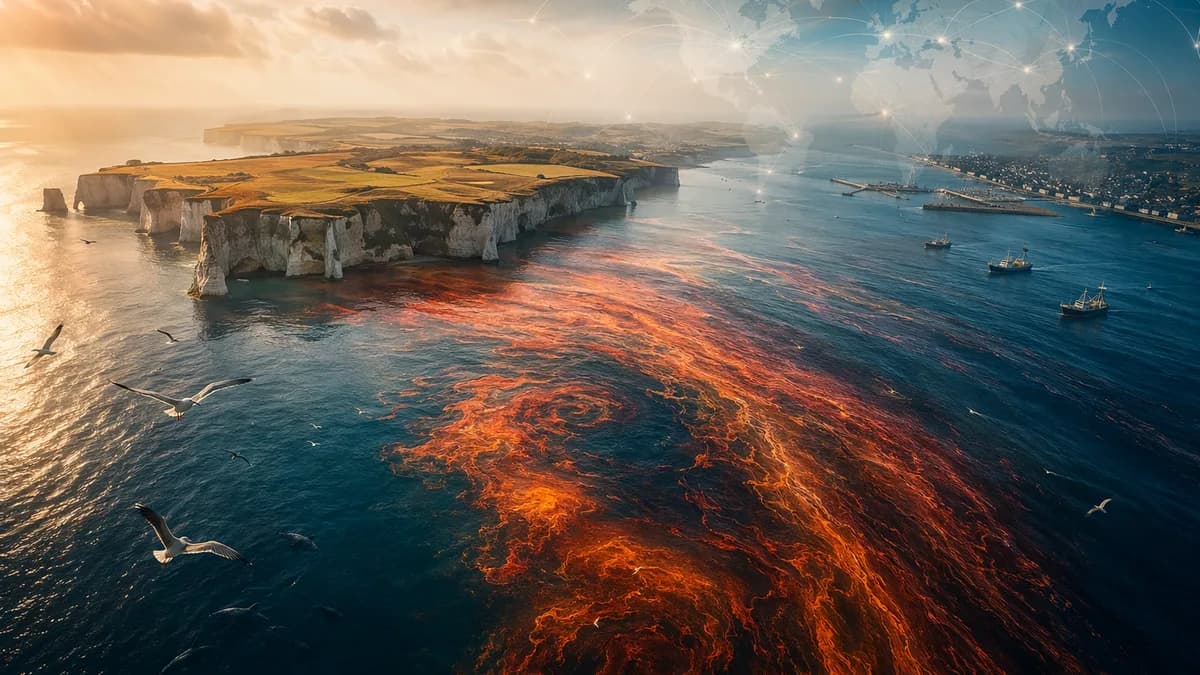
UK waters are in an “extreme” marine heatwave, with marine temperatures averaging 2C higher than usual and some areas running 4-5C warmer, according to Guardian World. That is the story beneath the weather headline: the ocean is no longer just absorbing heat quietly. It is feeding risk back into marine life, fishing patterns and coastal planning.
The immediate trigger is atmospheric. The Met Office said the elevated sea temperatures developed rapidly after last month’s heat dome, when much of Europe endured its worst ever heatwave, which scientists said would have been impossible without the climate crisis. The UK is now in its third heatwave of the summer, with temperatures on track to exceed 30C for up to 10 consecutive days.
Dr Ségolène Berthou, an air-sea interaction specialist at the Met Office, put the mechanism plainly:
“The ocean didn’t have enough time to cool down between the two land heatwaves,”
That sentence matters. XOOMAR analysis: this UK marine heatwave is less about one hot week than about heat carrying over from one atmospheric event to the next. The sea is acting like stored climate pressure.
For readers tracking how heat is showing up beyond the shoreline, XOOMAR has also covered related pressure points in Heatwave Forces Neso Power Warning as Grid Runs Tight and Deadly Heat Rewrites the Best Home Air Conditioners List.
Record sea surface temperatures put hard numbers behind the UK marine heatwave
A marine heatwave means sea surface temperatures stay unusually high against the expected seasonal range. The current UK marine heatwave is not a vague anomaly. It is showing up in measured departures from normal.
The Copernicus Climate Change Service and Copernicus Marine Service confirmed that global sea surface temperatures have surpassed previous records for this time of year, records set in 2023 and 2024. The Guardian reported that this had been anticipated to follow the development of El Niño conditions, which scientists forecast to be the strongest in decades.
The local picture is sharper:
- UK average: marine temperatures are around 2C warmer than usual.
- Severe pockets: some locations are 4-5C warmer than usual.
- Seasonal timing: the third UK land heatwave has arrived while the ocean has not cooled from earlier heat.
- Ocean role: oceans absorb more than 90% of the excess energy in the Earth system, primarily caused by burning fossil fuels.
The Met Office’s own briefing said waters south of the UK were seeing sea surface temperature anomalies of 1.5°C to 3°C above the 1982-2012 average, with the Celtic Sea, English Channel and Southern North Sea in moderate to strong marine heatwave conditions. It also said the Northwest European shelf seas reached an average of 14.6°C, the third warmest July 1st temperature on record, behind 2009 and 2023.
That gives the event its force. Air temperature can spike and fade. Ocean heat lingers.
Shellfish, kelp, cod and octopus show the food-chain split
The ecological risk is not evenly distributed. Some species gain room. Others lose it.
Prof John Pinnegar, principal scientist and lead adviser at the Centre for Environment, Fisheries and Aquaculture Science, warned that extreme marine heatwave conditions can result in “mass-mortality events” for some marine species and alter the distribution of commercially important fish and shellfish.
That phrase should be read carefully. It does not mean every species dies at once. It means vulnerable species can suffer large die-offs during prolonged periods of elevated seawater temperatures.
The BBC reported that long periods of sea heat can trigger mass die-offs among some seagrasses, shellfish and other species, while encouraging greater numbers of warm-water creatures such as octopus. It also cited concern for kelp forests, which are suited to cooler waters and can experience heat stress when temperatures surge.
The before-and-after dynamic is blunt:
| Assumption | Reality revealed by hotter UK waters |
|---|---|
| Cooler UK seas protect familiar marine habitats | Seagrasses and kelp can face high heat stress |
| Traditional species ranges shift slowly | Cool-adapted species such as cod are generally moving further north |
| New warm-water arrivals are only a curiosity | Octopus can create new catches while preying on crabs, lobster, scallops and other shellfish |
| Marine heat is a distant climate signal | UK coastal fishing is already seeing altered species mixes |
The octopus example is the clearest commercial signal in the sources. Record numbers of octopuses were found off the south-west coast of England last year, transforming the fishing industry and marine life in that area. A record 100 tonnes of octopus was sold in one day at Brixham market last month.
Britain has seen hot seas before, but the baseline has moved
The UK has experienced marine heatwaves before. The difference now is the starting point.
The BBC reported that the UK’s seas have been getting steadily warmer since the 1980s, driven by human-caused climate change. The southern North Sea and the English Channel are also shallow, which means they can heat quickly when warm air sits above them.
This year, high-pressure systems parked over Europe in late May and late June, allowing air temperatures to build. That warmth then transferred to the seas. The Met Office briefing described the second half of June as a period of anticyclonic conditions, increased sunshine and weaker winds, which pushed the English Channel, Southern North Sea and parts of the Celtic Sea back into marine heatwave conditions.
Dr Berthou’s warning is the long-range signal:
“We are likely to see marine heatwave conditions becoming average towards the middle-to-end of the century,”
“So, this is projected to increase if we don’t cut greenhouse gas emissions.”
XOOMAR analysis: the danger is not that Britain has never seen warm seas. It is that temporary heat spikes now land on a warmer ocean base, so the same weather setup can produce a more damaging marine result.
Fishing crews and marine scientists face opposite sides of the same shift
For scientists, the UK marine heatwave fits a clear pattern: long-term ocean warming, intensified by short-term atmospheric heat. For fishing communities, the same pattern arrives as changed catches, predatory pressure and less reliable assumptions about where species will be.
The BBC reported that UK fishing communities say shellfish catches have been badly hit as warming seas bring predatory octopus. It also noted that increasing octopus numbers may offer a new market for fishermen, while hitting populations of crabs, lobster, scallops and other shellfish on which they prey.
Prof Matt Frost of the Plymouth Marine Laboratory captured the trade-off:
“It can be exciting to see new species arrive and we all enjoy seeing something like an Atlantic bluefin [tuna] or an octopus, but the problem is we’ve also got the negative impacts of that,”
The Met Office also flagged risks beyond commercial catch. Marine heatwaves can raise the potential for harmful algal blooms and stress species such as mussels, oysters and salmon. It said that during the 2018 UK marine heatwave, elevated levels of pathogenic Vibrio species were detected in seawater and shellfish at several UK locations.
That makes hotter seas a public-health and coastal-management issue, not only a conservation story.
The next signals are species shifts, shellfish stress and algal blooms
António Guterres, the UN secretary general, said the arrival of El Niño conditions should be treated as an “urgent climate warning”.
“The only effective response is climate action equal to the crisis: ending the addiction to fossil fuels, accelerating the shift to renewables, protecting the most vulnerable, and delivering early warning systems for all.”
The near-term evidence that would strengthen the current warning is specific: more extreme patches around UK waters, further reports of shellfish stress, unusual warm-water species sightings, harmful algal blooms, and continued shifts in commercially important fish and shellfish.
Evidence that would weaken the thesis would also be clear: a rapid cooling of UK waters, limited biological disruption, and no persistence of marine heatwave conditions after the land heat eases. The sources do not show that yet. Berthou said, “There’s no sign of an end to it,” and the Met Office expected conditions to persist and intensify.
The practical takeaway is hard to dodge. Britain cannot treat overheated seas as distant climate news. The warning is already in its own waters, and the next test will be whether monitoring, fisheries management and coastal health systems move as fast as the heat does.
Impact Analysis
- UK seas are no longer acting only as a cooling buffer and are now storing heat between land heatwaves.
- Warmer waters can disrupt marine life, fishing patterns and coastal planning.
- The heatwave links local UK conditions to record global sea temperatures and escalating climate risks.
UK Marine Heatwave Temperature Anomalies
Primary Sources & Disclosures

Written by
XOOMAR Insights Team
Research and Editorial Desk
The XOOMAR Insights Team pairs automated research with human editorial judgment. We track hundreds of sources across technology, fintech, trading, SaaS, and cybersecurity, cross-check the facts, and explain what happened, why it matters, and what to watch next. We do not just rewrite headlines. Every article is fact-checked and scored for reliability before it goes live, and we link back to the original sources so you can verify anything yourself.