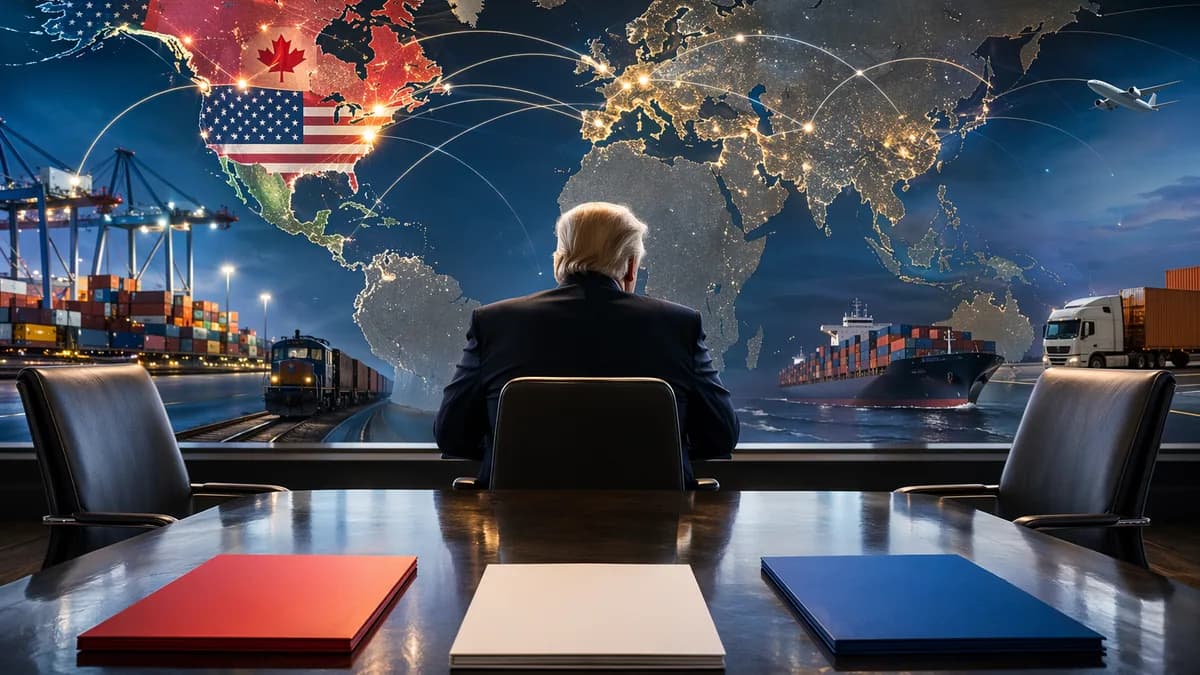
Donald Trump built USMCA as his answer to NAFTA, then refused to give his own deal the long-term USMCA renewal that businesses expected.
XOOMAR Intelligence
Analyst Take
That is the contradiction now hanging over North American trade. The Trump administration declined to renew the United States-Mexico-Canada Agreement on its existing terms by Wednesday’s deadline, choosing instead to keep the pact alive under annual reviews, according to Guardian World.
The move does not terminate USMCA. It does something more useful for Trump’s trade strategy: it keeps the deal in force while making certainty conditional. For companies that depend on cross-border production, that means the pact survives, but the planning horizon shrinks.
Trump turns his own USMCA victory into a pressure campaign
Trump once sold USMCA as proof that his trade agenda could replace NAFTA with a tougher, better deal. In 2020, during his first term, he described it as the “fairest, most balanced, and beneficial trade agreement we have ever signed into law”.
Now his administration is declining to renew that same agreement in its current form.
A senior administration official told reporters that Trump had “chose not to rubber stamp a USMCA renewal without addressing existing issues”. The official added:
“So in other words, the United States did not agree to renew the USMCA in its current form. So, as a result, the USMCA is not renewed.”
That phrasing matters. Washington is not blowing up the pact today. It is refusing to lock itself into the pact for the longer period the agreement allowed.
XOOMAR analysis: This is not a technical delay. It is a deliberate choice to preserve pressure over Canada and Mexico. Trade agreements are supposed to reduce uncertainty. Trump is using this one to create it.
The gap is stark:
- Expected path: renew the agreement and give companies a longer investment runway.
- Actual path: keep USMCA alive, but subject it to annual political review.
- Strategic effect: preserve market access while keeping Canada and Mexico under recurring negotiating pressure.
That is classic Trump trade politics: agreements are less like fixed rules and more like live bargaining instruments.
The 2036 expiry clause gives Washington a yearly USMCA renewal fight
The mechanics are simple, but the consequences are not.
USMCA is set to expire in 2036. Wednesday was the deadline built into the agreement for the three countries to decide whether to extend it for another 16 years. They did not do that. After virtual talks among officials from all three governments, the US Trade Representative’s office confirmed that Washington had walked away from renewal on existing terms.
The pact remains in force while negotiations continue. The difference is the review schedule. Instead of facing review once every six years, USMCA now faces review every year.
Jamieson Greer, the US trade representative, said the US would “continue to engage with Mexico and Canada to address the Agreement’s shortcomings”. FOX Business also reported that Greer said the US, Mexico, and Canada met virtually for the required joint review and that the US declined to renew the agreement in its current form.
Greer also said:
“However, the agreement remains in force pending resolution of these issues or until the agreement’s termination.”
That sentence is the new operating model for North American trade.
XOOMAR analysis: Annual reviews create a rolling political risk calendar. A company considering a plant, rail hub, supplier contract, or long-term sourcing plan now has to factor in a yearly moment when the pact can become a bargaining arena again.
Washington benefits from that structure. It can keep pressure on Canada and Mexico over trade deficits and whatever the administration defines as “shortcomings”, without paying the immediate economic and diplomatic cost of abandoning USMCA outright.
For a separate example of how Trump’s second-term strategy has tested institutional constraints, see our analysis of Trump v Slaughter Lets Presidents Gut Agency Watchdogs. The same governing instinct shows up here: keep formal structures in place, but bend them toward executive pressure.
About $2tn in North American trade now carries more political risk
The scale is not marginal. USMCA governs about $2tn annually in goods and services among the three countries, according to CNBC as cited by the Guardian.
FOX Business reported that Canada and Mexico remain among America’s largest trading partners. It also cited US International Trade Commission data showing that in 2024, Canada and Mexico were the two largest export markets for US-made goods, while Mexico was the largest source of US imports and Canada ranked third.
That is why this USMCA renewal decision lands beyond trade ministries. It hits corporate finance teams, logistics planners, manufacturers, farm exporters, retailers, and investors with cross-border exposure.
The source material does not identify every sector likely to be targeted in the next talks. But it does support the larger point: when a pact governing roughly $2tn in annual trade shifts from multi-year stability to yearly review, the uncertainty spreads across the companies that depend on that trade.
Small rule changes can carry large consequences. Rules governing origin, tariff treatment, customs enforcement, and eligibility for preferential access can alter costs across a supply chain. Even if the pact remains formally intact, the threat of unresolved disputes can change investment timing.
A battery plant, factory, warehouse network, or logistics corridor can take years to finance and build. Annual review risk may push companies to:
- Delay capital spending: wait for the next negotiating round before committing money.
- Demand higher returns: price in policy risk before approving projects.
- Build contract protections: add clauses tied to tariffs, customs delays, or rule changes.
- Diversify suppliers: reduce dependence on one border crossing, jurisdiction, or sourcing route.
- Spend more on compliance: prepare for tighter audits and shifting interpretations.
That is not the same as a trade collapse. It is a risk premium.
Automakers, farmers, unions, and border economies won’t read this move the same way
The politics of USMCA were never purely diplomatic. They are domestic.
Manufacturers and retailers generally prefer predictable rules because margins, inventory cycles, and supplier contracts depend on stable assumptions. Some unions and domestic producers may read the annual review structure differently. They may see a chance to press for tougher enforcement or revisions to provisions they believe are too weak.
That split is the point. USMCA sits at the intersection of trade, labor, border policy, and industrial politics. Trump’s refusal to renew it gives every affected group a reason to lobby harder before the next review.
Mexico’s public posture is calm. At a Wednesday press conference, Mexico’s economy minister Marcelo Ebrard said his government wants to address the issues raised by the US on foreign dependence.
“There is no difference that I can identify between Mexico, the United States and Canada that is so big that we cannot resolve it,” he said, according to Reuters.
That is diplomatic language for keeping the talks alive. Mexico has little reason to escalate immediately while the agreement remains in force. But it also has to prepare for negotiations where Washington may press harder on deficits and “shortcomings”.
Canada faces a parallel challenge. Ottawa is likely to prefer stability, but the Canadian political mood around US relations has already grown more sensitive. We covered one symbol of that friction in Canada Puts a Sting in America’s 250th Birthday Wish. Trade talks will now feed that broader political tension.
The US political map complicates Trump’s strategy too. Border states, farm states, industrial states, and logistics hubs do not share identical exposure. A tariff threat that looks useful in Washington can land differently in communities tied to exports, imports, trucking, warehousing, or cross-border manufacturing.
That is why the administration’s move is a domestic political gamble as much as a negotiation with Canada and Mexico.
From NAFTA backlash to USMCA uncertainty, North American trade stays politicized
USMCA was born from a backlash against NAFTA. The older 1992 North American Free Trade Agreement became a symbol in US politics of job losses, wage pressure, and deindustrialization. Trump campaigned against that model, then replaced NAFTA with USMCA during his first term.
The replacement was supposed to answer the political failure of NAFTA while preserving the commercial logic of North American integration. It kept the three-country framework but updated the rules.
The current problem is that one of the agreement’s accountability tools now doubles as a source of instability. A sunset-style review process can force governments to revisit unresolved problems. It can also make businesses wonder whether today’s rules will survive next year’s politics.
Trump has been openly critical of the agreement lately. Last month, he threatened to abandon it.
“We don’t need anything that Canada has. We don’t need anything that Mexico has, but they need everything that we have. And they have to treat us better,” he told reporters in the Oval Office.
That rhetoric shows why annual reviews carry weight. The threat does not need to become termination to affect behavior. It only needs to remain credible enough that companies and governments prepare for disruption.
The administration has also linked its refusal to renew to persistent US trade deficits with both neighbors. That gives Washington a broad frame for future demands. Deficits are not a narrow technical complaint. They can be used to justify sector-by-sector pressure.
North American companies should plan for a pact that survives but never feels settled
For executives and investors, the practical message is blunt: USMCA is not dead, but it is less settled than it was.
That matters for public companies with cross-border exposure. Analysts are likely to press management teams on margin risk, sourcing concentration, tariff exposure, and capital spending plans. Firms that once treated USMCA as a stable foundation may now have to explain how they would handle a rougher review cycle.
Large multinationals have options. They can hire more trade lawyers, redesign supply routes, shift sourcing, lobby in three capitals, and absorb short-term compliance costs. Smaller suppliers have less room. A family-owned parts maker, food exporter, or logistics subcontractor may not be able to restructure operations every time the political calendar tightens.
XOOMAR analysis: The biggest risk is not immediate cancellation. It is slow erosion of confidence. North American trade can keep moving while companies quietly demand higher returns, hold more inventory, delay projects, or build escape clauses into contracts.
That is how policy uncertainty becomes an economic cost before any formal rupture occurs.
There is also a negotiation signal here for Canada and Mexico. The US is not walking away today, but it is making clear that the current deal no longer gets automatic political protection from the president who signed it.
Trump’s USMCA gambit points to a rougher 2026 trade fight
The most likely near-term scenario is not instant collapse. It is a harder, more transactional version of USMCA.
FOX Business reported that the US is scheduled to meet with Mexico during the week of July 20 for a third round of bilateral negotiations tied to the USMCA joint review. It also reported that Trump imposed 25% tariffs on Canada and Mexico last year, which spurred negotiations over tariffs and the underlying issues he had with trade terms among the three countries.
That points to the pattern ahead: threats, bilateral pressure, sector-specific bargaining, and repeated claims that the agreement’s current terms are inadequate.
The evidence that would confirm this thesis is clear. Watch whether Washington uses the annual review structure to seek concessions without issuing a formal withdrawal notice. Watch whether companies start flagging USMCA renewal risk in earnings calls, filings, or capital spending decisions. Watch whether Canada and Mexico keep talks calm in public while preparing sector-by-sector responses behind closed doors.
The evidence that would weaken it would be a fast three-country agreement to extend the pact on stable terms. The administration’s current language does not point that way.
USMCA is likely to endure for now. But it will endure as a less comfortable deal, one that keeps North American trade open while making every year feel negotiable. For companies built around predictable borders, that is the change that matters.
Impact Analysis
- The decision keeps USMCA in force but shortens the planning horizon for North American businesses.
- Annual reviews give Washington continued leverage over Canada and Mexico.
- Trump is turning a trade deal he once championed into a tool for renewed pressure.
USMCA Renewal Paths
| Expected path | Actual path |
|---|---|
| Renew USMCA on existing terms | Decline renewal in current form |
| Give businesses a longer investment runway | Keep the pact alive under annual reviews |
| Reduce uncertainty for cross-border production | Use uncertainty as leverage over Canada and Mexico |
Primary Sources & Disclosures

Written by
XOOMAR Insights Team
Research and Editorial Desk
The XOOMAR Insights Team pairs automated research with human editorial judgment. We track hundreds of sources across technology, fintech, trading, SaaS, and cybersecurity, cross-check the facts, and explain what happened, why it matters, and what to watch next. We do not just rewrite headlines. Every article is fact-checked and scored for reliability before it goes live, and we link back to the original sources so you can verify anything yourself.