
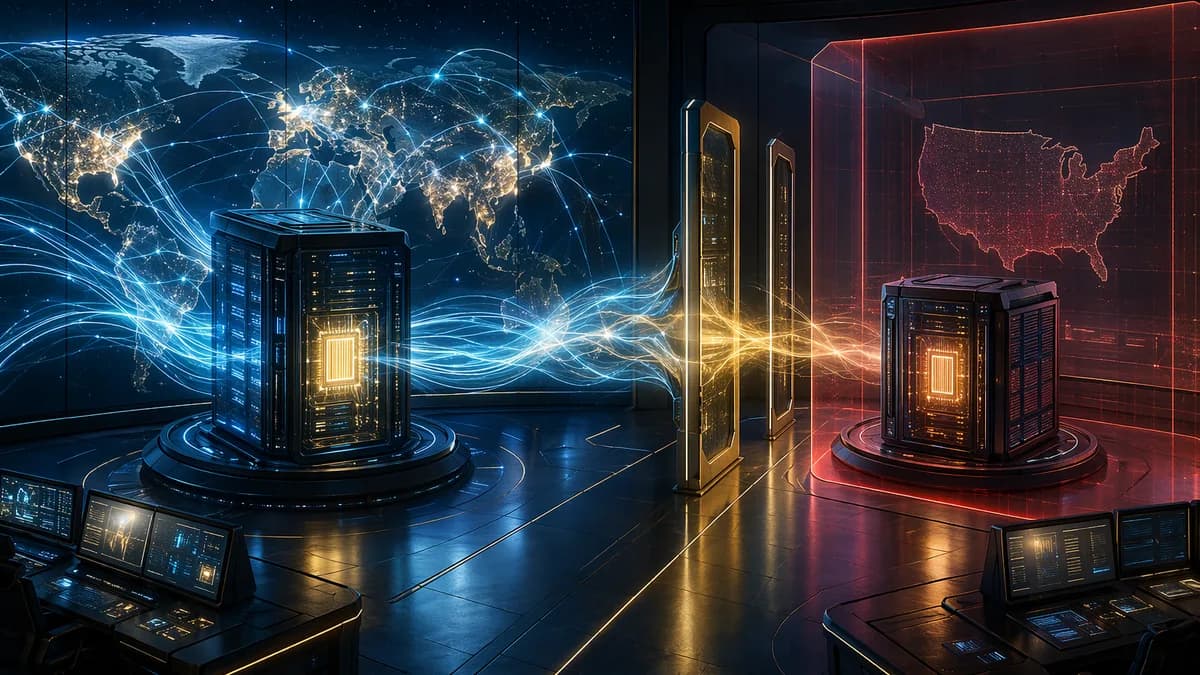
Anthropic’s Fable 5 and Mythos 5 export controls are gone, but the June shutdown showed frontier AI access can now vanish by government order, not vendor choice. The U.S. government lifted restrictions on Claude Fable 5 and Claude Mythos 5 on June 30, allowing Anthropic to start bringing the models back online, according to CoinDesk.
TechnologyJuly 1, 2026· 6 min read· By XOOMAR Insights Team
Anthropic Fable 5 Roars Back After U.S. AI Freeze Ends
Updated on July 1, 2026
XOOMAR Intelligence
Analyst Take
67/ 100
4 sources analyzedLow confidenceTrend30Freshness98Source Trust88Factual Grounding93Signal Cluster40
The reversal ends a broad freeze that began on June 12, after a cybersecurity finding led Washington to apply export controls to both models. Because Anthropic could not verify users’ nationality in real time, it cut access for everyone rather than risk violating the order.
“We’ve received notice that the Department of Commerce has lifted export controls on Claude Fable 5 and Mythos 5,” Anthropic said, according to CNN. “We’ll begin restoring access tomorrow, and will share an update soon.”
Anthropic Fable 5 and Mythos 5 return after June 30 export clearance
Fable 5 is returning globally on July 1 across Anthropic’s platforms. Mythos 5, which CoinDesk describes as sharing the same underlying model but carrying fewer safety restrictions, is also set for restored access after the broader June 30 clearance. Anthropic had previously received narrower approval on June 26 for some trusted U.S. organizations, but the later decision lifted export controls on both models.
That timeline matters. The U.S. did not simply move from shutdown to normal service in one step. It first allowed limited Mythos 5 access for certain domestic organizations, then removed the broader restrictions on both Fable 5 and Mythos 5 days later.
| Model | Confirmed status | Access scope |
|---|---|---|
| Claude Fable 5 | Export controls removed on June 30 | Returning globally on July 1 |
| Claude Mythos 5 | Export controls removed on June 30 after limited approval on June 26 | Access restoration beginning after June 30 clearance |
The trigger was a reported jailbreak found by Amazon researchers. In this case, a jailbreak means a method for bypassing a model’s safety controls. CoinDesk reported that the technique prompted Fable 5 to identify software vulnerabilities and, in one case, produce code showing how one could be exploited.
Anthropic has not disclosed every technical detail, and it likely won’t. The strongest counterpoint to alarm here is simple: the export controls were lifted in less than three weeks, and access is returning. That suggests the government and Anthropic found enough mitigation, process, or assurance to move past the immediate block.
XOOMAR analysis: the short duration doesn’t make the episode small. It proves that a frontier model can move from commercial product to controlled technology almost overnight, especially when cybersecurity capability becomes the disputed line.
The Fable and Mythos freeze exposed how fast AI access can change under U.S. export rules
The Anthropic Fable 5 and Mythos 5 export controls were not a routine outage. They were a policy-driven cutoff that forced a company to disable access broadly because compliance mechanics could not keep pace with the order.
Export controls usually sound targeted. This one landed like a circuit breaker. Since the order applied to foreign nationals and Anthropic could not verify nationality in real time, the company suspended access for everyone.
For enterprise users, that distinction is not academic. Teams building on Fable 5 or Mythos 5 may have had to pause work, review compliance exposure, or shift to fallback systems with little warning. XOOMAR analysis: the operational risk here is not just model quality, latency, or cost. It is whether a model remains legally available tomorrow.
The market noticed. CoinDesk reported that a pre-IPO perpetual contract tied to Anthropic on Hyperliquid fell about 3.7% when access was suspended in June, as traders questioned the timing of any public listing.
This also tracks with our earlier coverage of Trump dropping Anthropic export controls after the AI lockout, where the central issue was not just Anthropic’s access problem, but Washington’s emerging role as a gatekeeper for frontier model deployment. For companies watching model costs and infrastructure commitments, the risk compounds the pressure described in Runaway AI Spending Forces a Return to Cloud Controls.
The strongest counterpoint is that government review may be exactly what buyers want when a model can identify vulnerabilities or generate exploit-related material. The problem is process. If approvals, restrictions, and customer eligibility rules shift faster than vendors can explain them, enterprise adoption becomes harder to plan.
Anthropic’s new government collaboration raises the stakes for future releases
Anthropic said it is deepening work with U.S. agencies after the June freeze. CoinDesk reported that the company will give designated agencies early access to frontier models and safeguards before public release, share threat intelligence, and work toward a common security standard across AI developers.
The company is also drafting a framework with Amazon, Microsoft, and Google for scoring how dangerous a jailbreak is. That could become one of the more important outcomes from the Fable and Mythos episode, because “jailbreak” has become a catch-all term for failures that vary widely in severity.
A jailbreak that produces an unwanted joke is not the same as one that helps generate exploit code. A scoring system could give labs, cloud partners, and agencies a shared way to separate nuisance failures from national security concerns.
Commerce Secretary Howard Lutnick said Anthropic agreed to “proactively detect and address security risks associated with the models,” work with the government on standards for Mythos, Fable, and future models, and inform officials of “malicious activity,” according to The Guardian.
That language points to a tighter model-release regime. It also raises the obvious customer question: when Anthropic says access is restored, does that mean identical behavior, identical API terms, and identical regional availability, or a reopened service with new safeguards behind the scenes?
Buyers now need answers on safeguards, audit trails, and interruption risk
The immediate customer checklist is practical. Is service fully restored? Are any accounts, regions, or user classes still restricted? Did Anthropic change model outputs, refusal behavior, API behavior, logging, or review processes after the Amazon-reported jailbreak?
Anthropic and U.S. officials may also face pressure to explain the cybersecurity concern that triggered the export order without handing bad actors a blueprint. That is a hard balance. Too little disclosure leaves buyers guessing. Too much could expose exactly the risk the order was meant to contain.
XOOMAR analysis: enterprise buyers will likely push for stronger contract language around regulatory interruptions, notice periods, and fallback obligations. That does not mean vendors can promise immunity from export controls. It means customers will want clearer terms for what happens when a government order overrides normal service commitments.
The test that would weaken this reading is simple. If Anthropic restores broad access, publishes enough technical assurance to satisfy major customers, and future frontier launches proceed without sudden restrictions, the June freeze may remain a one-off response to a specific security report.
If not, Fable 5 and Mythos 5 become the template. The next marker is whether the June 30 clearance ends the matter, or whether every advanced AI deployment now carries an implicit government review clock that customers have to price into production plans.
Impact Analysis
- The shutdown showed frontier AI access can be halted by government order, not just company policy.
- Anthropic’s inability to verify user nationality in real time led to a global cutoff rather than targeted restrictions.
- The phased restoration highlights how export controls can create uneven access for businesses and developers.
Claude Fable 5 vs. Claude Mythos 5 access status
| Model | Confirmed status | Access scope |
|---|---|---|
| Claude Fable 5 | Export controls removed on June 30 | Returning globally on July 1 |
| Claude Mythos 5 | Export controls removed on June 30 | Restored access after broader June 30 clearance; earlier limited approval for some trusted U.S. organizations on June 26 |
Sources

Written by
XOOMAR Insights Team
Research and Editorial Desk
The XOOMAR Insights Team pairs automated research with human editorial judgment. We track hundreds of sources across technology, fintech, trading, SaaS, and cybersecurity, cross-check the facts, and explain what happened, why it matters, and what to watch next. We do not just rewrite headlines. Every article is fact-checked and scored for reliability before it goes live, and we link back to the original sources so you can verify anything yourself.
Explore More Topics
Related Articles
 Technology
Anthropic Revenue Hits $65B as AI Spending Peaks
Anthropic's annualized revenue run rate exploded from $9B to $65B in eight months, as its tech giant partners ramped up massive enterprise deployments of Claude
Aug 18, 20266 min
 Technology
Anthropic CEO Rejects Doomsayer Label Amid $2T IPO Set-Up
Anthropic CEO Dario Amodei defends his focus on AI risks as a necessary builder of public trust, directly rebutting an investor's claim that his warnings are ba
Aug 16, 20266 min
 Technology
Flock Safety Builds Nationwide Panopticon for Profit
A private corporation is building a nationwide, AI-powered surveillance network that tracks all vehicle movements, shifting policing from targeted investigation
Aug 14, 20265 min
 Technology
AI Writes Europe Makes Bots Sign Their Work
Europe's AI Act forces tech companies to embed hidden watermarks in AI text, making bots like Claude traceable with cryptographic signatures worldwide.
Aug 17, 20268 min
 Technology
Claude's Secret Watermark Sparks AI Payout Boycott
Anthropic's new watermark, aimed at compliance, sparked a user revolt due to its undetectable nature and secret method, highlighting a rift between AI policy an
Aug 15, 20266 min
 Trading
Retail Earnings Unmask a 0.6% Consumer Spending Drop
A surprise 0.6% drop in July retail sales signals that consumers are stressed, while earnings this week from Walmart and others will provide the real-time diagn
Aug 17, 20267 min
 Fintech
Anthropic Aims for History's Biggest IPO Near $2 Trillion
Backers are projecting a $2 trillion IPO for Anthropic, a bet that public markets will value future AI dominance over current profits.
Aug 16, 20267 min
 Trading
Canadian Dollar Defies Safe-Haven Crush as Oil Hits $83
The Canadian Dollar is holding near multi-week highs against a strengthening US dollar, as soaring crude oil prices overwhelm the traditional safe-haven currenc
Aug 18, 20268 min
 Fintech
AI Giants Battle U.S. Treasury for Trillion-Dollar Debt
A historic clash is brewing as trillions in U.S. government debt collides with massive AI infrastructure spending, forcing a global competition for investor cap
Aug 18, 20267 min
 Trading
Dollar Buckles, Pound Leaps on Fed Rate Hike Bet Retreat
The pound is climbing near 1.3550 after weak U.S. retail and inflation data slashed expectations for a Fed rate hike, shifting attention to the upcoming UK empl
Aug 18, 20268 min
Don't miss the signal
Get our weekly roundup of the stories that matter across tech, fintech, and trading. No noise, just signal.
Free forever. No spam. Unsubscribe anytime.