
$199 is the most honest thing about the BYOK distraction-free writing tool: you’re paying for a black plastic rectangle that refuses to become another computer.
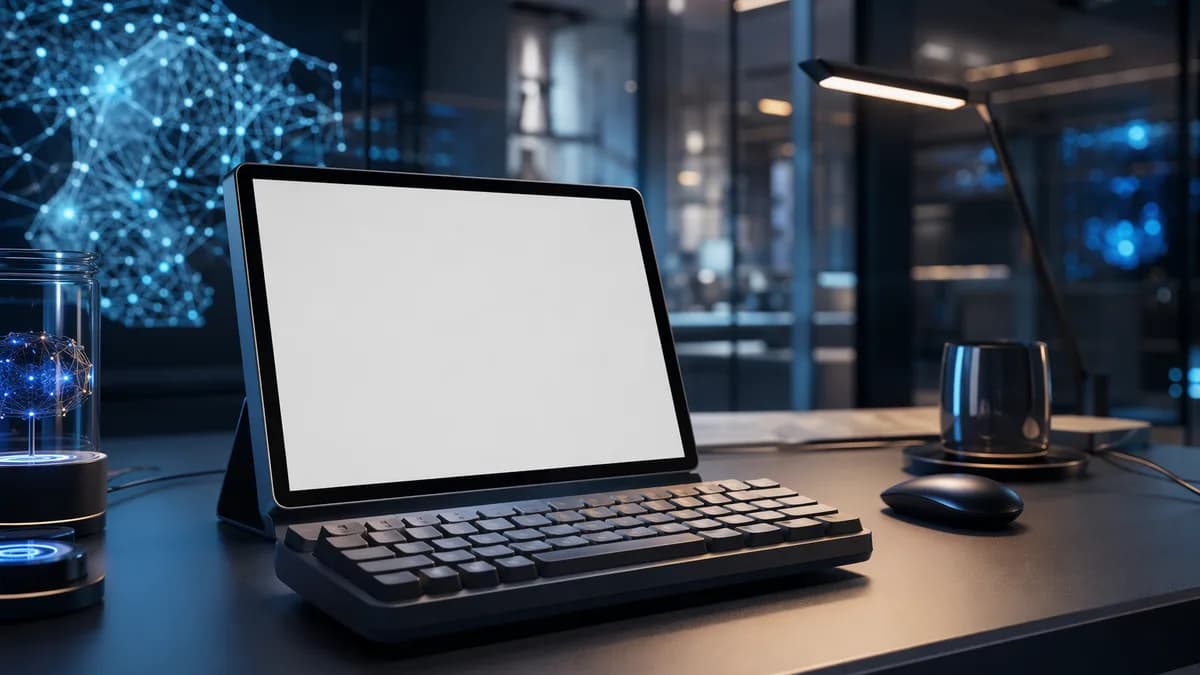
TechnologyJune 25, 2026· 9 min read· By XOOMAR Insights Team
BYOK Turns a $199 Plastic Slab Into a Writer's Escape
Updated on June 26, 2026
XOOMAR Intelligence
Analyst Take
72/ 100
4 sources analyzedMedium confidenceTrend10Freshness99Source Trust88Factual Grounding93Signal Cluster20
That sounds absurd until you sit with the alternative. Laptops, tablets, phones, writing apps, blockers, sync services, AI assistants, tabs, notifications, updates. The modern writing setup has become a pile of escape hatches. BYOK, short for Bring Your Own Keyboard, makes the opposite bet. It gives you a low-resolution LCD screen, basic text editing, and almost nothing else, according to The Verge. That’s not a flaw. That’s the product.
My thesis is simple: BYOK works because it knows writing is not a feature race. Writers don’t need another tiny productivity platform. They need a place where the cursor is the main event.
BYOK distraction-free writing tool proves $199 can buy less, and that’s the point
The most interesting part of BYOK is not what it includes. It’s what it declines to become.
The Verge describes it as a $199 black plastic rectangle with a low-resolution LCD screen that lets you edit text and does almost nothing else. That restraint matters. The BYOK distraction-free writing tool doesn’t pretend to be a laptop replacement. It doesn’t chase the romance of a vintage typewriter shape. It doesn’t trap you inside a built-in keyboard you may hate.
It is a screen. You bring the keyboard. You write.
That sounds small, but small is the strategy. The Verge’s Terrence O’Brien had already tried dedicated apps, an old laptop converted into a writerdeck, and a Boox Palma paired with a NuPhy Air. The Boox setup had appeal, especially with Obsidian, but the operating system was “a bit janky,” and the Android app added its own mess of extensions and maintenance.
BYOK cuts the variables. Fewer settings. Fewer app quirks. Fewer ways to pretend you’re preparing to write.
“For 99 percent of people, BYOK may seem frivolous. But if you, like me, struggle to stay on task and you want something to write on without the constant temptation of the internet at your fingertips, the BYOK’s allure is obvious.”
That is the sharpest defense of the product. BYOK is niche by design. So is the problem it solves.
A bare-bones LCD writing box beats the fake focus of laptops and tablets
A laptop can be configured for focus. So can a tablet. Airplane mode exists. Full-screen writing apps exist. Notification settings exist.
The problem is that all of those fixes live on machines built to do everything else.
A laptop can always become a browser. A tablet can always become a messages screen. A phone-sized device can always become a loop of settings, feeds, alerts, files, and half-finished tasks. BYOK’s advantage is that it removes the negotiation. If the device can’t do much, you don’t spend energy refusing much.
That’s the practical value of limitation. Not purity. Not nostalgia. Environment.
The Verge reviewer wrote three reviews, including the BYOK review, and two short stories on the device. That is the only productivity claim here that matters because it’s tied to actual use, not motivational branding.
BYOK also fits into a small but telling pattern: writers are cobbling together machines because general-purpose hardware keeps over-serving them. O’Brien converted an old laptop into a writerdeck. He paired niche hardware with Obsidian. Other writers look at devices like Freewrite, Pomera, or repurposed tablets because a blank document on a full computer is never really blank.
A simple comparison shows why BYOK has a real argument.
| Setup | Main strength | Main weakness |
|---|---|---|
| Laptop or tablet | Powerful, flexible, already owned by many writers | Browser, messages, apps, updates, and research loops sit one click away |
| App-based blockers | Cheap and easy to try | Still depend on willpower because they run on distraction machines |
| All-in-one writing gadgets | Purpose-built writing hardware | Fixed keyboard and fixed form factor may not fit every writer |
| BYOK | Minimal screen plus your preferred keyboard | Limited formatting, clunky extras, and a low-res display |
The lesson is not that everyone needs another gadget. The lesson is that focus built into hardware is harder to cheat than focus rented from software.
Bring Your Own Keyboard gets the most personal part of writing right
The name sounds like a joke until you realize it is the best design decision.
Bring Your Own Keyboard solves the problem many writing gadgets create for themselves. They assume the keyboard is just an input method. It isn’t. For people who write every day, the keyboard is pace, posture, sound, muscle memory, and ritual.
The Verge tested BYOK with several keyboards, both wired and Bluetooth, including small keyboards and the MQ80 from Iqunix. The reviewer liked the typing feel of the MQ80 but found its heavy aluminum chassis unpleasant to carry, so he mostly stuck with a NuPhy Air 60. That’s exactly the point. The “best” keyboard is situational. Desk writing, travel writing, fiction drafting, review writing, all can call for different gear.
BYOK also uses a MagSafe-compatible ring on the back, which lets it work with different stands, mounts, and holders. The Verge reviewer landed on a folding tripod stand from Ulanzi as the best balance of portability and height, even though it was not the most stable. That makes BYOK more modular than elegant, but modular wins here.
A fixed keyboard makes a device cleaner. A chosen keyboard makes it yours.
BYOK's limits beat app blockers because there is less to resist
The core software is almost aggressively plain. BYOK has projects, files, standard shortcuts like CTRL+F, CTRL+C, and CTRL+V, plus a status bar for word count and battery info. You can insert notes, tasks, and other content types with commands such as “::note” at the start of a line.
But the writing surface is still text. No links. No bold. No italics.
That constraint sounds brutal if you’re editing a feature, formatting a report, or building a heavily sourced article. For drafting, it is liberation by subtraction. The BYOK distraction-free writing tool turns the first draft into the job, rather than forcing the writer to manage formatting, source windows, and side quests before the words exist.
The hardware supports that case. Battery life is quoted at 20 hours, or five with the backlight at maximum. The Verge found that estimate may be low, saying the device lasted on and off for more than two weeks before needing a recharge. BYOK’s own site also lists Wi-Fi, USB-C, microSD storage, a warm adjustable backlight, and wired or wireless keyboard support, while saying the product is “Trusted by 3,000+ writers” on its preorder page.
The weak spot is where BYOK starts trying to become more than the quiet box. BYOK Studio can sync files, back up to Google Drive, and support paid features through a premium subscription at $9.99 a month or $83.88 billed annually. The Verge found basic text sync worked reasonably well, but the richer formats, including cards, wikis, story grids, and manuscripts, complicated the experience.
That matters. The best version of BYOK is not a second writing platform. It’s a clean drafting machine with easy export.
There’s a broader software lesson here too. As we’ve seen in Superhuman Buys GPTZero as AI Writing Trust War Starts, writing tools are gaining more intelligence, more verification layers, and more workflow machinery. That may help some teams. It also makes the blank page feel less blank. BYOK’s value is that it steps away from that arms race.
The $199 objection is real: this is a plastic text box
The strongest criticism of BYOK is obvious and fair: $199 is a lot for a plastic box that edits plain text.
The company recently raised the price from $179 to $199, according to The Verge. Buyers still need to provide their own keyboard and likely a stand. The screen is low-res, with uneven backlighting. Bluetooth did not always automatically reconnect in The Verge’s testing. The rear navigation buttons are clunky. BYOK Studio is described as clunky too.
Plenty of writers can work fine with a laptop in airplane mode, a focused writing app, or a cheap notebook. If your writing requires research tabs, citations, images, rich formatting, publishing tools, or heavy-duty editing, BYOK will slow you down. The Verge reviewer says it is not ideal for the daily news grind or anything reliant on pulling from other sources. It is better for drafting, then moving into Google Docs or another editor for revision and formatting.
That counterargument does not kill BYOK. It defines the buyer.
Compared with Freewrite Alpha at $349 and Pomera at $549, BYOK is cheaper, though less complete because you supply the keyboard and stand. The question is not whether BYOK does enough for everyone. It doesn’t. The question is whether it does the right little for writers who already know their attention is the bottleneck.
Recurring software extras deserve caution as well. A simple writing device can lose its charm if the companion app becomes another subscription to monitor, a problem familiar to readers of our coverage on how a Noom Promo Code Trap Could Cost You After Free Trial. BYOK is strongest when it avoids that kind of management burden.
Writers should buy fewer productivity promises and more quiet machines
The productivity business loves to sell complexity as progress. More features. More integrations. More assistant layers. More dashboards. More ways to organize the work instead of doing it.
BYOK argues for a smaller ambition. A machine can serve one task cleanly and then get out of the way.
That doesn’t make it perfect. The screen could be better. Bluetooth should reconnect more reliably. Studio needs restraint. The richer planning tools may belong on a computer, not on a tiny LCD drafting device. If BYOK’s makers keep adding layers until the product becomes another place to fiddle, they will damage the thing that makes it useful.
The forward path is clear: keep the device boring, make sync dependable, and resist the urge to turn every writer’s hesitation into a feature.
If your work is research-heavy, stay on a laptop. If your problem is formatting, BYOK won’t save you. But if the problem is that every writing session turns into a fight against the machine in front of you, the BYOK distraction-free writing tool has the right answer.
Choose the device that leaves you alone with the sentence. Then write the next one.
Key Takeaways
- BYOK shows that fewer features can be a strength for focused writing.
- At $199, it targets writers who want a dedicated tool instead of another general-purpose device.
- Its bring-your-own-keyboard approach avoids locking users into a typing setup they may dislike.
BYOK vs. Other Writing Setups
| Option | What It Offers | Main Tradeoff |
|---|---|---|
| BYOK | $199 black plastic device with a low-resolution LCD screen and basic text editing | Minimal features by design |
| Laptop, tablet, or phone | Full writing apps, sync services, AI tools, tabs, and notifications | Too many distractions and escape hatches |
| Boox Palma with NuPhy Air | Portable writing setup with Obsidian support | Janky operating system and app maintenance issues |
| Old laptop writerdeck | Repurposed dedicated writing machine | Still carries computer-like complexity |
Sources

Written by
XOOMAR Insights Team
Research and Editorial Desk
The XOOMAR Insights Team pairs automated research with human editorial judgment. We track hundreds of sources across technology, fintech, trading, SaaS, and cybersecurity, cross-check the facts, and explain what happened, why it matters, and what to watch next. We do not just rewrite headlines. Every article is fact-checked and scored for reliability before it goes live, and we link back to the original sources so you can verify anything yourself.
Explore More Topics
Related Articles
 Technology
Automattic Deploys Android CRM to Slash Clunky Legacies
Automattic's free, AI-enhanced Mesh CRM has launched on Android, targeting a massive user base to directly challenge clunky, legacy customer relationship softwa
Aug 12, 20265 min
 Technology
Bluesky Hides Reposts From That One Annoying Account
Bluesky added a feature allowing users to hide reposts from specific accounts they follow, a targeted tool for feed curation without unfollowing.
Aug 10, 20267 min
 Technology
Amazon Hides Your Order Data From AI Agents
Amazon has stripped product names from order confirmations to lock customers into its app and prevent AI shopping agents from accessing purchase data.
Aug 11, 20267 min
 Technology
Anker's Universal Charger Halts Travel Adapter Chaos for $20
The Anker Nano Travel Adapter consolidates four international plug types into one compact device on sale for $19.99, but it only adapts plugs, not voltage.
Aug 10, 20267 min
 Technology
Hall Effect Keyboard Hits Historic Low At $104
Keychron's flagship Hall effect keyboard has dropped to its lowest-ever price of $104, part of a broader trend where premium PC and gaming hardware is becoming
Aug 10, 20265 min
 Cybersecurity
AI Wrote a Zoom Hack in Under 20 Prompts
Researchers weaponized a critical Zoom flaw using fewer than 20 AI prompts, collapsing the barrier to sophisticated cyberattacks and turning screen-sharing into
Aug 11, 20265 min
 SaaS & Tools
ApartmentIQ Seals $25 Million Bet on Real-Time Rental Data
ApartmentIQ raised $25 million in growth funding led by Susquehanna Growth Equity to scale its AI-driven, real-time data platform, which now covers over 8 milli
Aug 12, 20267 min
 Global Trends
Drones Cripple Russian Grain Hub In Black Sea Attack
Ukrainian drone strikes have knocked major Russian grain export terminals offline at the Novorossiysk port, escalating a campaign of economic sabotage that thre
Aug 12, 20266 min
 Global Trends
Gen X Most At Risk as Grocery Bills Trap Tipping-Point Households
A majority of U.S. households remain stuck in a 'cutback economy,' where falling gas prices are no match for the relentless rise in essential costs like rent an
Aug 12, 20266 min
 Technology
ICE Plans Deploy $20M Electric Shock Gloves
ICE is pursuing a contract worth up to $20 million to arm agents with electrified gloves that deliver painful shocks to 'achieve compliance in less than three s
Aug 12, 20266 min
Don't miss the signal
Get our weekly roundup of the stories that matter across tech, fintech, and trading. No noise, just signal.
Free forever. No spam. Unsubscribe anytime.