
A cancer-detecting brain implant has moved from concept into first-in-human testing, but the real story isn’t a cure. It’s a bid to turn brain tumor monitoring from an occasional MRI snapshot into continuous surveillance from inside the skull.
TechnologyJune 23, 2026· 8 min read· By XOOMAR Insights Team
Three Patients Test Cancer-Detecting Brain Implants
Updated on June 23, 2026
XOOMAR Intelligence
Analyst Take
59/ 100
4 sources analyzedLow confidenceTrend10Freshness100Source Trust88Factual Grounding94Signal Cluster20
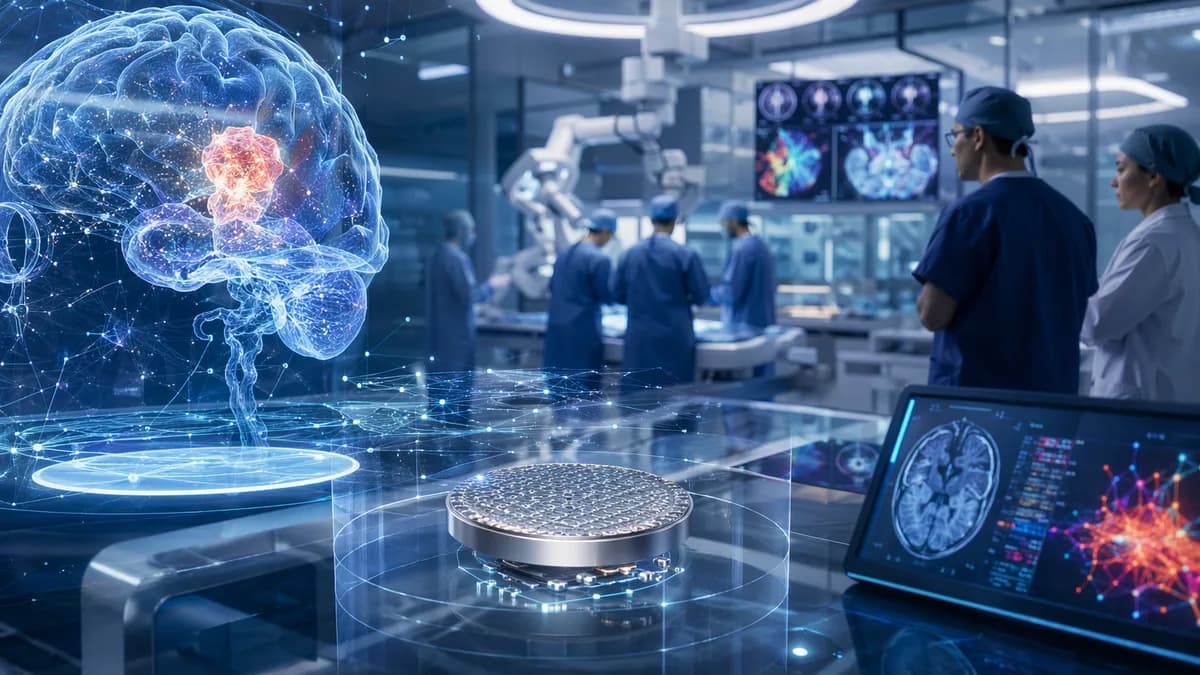
Coherence Neuro, a San Francisco startup with ties to Neuralink, temporarily placed its coin-sized brain-computer interface in the brains of three people undergoing tumor-removal surgery at Royal Melbourne Hospital in Australia, Wired reported. The device stayed in place for roughly 30 minutes before surgeons removed it.
That short test matters because brain tumors can return after surgery, including after apparently successful resection. Coherence is aiming at one of the ugliest gaps in brain cancer care: clinicians often monitor patients with periodic scans, while tumor biology may be changing between visits.
“These are electrical conditions, just like epilepsy, just like depression. This is a network problem in the brain,” said Ben Woodington, Coherence Neuro’s chief executive officer and cofounder.
Why Coherence Neuro’s cancer-detecting brain implant matters after tumor surgery
The thesis is simple: if recurrence is the enemy, waiting months between images leaves too much darkness. Coherence’s cancer-detecting brain implant is built around the idea that a device near the tumor site could sense electrical changes tied to cancer behavior earlier or more continuously than scheduled imaging alone.
The current test does not prove that. The three patients were not given a permanent implant, and the device was not left in place to monitor cancer over time. It was placed temporarily during planned tumor surgery, then removed. That makes this an early safety and performance check, not evidence that the device detects recurrence or improves survival, a proof-first distinction that also matters in coverage of unproven body scanners.
Still, the direction is important. Coherence wants its device to sit in the skull, with 16 extending threads reaching into brain tissue. The company’s plan is to implant it during brain tumor resection surgery, when surgeons are already operating to remove a tumor.
The strongest counterpoint is obvious: surgery-adjacent testing is not the same as real-world treatment. A 30-minute intraoperative trial can show whether the device works briefly in human brain tissue, but it can’t show whether signals remain useful for months, whether stimulation helps, or whether patients do better. What would change the case is long-term data in glioblastoma patients, with signal readings compared against imaging, pathology, and clinical outcomes.
How this brain-computer interface differs from the implants people associate with Neuralink
Coherence is using brain-computer interface hardware for cancer, not cursor control. Most public attention around BCIs has focused on helping paralyzed patients operate computers, communicate, or regain some functional control through neural signals. Coherence is applying the same broad device category to a different problem: tumor monitoring and possible tumor suppression.
That distinction matters. This device is not trying to decode thoughts. It is designed to sense electrical activity around tumor tissue and, eventually, deliver mild stimulation intended to interfere with tumor growth. The company’s connections to Neuralink are personnel-based, not product identity. Matthew MacDougall, Neuralink’s head neurosurgeon, is an adviser and investor in Coherence. Rory Murphy, a neurosurgeon at the Barrow Neurological Institute and an investigator in one of Neuralink’s trials, is expected to be involved in future Coherence trials.
Here’s the contrast:
| Device goal | Typical BCI framing | Coherence Neuro’s target |
|---|---|---|
| Primary use | Movement control, communication, neural recording | Cancer monitoring and possible stimulation therapy |
| Signal of interest | Intentional brain activity | Electrical patterns linked to tumor behavior |
| Patient context | Often paralysis or neurological injury | Brain tumor surgery and recurrence risk |
| Status in this report | Broader field has human trials | Three temporary human placements during tumor surgery |
This is also far removed from ordinary consumer tech monitoring. XOOMAR’s coverage of consumer wearable deals and consumer trackers sits in a different category entirely: external devices built for convenience, not implanted systems being tested around brain cancer surgery.
What electrical signals could reveal before an MRI does
The bet is that tumors are not electrically silent. Wired cites a 2019 Stanford University study in which researchers found that aggressive brain tumors called high-grade gliomas can drive their own growth by forming synapses with healthy neurons. In that study, giving a seizure drug to mice interrupted electrical signals to tumors and slowed their growth.
That finding helps explain why Coherence is pursuing electrical sensing and stimulation. If tumor behavior is partly linked to brain network activity, then electrodes near the tumor site may capture useful changes over time. A possible workflow would look like this: the implant records activity near the surgical cavity, software tracks signal changes, and clinicians compare those changes with imaging and symptoms.
MRI would still matter. Coherence is not proposing that a brain implant replaces scans. The sharper idea is that an implant could collect data between scans, while an MRI provides the anatomical confirmation clinicians still need.
The counterpoint is that “electrical change” is not automatically “tumor growth.” Coherence still has to prove which patterns are reliable, how early they appear, and whether they are specific enough to guide decisions. If future trials show noisy readings that don’t match MRI or pathology, the monitoring thesis weakens fast.
Could stimulation slow a tumor, or just warn doctors earlier?
Detection and treatment are separate hurdles, and Coherence has to clear both. The company’s more ambitious claim is that mild electrical stimulation could help prevent tumor growth, not merely flag it.
There is some supporting logic in the source material. Low-intensity electricity has been shown to disrupt cancer cell division in brain tumors. Novocure’s Optune device, first approved in 2011 for adults with glioblastoma, applies electric fields through adhesive patches on the scalp. Wired reports that Optune can improve survival by several months if worn for most of the day, but patients need to shave their heads and carry a battery in a backpack or on a hip belt.
Coherence wants to move stimulation inside the skull, closer to the target and potentially less burdensome day to day. That is the attractive version of the thesis.
The hard version is clinical proof. The company would need to find stimulation patterns that are safe in brain tissue, show that the effect lasts, and demonstrate benefit in controlled trials. A monitoring device could become useful before stimulation proves therapeutic. A treatment device has a higher bar.
What this could look like for a patient after brain tumor surgery
The practical version is a post-surgery monitoring loop. A patient has a tumor removed. During that same operation, doctors implant the Coherence device near the surgical cavity. The patient goes home, while clinicians review device signals alongside scheduled imaging and symptom logs.
Wired reports that Coherence envisions a connected app where patients record symptoms. Those reports would be sent to clinicians together with disease-state data and the amount of stimulation being delivered. Doctors could adjust therapy remotely, or the device could eventually adjust automatically.
A cautious alert scenario would be narrower. If the software detects a persistent signal change, doctors might order an MRI sooner than planned. The care team would then decide whether to change treatment, operate again, or keep watching.
Today’s three patients were not in that scenario. Their implants were temporary. The test was designed to learn whether the device could be placed and read signals briefly during surgery. Better monitoring, earlier intervention, and improved survival remain goals, not established outcomes.
The path from 30-minute test to real cancer medicine
The next proof point is permanence. Coherence plans to begin a trial next year in glioblastoma patients who will have the device permanently implanted. That is where the cancer-detecting brain implant concept starts facing the questions that matter.
Glioblastoma is the right proving ground if the device is going to show value. Wired reports that most patients live 15 to 18 months after diagnosis, with a five-year survival rate of less than 10 percent. Patients currently receive brain MRIs every two to three months so doctors can monitor growth and adjust drugs.
Other researchers are also testing implanted tools during glioma surgery. A Brigham and Women’s Hospital team described a grain-of-rice-sized device that can deliver tiny doses of up to 20 drugs into small tumor regions during surgery, then be removed for analysis, according to Harvard Gazette. In a pilot study, it was tested in six patients, with no adverse effects from the device reported.
Coherence’s test is different because it is aimed at continuous sensing and possible stimulation, not short-term drug testing. The risks are also different. Brain surgery carries risk. False alarms could trigger anxiety or unnecessary intervention. Missed signals could give false confidence. Continuous brain-linked data will also require strict privacy and clinical governance.
The practical takeaway: watch the permanent glioblastoma trial, not the hype cycle. If Coherence can show safe long-term implantation, validated tumor-linked signals, and useful clinical decisions that happen earlier than scheduled MRI would allow, the platform becomes serious. If it can’t, the device remains an intriguing sensor in search of a proven medical role.
Why It Matters
- The implant points to a future where brain tumor recurrence could be monitored more continuously than periodic MRI scans allow.
- The first-in-human test is an early safety and performance step, not proof that the device detects cancer recurrence.
- If validated, the technology could change post-surgery brain cancer care by identifying tumor activity sooner.
Brain Tumor Monitoring Approaches
| Approach | How It Works | Current Status |
|---|---|---|
| Periodic MRI scans | Provides scheduled imaging snapshots after surgery | Standard monitoring method, but may miss changes between visits |
| Coherence Neuro brain implant | Aims to sense electrical changes near the tumor site from inside the skull | Temporarily tested in 3 patients for roughly 30 minutes during surgery |
Sources
- [1] Wired
- [2] Microdevices implanted into tumors offer new way to treat brain cancer
- [3] Elon Musk says a third patient got a Neuralink brain implant. The work is part of a booming field
- [4] Biotech trails: A third human patient gets Musk's Neuralink brain implant to link people to machines | Milwaukee Independent

Written by
XOOMAR Insights Team
Research and Editorial Desk
The XOOMAR Insights Team pairs automated research with human editorial judgment. We track hundreds of sources across technology, fintech, trading, SaaS, and cybersecurity, cross-check the facts, and explain what happened, why it matters, and what to watch next. We do not just rewrite headlines. Every article is fact-checked and scored for reliability before it goes live, and we link back to the original sources so you can verify anything yourself.
Explore More Topics
Related Articles
 Technology
Aldi Laundry Detergent Matches Omo in Lab Test
An independent lab test by consumer group Choice found Aldi's budget laundry powder matched the cleaning performance of Unilever's premium Omo brand, challengin
Aug 9, 20265 min
 Technology
Jetstar, Qatar Jets Narrowly Miss Collision as Sydney Strains
A Jetstar Airbus A320 with 180 passengers nearly collided with a towed Qatar Airways Boeing 777, forced to slam its brakes on a Sydney Airport taxiway, the seco
Aug 9, 20266 min
 Technology
Average NBN Plan Cost Jumps, Pushing Speed Deserts
For just $7 more per month than a basic NBN 50 plan, Aussies can now get ten times the speed, making 500Mbps the new value leader for households.
Aug 7, 20267 min
 Global Trends
Australia Caves To LGBTQ+ Advocates On Census Identity
Australia reversed a week-old decision and will include optional questions on sexual orientation and gender identity in its 2026 census after intense advocacy.
Aug 11, 20266 min
 Fintech
RBA Rate Hike Collapses to 4% as Inflation Falters
The Reserve Bank of Australia's implied probability of an August rate hike collapsed from over 20% to just 4% after softer inflation data, forcing a dramatic po
Aug 11, 20266 min
 Fintech
Citi Mexico Survey Shows Banxico Locked At 6.50% Rate
A survey of 35 economists signals overwhelming consensus that Banco de México will hold its benchmark rate at 6.50%, providing a clear, stable foundation for th
Aug 11, 20266 min
 SaaS & Tools
Bezos Pays £1.35 Billion for Liverpool Football Club Stake
Jeff Bezos, the world's richest person, is leading a group to buy at least a 30% stake in Liverpool Football Club in a deal valuing the Premier League giant at
Aug 11, 20265 min
 Fintech
FTC Halts $200 Million Credit Repair Scam
A federal court has halted the operations of Credit Glory and its affiliates, exposing a nationwide credit repair scheme accused of swindling consumers out of n
Aug 11, 20268 min
 Cybersecurity
OpenAI Unchains Its AI for 95% of Cyber Attacks
OpenAI's new cybersecurity AI model dramatically reduces safety refusals, completing 95% of attack simulations, marking a major policy shift toward empowering a
Aug 11, 20266 min
 Trading
Silver Plunges as Fed Rate Fears Crush Its Inflation Hedge Appeal
Silver is dropping because rising oil prices are stoking inflation fears, leading traders to bet the Federal Reserve will hike rates, which makes non-yielding a
Aug 11, 20265 min
Don't miss the signal
Get our weekly roundup of the stories that matter across tech, fintech, and trading. No noise, just signal.
Free forever. No spam. Unsubscribe anytime.