
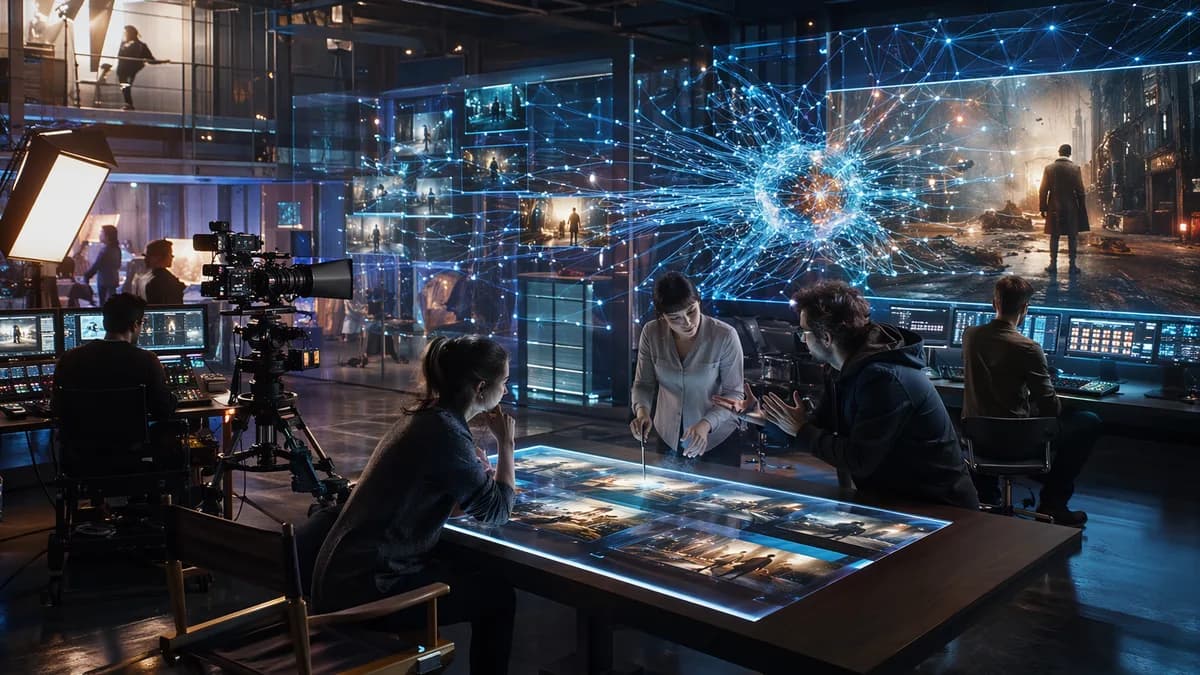
Around $75 million is not a studio takeover. It’s a strategic seat inside A24’s creative process, and that makes the Google A24 AI partnership more consequential than a one-off tech experiment.
TechnologyJune 23, 2026· 8 min read· By XOOMAR Insights Team
Google Pays $75M for a Seat in A24's AI Movie Future
Updated on June 23, 2026
XOOMAR Intelligence
Analyst Take
74/ 100
4 sources analyzedMedium confidenceTrend10Freshness97Source Trust88Factual Grounding92Signal Cluster40
Google’s DeepMind lab is teaming with A24 to develop AI movie production technologies meant to help future filmmakers “expand their storytelling possibilities,” according to The Verge. The Wall Street Journal reported that Google is investing “around $75 million” into A24, marking Google’s first stake in a film studio.
That structure matters. Google is not buying A24. A24 is not handing over its library. The reported deal is non-exclusive and expected to span “multiple projects over time.” XOOMAR analysis: this looks less like Google trying to make an AI movie, and more like Google trying to help define the software layer that future filmmakers may use before, during, and after production.
“The collaboration pairs a world-leading research lab with the industry’s most filmmaker-forward studio to help artists develop new workflows and techniques,” Google said. “This ensures the tools of the future are shaped by the creators who use them.”
Google A24 AI partnership starts with $75 million, but the control terms matter more
The headline figure gives the deal weight. The guardrails give it meaning.
The partnership links Google DeepMind with A24 on research and development for new movie production technologies. Google said the “initial focus is on bridging the gap between cutting-edge technology and next generation entertainment.” The Verge, citing WSJ, reports that Google and A24 are aiming to create tools for movie production and distribution.
Here is the cleanest read of the deal as reported:
| Deal element | Reported detail | Why it matters |
|---|---|---|
| Investment size | “around $75 million” | Meaningful capital for an independent studio, even if modest relative to Google |
| Structure | Research and development collaboration | Focuses on tools and workflows, not a single film announcement |
| Duration | “multiple projects over time” | Suggests iterative testing rather than a publicity demo |
| Exclusivity | Non-exclusive, according to WSJ | A24 can work with others, and Google can pursue other entertainment relationships |
| Data access | No access to A24’s film and television library data, according to WSJ | A key limit given Hollywood’s sensitivity around AI training and copyright |
That last point is central. The deal arrives while major studios including Disney, Universal, and Warner Bros have fought AI companies over alleged copyright violations, according to The Verge. Google’s AI models are trained on publicly available internet data, which is exactly the kind of detail that makes entertainment lawyers and creative workers pay attention.
This is also why A24’s role is unusually sensitive. Google’s own announcement describes the studio as “filmmaker-forward.” If artists see the partnership as tool-building with creative control, it has a chance to gain trust. If they read it as big tech entering production through the side door, the backlash writes itself.
DeepMind is pitching workflows, not prompt-to-movie spectacle
The public details remain narrow. That should restrain the hype.
Google has said the work will involve “new workflows and techniques.” WSJ, via The Verge, says the partners are looking at tools for production and distribution. Neither company has named specific films where Google will be involved, and the announcement does not spell out whether the tools will touch storyboarding, editing, visual effects, localization, marketing, or other parts of the pipeline.
That ambiguity is the point. The most plausible early version of the Google A24 AI partnership is not a banner saying “made by AI.” It is quieter: tools that sit inside existing creative workflows and support tasks that filmmakers already perform. But based on the source material, the exact toolset is still undisclosed.
A24 partner Scott Belsky, previously Adobe’s chief strategy officer, tried to draw a bright line between this collaboration and the type of generative AI that has made many artists uneasy.
“There are better uses that preserve creative control and support risk-taking,” Belsky said in his statement to WSJ. The tools Google and A24 are developing “won’t look anything like the prompted generation type of AI that people feel uncomfortable with.”
That quote is doing a lot of work. It suggests A24 knows the reputational risk. It also suggests the first public test will not be whether AI can spit out a film, but whether AI can assist a filmmaker without making the final work feel automated.
XOOMAR analysis: that distinction is where the battle will sit. “AI-assisted” can mean many things. The industry reaction will depend on whether the tools preserve authorship, consent, credit, and compensation, or whether they become a new way to compress labor under the language of efficiency.
A24 gives Google something cloud vendors can’t buy easily: artist trust
A24 is not valuable to Google because it owns the biggest franchise machine. The source material frames it differently: A24 is “the industry’s most filmmaker-forward studio,” in Google’s words. That brand positioning is the asset.
For Google, the advantage is obvious. DeepMind gets direct exposure to real creative workflows, not abstract demo environments. A24 gets access to DeepMind research and technical collaboration without granting Google access to its film and television library data, according to WSJ reporting cited by The Verge and Variety’s summary of the deal.
For A24, the risk is just as obvious. Its audience and creative network are likely more sensitive to anything that smells like synthetic culture. The Verge notes that the partnership may raise eyebrows because of ongoing disputes between studios and AI companies over alleged copyright violations.
That tension mirrors broader creator anxiety around AI-generated content. XOOMAR has covered how platform-level AI pressure can turn into a fight over creator power in AI Slop Forces Patreon into a Fight for Creator Power. The A24 case is different, but the underlying issue is familiar: creators want tools, not systems that quietly weaken their bargaining position.
Kane Parsons adds another wrinkle. WSJ reports that Google and A24 hope to include A24’s existing roster of artists in the deal, such as Parsons, the YouTube creator and Backrooms director. Yet Parsons told The Australian earlier this month that “generative AI feels less like innovation than a symptom of a broader cultural and economic rot,” and that he gets “no enjoyment” out of using the technology on any project.
That is not a small contradiction. It shows the partnership’s hardest problem may not be technical. It may be cultural consent.
The distribution angle may be as important as production
The reported scope includes distribution, not just production. That detail deserves attention.
Production tools are easier to imagine because they fit the standard AI narrative: faster iteration, cheaper experimentation, more automated support. Distribution is messier, and potentially more commercially important. Google’s announcement only says the initial focus is bridging technology and next generation entertainment, while The Verge says WSJ reported the partners aim to create tools for production and distribution.
The source does not specify what distribution tools mean. So the honest answer is: we don’t know yet.
Still, the inclusion of distribution widens the deal. It means Google and A24 are not only looking at how films are made. They are also looking at how they reach audiences. That could eventually touch marketing workflows, release strategy analysis, audience targeting, or other distribution functions, but none of those use cases has been confirmed in the supplied reporting.
This is where the Google A24 AI partnership starts to look less like a Hollywood side project and more like a test of AI’s place in the media stack. Google already operates massive systems for search, video, ads, and recommendation. XOOMAR recently examined how AI-driven discovery can expose gaps in commercial intent systems in 83% of ChatGPT Ad Triggers Slip Past Google Shopping. The film business is not shopping search, but both cases point to the same commercial question: who controls the layer between content and audience?
For studios, that layer is expensive and strategically sensitive. For Google, it is familiar territory.
The next test is whether filmmakers actually want these tools
The earliest credible outputs from this deal are likely to be invisible to audiences. Not because the work is insignificant, but because both companies need trust more than spectacle.
A branded AI-generated feature would trigger the loudest reaction and answer the fewest serious questions. Workflow tools, tested across “multiple projects over time,” give Google and A24 more room to learn where filmmakers accept AI help and where they reject it.
The evidence to watch is practical:
- Artist participation: Which A24 filmmakers agree to work with DeepMind, and which avoid it?
- Tool disclosure: Do projects publicly state how AI was used, or keep it vague?
- Creative control: Are directors, writers, editors, and other artists described as shaping the tools, or merely using them?
- Data boundaries: Does the promise that Google won’t access A24’s library data remain intact as the partnership expands?
- Audience reaction: Do A24 fans treat the results as experimentation, or as algorithmic intrusion?
The strongest version of this deal is clear: AI tools that widen a filmmaker’s range without flattening the voice that made A24 valuable in the first place. The weaker version is just as clear: efficiency software wrapped in artist-friendly language.
For now, Google has bought proximity, not proof. The proof will come when the first projects shaped by this collaboration arrive, and filmmakers either claim the tools as their own or distance themselves from them.
The Bottom Line
- Google is moving deeper into Hollywood by embedding DeepMind tools inside A24’s creative workflow.
- The non-exclusive structure suggests AI filmmaking tools could be shaped with filmmakers rather than imposed through a takeover.
- A24’s involvement gives the partnership cultural credibility in an industry wary of AI’s impact on creative labor.
Reported Google-A24 Partnership vs. Studio Takeover
| Aspect | Reported Google-A24 partnership | Studio takeover/library acquisition |
|---|---|---|
| Ownership | Google is investing around $75 million for its first stake in a film studio. | Google is not buying A24. |
| Content control | A24 is not handing over its library. | No library acquisition was reported. |
| Exclusivity | The deal is reported as non-exclusive. | An exclusive takeover structure was not reported. |
| Scope | Expected to span multiple projects over time focused on AI production and distribution tools. | Not framed as a one-off AI movie or full studio control. |
Sources

Written by
XOOMAR Insights Team
Research and Editorial Desk
The XOOMAR Insights Team pairs automated research with human editorial judgment. We track hundreds of sources across technology, fintech, trading, SaaS, and cybersecurity, cross-check the facts, and explain what happened, why it matters, and what to watch next. We do not just rewrite headlines. Every article is fact-checked and scored for reliability before it goes live, and we link back to the original sources so you can verify anything yourself.
Explore More Topics
Related Articles
 Technology
Google Ends DeepMind's Moonshot Era in CEO Shakeup
Google DeepMind founder Demis Hassabis is stepping down as CEO, a move central to a restructuring that absorbs the AI lab into Google's corporate machine and en
Aug 8, 20266 min
 Technology
DeepMind's AI Gave a Day Warning for Cat 5 Hurricane
Google DeepMind's AI model predicted a major hurricane with 80% confidence a day earlier than possible before, a breakthrough that could improve evacuation time
Aug 8, 20266 min
 Technology
Stripping the Moonshot Mystique from AI Leadership
Google's leadership reshuffle sidelines its premier AI researchers, ending the era of open-ended moonshots to enforce a stricter focus on product integration an
Aug 6, 20266 min
 Technology
Jeff Dean's Departure Evacuates Google's AI Brain Trust
Jeff Dean and other core Google AI architects have left to launch a startup, marking a major institutional brain drain for the tech giant.
Aug 5, 20265 min
 Technology
A London Red-Light District Hunts AI Brains
London's former red-light district, King's Cross, is now a premier global AI hub, rivaling San Francisco and Beijing, thanks to Google DeepMind's 2016 move that
Aug 9, 20265 min
 Trading
Global Stocks Smash Records as Inflation Fears Collapse
A global wave of record highs hit stocks from the US to Europe and Asia, as investors bet that plunging oil prices and softer inflation will force central banks
Aug 9, 20266 min
 Technology
Aldi Laundry Detergent Matches Omo in Lab Test
An independent lab test by consumer group Choice found Aldi's budget laundry powder matched the cleaning performance of Unilever's premium Omo brand, challengin
Aug 9, 20265 min
 Global Trends
Nigerian Army Frees 33 Hostages in Gunfight Rescue
Nigerian troops rescued all 33 people abducted just one day earlier in a firefight, forcing the kidnappers to flee into the bush.
Aug 9, 20264 min
 Global Trends
Zelenskyy Demands Patriots as Kyiv Missile Toll Rises
Ukraine lacks the specific Patriot systems needed to intercept ballistic missiles, a critical weakness laid bare by a deadly Russian attack on Kyiv.
Aug 9, 20266 min
 Trading
US Hiring Slows to 44,000 Jobs, Fed Faces Wage Sticker Shock
Private hiring slowed sharply to 44,000 jobs in July, a cooling demand signal for the Fed, but strong pay gains for job-switchers mean wage-driven inflation pre
Aug 9, 20267 min
Don't miss the signal
Get our weekly roundup of the stories that matter across tech, fintech, and trading. No noise, just signal.
Free forever. No spam. Unsubscribe anytime.