
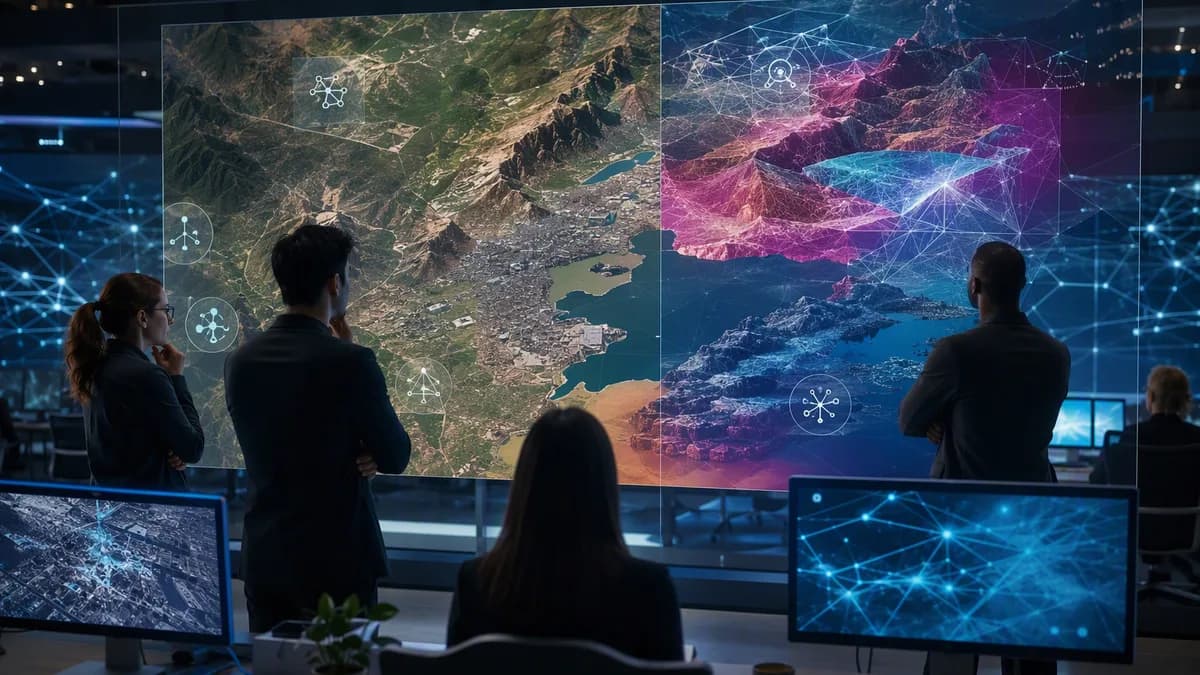
One day was all it took for Google to pull the Google Earth AI feature that let users generate fake images and place them over real map imagery. The tool, powered by Nano Banana 2, drew immediate criticism that it could make fabricated disasters, conflict scenes, or sensitive-site imagery look tied to real coordinates, according to TechCrunch.
TechnologyJuly 31, 2026· 6 min read· By XOOMAR Insights Team
Google Earth AI Gets Yanked After Fake Map Backlash
Updated on July 31, 2026
XOOMAR Intelligence
Analyst Take
58/ 100
4 sources analyzedLow confidenceTrend10Freshness96Source Trust90Factual Grounding92Signal Cluster20
Google launched the feature on Thursday, then scrapped it after users and researchers began sharing examples that appeared to test its limits. The company framed the move as a rollback, not a permanent cancellation.
“We’ve seen geospatial professionals using this feature for a range of useful purposes, however we’ve also seen people sharing screenshots of generated imagery that appear to violate our policies,” Google said. “We’re rolling back this feature in Google Earth while we work on implementing stronger guardrails.”
1 day after launch, Google pulls AI image feature from Google Earth
The Google Earth AI feature was prompt-based. Users could create AI-made imagery and superimpose it over real satellite-style map views inside Google Earth.
Google’s pitch was creative geography. The risk was obvious: a fake scene placed over a real place can travel as apparent visual evidence once it’s screenshotted and posted elsewhere.
That’s the part Google could not contain inside the product. Even if generated images did not alter Google Earth for other users, screenshots could move across social platforms stripped of product context, a risk mirrored by LinkedIn’s AI slop crackdown.
A BBC journalist summed up the concern sarcastically on Thursday:
“There’s no way that this new AI image generation feature on Google Earth, one of the most reliable sources of visual evidence for journalists and researchers, could possibly be abused to spread misinformation online.”
The rollback also lands as Google keeps pushing AI across its product line. XOOMAR has separately tracked that broader Google product cycle in coverage of the Google Pixel Tag leak before its event and the Google Home speaker’s price pressure on Sonos. This case is different. It touches a product many journalists, researchers, and open-source investigators treat as a reference layer.
Fake Google Earth scenes raised misinformation alarms within hours
The strongest criticism centered on credibility laundering. AI-generated imagery can look more persuasive when it appears anchored to a real map, a real landmark, or a real conflict zone.
BBC Verify reported that it was able to create a collapsed Eiffel Tower, a sinkhole swallowing the Great Pyramid of Giza, and Russian tanks in Ukraine's capital while testing the tool. It also cited AI and misinformation expert Henk van Ess, who generated fake images including a non-existent nuclear power plant in Iran, a refugee camp on the US-Mexico border, and a fake hospital in Gaza with a bomb crater nearby.
Van Ess described the core problem bluntly:
Google had allowed “invented” imagery to be “welded to genuine coordinates, drawn on genuine imagery”.
He added: “The forgery does not have to look convincing on its own. It inherits the credibility of the map it was born on.”
That is the sharpest risk for Google Earth AI. The fake image does not need to fool every expert. It only needs to move faster than verification during a breaking event.
NPR also tested the tool and said it generated images of Iran's Kharg Island on fire and a flooded U.S. Capitol complex, both events that had not happened. NPR quoted Jake Godin, a senior researcher at Bellingcat, saying satellite imagery has been “kind of a safe bet” for verification because it has historically been hard to fake.
The difference here is distribution. A fake satellite-style image once required more steps: capturing a map view, moving it into another tool, generating or editing the scene, then resharing it. Google briefly put that creative step inside the reference tool itself.
| Product layer | Intended control | Reported weakness |
|---|---|---|
| Google Earth AI prompts | Block harmful topics | BBC Verify said small prompt changes could bypass guidelines |
| SynthID watermarking | Mark AI-generated content | BBC Verify said checks could be circumvented in some cases |
| Google Earth display | Generated images did not become real map layers for everyone | Screenshots could still circulate outside the product |
| User trust in maps | Real geographic context supports verification | Fake scenes gained credibility from real coordinates |
Google said AI content from its tools contains invisible watermarks and that users can check uncertain images with Gemini or Lens. BBC Verify said those checks were generally effective in its tests, but also said it was possible to trick Gemini into saying fake Google Earth images were real.
Google faces a harder test when AI sits inside maps
The Google Earth AI feature shows why generative tools tied to maps are more sensitive than ordinary image toys. A fantasy cabin on a lake is harmless enough. A fake crater beside a hospital is not.
Location changes the stakes. So do public safety, conflict reporting, election claims, and disaster response. A synthetic image of a landmark, border crossing, military site, or government building can be read as evidence before anyone asks how it was made.
Google’s own statement acknowledged two realities at once: geospatial professionals found useful cases, and other users shared screenshots that appeared to violate policies. That split is the hard product problem. A tool powerful enough for professionals can also produce convincing fakes for people who don’t care about provenance.
This is where Google’s AI push collides with the trust built into its older information products. Search, maps, Earth imagery, and browser security all depend on users believing Google’s surfaces are reliable. XOOMAR has covered Google’s AI work in another technical domain in AI Floods Chrome With 1,072 Security Bug Fixes in June, but Earth’s issue is not a software maintenance win. It’s a credibility failure at launch.
Analysis: The rollback suggests Google underestimated the screenshot problem. Guardrails that work only inside a product are weak once an image leaves that product. For a map-based AI tool, export behavior is not a side issue. It is the main threat channel.
The next signal is whether Google relaunches Earth AI with stronger labels
Google says it is working on stronger guardrails. The immediate questions are practical: who tested the feature before launch, what prompts were blocked, how generated images were labeled, and whether screenshots can remain identifiable after they leave Google Earth.
A relaunch would likely face pressure for clearer visible labels, stricter prompt limits, stronger sharing controls, and detection that does not depend only on Google’s own tools. The sources do not say what Google will implement.
The wider lesson is already visible. When generative AI enters products people use to verify reality, the margin for playful experimentation shrinks fast. The Google Earth AI tool lasted roughly a day because it blurred the line between imagination and evidence, and that line is exactly what Google now has to redraw before bringing it back.
Impact Analysis
- AI-generated imagery tied to real locations can make fake events appear more credible online.
- Google’s quick rollback shows major platforms are still struggling to set guardrails before launching generative AI tools.
- Journalists, researchers, and the public rely on map imagery as evidence, making trust in geospatial tools especially important.
Sources

Written by
XOOMAR Insights Team
Research and Editorial Desk
The XOOMAR Insights Team pairs automated research with human editorial judgment. We track hundreds of sources across technology, fintech, trading, SaaS, and cybersecurity, cross-check the facts, and explain what happened, why it matters, and what to watch next. We do not just rewrite headlines. Every article is fact-checked and scored for reliability before it goes live, and we link back to the original sources so you can verify anything yourself.
Explore More Topics
Related Articles
 Technology
950M Google Gemini Users Force AI Race Into a Habit War
Gemini has passed 950 million monthly users, proving Google's AI edge may be distribution as much as model quality.
Jul 23, 20267 min
 Technology
AI Collaboration Quietly Rewrites Work Before Layoffs
AI is reshaping tasks before it replaces workers. The first shock is workflow, not mass layoffs.
Jul 26, 20269 min
 Technology
Avoiding AI Workshops Turn Libraries Into Big Tech Revolt
Public libraries are becoming AI opt-out clinics as users push back against forced defaults from Apple, Google, and Big Tech.
Jul 25, 202613 min
 Technology
2,000 Forward-Deployed Engineers Could Decide AI's ROI
A study says the U.S. has just 2,000 forward-deployed engineers who can turn enterprise AI pilots into measurable returns.
Jul 30, 20269 min
 Technology
$1B Google Search Fine Threatens Its Ranking Machine
The EU's $1B Google fine goes after search placement and Play Store control, not just a one-off antitrust penalty.
Jul 26, 20267 min
 Fintech
Falling Migration Forces Western Union AI Savings Bet
Western Union is turning AI savings into a defense plan after migration weakness dragged Americas retail and revenue lower.
Jul 31, 20268 min
 Fintech
800 AI Models Test Lloyds AI Strategy's Profit Bet
Lloyds has 800 AI models live and is betting they can cut costs while pushing returns toward 20% by 2030.
Jul 30, 20266 min
 Fintech
£2bn Cuts Force Lloyds AI Strategy Into a Hard Test
Lloyds is making AI central to a four-year plan, but the headline test is brutal: another £2bn in cuts without losing trust.
Jul 30, 20267 min
 Technology
41% LinkedIn AI Slop Forces a Long-Overdue Feed Crackdown
Pangram says 41% of LinkedIn’s long-form posts are AI-written. LinkedIn’s new slop button puts its credibility on the line.
Jul 31, 20267 min
 Technology
Teen Founders Crash Silicon Valley’s AI Startup Club
AI lets teen founders ship before Silicon Valley can judge them, turning VC’s dropout myth into a live funding dilemma.
Jul 31, 20268 min
Don't miss the signal
Get our weekly roundup of the stories that matter across tech, fintech, and trading. No noise, just signal.
Free forever. No spam. Unsubscribe anytime.