Microsoft emissions just jumped 25 percent, and that makes the company’s climate pitch look less like leadership and more like a stress fracture in the AI boom.
XOOMAR Intelligence
Analyst Take
Microsoft said its greenhouse gas pollution rose in its new sustainability report, with the increase driven “primarily by the expansion of our datacenter infrastructure,” according to Wired. That’s the central fact. Not a rounding error. Not a quirky accounting footnote. The same infrastructure Microsoft needs to sell more AI is pushing its carbon problem in the wrong direction.
The company emitted 20 million metric tons of carbon dioxide equivalent in 2025, up from 16 million metric tons the year before, according to Fortune’s summary of Microsoft’s annual sustainability report. Microsoft still says it plans to become “carbon negative” by 2030. The gap between that promise and this emissions curve is now the story.
Microsoft's 25 Percent Emissions Jump Exposes the Cost of the AI Data Center Boom
Microsoft can’t credibly claim climate leadership while Microsoft emissions are surging at this pace. The company’s explanation is clear enough: data centers. More specifically, the massive build-out needed to run cloud services and AI workloads.
Microsoft’s emissions increase was driven “primarily by the expansion of our datacenter infrastructure.”
That line matters because it ties the problem directly to Microsoft’s current growth engine. The company is not being dragged backward by some unrelated industrial asset. It’s being pulled by the very infrastructure behind its AI strategy.
The company also said Scope 2 emissions, tied to energy it purchased or acquired to run operations, accounted for 13 percent of its total. Microsoft highlighted that it matched 100 percent of its electricity consumption with carbon-free sources. Both statements can be true. They also show why this debate has become so slippery.
Matching electricity use on paper is not the same as proving that every data center is running on clean power, every hour, on the same grids where the demand is rising. That distinction is now too large for Microsoft to blur.
Azure, Copilot, and AI Servers Are Turning Climate Pledges Into a Stress Test
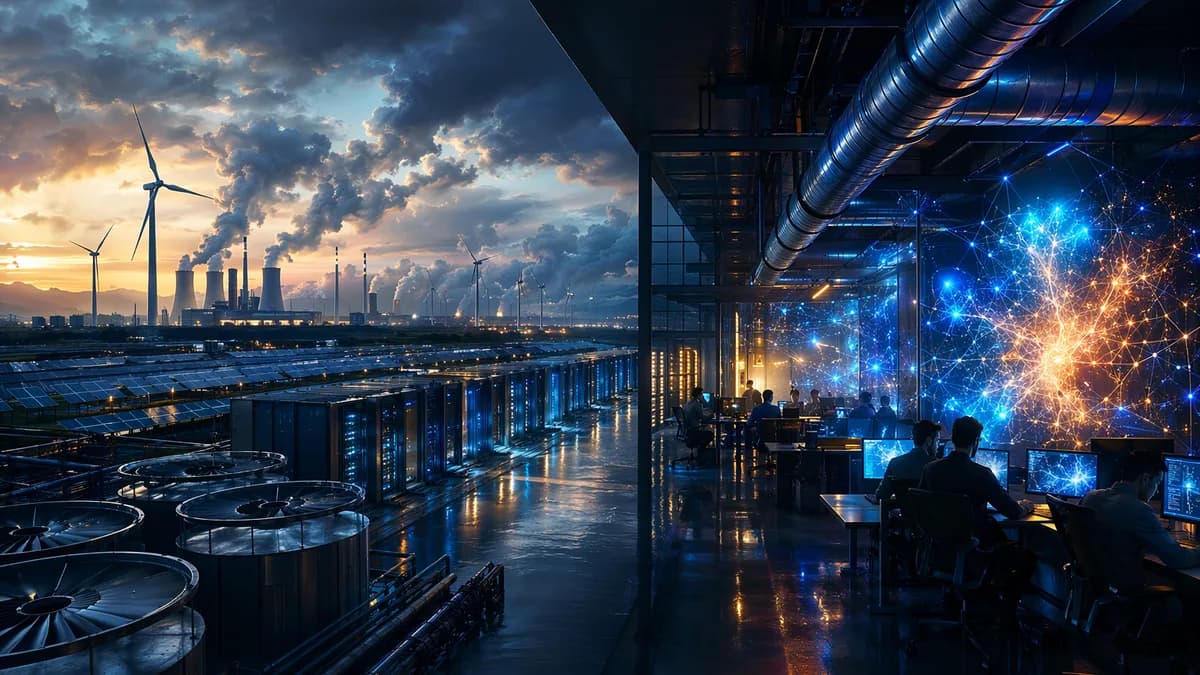
Microsoft’s AI push lives in physical buildings packed with chips, cooling systems, storage, networking gear, and power contracts. The software may appear weightless to customers. The infrastructure is not.
This is where the company’s climate promise meets its commercial ambition. Microsoft has marketed AI as a productivity engine, but the sustainability report shows the other side of that engine: electricity demand, construction, and carbon pollution.
Smith and Nakagawa wrote that the global race for AI is “increasing demand for … energy, water, land, and materials.” That sentence should sit next to every glossy AI demo. It’s the cost line.
XOOMAR has tracked Microsoft’s broader AI and platform pressure points separately, including our coverage of Microsoft AI development and Office prompts and Windows reliability issues. The emissions report is a different kind of test. It asks whether Microsoft can scale the future it is selling without blowing through the environmental constraints it set for itself.
Investors and customers don’t need a sermon. They need symmetry. If AI revenue growth gets scrutinized, the energy footprint deserves the same treatment.
Carbon Removal Promises Can't Substitute for Cutting Microsoft Data Center Pollution
Microsoft has invested in cleaner procurement and carbon removal. Its own 2026 Environmental Sustainability Report says it signed an agreement with Rubicon Carbon to purchase up to 18 million metric tons of afforestation, reforestation, and revegetation credits, beginning with the Kijani Forestry Smallholder Farmer Project in Uganda.
That kind of investment may have value. It doesn’t cancel out the immediate problem of rising data center demand.
The sharper point is Microsoft’s move away from unbundled renewable energy certificates, or RECs sold separately from the electricity itself. These certificates have drawn criticism because they may not add new clean power to the grid. Microsoft said it stopped purchasing unbundled RECs, and Wired reported that this contributed in part to the rise in Scope 2 emissions.
Danny Cullenward, a researcher at the University of Pennsylvania, put the problem bluntly:
Unbundled RECs are essentially a “paper transaction that is physically disconnected from real-world consequences.”
He also credited Microsoft for moving away from them:
“I think it's highly commendable that [Microsoft] is moving away from unbundled RECs and prioritizing investments in new clean electricity, where power purchase agreements and other long-term offtake agreements can and do cause new clean electricity to come online.”
That is the strongest charitable reading of Microsoft’s report. Part of the emissions jump reflects cleaner accounting, not just dirtier operations. Fine. But cleaner accounting is not the same as lower pollution. If the number rises after Microsoft stops using a controversial instrument, the public gets a more honest view of the problem. Now Microsoft has to solve that more honest problem.
Gas-Powered Data Center Deals Make the 2030 Target Harder to Believe
The most uncomfortable part of the report is not just what happened in FY2025. It’s what may be coming next.
Wired reported that the new sustainability report covers fiscal year 2025, which ended last June. Since then, Microsoft has made deals involving gas-powered data centers. One partnership with Chevron involves a power plant for a future Microsoft data center in West Texas. Permits show that plant could emit more than 11.5 million tons of CO2 equivalent annually, more than the entire state of Rhode Island, according to Wired.
Microsoft has also leased buildings on the Stargate campus in Abilene, Texas, which will be powered by an onsite power plant that could emit more than 7.8 million tons of CO2 equivalent each year. The company has also signed a nonbinding letter of intent for compute at a West Virginia data center powered by off-grid gas that could emit more than 11 million tons of greenhouse gases.
| Microsoft-linked project | Power source described in source | Potential annual emissions cited |
|---|---|---|
| West Texas data center power plant with Chevron | Gas-powered plant | More than 11.5 million tons of CO2 equivalent |
| Stargate campus in Abilene, Texas | Onsite power plant | More than 7.8 million tons of CO2 equivalent |
| West Virginia data center compute letter of intent | Off-grid gas | More than 11 million tons of greenhouse gases |
Microsoft’s statement to Wired leaves room for strategy, but not much comfort.
“Microsoft’s strategy includes exploring a variety of options for mitigating the emissions from its electricity consumption, consistent with our sustainability ambitions,” Nakagawa says in a statement to WIRED.
“Mitigating” is doing a lot of work there. If gas-backed compute becomes a bridge for AI growth, Microsoft needs to show exactly how that bridge gets dismantled before 2030.
The Best Defense of Microsoft's Emissions Surge Still Falls Short
There is a serious counterargument. AI could help improve efficiency, accelerate research, and make some systems less wasteful. Microsoft is also not alone. Wired reported that Amazon disclosed a 16 percent increase in CO2 emissions in its recent sustainability report, while Google said annual greenhouse gas emissions rose 18 percent last year compared to 2024, its biggest single-year increase.
So yes, the whole sector is under pressure. Microsoft also deserves credit for dropping a REC practice critics viewed as weak. A more transparent emissions number is better than a prettier one built on accounting fog.
But future climate benefits don’t give Microsoft a blank check now. The company has capital, engineering talent, procurement power, and influence over where infrastructure gets built. If any company should be able to tie AI expansion to real clean power, it’s Microsoft.
The public should not be asked to trust that the curve bends later. That’s not a climate plan. That’s a promissory note.
Microsoft Should Tie AI Growth to Real Clean Power, Not PR-Friendly Climate Math
The prescription is straightforward: Microsoft should make new AI data center expansion conditional on additional clean power that reaches the grids where its facilities operate. It should publish clearer location-based emissions data, show progress toward hourly clean-energy matching, and separate energy use tied to AI workloads from broader corporate reporting.
That would make Microsoft emissions harder to spin and easier to judge.
The company says it still wants to be carbon negative by 2030. Good. Then it should treat every gas-backed data center arrangement as a liability that needs a dated exit path, not as a temporary footnote buried under future offsets.
Microsoft wants to sell the future. It has to prove it can power that future without cooking the planet in the process.
Impact Analysis
- Microsoft’s emissions increase highlights the climate cost of rapid AI data center expansion.
- The jump makes the company’s 2030 carbon-negative pledge harder to reconcile with its current trajectory.
- The report shows how matching electricity with carbon-free sources does not fully eliminate operational emissions concerns.
Microsoft Greenhouse Gas Emissions
Primary Sources & Disclosures

Written by
XOOMAR Insights Team
Research and Editorial Desk
The XOOMAR Insights Team pairs automated research with human editorial judgment. We track hundreds of sources across technology, fintech, trading, SaaS, and cybersecurity, cross-check the facts, and explain what happened, why it matters, and what to watch next. We do not just rewrite headlines. Every article is fact-checked and scored for reliability before it goes live, and we link back to the original sources so you can verify anything yourself.