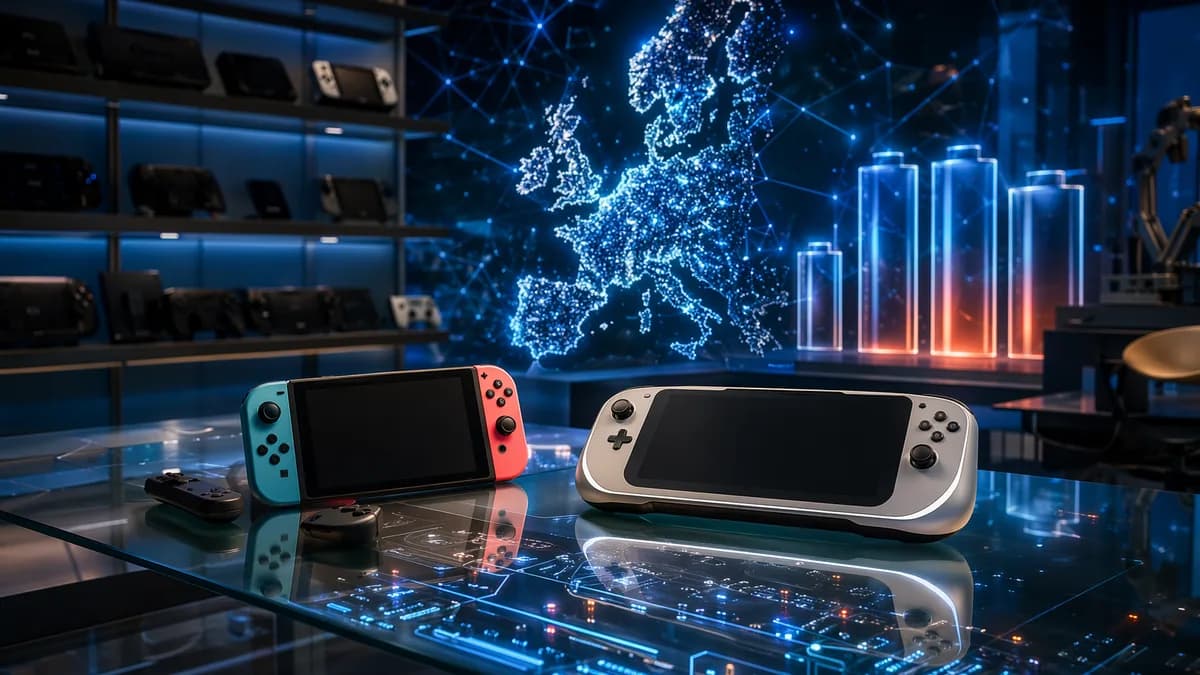
Nintendo Switch discontinued in Europe is now dated for mid-February 2027, and the move looks less like a routine product sunset than a controlled handoff to Switch 2 under Europe’s battery-repair rules.
XOOMAR Intelligence
Analyst Take
Nintendo confirmed in an updated FAQ that it will stop selling hardware in the original Nintendo Switch family to European retailers from mid-February 2027, according to The Verge. The cutoff covers Nintendo Switch, Nintendo Switch Lite, and Nintendo Switch OLED Model. Nintendo Store sales of that hardware will also end at the same time.
“There is no difference in functionality between current products and revised products containing user-replaceable batteries,” Nintendo says.
The sharper read: Europe is becoming the first clearly dated end point for the original Switch retail era. Nintendo is adapting the Switch 2 for user-replaceable batteries, while letting the older family age out instead of rebuilding three legacy models for a rulebook that takes effect on February 18, 2027.
Europe becomes the cutoff line for Nintendo Switch's decade-long run
Nintendo is not merely clearing an old shelf. It is drawing a regional boundary around the end of one of its defining hardware generations.
The original Switch launched in March 2017. By mid-February 2027, it will be almost ten years old. Nintendo’s statement says it will no longer sell to retailers hardware in the Switch family, naming the Switch, Switch Lite, and Switch OLED Model. That does not necessarily mean every shop will be empty that day. Retailers may still have remaining inventory, but Nintendo’s own pipeline of new original Switch hardware into Europe will close.
The timing matters because Nintendo is revising other products instead of withdrawing them. The company says updated versions of several devices will arrive on “a rolling basis” ahead of the European battery requirement. The Switch 2 is the headline revision, with a new European version expected to start rolling out in the fall, per The Verge.
XOOMAR analysis: this is an orderly exit, not a panic move. Nintendo can keep selling original Switch software and accessories where it chooses, while removing the older hardware from the center of the buying decision. That helps the Switch 2 become the default new purchase in Europe without requiring Nintendo to publicly declare the original platform dead worldwide.
The 2027 Switch sunset is built around dates, not drama
The timeline is clean enough to look intentional. March 2017 gave Nintendo the original Switch. The Switch Lite followed in 2019, according to the supplied related reporting. The OLED Model arrived in 2021. The European supply cutoff lands in mid-February 2027, just before the new battery rule takes effect.
The supplied source material does not provide updated lifetime Switch family sales, so any direct comparison with Nintendo DS or PlayStation 2 would go beyond the record here. What it does provide is a narrower but useful sales signal: Gizmodo’s related reporting says Nintendo sold 3.8 million new Switch consoles in fiscal year 2026, a near 65% drop from the same time last year, with Europe accounting for about 830,000 of those fiscal year 2026 original Switch sales.
That data supports the core business logic. The original Switch still sells, but the hardware curve is mature. A redesign for Europe would preserve some late-cycle volume, yet it would also keep the old machine visible while Nintendo is trying to build momentum behind Switch 2.
The strongest counterpoint is simple: 830,000 European units is not trivial. If Nintendo could cheaply revise the older hardware, keeping it alive might protect lower-cost entry points for families and late adopters. But the company’s actual decision points the other way. It is revising Switch 2 and related controllers, while setting a fixed end date for the original Switch family in Europe.
Europe's battery rule turns a normal console handoff into a hardware design choice
The regulatory hook is unusually direct. Europe’s rules will require user-replaceable batteries in portable devices sold in the region from February 18, 2027, according to The Verge’s reporting. Nintendo says revised products will be introduced before then, and that current and revised versions will not differ in functionality.
That creates a clear split in Nintendo’s product line:
| Product group | Europe plan described in source material |
|---|---|
| Original Switch, Switch Lite, Switch OLED Model | Nintendo stops selling new hardware to retailers and through Nintendo Store in mid-February 2027 |
| Switch 2 | Revised version with user-replaceable battery expected to start rolling out in the fall |
| Joy-Con, Joy-Con 2, Switch 2 Pro Controller, N64 and GameCube Switch controllers | Revised versions with user-replaceable batteries planned on a rolling basis |
Nintendo also notes that “revised products may not become available in all European countries simultaneously.” That matters for buyers. The transition may not look identical across the region.
XOOMAR analysis: regulation is the trigger, but lifecycle management is the opportunity. Nintendo could treat Europe as a compliance headache. Instead, it is using the deadline to simplify the old-versus-new hardware message. The original Switch family exits new retail supply. Switch 2 gets the compliant revision.
If Nintendo later keeps selling original Switch hardware outside Europe for a long period, that would weaken the thesis that this is a broader succession plan. For now, The Verge says it is unclear what fate awaits the original Switch in other territories.
Retailers, players, developers, and repair advocates will read the same cutoff differently
Retailers get a rare thing in hardware transitions: time. Nintendo is signaling the end of new original Switch supply more than half a year before the cutoff. That gives shops a runway to manage inventory, push bundles, and shift attention toward Switch 2 hardware, controllers, and software. That is analysis, not a stated Nintendo plan.
Players in Europe face a more practical fork. Buy an original Switch family system before Nintendo’s new supply ends, move to Switch 2, or rely on used hardware after the cutoff. The Verge notes the decade-old hardware is still getting notable first-party releases, including Rhythm Heaven Grove and Tomodachi Life: Living the Dream, so the original Switch is not being treated as irrelevant software-wise yet.
Developers and publishers will watch the signal. A large existing Switch audience can still justify cross-generation releases, especially for games that do not need Switch 2-specific performance. But ending new hardware supply in Europe weakens the case for treating the original Switch as a long-term primary target in that region.
Repair advocates may read the Switch 2 revision as a win, while asking the obvious question: why revise the successor and not the older family? Nintendo has not given a detailed cost breakdown in the supplied material. The only safe conclusion is narrower: Switch 2 gets the battery revision in Europe, and the original Switch family gets an end date.
For readers comparing how external rules and platform defaults shape tech strategy outside gaming, XOOMAR has separately covered MiCA 2.0 and Europe’s costlier crypto rulebook and model lock-in pressure as Vercel AI agents pick labs. Those are not evidence about Nintendo. They are useful parallels for how product roadmaps change when outside constraints tighten.
Nintendo is avoiding a muddled handoff by making Switch 2 the cleaner shelf story
Nintendo’s Europe move suggests the company wants a cleaner generational message than “buy the old one unless you really need the new one.” That matters because the Switch was unusual from the start. It combined Nintendo’s handheld and living-room hardware strategies into one platform family, so retiring it carries more weight than ending a single accessory line.
The supplied sources do not provide enough verified historical detail to compare this move deeply with the Game Boy, Wii, or 3DS transitions. The safer point is strategic: Nintendo is narrowing the hardware story in Europe before the old and new systems compete too long in the same retail lane.
There is a counterpoint. Nintendo could keep the original Switch around as a cheaper path into its catalog, especially if software support continues. Related reporting from Gizmodo cites US pricing context, with the original Switch at $330, the Switch OLED at $400, and the Switch 2 described as $500. But Europe’s battery requirement changes that equation. A lower-priced legacy machine is less useful to Nintendo if selling it requires a hardware revision the company does not want to make.
The evidence that would prove this reading too aggressive would be a broad, long-running original Switch sales push in non-European markets after February 2027. If that happens, Europe looks more like a compliance exception. If it does not, Europe may simply be the first public date in a wider phaseout.
The shelf test: Switch 2 visibility, old-stock pricing, and software support
The practical watch item is retail behavior through 2026 and early 2027. If Nintendo and retailers steadily reduce original Switch visibility, the transition is controlled. If stores keep pushing old hardware hard until the cutoff, Nintendo may be trying to harvest the last late-cycle demand before the rule takes effect.
For families and late adopters in Europe, the final supply window could matter. The source material does not confirm discounts, so buyers should not assume fire-sale pricing. But a fixed end to new Nintendo supply makes inventory timing more important. Once retailer stock dries up, new sealed units will depend on what remains in the channel.
Collectors will pay attention to OLED Model units and special editions, if they can still find them new. That is not a forecast of price spikes. It is a supply observation: once Nintendo stops feeding new hardware into Europe, sealed inventory becomes finite.
The bigger software question remains open. The Verge says original Switch hardware is still getting notable first-party releases, but Nintendo has not laid out a long-term European software and services cutoff in the supplied material. The strongest confirmation of the thesis would be Switch 2 becoming the default home for major new Nintendo showcases while the original Switch continues receiving selected releases for its existing base.
For now, Nintendo Switch discontinued in Europe means one thing with certainty: from mid-February 2027, Nintendo stops sending new original Switch family hardware into that market. Everything else, used prices, late software support, and whether other regions follow, becomes the next test of how firmly Nintendo wants to close the Switch era.
Impact Analysis
- Europe is becoming the first clearly dated end point for sales of the original Switch hardware family.
- The move reflects how repairability rules are shaping console hardware decisions.
- Retailers may still sell remaining inventory, but Nintendo’s new supply pipeline for original Switch models in Europe will close.
Nintendo’s Europe Hardware Transition
| Product | Europe Status | Timing |
|---|---|---|
| Nintendo Switch | Nintendo will stop selling to European retailers and through Nintendo Store | Mid-February 2027 |
| Nintendo Switch Lite | Nintendo will stop selling to European retailers and through Nintendo Store | Mid-February 2027 |
| Nintendo Switch OLED Model | Nintendo will stop selling to European retailers and through Nintendo Store | Mid-February 2027 |
| Switch 2 | Being adapted for user-replaceable batteries | Ahead of Europe’s February 18, 2027 battery-repair rule |
Primary Sources & Disclosures

Written by
XOOMAR Insights Team
Research and Editorial Desk
The XOOMAR Insights Team pairs automated research with human editorial judgment. We track hundreds of sources across technology, fintech, trading, SaaS, and cybersecurity, cross-check the facts, and explain what happened, why it matters, and what to watch next. We do not just rewrite headlines. Every article is fact-checked and scored for reliability before it goes live, and we link back to the original sources so you can verify anything yourself.