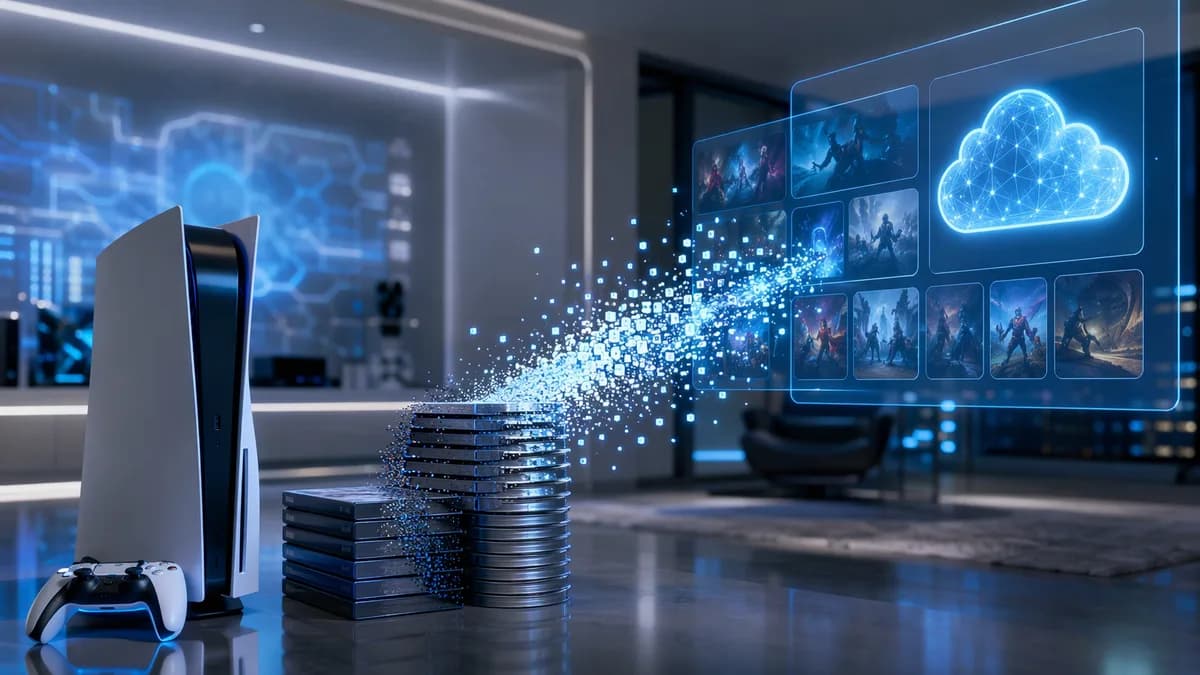
Sony’s plan to stop making physical PlayStation games in 2028 forces a harder question: what does a PlayStation purchase mean when the disc disappears?
XOOMAR Intelligence
Analyst Take
Starting in January 2028, new PlayStation games will be sold “in digital formats only” through the PlayStation Store and retailers, according to Ars Technica. Sony framed the move as “a natural direction” as digital buying outpaces discs. Players heard something else: ownership is getting thinner.
One commenter on Sony’s announcement put the anxiety bluntly:
“We will own nothing, it’s truly sad.”
That line lands because Sony is not just changing packaging. Since Ars reports that no company other than Sony Digital Audio Disc Corporation makes PlayStation discs, this decision effectively marks the end of new physical PlayStation games after the cutoff. The practical result is a PlayStation market built more heavily around accounts, licenses, storefront access, and whatever Sony keeps available.
Does Sony’s 2028 physical PlayStation games cutoff change ownership or just packaging?
It changes ownership more than Sony’s blog language admits.
Sony says new games will still be sold at retailers, just in digital formats. That keeps stores in the transaction, but it removes the disc as a transferable object. A boxed game can be lent, resold, gifted, kept on a shelf, or discovered years later. A digital PlayStation purchase is governed by account rules and license terms.
Sony’s own terms, quoted by Ars, are clear:
“When you order or purchase a product from PlayStation Store, you buy a personal license to use that product for private, non-commercial use. That license is not transferable unless your local applicable laws say it must be. This means you can use a product in the ways described in the license, but do not own the product.”
That sentence is the center of the story. Sony can talk about access and convenience. Players are reading the contract.
XOOMAR analysis: A disc-free PlayStation model does not mean Sony will suddenly remove games from libraries. Ars explicitly says gaming companies rarely delete previously purchased games. But the legal relationship is different. The buyer is not holding a product. The buyer is holding permission.
Calendar promises can be slippery across tech, as we noted in Trump’s 2028 Quantum Computer Bet Crashes Into Reality, but this PlayStation date is not a research ambition. It is a commercial cutoff.
Do Sony’s own numbers justify ending physical PlayStation games?
Sony has one strong data point: during its fiscal year ending March 31, 2026, digital downloads accounted for 78 percent of full-game unit purchases, up from 76 percent in fiscal 2024.
That is not a dramatic two-year jump. It is still a decisive share.
Sony’s argument is that it is following where customers already went. The company said it will “continue to prioritize our resources to drive innovation in how players can access games and provide choices as to where players prefer to purchase new games, whether that’s at retailers or PlayStation Store.”
The keyword is “formats.” Sony is preserving purchase locations, not physical ownership.
| After January 2028 | What changes |
|---|---|
| PlayStation Store | New games remain digital purchases tied to Sony’s platform rules |
| Retailers | New games can still be sold, but in digital formats only |
| Physical discs | No new PlayStation game disc production after the cutoff |
| Existing disc games | Games released before January 2028 are not affected by the announced cutoff |
Retailers still matter in Sony’s phrasing. Deal-led buying in consumer electronics is still alive elsewhere, as seen in Prime Day 2026 Deals Vanish as Apple and TV Cuts Linger. But Sony’s post-2028 version of retail does not include a new disc on a shelf.
XOOMAR analysis: The 78 percent figure gives Sony cover. The harder issue is the remaining 22 percent. That minority includes collectors, used-game buyers, households that share discs, and players who want a fallback if a storefront changes.
Why do Sony’s older storefront decisions make the digital future feel fragile?
Because Sony announced more than one access change at once.
Ars reports that Sony also said it will close the PlayStation Store on PlayStation 3 and PS Vita, with the US losing access in July 2027. Sony said players will still be able to download previously purchased content “for the foreseeable future.”
That phrase is meant to reassure. It does the opposite.
“Foreseeable future” is not lifetime access. It is not a preservation guarantee. It is a holding statement.
Sony has already shown that digital libraries can be temporary in other media categories. Ars cites StudioCanal titles that users in the United Kingdom will lose access to in September, after Sony previously pulled StudioCanal content from PlayStation libraries in Germany and Australia. Ars also notes that in 2024, Sony deleted customers’ Funimation digital libraries despite Funimation previously saying customers could access those digital copies “forever but” with “some restrictions.”
Those examples involve movies and shows, not PlayStation games. That distinction matters.
Still, the trust problem crosses categories. If a user buys through a PlayStation account and later sees purchased media vanish, the distinction between games, films, and shows may not feel comforting.
Who loses most when PlayStation discs stop?
The losses are uneven.
Convenience-focused players lose the least. They already prefer downloads, fast purchasing, and library access without storing boxes.
Collectors lose the object. Box art, sealed copies, shelves, and physical libraries are not just nostalgia. They are how some players organize value.
Used-game buyers lose flexibility. A digital license generally cannot be resold or passed along unless local law requires it. That changes how players manage risk when buying a game they might not like.
Preservation advocates lose another legal path to keeping games findable. Ars cites a 2023 Video Game History Foundation report showing that after the Nintendo 3DS and Wii U storefronts closed in 2023, the number of Game Boy games released during the Game Boy’s lifetime that were still available dropped from 155 out of 1,873 to 25.
That is the preservation nightmare in numbers. Once storefront access narrows, availability can collapse.
XOOMAR analysis: Sony’s decision makes preservation dependent on corporate continuity rather than consumer possession. That is a weaker foundation. Companies change priorities. Licenses expire. Stores close. Accounts get lost.
Can Sony make a disc-free PlayStation feel less risky?
Yes, but not with slogans about choice.
A disc-free PlayStation needs stronger assurances than “for the foreseeable future.” Sony could reduce backlash by being more explicit about long-term download rights, account recovery, delisting policies, refund rules, and access to already purchased games after store closures.
None of that appears settled in the source material.
The consumer response is simpler:
- Preserve discs: If you care about ownership, keep existing physical PlayStation games in good condition.
- Treat digital purchases as licenses: Sony’s own terms say you “do not own the product.”
- Watch store closures: The PS3 and PS Vita shutdowns will test how Sony handles old purchases.
- Track access changes: StudioCanal and Funimation show that paid digital libraries can be altered.
- Buy with exit risk in mind: If you can’t resell or lend it, the purchase calculus changes.
Sony’s 2028 move may match where most purchases already happen. That does not settle the ownership question. It sharpens it.
The evidence that would support Sony’s case is simple: years of reliable access to purchased games after storefront closures, clear license language, and no surprise removals from game libraries. The evidence that would weaken it is just as clear: more “foreseeable future” promises, more vanished paid content, and no durable answer for players who believed buying a game meant keeping it.
What This Means For You
- Sony’s move could make PlayStation game ownership more dependent on accounts, licenses, and storefront access.
- Players may lose the practical benefits of discs, including resale, lending, gifting, and long-term collecting.
- The decision effectively ends new physical PlayStation games because Sony’s disc manufacturing is central to the market.
Physical vs. Digital PlayStation Game Purchases
| Physical PlayStation games | Digital PlayStation games |
|---|---|
| Sold as discs before Sony’s January 2028 cutoff | New games sold in digital formats only starting January 2028 |
| Can be lent, resold, gifted, or kept as a physical item | Governed by PlayStation account rules and license terms |
| Provides a transferable object separate from Sony’s storefront | Sony says buyers receive a personal, generally non-transferable license, not ownership |
Primary Sources & Disclosures
- [1]Ars Technica
- [2]Sony confirms it will stop making physical PlayStation games in 2028 - Dexerto
- [3]Sony Just Killed Discs: Physical Disc Production to End January 2028 for New Games Releasing on PlayStation Consoles in 'Watershed Moment for the Industry'
- [4]PlayStation Will Stop Producing Physical Game Discs in 2028

Written by
XOOMAR Insights Team
Research and Editorial Desk
The XOOMAR Insights Team pairs automated research with human editorial judgment. We track hundreds of sources across technology, fintech, trading, SaaS, and cybersecurity, cross-check the facts, and explain what happened, why it matters, and what to watch next. We do not just rewrite headlines. Every article is fact-checked and scored for reliability before it goes live, and we link back to the original sources so you can verify anything yourself.