
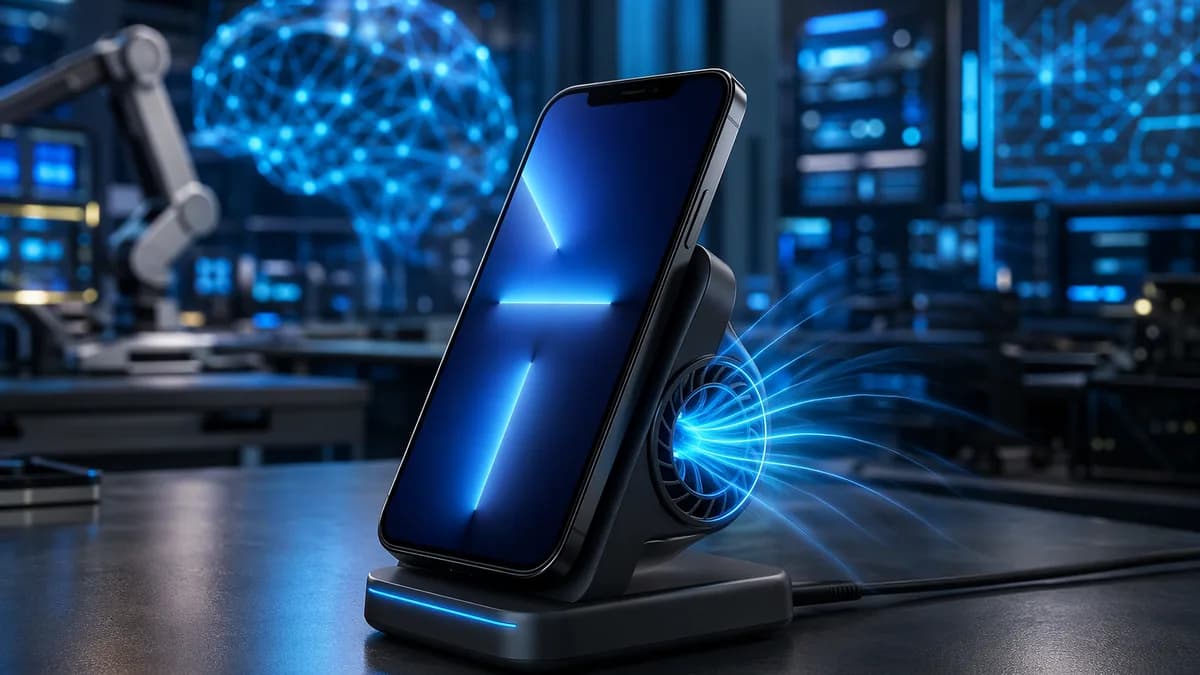
I expected fan-cooled Qi chargers to be gimmicks; the Kuxiu D5 Qi2.2 makes the opposite case, that active cooling should become standard on premium wireless chargers for people who charge hard and push their phones while plugged in.
TechnologyJuly 4, 2026· 7 min read· By XOOMAR Insights Team
Tiny Fan Rescues Qi2 Chargers From Their Heat Trap
Updated on July 4, 2026
XOOMAR Intelligence
Analyst Take
72/ 100
1 source analyzedMedium confidenceTrend10Freshness100Source Trust88Factual Grounding90Signal Cluster20
That’s the useful lesson from Thomas Ricker’s review at The Verge, where a $59.99 charging dock kept his phone cool while also supporting a watch and earbuds. The surprise isn’t that a fan can move air. The surprise is that such a small change attacks the real tax on wireless charging: heat.
“Despite my initial skepticism, I’m now sold on wireless Qi chargers that add integrated fans to keep your phone cool while charging.”
Qi2 chargers need fans because heat is the real wireless charging tax
Wireless charging has always sold convenience and quietly billed users in warmth. In Ricker’s review, the practical issue is not an abstract spec fight: when a phone warms up on a charger, the experience feels less trustworthy. The Verge’s test suggests active cooling can change that feel by keeping the phone cooler on the stand.
That heat doesn’t just make a phone unpleasant to hold. It makes the whole promise of wireless charging feel shakier, especially when the user is doing more than leaving a handset idle overnight. So the user gets a familiar bargain: convenience with a nagging sense that the device is being stressed.
The Kuxiu D5 Qi2.2 is a proof point that the fix doesn’t have to be dramatic. Rather than asking users to accept warmth as the cost of cable-free charging, the dock builds cooling into the moment when the phone is sitting on the stand. This is not luxury trim. It’s thermal management finally arriving where wireless charging needs it.
The Kuxiu D5 makes wireless charging feel less fragile
The D5 is presented as a Qi2.2 charging dock that can handle a phone while also accommodating a watch and earbuds. The exact appeal is less about chasing a spec-sheet number and more about solving the thing users notice immediately: whether the phone comes off the charger cool enough to trust.
Here’s the conflict in one table:
| Assumption | Reality in The Verge test |
|---|---|
| Fan-cooled Qi docks are likely loud or gimmicky | Ricker reported that the D5’s fan was silent in use |
| Wireless charging heat is just something users accept | The D5 kept Ricker’s phone from heating up, unlike every other Qi charger he had tried |
| Multi-device docks are mostly about convenience | Active cooling changes the reliability argument, not just the desk setup |
That is the category’s real opportunity. A dock that charges multiple devices is useful, but a dock that makes wireless charging feel calmer and less fragile is more interesting. Keep the quiet thermal engineering. Cut anything that makes the product feel toy-like or overcomplicated.
Phone makers made heat management a user problem
Modern phones are asked to do more than sit on a nightstand. Ricker’s example is specific and ugly: he was editing a 4K video on a titanium iPhone 15 Pro while charging from a magnetically attached Qi power bank on a sweltering train.
That’s the point. Charging adds heat. Heavy phone use can add more. A hot train carriage and a magnetic wireless battery add another variable. The user is left to judge, by feel, whether the device is merely warm or entering the danger zone.
Accessory makers such as Anker, Aukey, ESR, and Kuxiu have started building active cooling into Qi chargers, according to The Verge. XOOMAR’s read: that is less a novelty race than a quiet admission that the charger can’t pretend heat is someone else’s problem.
That distinction matters because gadget coverage often rewards spectacle. Readers tracking hardware claims have seen that pattern in other leak-and-denial cycles. The D5 is less flashy, but its claim is testable every time a phone stays cool on the stand.
A fried iPhone logic board is the warning label wireless chargers don’t print
Ricker’s personal anecdote is the part every wireless charger maker should read twice. On that train, his iPhone got hot. Then the screen went blank forever. The repair bill was €660.33 (over $750), though he paid nothing because it was inside the two-year warranty.
We should be careful here. The Apple “genius” would not say whether overheating caused the failure, and The Verge does not prove the Qi power bank killed the logic board. But the sequence is still a useful warning: heat can stack quickly when a phone is working hard and charging wirelessly.
Users shouldn’t need to baby expensive phones or play thermal roulette with a magnetic puck. If a charger encourages people to attach power and keep working, it should also help control the heat that setup creates.
Fan-cooled Qi docks can make faster wireless charging easier to trust
The performance case is straightforward but should not be oversold. If a fan-cooled dock keeps a phone cooler in real use, it can make wireless charging feel less like a compromise and more like a dependable daily setup.
The battery-health case should be framed just as carefully. This review’s strongest evidence is experiential: Ricker tried a fan-cooled Qi dock and found that it kept his phone cool where other wireless chargers had not. That is enough to make active cooling feel practical without pretending one product test answers every long-term battery question.
This becomes more important as wireless charging ambitions rise. Before companies ask users to trust faster stands and more capable multi-device docks, they should show that heat has been treated as a design problem, not shrugged off as the user’s problem. If that happens, active cooling stops looking optional.
The fair complaint: nobody wants a noisy gadget blowing on a bedside table
The counterargument is strong. Fans add moving parts. Moving parts can fail. A bedside charger that hums, rattles, or distracts the room deserves no praise, no matter how clever the spec sheet looks.
The D5 clears the first hurdle in Ricker’s test: the fan operates silently. That matters more than branding flourish. A charger can be clever, compact, and visually polished, but if it draws attention to itself at night, it has missed the point.
Kuxiu still overreaches. Calling the D5 a “5-in-1” charger is misleading because it charges only up to three devices at once, apparently counting the display and fan in the total. The motorized watch charger also feels over-engineered: a long press triggers a tiny motor that slowly pushes the watch dock out, and it can only retract when plugged into the wall.
Fan-cooled chargers deserve attention only if they meet three tests:
- Quiet: No audible penalty for cooling the phone.
- Honest: Clear device counts and output claims, not inflated “in-1” branding.
- Practical: Priced close enough to standard Qi2 docks that cooling feels like a sensible default, not a luxury tax.
Accessory brands should stop selling heat as the user’s fault
The next step is obvious: charger makers should publish real thermal data, not just wattage claims and glossy product photos. If active cooling works, show the temperature difference under load. Show how consistently the charger performs. Show what happens with cooling compared against a passive dock.
Phone makers and standards bodies should also treat cooling guidance as part of the wireless charging experience, especially if Qi keeps moving toward higher-power charging. Faster wireless charging without a serious thermal plan is just a hotter version of the same old compromise.
The Kuxiu D5 Qi2.2 is imperfect. The presentation is fussy. The “5-in-1” label strains credibility. The motorized watch dock is more clever than necessary. But the fan is the point, and it works well enough to change the argument.
If wireless charging is going to replace the cable for serious users, it has to stay cool under pressure.
Key Takeaways
- Active cooling addresses heat, one of the biggest drawbacks of wireless charging.
- The $59.99 Kuxiu D5 Qi2.2 suggests premium chargers can add practical thermal management without a major redesign.
- Cooler charging could make wireless docks more appealing for users who charge while actively using their phones.
Fan-Cooled Qi Charging vs Traditional Wireless Charging
| Aspect | Kuxiu D5 Qi2.2 | Traditional Wireless Charging |
|---|---|---|
| Cooling approach | Integrated fan keeps the phone cooler while charging | Can leave phones noticeably warm |
| User experience | Makes wireless charging feel more trustworthy during heavier use | Convenience can come with heat-related concern |
| Device support | Charges phone, watch, and earbuds | Varies by charger |
Sources

Written by
XOOMAR Insights Team
Research and Editorial Desk
The XOOMAR Insights Team pairs automated research with human editorial judgment. We track hundreds of sources across technology, fintech, trading, SaaS, and cybersecurity, cross-check the facts, and explain what happened, why it matters, and what to watch next. We do not just rewrite headlines. Every article is fact-checked and scored for reliability before it goes live, and we link back to the original sources so you can verify anything yourself.
Explore More Topics
Related Articles
 Technology
Great Hardware Can't Save Google Home Speaker From Gemini
Google's speaker hardware looks ready, but Gemini for Home still feels too unfinished for a device meant to run the household.
Jul 1, 20267 min
 Technology
Decade Away Can't Dull Rhythm Heaven Groove's Weird Magic
Rhythm Heaven Groove returns after a decade and still feels brutally precise, proving Nintendo’s strangest series didn’t need to grow up.
Jul 1, 20267 min
 Technology
32GB OLED Drops Under $900 in Acer Swift Go 16 AI Deal
Best Buy cut the Acer Swift Go 16 AI to $899.99, pairing 32GB RAM, 1TB storage and a 16-inch OLED touchscreen under $1,000.
Jun 30, 20265 min
 Technology
Xbox Blade Cancellation Threat Puts Arkane on the Brink
Microsoft may cancel Blade and cut Arkane, exposing how far Xbox's cost purge could reach across its studio empire.
Jun 30, 20268 min
 Technology
AI Music Loses Royalties under Tidal's New Pay Rules
Tidal will keep fully AI-generated tracks online, but it won't pay them royalties. Listener labels arrive July 15.
Jun 29, 20268 min
 Trading
$60 Silver Bounce Dares Sellers as Price Forecast Sours
Silver is testing $60 after a 2.5% bounce, but the chart still favors sellers unless XAG/USD can break key resistance.
Jul 4, 20267 min
 Technology
Senate Threatens to Sink House Kids Online Safety Bill
The House passed the KIDS Act 267-117, but the Senate may reject it for lacking tougher platform safety duties.
Jul 4, 202610 min
 Trading
Bitcoin Parabolic Run Demands $1 Trillion Gut Check
Bitcoin can still rip, but old cycle math is breaking. The next parabolic move may need $1 trillion in fresh demand.
Jul 4, 20267 min
 Global Trends
Germany's 58,700 Far-Right Extremists Rattle Democracy
Germany now counts 58,700 far-right extremists, and the BfV says right-wing extremism is the top threat to its democracy.
Jul 4, 20268 min
 Cybersecurity
Huntress Insider Threat Alarm Puts Client Trust on Trial
A Huntress staffer warned a ransomware actor about law enforcement interest. The CEO calls it poor judgment. Critics call it an insider threat.
Jul 4, 20268 min
Don't miss the signal
Get our weekly roundup of the stories that matter across tech, fintech, and trading. No noise, just signal.
Free forever. No spam. Unsubscribe anytime.