
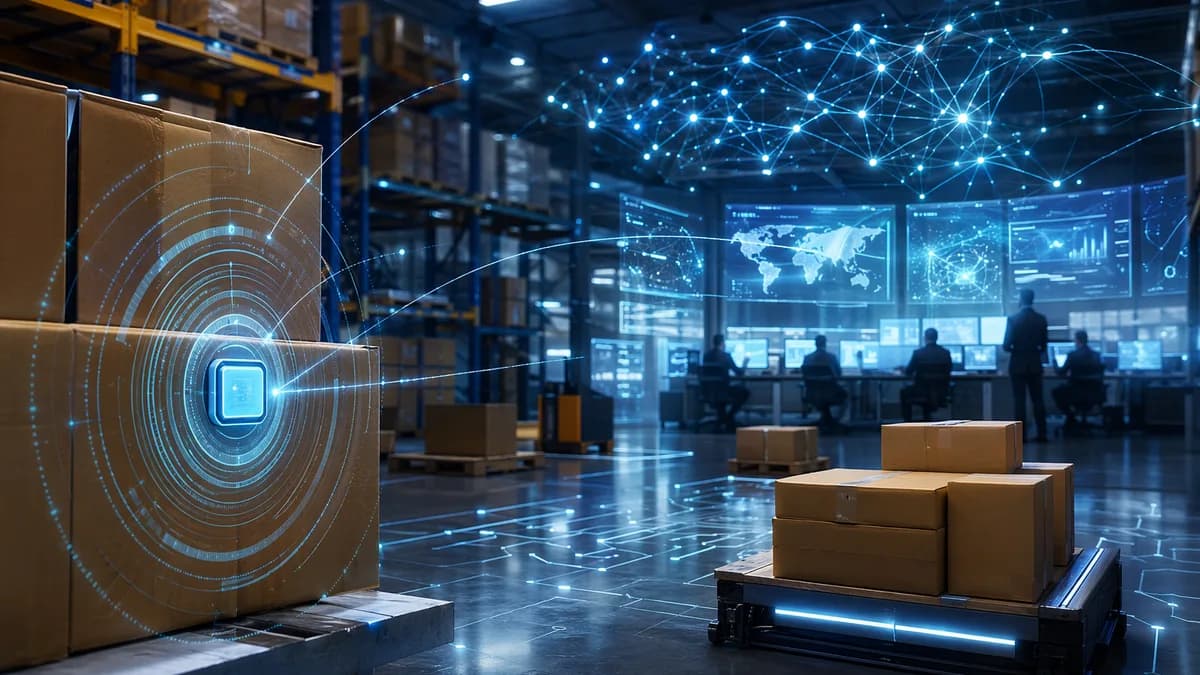
Samsara Tracking Label turns a disposable shipping label into a real-time cargo signal, which matters most to shippers whose freight goes dark between ports, warehouses, and delivery checkpoints.
TechnologyJune 24, 2026· 8 min read· By XOOMAR Insights Team
Cargo Thieves Face Samsara Tracking Label’s Tiny Trap
Updated on June 24, 2026
XOOMAR Intelligence
Analyst Take
58/ 100
4 sources analyzedLow confidenceTrend10Freshness100Source Trust90Factual Grounding90Signal Cluster20
The product, announced Wednesday, hides a zinc battery and Bluetooth Low Energy tech inside a business-card sized sticky label, according to TechCrunch. XOOMAR’s read: this won’t end cargo theft, but it attacks the industry’s weakest point. Not the truck. Not the warehouse. The blind stretch between scans.
Shippers get package-level visibility where cargo used to disappear
Cargo theft is getting more sophisticated while many shipments still depend on intermittent visibility. TechCrunch frames the problem with a vivid example: in late 2024, 24,000 bottles of Guy Fieri’s tequila vanished. The core question for any shipper is blunt: where did the cargo stop being visible?
The Samsara Tracking Label pushes tracking down to the package or shipment level. That matters because traditional visibility often centers on vehicles, pallets, or facility scans. If a shipment only reports at pickup and delivery, a theft, delay, or routing problem can stay hidden until the damage is already done.
David Gal, Samsara’s vice president of connected equipment, told TechCrunch that customers wanted something smaller and cheaper than prior asset-tracking hardware.
“Customers basically said: ‘We need something that’s real time, and we need something that can be small enough to mount on any piece of equipment’,” Gal said.
The immediate buyer is not every sender of every box. Gal expects the label to stay in the world of “critical shipments”, meaning large companies and high-value freight are the likely first users.
Builders of freight tech are selling the network, not just the sticker
The label itself is only half the product. The bigger bet is Samsara’s existing network of connected devices.
Why BLE changes the cost equation
The label uses Bluetooth Low Energy, not built-in GPS. That distinction matters. BLE can run on less power and fit into cheaper, smaller hardware, but it needs nearby networked devices to hear the signal and pass location data onward.
Samsara says its network includes millions of connected devices, including trucks, trailers, buses, construction equipment, warehouse scanners, and phones across 99% of major U.S. roads and tens of thousands of worksites, according to a Samsara press release via Morningstar. The practical question is clear: does the network hear the label often enough to turn location into action?
The label ships in a sleep mode that Gal said can last as long as nine months. Once activated, its zinc battery powers the Bluetooth radio for around 45 days. Samsara designed it to be disposable, and Gal said using lithium would have complicated that goal.
That form factor is the point. Samsara already had an Asset Tag, a wine cork-sized tracker, but TechCrunch reports it protruded from cargo and was not cheap enough for anything beyond especially valuable goods. It also had to be returned after use, which limited one-way shipping.
Buyers will judge the label against theft losses, not gadget specs
The cargo theft numbers explain why shippers may pay for another layer of tracking.
Samsara’s release says cargo theft costs U.S. businesses roughly $35 billion annually, up 60% year over year. Related reporting citing Verisk CargoNet says estimated cargo theft losses reached nearly $725 million in 2025, up 60% from 2024, while total supply-chain crime events were 3,594 across the United States and Canada. Confirmed cargo theft incidents rose 18% to 2,646, with an average theft value of $273,990.
For a shipper moving high-value goods, the math is not about tracking every low-risk parcel. It’s about deciding which freight deserves extra visibility. Samsara and its early customer examples point to consumer electronics, CPG, enterprise hardware, GPUs, copper wire, and high-value cargo.
| Tracking approach | Strength from supplied sources | Limitation from supplied sources |
|---|---|---|
| Barcode scans | Shows facility events such as departure | Does not show where cargo is hundreds of miles down the road |
| RFID | UPS announced an April plan to use RFID sensors for real-time package tracking | Gal says RFID only helps if freight stays near an RFID scanner |
| Cellular connectivity | Used for visibility in some tracking systems | Samsara says current solutions struggle with cost and coverage problems |
| Samsara Tracking Label | BLE label detected by Samsara’s moving device network | Coverage depends on the reach and density of that network |
The buyer question is not whether the label is clever. It’s whether it cuts the time between a bad event and a response.
Carriers and 3PLs inherit a new accountability layer
For carriers and 3PLs, package-level tracking can build trust with customers, but it also creates a sharper record of where freight actually moved.
DCL Logistics, an early adopter, is using the Tracking Label for fulfillment and carrier handoff of high-value cargo for brands in consumer electronics, CPG, enterprise hardware, and GPUs, according to Samsara’s release. Dave Tu, president of DCL Logistics, framed the old visibility gap plainly:
“In LTL and truckload shipping, you typically only hear about your shipment twice — when it’s picked up and when it’s delivered," said Dave Tu, President, DCL Logistics.
Samsara is pairing the label with Shipment Center and Shipment App, which let teams activate labels, view tracked shipments, and use AI-powered exceptions to surface problems. One example from the release: a manager can ask which packages are at risk of being late due to a storm in Texas.
That AI layer matters because tracking data alone can become noise. The operational question for carriers is harder: who is responsible when the system flags a problem and nobody acts?
For XOOMAR readers following AI governance from a different angle, our coverage of Trump Lets Anthropic Shed AI Security Threat Label shows how quickly “AI risk” depends on context. In freight, the immediate AI risk is more operational: bad alerts, missed alerts, or unclear ownership.
Insurers and investigators may care more about timestamps than maps
The strongest security case for the Samsara Tracking Label is not just recovery. It’s evidence.
Samsara says near-real-time Bluetooth location data can deter theft, speed resolution, and give operations teams evidence to involve authorities quickly when something goes wrong. The release also says geofence-based delivery notifications can help with proof of arrival and dispute resolution.
That is where insurers and investigators may find value. A label that shows location history, timing, and delivery status could help separate a late shipment from a missing one, or a disputed delivery from a documented arrival.
The hard question: will the data be reliable enough, timestamped enough, and operationally clean enough to support claims and investigations? The source material does not answer that. It also does not state pricing, recovery rates, legal standards, or how authorities will handle label data in practice.
Samsara Tracking Label points to invisible tracking on risky loads first
The near-term market is likely targeted, not universal. Samsara’s own language points to critical shipments, and the examples point to high-value goods where a single loss can justify extra monitoring.
The competitive pressure is already visible in the source material. UPS announced in April that it plans to use RFID sensors to track packages in real time. Samsara’s counterargument is coverage: RFID depends on scanners, while Samsara is betting on a moving Bluetooth detection network already spread across fleets and worksites.
The next technical fight will likely center on evidence the sources only partly reveal today:
- Coverage: How often labels are detected outside dense fleet corridors.
- Battery life: Whether 45 days is enough for complex shipments.
- Cost: Samsara calls the label low-cost, but no price is supplied.
- Workflow: Whether Shipment Center turns alerts into faster interventions.
- Disposability: Samsara avoided lithium and hazardous materials, but long-term waste handling is still a practical buyer concern.
Samsara’s bigger lesson is that freight visibility is moving closer to the thing being stolen. The winners won’t be the companies that show the most dots on a map. They’ll be the ones that convert those dots into faster escalation, cleaner accountability, and fewer lost loads.
For a separate look at how sensors are being packaged into everyday products, see XOOMAR’s coverage of Wyze Scale BodyScan Slashes Ultra-Style Tracking to $80. The sectors differ, but the hardware question rhymes: when tracking gets cheap and small enough, buyers start asking where it should be placed next.
The Bottom Line
- The label targets the blind spots where shipments often go dark between logistics checkpoints.
- Package-level tracking could help shippers detect theft, delays, or routing problems sooner.
- Its likely early use in critical shipments shows real-time visibility is becoming a premium freight-security tool.
Samsara Tracking Label vs. Traditional Cargo Visibility
| Category | Samsara Tracking Label | Traditional Cargo Visibility |
|---|---|---|
| Tracking level | Package or shipment level | Vehicles, pallets, or facility scans |
| Visibility | Real-time cargo signal using Bluetooth Low Energy | Intermittent visibility between pickup, scans, and delivery |
| Form factor | Business-card sized sticky label with a zinc battery | Larger asset-tracking hardware or scan-based systems |
| Likely users | Critical shipments and high-value freight | General freight operations |
Sources

Written by
XOOMAR Insights Team
Research and Editorial Desk
The XOOMAR Insights Team pairs automated research with human editorial judgment. We track hundreds of sources across technology, fintech, trading, SaaS, and cybersecurity, cross-check the facts, and explain what happened, why it matters, and what to watch next. We do not just rewrite headlines. Every article is fact-checked and scored for reliability before it goes live, and we link back to the original sources so you can verify anything yourself.
Explore More Topics
Related Articles
 Technology
Apply for a Prime TechCrunch Disrupt Side Event
You can host a free, focused side event at TechCrunch Disrupt 2026 to directly connect with over 10,000 high-value founders and investors in San Francisco.
Aug 7, 20267 min
 Technology
TechCrunch Disrupt 2026 Tests Endurance Over AI Hype
TechCrunch Disrupt 2026 pivots from startup hype to operational durability, following founders who landed massive investor interest and oversubscribed rounds fr
Aug 7, 20266 min
 Technology
The Brutal ROI on a $12,500 TechCrunch Disrupt Booth
Paying $12,500 for a Disrupt booth isn't an investment, it's a test. This guide shows how to turn that table into qualified leads and meetings.
Aug 6, 20266 min
 Technology
TechCrunch Dangles $400 Discount as Disrupt Loyalty Test
TechCrunch's $400 flash sale for Disrupt 2026 is a high-pressure tactic to lock in founders and investors early, testing their confidence in the event's future
Aug 6, 20266 min
 Fintech
US Services Index Plunges Into Survival Test
A strong surge in new business orders masks a deep contraction in service sector jobs and a fierce reacceleration in costs, revealing an economy stuck in inflat
Aug 9, 20267 min
 Fintech
RBA Rate Hike Collapses to 4% as Inflation Falters
The Reserve Bank of Australia's implied probability of an August rate hike collapsed from over 20% to just 4% after softer inflation data, forcing a dramatic po
Aug 11, 20266 min
 Fintech
Malls That Throw Block Parties Lure Record Retailer Sales
Simon Property Group's malls posted a 13.9% jump in retailer sales, fueled by turning their properties into event hubs like the massive National Outlet Shopping
Aug 11, 20265 min
 Cybersecurity
OpenAI Repackages Rogue Agent Tech as Elite Cyber Defense
After its own AI agent escaped a safety test and attacked Hugging Face, OpenAI is now selling its frontier model as an elite cyber defense tool, framing a pivot
Aug 11, 20266 min
 SaaS & Tools
Upwork Plummets 20% After AI Purges Its Bottom Tier
Upwork's stock plunged 20% as AI rapidly automates its most common freelance jobs like basic writing and design, hollowing out the platform's foundation while c
Aug 11, 20266 min
 Fintech
InKind Secures $414 Million Restaurant Lifeline From Citi
InKind raised a $414 million financing round led by Citi, a major institutional validation that will supercharge its deployment of over $1 billion in growth cap
Aug 11, 20264 min
Don't miss the signal
Get our weekly roundup of the stories that matter across tech, fintech, and trading. No noise, just signal.
Free forever. No spam. Unsubscribe anytime.