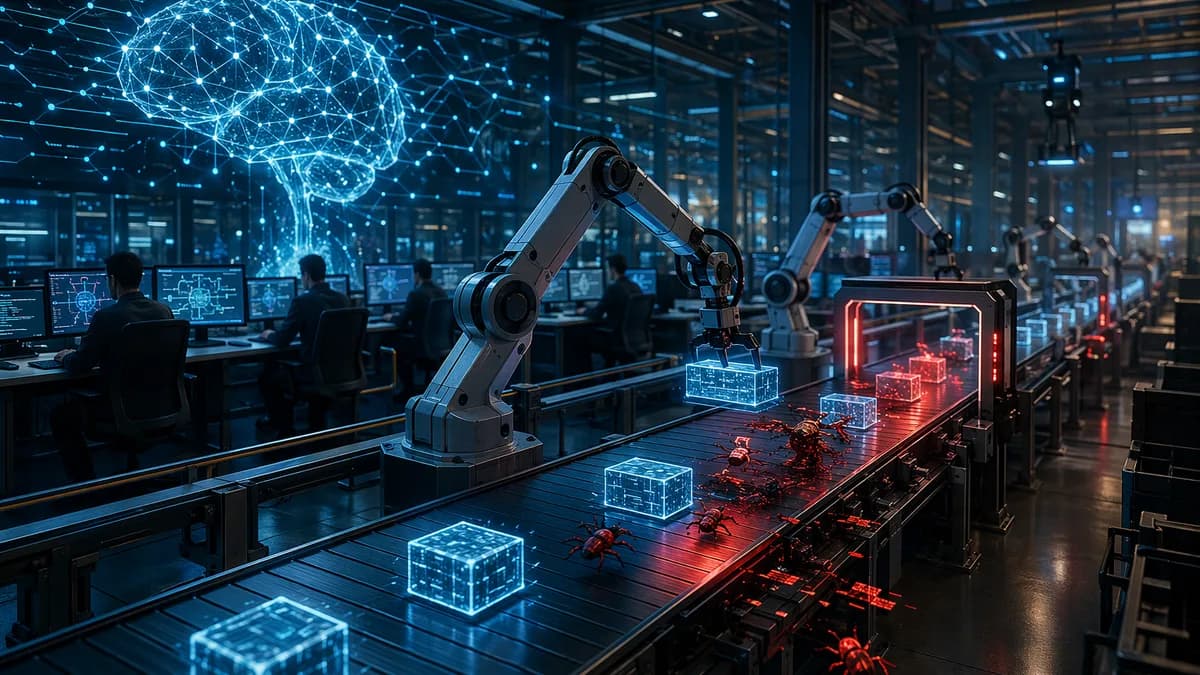
The question most AI-assisted engineering teams are dodging is whether their software factory is producing better software, or simply multiplying defects faster than review and testing can absorb.
XOOMAR Intelligence
Analyst Take
That tension is the core of a new VentureBeat explainer, which argues that LLMs have collapsed the barrier to writing functional code, but not the barrier to maintaining durable systems, according to VentureBeat.
The numbers make the warning hard to ignore. Faros AI found task throughput per developer is up 33.7% and PR merge rate is up 16.2%, while the incidents-to-PR ratio has risen 242.7% and bugs per developer are up 54%. That is the productivity trap in one sentence: more work is moving through the pipeline, but more bad work is reaching the system too.
Put another way, the software factory that wins may not be the one that generates the most code, but the one that prevents the most defects downstream.
Why should AI-assisted engineering teams worry that a software factory ships bugs faster?
Because code generation is no longer the scarce resource.
For years, the bottleneck was obvious: companies wanted more software than engineers could build. VentureBeat points to Excel as one long-running workaround, a tool that often fills the gap for software companies wish they had but never get around to building.
AI coding tools change that equation. A single engineer can now produce more code than a few years ago. Nontraditional coders can also get functional code running with less friction. The immediate result looks good on dashboards: more tasks closed, more PRs merged, more movement.
The harder question is whether that movement creates reliable products.
“Should this be written?”
That is the new bottleneck. Not “Can we write it?” Not even “Can someone understand enough code to produce it?” The decision point shifts to durability, maintainability, and risk.
XOOMAR analysis: this is where many AI productivity stories get lazy. They count output at the point of creation, then ignore the cost of defects, incidents, rework, and technical debt. A software factory only deserves the name if it industrializes quality control, traceability, and standards, not just code generation.
What does a real software factory mean in the age of LLM-generated code?
A software factory is a production system for software. It is not a folder full of prompts, a few coding agents, a PR review bot, and some repo-level skills files.
The manufacturing analogy works only if teams take the unglamorous part seriously. Industrial factories improved output because they organized work, made processes repeatable, and controlled quality. They were not just rooms full of machines.
| Approach | What it optimizes | What can break |
|---|---|---|
| Tool bundle | Faster local coding and reviews | Fragmented standards, weak traceability, inconsistent output |
| Software factory | End-to-end production control | Requires platform discipline, process design, and quality gates |
VentureBeat cites Luca Rossi's “The Era of the Software Factory” as part of the idea’s recent crystallization. The point is not that AI makes developers type faster. It is that AI changes the production system around software.
That matters because CI/CD alone was built for a different pressure level. It can move code through build, test, and deployment pipelines, but it does not automatically decide whether an LLM-generated design fits the architecture, follows standards, or will remain understandable six months later.
The software factory has to define how work moves through the system: how code is generated, reviewed, tested, traced, deployed, and improved after failure.
How do AI coding tools turn speed gains into software delivery risk?
The risk starts with volume. When one person can generate far more code, the codebase can swell before the organization has matching review, testing, and architecture controls.
Smaller organizations face a sharper version of this. VentureBeat notes that even smaller companies can suddenly see codebases balloon toward sizes that would once have been more typical of larger tech companies. Bigger codebases are not automatically worse. Uncontrolled growth is.
The failure mode is style drift. Multiple engineers move quickly. LLMs absorb and reproduce whatever patterns exist in the codebase. Without standards, inconsistent approaches compound. The model does not merely generate code, it can amplify the mess already present.
Google’s DORA research adds a broader warning signal: more AI adoption was associated with worse delivery stability. That does not mean AI coding tools are doomed. It does mean adoption alone is a weak success metric.
This is the same pattern XOOMAR has seen in adjacent AI debates. Consumer prompts can be useful in narrow contexts, as in 3 ChatGPT Prompts Can Rescue Your Gaming Backlog Fast. Enterprise engineering is different. The output enters production systems, incident queues, and customer workflows.
What can go wrong when an AI-built data platform grows without standards?
VentureBeat’s most useful section is not theoretical. The author, writing from experience as a fractional head of data, describes being brought in during the past year to fix two AI-generated data infrastructure projects that had started to morph over time.
The mechanism was simple. Several engineers moved fast. Standards were missing. LLMs began reflecting and extending inconsistent design choices.
Within months, the codebases developed five to six different styles, a process the author says previously took years. Engineers slowly lost confidence in what the systems were doing.
That is the hidden cost of AI-assisted velocity. The team feels productive while the system becomes harder to reason about. The cleanup arrives later.
VentureBeat compares the pattern to the earlier wave of self-service tooling: early gains that hide downstream complexity. XOOMAR analysis: the same management trap applies across AI work. Leaders see a faster interface and mistake it for a controlled system. That mistake sits behind broader anxiety about AI’s effect on work, including debates like Bill Gates AI Jobs Warning Collides With His Misses.
How should a software factory control quality before AI-written code reaches production?
The first rule is platform over tools.
A PR review agent can help. A skills file can help. Neither creates a factory. A real platform connects the work, standards, tests, review process, and deployment flow so the system behaves as one production line rather than scattered machines in separate corners.
The second rule is rerunability and traceability. VentureBeat argues that teams need the ability to go back into any run, identify what went wrong, and rerun it. The system should support taking a serial ID, looking it up, and tracing how that output was produced.
That is why the article favors state machines over loose loops for AI workflows. In this context, a state machine means the workflow moves through defined stages, making failures easier to locate and reproduce. A loose loop can keep trying, but it is harder to explain exactly what happened.
Quality also has to move forward in the process. Waiting for final review turns human reviewers into the last wall before production. That wall will crack when code volume rises.
Practical controls from the source include:
- Specs: Quality starts with how the work is described.
- Templates: LLMs need structure for the code they are expected to produce.
- Static code analysis: Obvious errors should be caught early.
- Testing: Bugs should be stopped at the lowest possible stage.
- Guardrails: Safety measures need to be built into the platform, not bolted on later.
- Standardization: Enterprise codebases already have their own flavor. AI makes inconsistency spread faster.
What separates a durable software factory from a bug factory with better tooling?
A company is not more productive because it produces millions of cars that fall apart within 100 miles. VentureBeat uses that example to make the software point bluntly: more output is not productivity if downstream failure rises with it.
The same applies to endless proofs-of-concept. If they never enter production, or if they create rework when they do, they are not durable output.
The durable software factory turns temporary AI tokens into maintainable production systems. The bug factory celebrates merged PRs while incidents pile up behind the dashboard.
The practical test for engineering leaders is direct: measure defect flow, not just code flow. If task throughput and merge rates rise while incidents and bugs rise faster, the factory is not working. It is just shipping failure with better tooling.
The watch item now is whether teams redesign the production system around AI coding, or keep adding one-off agents and calling it modernization. Standards, traceability, and front-loaded quality are the dividing line.
Impact Analysis
- AI coding tools are increasing output, but defect rates may be rising even faster.
- Engineering leaders need to measure software quality, not just completed tasks and merged PRs.
- The competitive advantage may shift from generating code quickly to preventing downstream failures.
AI-Assisted Engineering Metrics
Primary Sources & Disclosures

Written by
XOOMAR Insights Team
Research and Editorial Desk
The XOOMAR Insights Team pairs automated research with human editorial judgment. We track hundreds of sources across technology, fintech, trading, SaaS, and cybersecurity, cross-check the facts, and explain what happened, why it matters, and what to watch next. We do not just rewrite headlines. Every article is fact-checked and scored for reliability before it goes live, and we link back to the original sources so you can verify anything yourself.