
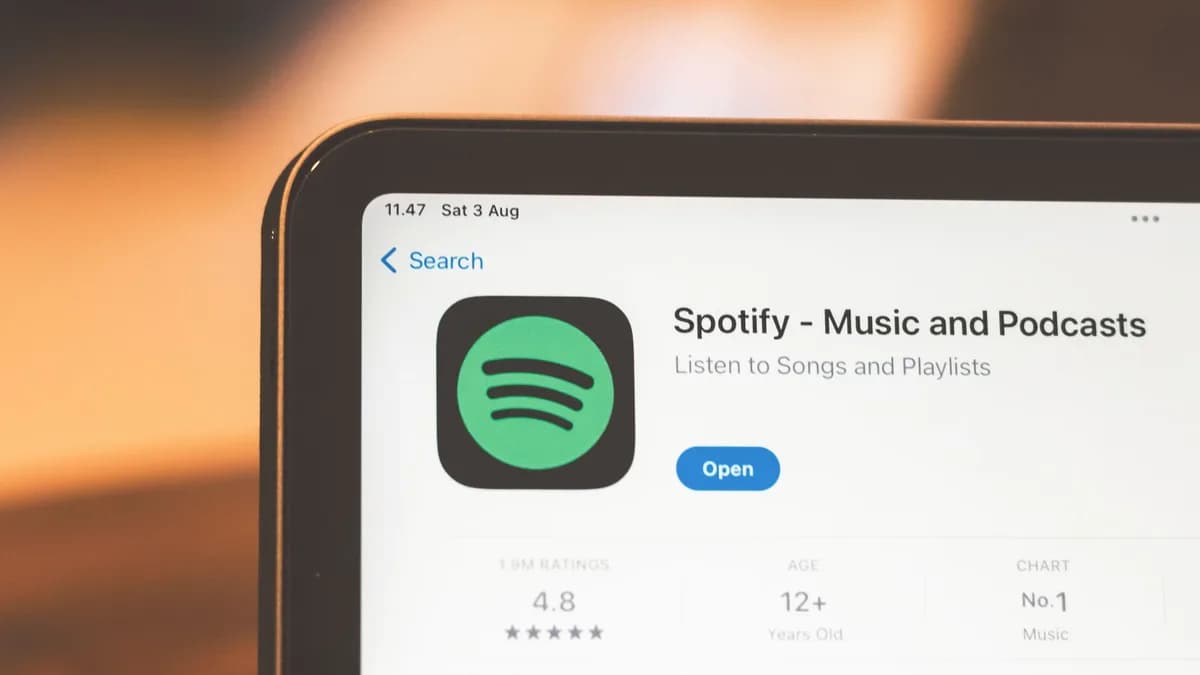
Spotify isn't just labeling AI-generated artists. It's systematically removing them from the economic engine of modern music. Starting in mid-September, the platform will apply "AI Persona" badges to profiles it determines represent photorealistic, non-human identities and, by default, exclude their music from every editorial and algorithmic recommendation system. This is a stark declaration of how the world's largest music streamer plans to navigate an ocean of synthetic content, according to TechCrunch. It's a policy of quarantine.
TechnologyAugust 11, 2026· 9 min read· By XOOMAR Insights Team
Spotify Quarantines AI Persona Artist Music
Updated on August 11, 2026
XOOMAR Intelligence
Analyst Take
58/ 100
4 sources analyzedLow confidenceTrend10Freshness100Source Trust90Factual Grounding88Signal Cluster20
"While we believe all artists have creative choice in determining how they present themselves, Spotify’s programming is focused on elevating music from authentic artists building careers in music," the company stated.
This is the core tension. Spotify champions its own AI-powered Prompted Playlists and upcoming licensed AI remix tools, yet it draws a bright red line at AI-generated identities. The move is a direct response to a simple user feedback loop: "Listeners have been clear in telling us that they don’t like seeing an artist profile that seems human, only to find out that the persona is AI-generated."
The Spotify Loyalty Test: When Fake Voices Flood the Streams
Spotify's new labeling policy isn't an act of corporate responsibility. It's a preemptive defense of its most valuable asset: listener trust. The platform's entire value proposition hinges on being a reliable guide through a universe of 100 million tracks. When that guide can't distinguish a human artist from a convincing simulation, the foundation cracks.
The policy creates an immediate tension. Spotify functions as both an open distribution platform and, now, an explicit taste arbiter with a bias for the "authentic." It's attempting to balance innovation, leveraging AI for features like its AI DJ, with containment, stopping what it internally labels "slop," the low-quality content AI makes trivial to mass-produce. Allowing that "slop" to proliferate unchecked, Spotify's own announcement implies, "could lead to a poor user experience and subscription cancellations."
This isn't a philosophical stance on art. It's a cold, strategic calculation about churn.
Amplifying Silence: How Spotify’s Recommendation Blackout Cripples AI Artists
Excluding AI Persona music from recommendations isn't a gentle nudge. It's a commercial death sentence within the Spotify ecosystem. The company specifies the blockade: no inclusion in editorial playlists (like RapCaviar or Lorem), no algorithmic charts, no Discover Weekly, no Release Radar, no personalized radio stations, and no "Fans Also Like" sections.
For the vast majority of artists, human or not, discovery is the business model. Without algorithmic amplification, a track is a piece of digital driftwood in a vast ocean. Spotify is architecting a two-tier ecosystem:
- Tier 1: Algorithmically-supported human artists.
- Tier 2: Quarantined AI Personas, accessible only by direct search or if a user actively chooses to follow them.
The policy makes a critical distinction. The badge is "about the artist’s public identity, not about how the music was made." A human artist can use every AI tool in the box, disclose it via Spotify's AI Credits and SongDNA features, and still receive full promotional support. An entity presenting as a photorealistic AI identity cannot, regardless of musical quality. This frames the debate not as human-vs-machine creativity, but as truth-vs-fiction in artist branding.
Is this curation or censorship? From Spotify's view, it's feature curation to maintain ecosystem health. From an AI artist's perspective, it's platform-enforced obscurity for an entire category of art.
The Data Divide: A Numbers Look at Music’s AI Inflection Point
The urgency behind Spotify's move is quantified by rival platforms. France's Deezer, which began detecting AI music in 2025, reported that fully AI-generated tracks made up more than 50% of its daily uploads in June 2026, hitting nearly 90,000 tracks per day. That was up from 75,000 daily in April. Deezer also noted that up to 85% of streams on fully AI-generated music were fraudulent in 2025, leading it to strip those streams from royalty payments.
These numbers paint the precipice. If unchecked, AI-generated content could not only overwhelm catalogs but also become a primary vector for streaming fraud, distorting royalty pools and eroding trust further. While Spotify hasn't released its own comparable stats, it stated in September 2025 that it had removed over 75 million 'spammy' tracks in the prior year, a purge tied to new rules against AI-enabled fraud.
The potential cost/benefit for Spotify is stark:
| Potential Benefit for Spotify | Potential Risk for Spotify |
|---|---|
| Reduced fraud monitoring costs | A homogenized, less "viral" catalog |
| Simplified royalty calculations (less AI persona traffic) | Missed opportunities on AI-driven hits |
| Stronger user retention via trusted discovery | Backlash from creators over perceived gatekeeping |
Spotify is betting that the risk of a bland, untrustworthy service outweighs the cost of walling off a fast-growing segment of its uploads.
Stakeholder War Games: Labels, Indie Artists, and Listeners Collide
Every party in music now faces a redefined battlefield.
Major Labels (UMG, Sony, Warner): They are likely quietly supportive. This policy protects their core IP, human star power, and complements their own industry push. In July 2026, a coalition of majors and independents proposed principles to bar AI-made recordings from official charts unless "substantially human-made." Spotify's move aligns perfectly, shielding their roster from synthetic competition in the recommendation queue. It also creates a clearer lane for their recent licensing deals for AI remixes, as seen in our coverage of the Spotify Converts AI Music Chaos Into Licensed Gold Rush.
Independent Human Artists: Reactions will be mixed. Many will welcome less algorithmic competition from an infinite army of AI personas. Yet a chilling thought lingers: if Spotify feels empowered to quarantine "inauthentic" identities today, what defines "authenticity" tomorrow? Could a heavily AI-assisted human face similar scrutiny?
Listeners: The policy assumes a default preference for human provenance. But is that true across all listening contexts? A listener seeking ambient soundscapes for focus may not care if the "artist" is a neural network. Spotify's "do not recommend" default preemptively makes that choice for them, sacrificing serendipity for transparency.
AI Artists/Developers: For them, this is stigmatization. It frames their work as inherently less worthy of discovery and challenges the very definition of an "artist." Their path to audience growth, once reliant on platform algorithms, now depends entirely on off-platform virality.
From Auto-Tune to AI Tunes: A History of Tech Backlash in Music
Spotify's policy is the newest chapter in a long saga of music industry gatekeeping facing technological shockwaves.
- Drum machines were accused of destroying "real" rhythm sections.
- Sampling sparked a decade of litigation before establishing licensing norms.
- Auto-Tune faced purity debates before becoming a ubiquitous production tool.
Each wave followed a pattern: moral panic, legal and commercial battles, followed by eventual absorption (or regulated guidelines). The critical difference now is the gatekeeper. It's not a genre elite or a label legal team. It's the distribution and discovery platform itself, the infrastructure. Spotify is writing the rules for what gets amplified on its privately owned public square.
This contrasts sharply with platforms like YouTube, which have taken a more permissive, reactive approach to AI music. Spotify is choosing to be proactive, acting as a filter at the point of ingestion rather than a referee post-facto.
For Users and Creators, Spotify Draws a Line in the Sand
The practical implications are immediate and severe.
For listeners, you gain transparency but lose a degree of serendipity. You'll never accidentally fall for a compelling AI pop star, but you might also never encounter a synthetic track you'd genuinely love. Your discovery universe just became explicitly human-curated.
For aspiring producers and creators, the message is codified: using AI as a core identity forfeits access to the platform's growth engine. AI is a permissible tool, but not a permissible persona. This echoes recent shifts in other tech sectors where default permissions are being tightened, much like Anthropic Erases Claude's Default Permission Prompts.
For the wider industry, Spotify is setting a precedent other DSPs will feel pressure to follow. Apple Music relies on label declarations for AI tags. Deezer and Tidal already detect and demote AI content. Spotify's move could solidify a de facto streaming standard where algorithmic support is reserved for human-presenting artists.
The unspoken implication is Spotify's ultimate bet: that "human connection" and "authenticity" are its defensible moats against a future of commoditized, infinite AI music.
The Next Move: Predictions for a Labeled and Sorted Soundscape
Spotify's mid-September rollout is not the end. It's the start of a brutal, platform-managed sorting process.
Prediction 1: The 'AI Persona' badge will become a badge of underground cred. A niche scene will emerge where being "algorithmically rejected" is a point of pride, with communities forming off-platform to promote quarantined AI artists who operate outside Spotify's mainstream.
Prediction 2: A 'human-assisted' metadata category will be forced into existence. The current binary, AI Persona vs. everything else, is too crude. Pressure will mount for a formal category for human artists who are transparent about heavy AI collaboration, creating a complex new layer for royalty attribution and perhaps even a separate, limited recommendation lane.
Prediction 3: The first viral crisis will test the policy's rigidity. What happens when a track from a labeled AI Persona blows up on TikTok and floods Spotify with direct searches? Will Spotify hold the line and deny it algorithmic placement, or will it create a "viral escape hatch" for AI tracks that prove organic appeal? This will be the policy's first major stress test.
Spotify has declared that authenticity is binary, identity is the line, and its algorithms will enforce it. The coming months will reveal whether listeners and creators accept those terms, or if they find ways to subvert, appeal, or redefine them from the outside.
Impact Analysis
- This policy directly shapes the economic viability of AI-generated artists by removing them from Spotify's critical recommendation and playlist systems.
- It sets a major industry precedent for defining 'authentic' artists versus synthetic personas, influencing other platforms' content policies.
- The move protects Spotify's core value proposition—listener trust—by preemptively addressing user discomfort with deceptive AI personas.
Sources
- [1] TechCrunch
- [2] Spotify to label 'AI personas' and exclude AI music from personal recommendations
- [3] Spotify’s new ‘AI Persona’ label flags AI-generated artist identities – and keeps their music out of recommendations by default - Music Business Worldwide
- [4] Spotify Creates New ‘AI Personas’ Label To Flag AI-Generated Artists

Written by
XOOMAR Insights Team
Research and Editorial Desk
The XOOMAR Insights Team pairs automated research with human editorial judgment. We track hundreds of sources across technology, fintech, trading, SaaS, and cybersecurity, cross-check the facts, and explain what happened, why it matters, and what to watch next. We do not just rewrite headlines. Every article is fact-checked and scored for reliability before it goes live, and we link back to the original sources so you can verify anything yourself.
Explore More Topics
Related Articles
 Technology
Spotify Converts AI Music Chaos Into Licensed Gold Rush
Spotify's licensed AI remix tool now has major backing from Merlin, converting the AI music flood into a direct revenue stream for thousands of independent arti
Aug 10, 20265 min
 Technology
Spotify AI Team Raises $10M for E-Commerce Makeover
The team behind the AI recommendation engine used by 800 million Spotify users has raised $10 million to bring similar, intent-based personalization to the worl
Aug 6, 20266 min
 Technology
Zuckerberg's Personal AI Pitch Betrays Meta's True Motive
Mark Zuckerberg's new AI manifesto, promising universal 'personal superintelligence,' inadvertently exposes the commercial engagement and data-harvesting logic
Aug 10, 20265 min
 Technology
AI Hunts for New Chips to Shatter Hardware's Heat Barrier
Discovered Materials is using AI to hunt for new semiconductor materials, aiming to replace a decade-long manual process and smash the heat wall throttling mode
Aug 10, 20267 min
 Technology
How AI Rescued Britain's Worst On-Time Airline
After years of Heathrow delays, British Airways recorded its best on-time performance by deploying AI tools to manage the airport's cascading logistical chaos.
Aug 10, 20266 min
 Cybersecurity
OpenAI Unchains Its AI for 95% of Cyber Attacks
OpenAI's new cybersecurity AI model dramatically reduces safety refusals, completing 95% of attack simulations, marking a major policy shift toward empowering a
Aug 11, 20266 min
 Cybersecurity
Visa Buys BioCatch for $2.4 Billion in Security Arms Race
Cybersecurity dealmaking topped $100 billion this year, driven by strategic buys like Visa's $2.4 billion BioCatch deal to combat behavioral fraud.
Aug 10, 20265 min
 Cybersecurity
North Korea's Cyber Arsenal Now Runs on Local AI
A new report warns that North Korean hacking groups are now operating fully localized, AI-driven cyber infrastructure to build malware and analyze stolen intell
Aug 10, 20266 min
 Global Trends
Trump Flees Bombers in an Airport Galley Truck
Faced with a credible Iranian threat, Donald Trump was secretly transferred from Air Force One via a catering truck and decoy flight, revealing a new era of pre
Aug 11, 20267 min
 Trading
Middle East Tumult Mutes RBNZ's Hawkish Rate Signal
The Reserve Bank of New Zealand's hawkish signals are powerless against a surging US Dollar and spiking oil prices driven by Middle East tensions, trapping the
Aug 11, 20266 min
Don't miss the signal
Get our weekly roundup of the stories that matter across tech, fintech, and trading. No noise, just signal.
Free forever. No spam. Unsubscribe anytime.