
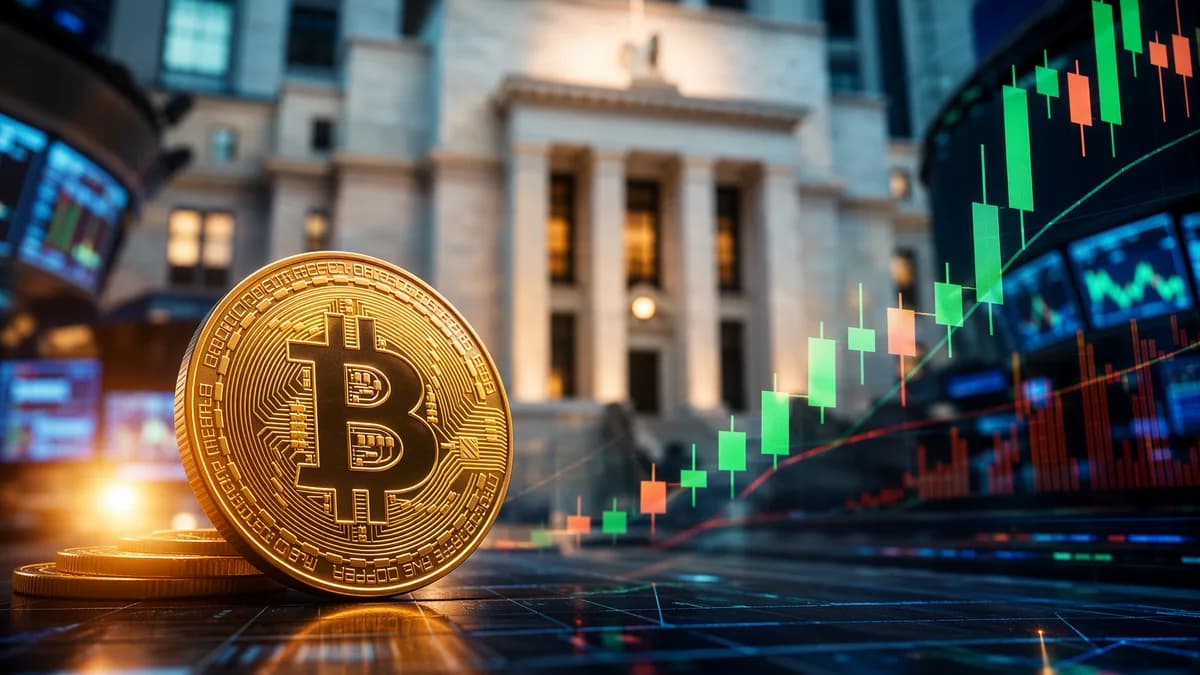
The bitcoin Fed meeting trade has narrowed to a cleaner bet than usual: traders don't need the Federal Reserve to promise cuts, they may only need Chair Kevin Warsh to sound less committed to tightening.
TradingJuly 28, 2026· 7 min read· By XOOMAR Insights Team
Bitcoin Fed Meeting Pins $64K Rally on Warsh's Tone
Updated on July 28, 2026
XOOMAR Intelligence
Analyst Take
57/ 100
3 sources analyzedLow confidenceTrend10Freshness98Source Trust88Factual Grounding88Signal Cluster20
Bitcoin held above $63,000 and was trading just below $64,000 on Tuesday, even as AI-linked technology shares weakened ahead of Wednesday's decision, according to CoinDesk. The setup is unusually tense. CME FedWatch data cited by CoinDesk showed markets pricing a 70% chance that the Fed stays on hold and a 30% chance of a surprise 25-basis-point hike.
Bitcoin bulls only need the Fed to blink, not pivot
The phrase that matters came from Thahbib Rahman, research analyst at Block Scholes:
"Anything remotely dovish from Warsh could lead to BTC's outperformance continuing," Rahman wrote.
That line captures the current bitcoin Fed trade. The market isn't necessarily demanding an outright easing signal. A softer inflation tone, less appetite for further hikes, or language that lowers the perceived risk of a policy surprise could be enough to keep bitcoin's July resilience intact.
XOOMAR analysis: Bitcoin is behaving less like a single-purpose crypto asset in this setup and more like a liquidity-sensitive macro instrument. That doesn't mean it will rally on any pause. A pause wrapped in hard inflation language could still pressure risk appetite. But when traders are already split 70% to 30% on the decision, even a small change in tone can matter.
The cleanest read is this: a dovish Fed tone would probably help bitcoin in the short run, but only if traders treat it as a real reduction in policy risk rather than cautious central-bank wording with no change in direction.
For related market context, see XOOMAR's earlier piece on how the Bitcoin Fed Meeting Threatens to Crack $65K Calm This Week.
Rate hike odds and bitcoin price action show a split bitcoin Fed trade
The strongest numbers in the CoinDesk report tell a divided-market story.
| Market signal | Source-supported read |
|---|---|
| Fed pricing | 70% chance of no change, 30% chance of a 25-basis-point hike |
| Bitcoin | Held above $63,000, traded just below $64,000 Tuesday, up about 6% for the month |
| S&P 500 | Little changed for the month |
| Semiconductor basket | Down nearly 20% |
| Policy uncertainty | Block Scholes said only two Fed meetings since 2015 had markets more divided |
Rahman said expectations have whipsawed over the past month as softer inflation data competed with renewed geopolitical tensions, higher oil prices, and tariff risks. That mix explains why the Fed decision is hard to price. One side sees room for patience. The other sees enough inflation and external pressure to justify staying restrictive.
"Tomorrow's FOMC meeting, Kevin Warsh's second as chairman of the Fed, is one of the most uncertain in years," Rahman said.
The source does not provide Treasury yield levels, real-rate data, dollar-index moves, or bitcoin's exact trading range beyond Tuesday's level near $64,000. So the defensible conclusion is narrower: the split is visible in Fed funds pricing and relative asset performance, not in a full cross-market rates map.
Why bitcoin may be less vulnerable than AI stocks if the Fed stays tough
CoinDesk's central contrast is blunt: bitcoin has held firm while AI-linked technology and semiconductor stocks have stumbled.
That does not make bitcoin immune to a hawkish Fed. It means the pressure points may differ. AI-linked equities can be hit by rate sensitivity and positioning at the same time. CoinDesk cited Vetle Lunde, head of research at K33 Research, who pointed to the Nasdaq entering July with strong momentum and increasingly stretched positioning, while BTC continued to consolidate near multi-year lows.
“With the Nasdaq entering July on the back of strong momentum and increasingly stretched positioning, while BTC continues to consolidate near multi-year lows, softer correlations are to be expected,” Lunde wrote. “As a result, this week's FOMC meeting may have a more limited impact on BTC than in previous periods of heightened policy uncertainty."
XOOMAR analysis: That is the core distinction. If a trade is crowded, a tough Fed can force faster de-risking. Bitcoin may have less air to lose if positioning is already less extended. But that is not the same as safety. If Warsh surprises with a hike or keeps a hard inflation-fighting tone, crypto can still sell off quickly.
The key phrase is "more limited impact." Not no impact.
Different investors are asking Warsh for different things
Short-term crypto traders want the simplest thing: a dovish surprise. If bitcoin is already up about 6% for the month while semiconductors are down nearly 20%, traders will look for confirmation that the divergence can continue.
Longer-term holders may read the Fed differently. The CoinDesk article does not provide spot ETF flow data, miner balance-sheet data, or wealth-manager allocation figures, so there is no basis to claim those groups are actively repositioning before the meeting. The cleaner inference is that all of them are watching the same immediate signal: whether BTC can hold its July gains after the policy decision.
XOOMAR analysis: The stakeholder split is about time horizon. Fast-money traders care about the first reaction to Warsh's wording. Longer-term allocators care about whether bitcoin's weaker equity correlation persists after the Fed event passes.
For broader fintech allocation context outside this specific Fed trade, XOOMAR recently covered how private-market appetite surfaced in Revolut Valuation Rockets to $115B in Employee Share Sale.
The old Fed playbook is less useful when bitcoin correlation softens
The temptation is to treat every Fed meeting as a simple risk-on or risk-off switch. This one is messier.
Block Scholes said bitcoin's divergence from stocks has become more pronounced this month. CoinDesk reported BTC up about 6%, the S&P 500 little changed, and a semiconductor basket down nearly 20%. That spread is the story.
A weaker correlation with equities means the bitcoin Fed meeting may not follow the usual script. If the Fed stays on hold but sounds stern, richly positioned equity trades may still absorb more damage than BTC. If Warsh sounds softer, bitcoin may have a clearer path to extend its outperformance.
The risk is overreading one month. Lunde's point supports softer correlations "at the margin," not a permanent decoupling. Bitcoin has not exited macro trading. It has only shown that this particular Fed shock may land unevenly across assets.
A softer Fed gives crypto a window, not a free pass
A dovish tone could lift crypto sentiment because it would reduce the odds of an immediate policy squeeze. That is the simple bullish case.
But investors should separate a Fed-driven bounce from a durable trend. CoinDesk's source material supports improving crypto sentiment, bitcoin's July gain, and softer equity correlations. It does not establish sustained ETF demand, stable funding conditions, or a sector-wide recovery in crypto equities.
The practical markers after the decision are straightforward:
- Bitcoin level: Does BTC hold above the zone it defended before the meeting, or fade the first move?
- Fed tone: Does Warsh sound patient, or does he keep the door open to further tightening?
- Relative performance: Does bitcoin keep outperforming AI-linked technology and semiconductor stocks?
- Market pricing: Does the current 70% hold and 30% hike split resolve cleanly, or does uncertainty roll into the next meeting?
Bitcoin's next move hinges on Fed language, not just the rate decision
The rate decision matters. The language may matter more.
If the Fed stays on hold and Warsh sounds even mildly less hawkish, bitcoin could catch support from traders already leaning into its July outperformance. That would fit Rahman's "anything remotely dovish" setup.
If the Fed hikes, or pauses while stressing inflation risks, bitcoin faces pressure. The difference is that AI-linked tech may remain more exposed if stretched positioning continues to unwind, as Lunde's framing suggests.
The strongest bullish scenario is narrow and evidence-based: no hike, less hawkish language, and bitcoin holding gains while semiconductors remain weak. The thesis weakens if BTC gives back its July strength despite a Fed pause, or if the Fed's wording makes the 30% hike risk look less like a one-off scare and more like the start of a tougher policy path.
Disclaimer: This XOOMAR analysis is for informational and educational purposes only. It is not financial, investment, legal, tax, or professional advice. It does not provide buy, sell, hold, price-target, portfolio, or personalized recommendations. Verify information independently and consult qualified professionals before making decisions.
The Bottom Line
- Bitcoin is trading as a liquidity-sensitive macro asset ahead of the Fed decision.
- Markets are split enough that even a small shift in Fed tone could move BTC.
- A dovish signal may help bitcoin, but hawkish inflation language could limit upside.
Fed Meeting Scenarios for Bitcoin
| Scenario | Market Signal | Potential Bitcoin Impact |
|---|---|---|
| Remotely dovish tone | Less commitment to tightening or softer inflation language | Could support continued BTC outperformance |
| Pause with hawkish language | Fed stays on hold but stresses inflation risk | Could still pressure risk appetite |
| Surprise 25-basis-point hike | Tighter policy than most traders expect | Could raise policy risk for bitcoin |
Market-Implied Fed Decision Odds
Fed stays on hold
%70
25-basis-point hike
%30
Sources
Disclaimer: Content on XOOMAR is produced using AI-assisted research, drafting, and verification workflows and is intended for informational and educational purposes only. It does not constitute financial, investment, legal, tax, medical, or professional advice of any kind. All analysis reflects available information at the time of publication and may not be current. Verify information independently and consult qualified professionals before making decisions. Editorial policy

Written by
XOOMAR Insights Team
Research and Editorial Desk
The XOOMAR Insights Team pairs automated research with human editorial judgment. We track hundreds of sources across technology, fintech, trading, SaaS, and cybersecurity, cross-check the facts, and explain what happened, why it matters, and what to watch next. We do not just rewrite headlines. Every article is fact-checked and scored for reliability before it goes live, and we link back to the original sources so you can verify anything yourself.
Explore More Topics
Related Articles
 Trading
Bitcoin Fed Meeting Threatens to Crack $65K Calm This Week
Bitcoin held near $65,000 after Nvidia's slide, but Fed week will test whether BTC's calm is real demand or just a macro pause.
Jul 27, 20268 min
 Trading
July Fed Rate Hike Bets Jolt Bitcoin Before CPI Test
Bitcoin fell as July Fed hike odds jumped to 50%, turning the inflation report into a make-or-break test for crypto risk.
Jul 14, 20269 min
 Trading
Fed Rate-Hike Bets Collapse as Bitcoin Nears $65,000
Bitcoin neared $65,000 after cool CPI crushed Fed hike odds from 43% to 13%, flipping the trade back toward risk.
Jul 15, 20268 min
 Trading
Oil Shock Traps Bitcoin Inflation Bulls in Fed Squeeze
Oil’s jump is turning Bitcoin’s inflation hedge story into a liquidity squeeze, putting Fed-cut hopes and BTC’s rally at risk.
Jul 10, 20268 min
 Trading
Dogecoin and Ether Stumble as Crypto's Rally Gets Tested
Dogecoin and ether led a shallow crypto pullback, but weekly gains held as traders looked ahead to the Fed.
Jul 24, 20267 min
 Fintech
Fed Skinny Account Fight Pits Local Banks Against Fintechs
Community banks warn the Fed's skinny account could give fintechs cheaper payment access while leaving banks and customers holding the risk.
Jul 28, 20268 min
 Cybersecurity
App Store Crypto Scam Drags Apple Into $1.8M Fight
Apple faces a lawsuit after users say a fake Sparrow Wallet on the App Store drained $1.8M in Bitcoin, testing its safety pitch.
Jul 27, 20269 min
 Fintech
Upstart Bank Charter Throws AI Lending Into Hot Seat
Upstart won OCC conditional approval, but its bank charter still needs FDIC and Fed signoffs before its AI lending model faces the real test.
Jul 27, 202610 min
 Trading
$4.5B GrubMarket IPO Throws Food Tech Under SEC Glare
GrubMarket has quietly started its IPO process, testing whether public investors will buy its $4.5B food supply chain tech story.
Jul 28, 20266 min
 SaaS & Tools
Zapier vs Tray Forces a Tough Enterprise Automation Bet
Zapier wins on adoption and app breadth, while Tray fights back with developer control. The real risk is letting edge cases slow everyone.
Jul 28, 202612 min
Don't miss the signal
Get our weekly roundup of the stories that matter across tech, fintech, and trading. No noise, just signal.
Free forever. No spam. Unsubscribe anytime.