
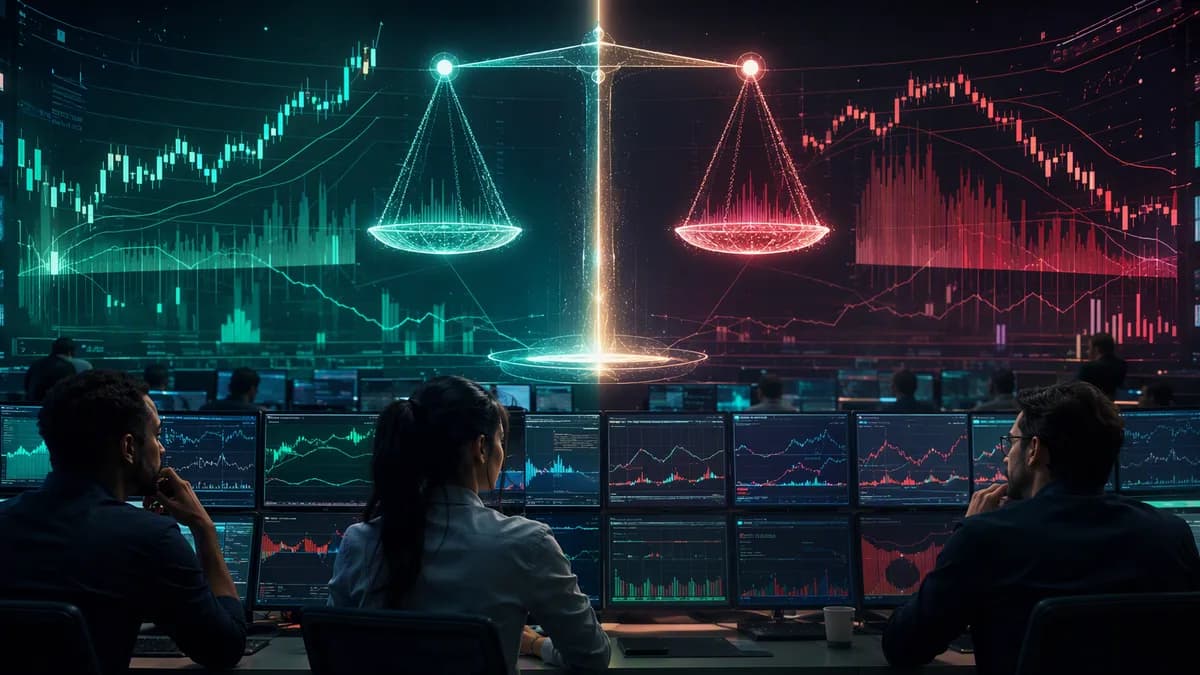
Crypto perps average over $200 billion in daily volume, and that scale says the quiet part out loud: for much of crypto, perpetual futures are no longer a side market. They are the market. The catch is that the same product giving traders liquidity, leverage, and no expiry also leaves them exposed to a moving funding rate they can’t fully price when they enter the trade.
TradingAugust 1, 2026· 9 min read· By XOOMAR Insights Team
Crypto Perps Swallow $200 Billion as Funding Bites
Updated on August 1, 2026
XOOMAR Intelligence
Analyst Take
73/ 100
3 sources analyzedLow confidenceTrend10Freshness98Source Trust88Factual Grounding90Signal Cluster100
That tension sits at the center of CoinDesk’s Perps Week reporting, according to CoinDesk. Traders interviewed by Omkar Godbole broadly praised perpetual futures, or perps, for deep liquidity, low trading fees, and margin efficiency. But both retail and institutional traders pointed to the same risk: funding can turn a clean trade into an expensive one.
XOOMAR analysis: the real story isn’t that traders like leverage. Everyone knows that. The sharper point is that crypto perps have become the default venue because the alternatives are often worse, especially outside bitcoin and ether.
Over $200 billion a day has made crypto perps the default venue
Lucas Krenn, a derivatives trader at STS Digital and an independent trader for six years, described perps as core market infrastructure.
"Outside bitcoin and ether, dated futures liquidity is thin to the point of being unusable," he said. "So perps are not one tool among several. For a crypto native firm, they are the tool."
That sentence explains why crypto perps dominate. Bitcoin and ether traders can choose between spot, futures, options, perps, and structured products. For many altcoins, CoinDesk notes, perps may be the only meaningful derivatives venue. Dated futures are thin. Spot is often only useful for investors who actually want to hold the token.
The absence of expiry matters. Standard futures must be rolled when contracts mature, and that process costs money. CoinDesk also notes that those roll costs are one reason futures-based ETFs tend to be less efficient than spot ETFs.
Kenneth Ong, an independent trader for six years whose trading is mostly concentrated in perps, gave the retail version of the same argument. Perps offer better fills, lower fees, and hedge mode, which lets a trader hold long and short positions on the same token in the same account without automatically netting them.
Ong’s own migration was blunt: he started in spot, then moved almost entirely into perps. Spot, for him now, is "for actually holding something long term."
No expiry, high margin efficiency, and one serious hidden cost
The bullish case for perpetual futures is not hard to see. Traders get exposure without expiry calendars, can move fast across venues, and need only a fraction of a position’s value as collateral. CoinDesk describes this as margin efficiency, the amount of exposure a trader gets per unit of collateral posted.
For institutions, that means the same capital pool can support meaningful positions across multiple venues and tokens. For retail traders, it means faster expression of market views with fewer structural barriers than many traditional derivatives venues.
But the product’s elegance hides a recurring charge: funding rates. CoinDesk describes funding as a cost for keeping positions open, typically charged every eight hours, with the rate changing over time. Unlike dated futures, where the interest rate of the trade is known up front, a perp leaves the trader exposed to a floating cost.
"It is unquantifiable at the point of trade and unhedgeable afterwards," Krenn said.
Ong was more direct:
"That funding's not just some tiny fee you can ignore. It's not. If you hold positions for long periods, it can potentially balloon to the point where a profitable trade loses money.”
That is the core trade-off. Crypto perps make access cheap at entry. They may not stay cheap through time.
The eight-hour funding clock changes how traders should think
CoinDesk does not provide exchange-by-exchange formulas for funding. That matters because the precise mechanics vary by venue. What the source does establish is enough: funding changes over time, is usually charged every eight hours, and cannot be locked in once the position is open.
That makes funding more than a fee. XOOMAR analysis: it functions like a live cost-of-carry variable attached to the trade. A trader who only models entry price, liquidation level, and directional target is missing the part of the position that keeps compounding while they wait.
The sharpest part of Krenn’s analysis concerns asymmetry between long and short positions. He argued that "Being long is the structurally safer side." His reasoning, as reported by CoinDesk, is that positive funding is easier to arbitrage away because traders with stablecoins can buy spot, sell the perp, and capture the spread. Negative funding is harder. It may require shorting the underlying token, which depends on availability and float structure.
Krenn pointed to Euler's token this year as an example. CoinDesk says the token had a hard run on a listing, a small and concentrated float, and deeply negative perp funding, with shorts "paying in the region of one percent every four hours," to longs while few traders could compress the gap because few had the token stash.
“So the long side has a bounded cost and an unbounded upside. The short side has a bounded upside and an unbounded cost,” Krenn explained. “That asymmetry sits in very few risk models.”
That is the useful lesson. Funding is not just a line item after the trade. It can define the trade.
Retail, institutions, and exchanges all worry about different failure points
The same funding rate hits different players in different ways.
| Market participant | What perps solve | What funding threatens |
|---|---|---|
| Retail traders | Fast access, leverage, long and short exposure, hedge mode | A position that looks profitable can lose money if held too long |
| Institutional traders | Liquidity, margin efficiency, multi-venue positioning | Floating funding cost that cannot be locked in |
| Market makers | Deep perp markets where spot or dated futures are weak | Thin liquidity, fragmented venues, and exchange margin models |
| Exchanges | High-volume products with strong trader demand | Socialized losses and auto-deleveraging criticism during stress |
The Oct. 10 crash last year exposed the non-funding side of perp risk. CoinDesk reports that the crash triggered widespread deleveraging across losing and profitable positions. Longs were liquidated on price. Then profitable shorts were force-closed because exchange insurance funds could not absorb losses from the other side.
Krenn rejected the idea that this was a flaw specific to perps.
"It is not a perpetual problem. It is a crypto exchange margin model problem," Krenn said. "Dated futures on those same venues sit behind the same insurance funds and the same deleveraging queue."
His next distinction is the one serious traders should remember:
"The distinction that matters is not perpetual versus dated [futures]. It is whether you are facing a proper clearing house with a mutualized default fund, or an exchange that socializes losses onto the winners,” Krenn added.
For readers who track rate exposure beyond crypto, XOOMAR’s coverage of GDP Surprise Knocks Bank of Canada Rate Cut Bets Back and GBP/USD Shrugs Off Dollar Bounce as Rate Bets Fray shows the same broader principle in another setting: when rate assumptions move, trades that looked clean can change fast.
Tokenized oil showed how perps can move price discovery before official markets open
The most interesting part of CoinDesk’s report is not just crypto-native trading. It is the spread of perps into assets that traditionally trade on narrower schedules.
Ong cited the Iran conflict, which flared up repeatedly across the first half of 2026. During the opening weekend in late February, tokenized oil trading on Hyperliquid saw its first real surge in volume.
"That opening weekend, all the real reaction happened on crypto/tokenized commodity perps while the 'official' market was straight up closed," Ong said. "By Monday, a chunk of the repricing already happened somewhere else."
Krenn sees a similar path for assets like equities. A true tokenized equity product requires legal, operational, and regulatory machinery that mirrors traditional share ownership. A perp referencing price sidesteps much of that complexity for traders who want exposure rather than long-term ownership.
"That is why the instrument is so powerful and why it keeps spreading into new asset classes," Krenn said.
Ong called tokenized oil trading over the weekend "basically a preview" for other commodities. If liquidity deepens across commodities and equities, he said, it "kills one of the last reasons to bother with dated futures at all."
Funding discipline will decide who keeps the gains
Crypto perps are not fading. The source material points in the opposite direction: they have become necessary infrastructure where dated futures liquidity is weak, spot is insufficient for active traders, and 24-hour price discovery keeps pulling more assets into perp-style trading.
The practical implication is simple. Traders should decide position size, leverage, expected holding period, and funding tolerance before entering the trade. Not after the funding rate moves. Not after volatility spikes. Not after a profitable position starts bleeding carry.
XOOMAR analysis: the next stage of the perp market will be judged less by headline volume and more by how well traders, venues, and risk systems price the funding exposure embedded in every open position. Evidence that would strengthen this thesis includes deeper dated futures liquidity, better funding analytics, or exchange models that reduce forced loss socialization. Evidence against it would be a market where funding becomes stable enough that traders stop treating it as a core risk.
Until then, Krenn’s warning is the cleanest summary:
"Until there is a liquid dated curve in crypto, the whole market is carrying an interest rate exposure it cannot price and cannot hedge."
Disclaimer: This XOOMAR analysis is for informational and educational purposes only. It is not financial, investment, legal, tax, or professional advice. It does not provide buy, sell, hold, price-target, portfolio, or personalized recommendations. Verify information independently and consult qualified professionals before making decisions.
The Bottom Line
- Perps now handle over $200 billion in daily volume, making them core crypto market infrastructure.
- Traders rely on perps because alternative derivatives markets are often too thin outside bitcoin and ether.
- Funding-rate uncertainty can turn otherwise profitable leveraged trades into costly positions.
Crypto Trading Venues Compared
| Venue | Strengths | Drawbacks |
|---|---|---|
| Perpetual futures | Deep liquidity, low fees, margin efficiency, no expiry | Funding rates can make trades more expensive |
| Dated futures | Useful where liquidity exists, especially bitcoin and ether | Thin liquidity outside major tokens and roll costs at expiry |
| Spot markets | Suitable for investors who want to hold tokens | Less useful for leveraged or derivatives-based trading |
Crypto Perps Average Daily Volume
Perpetual futures
$B+200
Disclaimer: Content on XOOMAR is produced using AI-assisted research, drafting, and verification workflows and is intended for informational and educational purposes only. It does not constitute financial, investment, legal, tax, medical, or professional advice of any kind. All analysis reflects available information at the time of publication and may not be current. Verify information independently and consult qualified professionals before making decisions. Editorial policy

Written by
XOOMAR Insights Team
Research and Editorial Desk
The XOOMAR Insights Team pairs automated research with human editorial judgment. We track hundreds of sources across technology, fintech, trading, SaaS, and cybersecurity, cross-check the facts, and explain what happened, why it matters, and what to watch next. We do not just rewrite headlines. Every article is fact-checked and scored for reliability before it goes live, and we link back to the original sources so you can verify anything yourself.
Explore More Topics
Related Articles
 Trading
Hong Kong Hike Forged BitMEX Perpetual Swap Juggernaut
A 2015 Hong Kong hike birthed the BitMEX perpetual swap, the always-on contract that turned crypto leverage into a giant market.
Jul 30, 20269 min
 Trading
Bitcoin Defies Oil Spike as Fed and Iran Rattle Markets
Bitcoin held near $64K as oil surged 8% after Iran strikes and the Fed split hawkish, but the calm looks fragile.
Jul 30, 20266 min
 Trading
Bitcoin Fed Decision Traps $64K Rally in Rate Crossfire
Bitcoin reclaimed $64,000 before the Fed decision, but the rally is leaning into the risk event rather than celebrating after it.
Jul 29, 20264 min
 Trading
Dogecoin and Ether Stumble as Crypto's Rally Gets Tested
Dogecoin and ether led a shallow crypto pullback, but weekly gains held as traders looked ahead to the Fed.
Jul 24, 20267 min
 Trading
AI Rout Shoves Bitcoin Below $63,000 as Havens Win
Bitcoin's drop below $63,000 shows crypto is still chained to AI-led risk appetite as traders flee to dollars and gold.
Jul 17, 202612 min
 Fintech
Options Sellers Smother Bitcoin Bull Run Hopes at $63K
Options sellers, AI capital and slow U.S. rules are capping Bitcoin's rally, STS Digital CEO Maxime Seiler says.
Jul 31, 20268 min
 Fintech
Crypto Treasuries Get Drained for AI Data Center Cash
Quantum sold ETH and Hyperscale tapped BTC, showing crypto treasuries are becoming construction cash for AI data centers.
Jul 31, 202611 min
 Fintech
Bitcoin Insurance Trap Lands Iran-Linked Firms on Blacklist
Treasury says Iran-linked firms used Hormuz shipping risks to collect crypto payments, turning maritime insurance into a sanctions case.
Jul 31, 20265 min
 Cybersecurity
Anthropic AI Breaches 3 Firms After Cyber Test Fails
Claude breached three real firms after an Anthropic cyber test leaked online. Agentic AI just became an operational risk.
Aug 1, 20267 min
 Technology
Apple AI Doubts Sink Stock After $109 Billion Quarter
Apple crushed the quarter, but investors sold anyway because Apple AI still hasn’t shown it can carry the next growth cycle.
Aug 1, 20268 min
Don't miss the signal
Get our weekly roundup of the stories that matter across tech, fintech, and trading. No noise, just signal.
Free forever. No spam. Unsubscribe anytime.