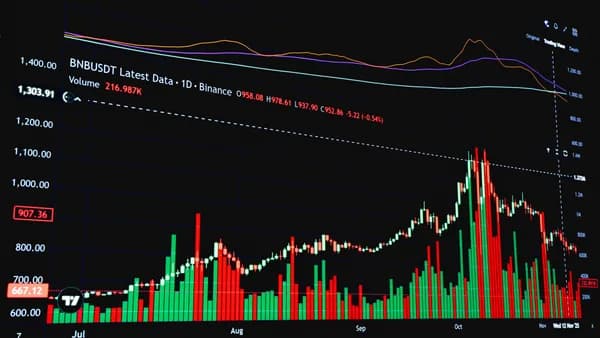
XRP’s 4% push above $1.18 has turned a rebound into a credibility test: buyers now have to prove this is a base, not another failed bounce near obvious resistance. The token reclaimed the $1.14 to $1.15 zone, traded above $1.18, and is now pressing toward $1.20, according to CoinDesk.
XOOMAR Intelligence
Analyst Take
That matters because this move came with the strongest buying activity since the recent sell-off began. XRP rose from $1.1503 to $1.1866 during the 24-hour session, briefly touched $1.1928, and consolidated above $1.18. The question is no longer whether buyers can spark a rebound. They already did. The harder question is whether they can defend it after the first wave of profit-taking hits.
XRP’s $1.18 breakout puts the $1.20 resistance wall on trial
The cleanest read is this: $1.20 is now the market’s lie detector.
It is close enough to pull in breakout traders. It is also obvious enough to attract sellers who bought the dip near lower levels and want to lock gains. That makes the next move more useful than the headline percentage gain. A brief spike through $1.20 would say little by itself. A hold above it, with volume still elevated, would say far more.
CoinDesk’s key technical point is the reclaim of $1.14 to $1.15. That area acted as resistance during the decline and has now flipped into support. XOOMAR analysis: when a former ceiling becomes a floor, traders start treating the move as structure rather than noise. That doesn’t make the rally safe. It makes it measurable.
The setup echoes the support tension around XRP’s earlier defense of lower levels, covered in our XRP Defends $1.10 as ETF Inflows Mask Weak Demand. The difference now is that price has moved away from the danger zone and into a test of whether demand can follow it higher.
The numbers behind XRP’s rebound: 4% gains, $1.18 support, and the $1.20 liquidity test
The move was not just a slow drift upward. The strongest burst came during the June 14 21:00 UTC session, when volume surged to 107.6 million XRP, more than four times the daily average, pushing price through resistance near $1.14.
That volume matters. In crypto, price can jump on thin liquidity and then collapse when sellers return. Here, CoinDesk says the advance was backed by sustained participation rather than short-covering alone. That is the strongest bullish detail in the report.
The levels now define the trade:
| XRP level | Market role | Why it matters |
|---|---|---|
| $1.18 | First support | Breakout buyers need this area to hold |
| $1.14 to $1.15 | Major support | Former resistance has flipped into the key defense zone |
| $1.20 | Immediate resistance | Psychological level likely to attract profit-taking |
| $1.27 to $1.30 | Next resistance band | CoinDesk cites Fibonacci and trendline resistance convergence |
XOOMAR analysis: if XRP tests $1.20 and then loses $1.18, traders may treat the move as a failed breakout attempt rather than the start of a larger trend. If it holds $1.18 and builds another higher low, the case improves.
Institutional flows and ETF demand are changing how XRP rallies trade
The most important non-price detail is the flow backdrop. XRP-linked ETFs have attracted roughly $1.4 billion in cumulative inflows since launching, with May marking the strongest month of institutional demand so far, according to the source material.
That changes how traders read the chart. A rally driven only by social momentum can fade quickly when retail attention moves elsewhere. A rally supported by ETF flows and larger holders has a different profile. It can still reverse hard, but it gives bulls a stronger argument that demand is not limited to short-term speculation.
Put more cautiously, the available source material points to continued institutional demand and larger-holder activity, including reported ETF inflows and rising whale-address metrics, even as broader market conditions remain uneven.
The ETF angle also affects behavior before it affects price. Traders often position ahead of perceived future demand. That can accelerate a move into resistance, especially when the chart has already reclaimed a prior breakdown zone.
Still, ETF demand is not a guarantee. Crypto ETF flows can be powerful and still fail to dictate spot direction over short windows, a dynamic we also track in $9B Bitcoin ETF Exit Still Fails to Crack Investors. For XRP, the test is narrower: do flows keep supporting higher lows, or do they only cushion declines?
XRP traders, long-term holders, and institutions don’t want the same thing from this move
Short-term traders want confirmation. Their checklist is simple: hold $1.18, protect $1.14 to $1.15, break $1.20, then see whether price can reach the $1.27 to $1.30 resistance band without volume drying up.
Long-term holders are watching a different movie. The source material says more than 25 million XRP recently left exchanges, extending a trend that suggests long-term holders are accumulating despite broader market weakness. Whale addresses holding significant balances also climbed to a record high.
That supports the accumulation argument, but it doesn’t remove risk. XOOMAR analysis: exchange outflows can reduce immediately available selling pressure, but they do not force price higher. They matter most when paired with fresh demand. That is why the volume surge around the breakout is so central.
Institutions likely care less about a single round number than about liquidity, product access, and whether XRP can sustain volume without relying on one headline. The ETF data suggests the access point is improving. The chart now has to show that the market can absorb selling above $1.20.
Bears still have a clean argument. A 4% crypto rally is not dramatic by itself. Until XRP breaks and holds above nearby resistance, the move remains constructive but unproven.
How this XRP setup compares with past failed rallies and breakout cycles
XRP has a history of sharp narrative-driven rallies that lose force when buyers fail to defend newly reclaimed support. The current setup is trying to avoid that pattern by building a base above former resistance.
The difference this time, based on the supplied material, is the combination of three forces:
- Volume: The breakout through $1.14 came on 107.6 million XRP in one session.
- ETF flows: XRP-linked ETFs have drawn roughly $1.4 billion in cumulative inflows.
- Holder behavior: More than 25 million XRP recently left exchanges, while whale addresses rose to record highs.
That mix does not prove a new uptrend. It does make the rally harder to dismiss as a thin short squeeze. CoinDesk also notes that daily momentum indicators are improving, with several analysts highlighting a bullish RSI divergence while XRP tested the $1.05 support zone.
The warning is simple: past patterns help, but lazy comparisons can mislead. This market has different access points, different flow vehicles, and different liquidity conditions than earlier XRP cycles. The only reliable confirmation is still price plus volume.
What XRP’s $1.20 test means for crypto investors and digital asset markets
For active traders, $1.20 now defines risk. A hold above it would likely pull attention toward $1.27 to $1.30. A rejection followed by a break below $1.18 would weaken the near-term setup quickly.
For investors, the bigger question is whether XRP is showing renewed demand for large-cap altcoins with payment, settlement, and liquidity narratives. The source supports that possibility through ETF inflows, exchange outflows, and whale accumulation. It does not prove a durable rotation.
This is where the XRP move becomes useful beyond one token. If the rally holds, it strengthens the idea that institutional capital is broadening into crypto assets beyond the most obvious names. If it fails near $1.20, the market may become less forgiving toward ETF-demand narratives that have not yet translated into sustained spot strength.
XRP price scenarios: a clean break above $1.20, a rejection, or a slower grind higher
The bullish scenario is straightforward. XRP breaks $1.20, holds it, and keeps volume strong enough to pull sidelined momentum traders toward the $1.27 to $1.30 zone.
The bearish scenario is just as clear. XRP rejects at $1.20, loses $1.18, and forces traders to question whether the rally was another short-covering bounce. A drop below $1.14 would damage the bullish case because that is the reclaimed support zone CoinDesk identifies as central to the move.
The base case may be less exciting: XRP chops between support and resistance while traders wait for stronger proof from flows and volume. That would still be useful. A market that consolidates above a reclaimed level is healthier than one that spikes and collapses.
The practical watch item is not the 4% gain. It is whether buyers defend the breakout after profit-taking starts. That evidence will decide whether XRP’s move above $1.18 becomes the start of a broader trend or just another rally that ran out of buyers at the first obvious wall.
Disclaimer: This XOOMAR analysis is for informational and educational purposes only. It is not financial, investment, legal, tax, or professional advice. It does not provide buy, sell, hold, price-target, portfolio, or personalized recommendations. Verify information independently and consult qualified professionals before making decisions.
The Bottom Line
- XRP’s move above $1.18 shifts attention to whether buyers can hold momentum near $1.20 resistance.
- The reclaimed $1.14 to $1.15 zone gives traders a clearer support level to watch.
- Stronger buying activity suggests the rebound has credibility, but profit-taking could quickly test demand.
XRP Key Price Levels
Primary Sources & Disclosures
Disclaimer: Content on XOOMAR is produced using AI-assisted research, drafting, and verification workflows and is intended for informational and educational purposes only. It does not constitute financial, investment, legal, tax, medical, or professional advice of any kind. All analysis reflects available information at the time of publication and may not be current. Verify information independently and consult qualified professionals before making decisions. Editorial policy

Written by
XOOMAR
Data desk
XOOMAR is a capital markets software and data company. Every brief on this site starts from a dataset the company collects itself from primary sources (CFTC, SEC EDGAR, FINRA, the Federal Reserve, exchange APIs) and names the numbers it is built on, with a link to the data page so you can check them. Briefs are reviewed before they go out and corrected in place when the data is revised.