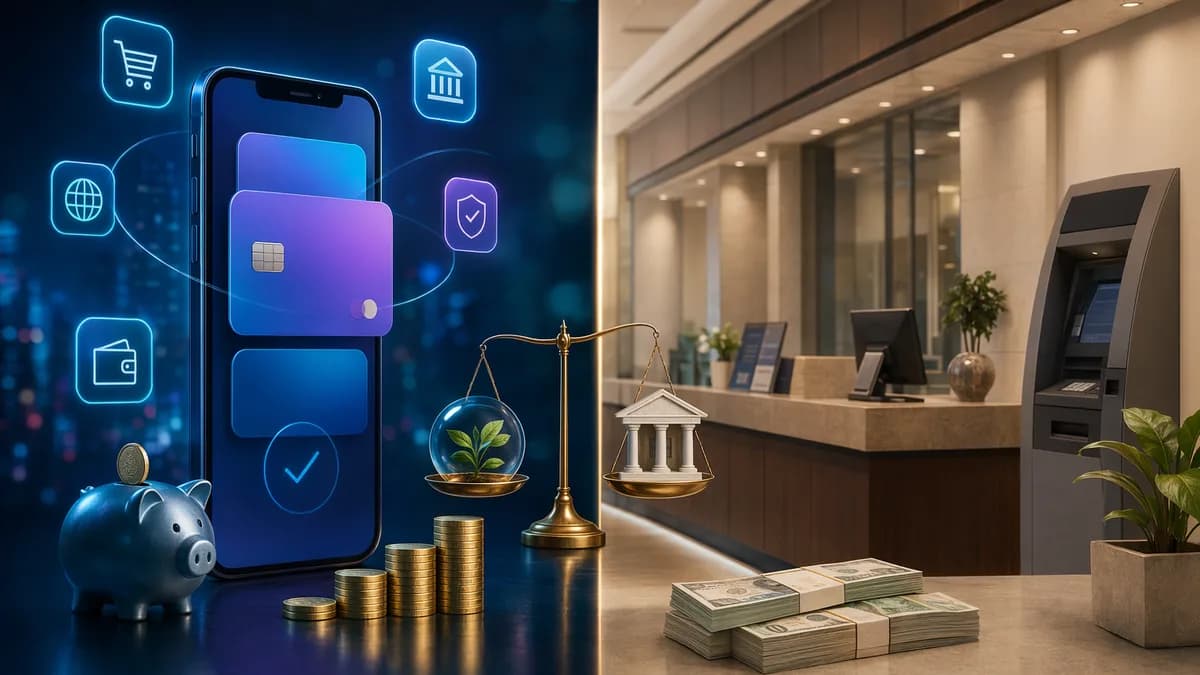
Choosing between digital banks vs traditional banks is less about finding a universal winner and more about matching the bank model to how you actually use money every day. The research consistently shows a trade-off: digital banks tend to win on convenience, lower fees, faster onboarding, and app-based tools, while traditional banks remain stronger for branch access, cash handling, complex products, and face-to-face support.
For everyday banking, the best answer may be a primary digital account, a primary traditional account, or a hybrid setup. Below is a grounded comparison across fees, savings rates, mobile features, ATM access, customer support, safety, and account protections.
Digital Banks and Traditional Banks Defined
Digital banks are online-first or online-only financial institutions that provide banking services through mobile apps and websites. Sources describe them as operating without physical branches, with account opening, transfers, bill payments, support, and other services handled digitally.
Examples mentioned in the research include Chime, Monzo, Revolut, N26, GXS Bank, Trust Bank, and MariBank.
Traditional banks are established financial institutions with physical branches, branch staff, ATMs, and digital platforms. They usually combine in-person service with online banking and mobile apps.
Examples cited in the source data include JPMorgan Chase, Wells Fargo, HSBC, Citibank, DBS, UOB, OCBC, Bank of America, and State Bank of India.
The core difference in the digital banks vs traditional banks comparison is physical presence: traditional banks have branches; digital banks operate primarily or entirely online.
Digital banks vs traditional banks at a glance
| Category | Digital Banks | Traditional Banks |
|---|---|---|
| Access model | Mobile apps and websites | Branches, ATMs, apps, websites |
| Service hours | Typically 24/7 digital access | Branch services limited to operating hours; digital access available |
| Account opening | Fully digital; often fast and paperless | Online or in-person; may involve paperwork or branch visits |
| Fees | Often lower due to reduced overhead | Often higher due to branch and staffing costs |
| Savings rates | Often higher or promotional/tiered | Generally lower unless using specific high-yield products |
| Cash handling | Limited or no physical cash services | Stronger for deposits, withdrawals, and large cash transactions |
| Support model | In-app chat, email, phone, chatbots | Branch staff, phone banking, digital channels |
| Product range | Core accounts, cards, loans in some cases, digital tools | Broader range: mortgages, loans, investments, insurance, wealth management |
| Best fit | Mobile-first users, savers, travelers, freelancers | Cash users, complex financial needs, relationship banking |
Digital banks are often described as especially appealing to tech-savvy users who want fast access, real-time notifications, budgeting tools, and lower-cost account structures. Traditional banks are better suited to customers who want in-person advice, broader product availability, and physical access for cash or complex financial matters.
Account Fees and Minimum Balance Requirements
Fees are one of the clearest differences between digital banks and traditional banks. The source data repeatedly connects digital banks’ lower fees to their lower operating costs: they do not maintain physical branch networks, branch staff, rent, and utilities in the same way traditional banks do.
Traditional banks, by contrast, often have higher operating costs. Several sources state that those costs can be reflected in higher service fees, account fees, or minimum balance requirements.
Common fee differences
| Fee or requirement | Digital Banks | Traditional Banks |
|---|---|---|
| Monthly maintenance fees | Often low or waived | More common, depending on account type |
| Minimum balance requirements | Often fewer or lower requirements | More likely to apply |
| Fall-below fees | Source data says digital banks often avoid these | Common in some traditional bank accounts |
| Miscellaneous charges | Often fewer | May be more common |
| ATM fees | Some digital banks may offer ATM fee reimbursements, according to source data | Traditional banks often rely on their own ATM networks |
The Singapore-focused source specifically notes that digital banks “often do away with” fall-below fees for not maintaining a minimum balance. It also says traditional banks commonly have fall-below fees, although some accounts may offer waivers if the customer meets conditions such as salary crediting.
Lower fees are not automatic. Even when digital banks advertise fewer fees, customers still need to check account terms, eligibility rules, withdrawal limits, card fees, and any conditions attached to advertised benefits.
Why digital banks often cost less
Digital banks reduce overhead by removing or minimizing branch infrastructure. According to the research, that cost advantage can allow them to offer:
- Lower fees: Reduced or waived maintenance charges.
- Fewer balance penalties: Less reliance on fall-below fees.
- Faster account setup: Less paperwork and no branch queue.
- More automated service: Routine tasks handled through apps and web interfaces.
Traditional banks may charge more, but they also provide services digital banks may not fully match, such as branch assistance, safety deposit boxes, in-person consultations, and broader financial products.
For everyday checking and spending, digital banks may be cheaper. For customers who use bundled services, need branch support, or want an established relationship for loans and wealth services, traditional bank fees may be part of a broader service package.
Savings Rates and Interest-Bearing Accounts
Savings rates are another area where digital banks often stand out. Multiple sources state that digital banks can offer higher savings rates because they have lower overhead costs.
The Singapore source provides the most specific rate data. It says that, at the time of writing, digital banks commonly advertised rates such as 2.5% to 3.8% p.a., but those rates were usually tiered, promotional, or conditional. It also states that traditional bank rates were generally low, around 0.05% p.a., unless tied to specific high-yield accounts with multiple conditions.
Savings rate comparison from the source data
| Savings feature | Digital Banks | Traditional Banks |
|---|---|---|
| Typical positioning | Higher potential savings rates | Generally lower basic savings rates |
| Specific rate examples in source data | 2.5% to 3.8% p.a. advertised by some digital banks in Singapore | Around 0.05% p.a. for general savings in Singapore unless using specific high-yield accounts |
| Conditions | Often tiered, promotional, or tied to actions such as spending or using services | High-yield accounts may require multiple conditions |
| Best use case | Parking cash for higher yield and goal-based saving | Primary relationship banking, bill payments, long-term product access |
Read the fine print on high-yield digital accounts
The research is clear that higher advertised rates may not apply to every dollar or every customer. In the Singapore example, the highest digital bank rate may apply only to the first S$20,000, and may require conditions such as minimum credit card spending or use of related services.
That makes the headline rate only one part of the decision.
Before choosing an interest-bearing account, compare:
- Rate tiers: Does the advertised rate apply to all balances or only a portion?
- Balance caps: Is there a maximum eligible balance, such as the first S$20,000?
- Required activity: Do you need salary crediting, card spending, bill payments, or ecosystem usage?
- Promotional terms: Is the rate temporary?
- Fees: Could account fees offset the interest earned?
For customers focused on maximizing idle cash, digital banks can be attractive. For customers who want savings, mortgages, investment services, and personal advice under one institution, traditional banks may still be more practical.
Mobile App Features and Money Management Tools
Digital banks are built around mobile-first banking. The research repeatedly points to app design, speed, automation, and financial management tools as major advantages.
Common digital bank features mentioned across sources include:
- Real-time notifications: Alerts for deposits, purchases, suspicious activity, and account changes.
- Budgeting tools: Spending categories and dashboards.
- Savings pockets or vaults: Separate spaces for goals such as a holiday fund or new phone.
- Fast onboarding: Account opening in minutes in some markets, such as via Singpass in Singapore.
- AI chatbots: Basic support and account assistance.
- Personalized insights: AI-driven recommendations or alerts based on spending behavior.
- Digital forms and e-statements: Less reliance on paper documentation.
Traditional banks also offer digital platforms and mobile apps, but the research suggests they may adopt new technology more slowly than digital banks. That said, traditional banks provide a hybrid experience: customers can use mobile banking for routine tasks and visit a branch for complex ones.
Mobile feature comparison
| Feature | Digital Banks | Traditional Banks |
|---|---|---|
| Account opening | Often fully digital and fast | Online or in-person; may require paperwork |
| Transaction alerts | Real-time notifications commonly emphasized | Available through many digital platforms, depending on bank |
| Budgeting tools | Commonly integrated into apps | May be available, but sources position digital banks as more innovative |
| Savings goals | Pockets, vaults, or goal-based tools often highlighted | May offer savings tools, but not emphasized in source data |
| AI support | Chatbots and AI-driven insights mentioned | Some digital support, plus human staff |
| Paperwork | Digital forms and e-statements | More paper-based processes may remain for some services |
Digital banks tend to excel at everyday mobile money management: checking balances, moving money, getting alerts, tracking spending, and setting savings goals.
Where traditional banks still compete digitally
Traditional banks are not offline-only institutions. The source data notes that they offer robust online platforms and mobile apps, especially in markets with major institutions such as DBS, UOB, and OCBC.
Their advantage is not necessarily app-first innovation, but the combination of:
- Branch support: Human help for complex decisions.
- Full product range: Loans, mortgages, investment products, insurance, and wealth management.
- Hybrid banking: Digital access plus in-person backup.
- Established trust: Long operating history and regulatory oversight.
For routine mobile banking, digital banks may feel faster and simpler. For a financial life that includes borrowing, investing, business banking, or advice, traditional banks may offer more under one roof.
ATM Access, Cash Deposits, and Branch Availability
Cash access is one of the strongest reasons some customers keep a traditional bank account. The research consistently states that traditional banks have an advantage in physical presence, ATM networks, and cash handling.
Traditional banks support:
- Branch deposits: Useful for large cash or check deposits.
- ATM withdrawals: Often through extensive ATM networks.
- In-person teller services: Helpful for unusual or high-value transactions.
- Cash-dependent customers: Individuals or businesses that handle cash frequently.
Digital banks may provide debit cards and ATM access, and one source notes that some digital banks offer ATM fee reimbursements. However, the same research also emphasizes that digital banks have limited ability to handle physical cash transactions because they lack branches.
Cash and branch access comparison
| Banking need | Digital Banks | Traditional Banks |
|---|---|---|
| Cash withdrawals | May depend on ATM partnerships or reimbursement policies | Stronger through branch and ATM networks |
| Cash deposits | Limited or not available through branches | Strong support through branches and ATMs |
| Large cash transactions | Less suitable | Better suited |
| Check handling | Depends on digital tools and policies | Stronger physical processing options |
| Branch availability | No physical branches | Core advantage |
| Face-to-face service | Not available in branch form | Available through branch staff |
The Singapore source says customers who frequently handle large cash transactions should lean toward a traditional bank. EDUCBA’s source also lists physical cash deposits and withdrawals as a key advantage of traditional banking.
When cash access matters most
A traditional bank may be more practical if you:
- Run a cash-heavy business: Retail, food service, personal services, or events.
- Receive cash often: Tips, rent payments, side income, or family support.
- Deposit checks or large sums: Especially when branch verification is useful.
- Need teller support: For cashier services, account issues, or documentation.
- Prefer physical backup: A branch can help when app or card access fails.
Digital banks are often better for customers who rarely use cash and handle most spending by card, transfer, or mobile payment.
Security, FDIC Insurance, and Consumer Protections
Both digital and traditional banks use security measures, but their risk profiles and customer experiences differ.
The research says digital banks use modern security technologies such as encryption, multi-factor authentication, fraud monitoring, and AI-based systems. Traditional banks also use regulatory compliance, physical verification, and digital security protocols.
Security comparison
| Security factor | Digital Banks | Traditional Banks |
|---|---|---|
| Authentication | Multi-factor authentication and app-based controls are commonly emphasized | In-branch verification plus digital login controls |
| Encryption | Advanced encryption mentioned in source data | Digital security protocols also used |
| Fraud monitoring | Mentioned as part of digital banking safety | Used by regulated institutions |
| Cyber risk | Sources warn about hacking, outages, and data breaches | Also exposed to digital risks, though branches provide alternative access |
| Regulatory compliance | Digital banks must comply with banking laws and licensing requirements | Longstanding regulatory oversight |
| Physical verification | Limited or unavailable | Available through branches |
Digital banking is generally described as secure, but source data also warns that technical glitches, outages, hacking, and data breaches can disrupt service or expose sensitive information.
FDIC insurance and deposit protection
For U.S. readers, FDIC insurance is a key account-protection concept when comparing digital banks vs traditional banks. However, the provided source data does not specify FDIC coverage amounts or confirm FDIC status for any specific U.S. digital bank or traditional bank example.
At the time of writing, the safest practical approach is to verify directly with the institution and the relevant regulator before opening an account. This is especially important when a financial app partners with a licensed bank rather than operating as a bank itself.
The source data does provide a specific non-U.S. example: in Singapore, both traditional and digital banks are described as covered by the Singapore Deposit Insurance Corporation, with protection up to S$100,000 per depositor, per bank.
Consumer protection checklist
Before choosing any bank account, confirm:
- Deposit insurance: Is the account covered by the relevant national deposit insurance program?
- Legal institution: Is the provider a licensed bank, or a fintech partner using another bank?
- Coverage limit: What amount is protected per depositor and per institution?
- Authentication options: Does the app support multi-factor authentication?
- Fraud alerts: Are real-time alerts available?
- Support escalation: Can you reach a human for fraud or disputes?
- Outage planning: Do you have another way to access money if the app is unavailable?
Security is not simply a digital-versus-traditional issue. Both models can be secure, but customers should verify protections and use safe account practices.
Customer Support and Dispute Resolution
Customer support is one of the most personal parts of the banking decision. The source data shows a clear split: digital banks emphasize speed and digital channels, while traditional banks emphasize human interaction and in-person help.
Digital bank support commonly includes:
- In-app chat
- Phone support
- AI chatbots
- Video calls or synchronous messaging for complex issues, according to one source
Traditional bank support commonly includes:
- Branch visits
- Phone banking
- Digital channels
- Dedicated financial advisors
- In-person consultations
Support comparison
| Support need | Digital Banks | Traditional Banks |
|---|---|---|
| Routine questions | Chatbots, app chat, email | App, phone, branch |
| Complex issues | Human agents may be available through digital channels | Branch staff and advisors available in person |
| Disputes | Digital escalation through app, email, or phone | In-person assistance may be available |
| Financial advice | AI-driven insights or digital guidance | Human advisors and consultations |
| Emotional reassurance | Less personal | Stronger for customers who value face-to-face help |
| Availability | Digital support may be accessible outside branch hours | Branch support limited to operating hours |
For simple account questions, app-based support may be enough. For fraud concerns, loan problems, documentation issues, or complicated disputes, many customers prefer the ability to sit down with a branch representative.
The sources do not provide dispute-resolution timeframes or success rates, so it would be inaccurate to claim that either model resolves disputes faster in all cases. What the research does support is this: digital banks may offer quick digital response channels, while traditional banks offer face-to-face escalation for complex problems.
Choosing support based on your habits
A digital bank may suit you if:
- You are comfortable with chat support: You prefer in-app messaging over branch visits.
- Your needs are routine: Transfers, spending alerts, savings goals, and card management.
- You value convenience: You do not want to visit a branch for everyday issues.
A traditional bank may suit you if:
- You want human advice: Especially for loans, investments, or disputes.
- You dislike chatbot-first service: You prefer a teller, banker, or advisor.
- You need document-heavy help: Mortgages, business accounts, estate matters, or complex account changes.
Who Should Choose a Digital Bank?
A digital bank is often better for people who want low-cost, app-first everyday banking and do not rely heavily on branches or cash.
Based on the source data, digital banks are especially well suited for:
Tech-savvy everyday users
If you already manage bills, transfers, savings, and spending from your phone, a digital bank’s mobile-first design can be a strong fit.Fee-sensitive customers
Digital banks often have lower fees, fewer maintenance charges, and fewer minimum-balance penalties because they avoid branch overhead.Savings-focused customers
Digital banks may offer higher potential savings rates. In the Singapore example, advertised rates of 2.5% to 3.8% p.a. were noted, though often with tiers and conditions.People who rarely use cash
If your spending is mostly card-based, transfer-based, or app-based, lack of branch cash services may not matter much.Freelancers and travelers
One source identifies digital banks as appealing to freelancers and travelers seeking low-cost, flexible, accessible services.Goal-based savers
Features such as savings “pockets” or “vaults” can help separate money for goals like travel, purchases, or emergency funds.
Digital banks may be a poor fit if you need:
- Frequent cash deposits
- Large cash transactions
- In-person dispute help
- Complex mortgages or wealth management
- A broad product relationship
- Comfort from a physical branch
Digital banks can be excellent for everyday transactions, savings, and budgeting. But they are less ideal for customers whose financial life depends on cash, complex borrowing, or personal advisory service.
Who Is Better Served by a Traditional Bank?
A traditional bank is often better for customers who need branch access, broad financial products, cash services, or human guidance.
Based on the source data, traditional banks are especially well suited for:
Customers who use cash regularly
Branches and ATMs make traditional banks stronger for deposits, withdrawals, and large cash handling.People applying for mortgages or major loans
Sources consistently identify mortgages, loan applications, and complex borrowing as areas where traditional banks have an advantage.Customers seeking wealth management or investment advice
Traditional banks offer broader services, including investment products, insurance, brokerage services, and wealth management.Business owners with complex needs
Traditional banks often provide more comprehensive business banking, lending, and advisory options.Customers who value face-to-face service
If you want to talk with a teller, banker, or advisor, traditional banks provide the human interaction digital banks lack.Less tech-comfortable users
Customers who struggle with apps, passwords, online forms, or digital-only support may prefer branch banking.
Traditional banks may be a poor fit if you prioritize:
- Lowest possible fees
- Fastest app experience
- High savings rates
- Paperless account opening
- 24/7 mobile-first banking
- Minimal branch interaction
Traditional banks remain valuable because they act as full-service financial hubs. Their main drawback is that branch infrastructure can come with higher fees, slower processes, and less agile digital innovation.
Bottom Line
The digital banks vs traditional banks decision depends on your banking behavior. Digital banks tend to be better for mobile-first customers who want lower fees, higher potential savings rates, fast onboarding, real-time alerts, and budgeting tools. Traditional banks are better for customers who need cash access, branch service, mortgages, wealth management, business banking, or in-person dispute support.
A hybrid approach is often the most practical option. You can use a traditional bank as your main financial base for salary deposits, bill payments, cash access, and future borrowing, while using a digital bank as a high-interest savings account or everyday mobile spending tool.
The best choice is not the bank with the most features. It is the bank — or combination of banks — that matches how you spend, save, borrow, deposit cash, get support, and protect your money.
FAQ
Are digital banks better than traditional banks for everyday banking?
Digital banks can be better for everyday banking if you mostly use mobile apps, want lower fees, value real-time notifications, and rarely handle cash. Traditional banks may be better if you need branches, frequent cash deposits, or in-person help.
Which is cheaper: digital banks or traditional banks?
The source data consistently says digital banks usually have lower fees because they do not carry the same physical branch costs. Traditional banks may have higher fees due to branches, staff, and maintenance costs, though some accounts may waive fees when conditions are met.
Do digital banks offer better savings rates?
Often, yes. The research says digital banks may offer higher savings rates because of lower overhead. One Singapore-focused source cites digital bank advertised rates of 2.5% to 3.8% p.a., while traditional bank general savings rates were described as around 0.05% p.a., unless tied to specific high-yield accounts with conditions.
Are digital banks safe?
The source data describes digital banks as generally secure, using tools such as encryption, multi-factor authentication, fraud monitoring, and regulatory compliance. However, it also warns about cyber threats, data breaches, technical glitches, and outages. Customers should verify licensing, deposit protection, and security features before opening an account.
Can I use both a digital bank and a traditional bank?
Yes. Several sources describe a hybrid strategy as practical. For example, you might use a traditional bank for salary deposits, bills, cash access, mortgages, or long-term financial relationships, while using a digital bank for high-interest savings, budgeting tools, and everyday mobile transactions.
Who should avoid digital-only banking?
Digital-only banking may not be ideal for people who frequently deposit cash, need large cash transactions, prefer face-to-face support, are uncomfortable with apps, or require complex products such as mortgages, structured investments, business banking, or wealth management.