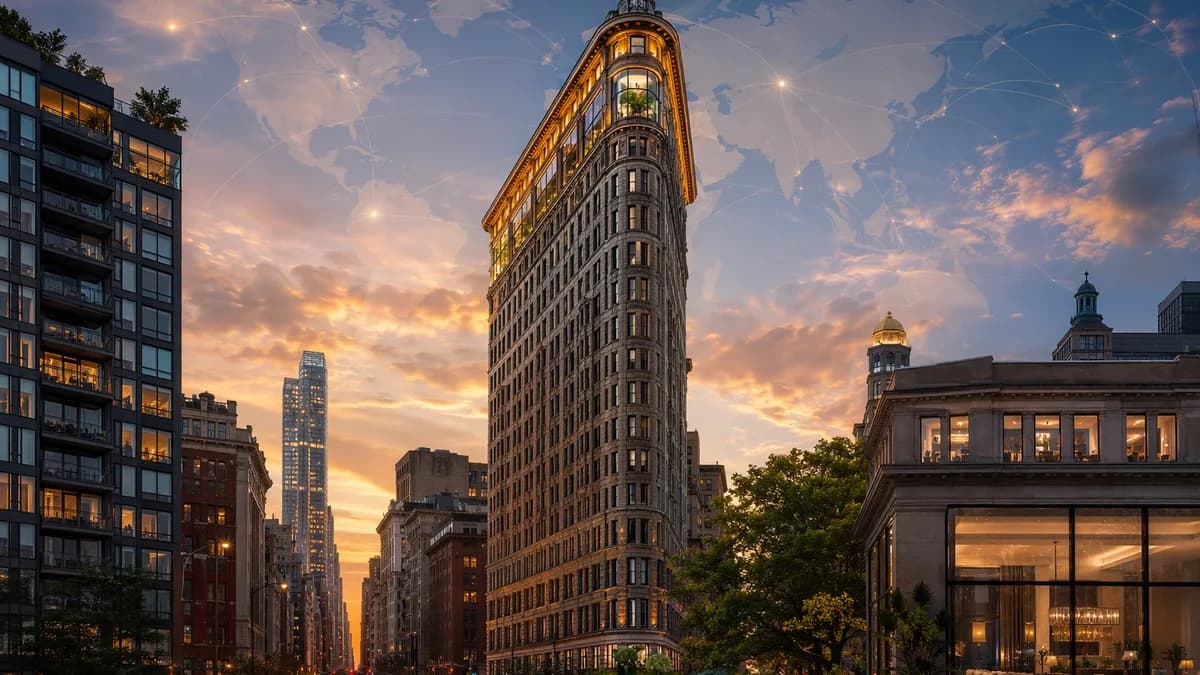
The Flatiron Building Apartments Put a $58.5m Price on Architectural Fame
Only 21 residences currently on the public market or under contract in New York City are priced above the top home planned for the Flatiron Building, where one full-floor residence is in contract at $58.5m (£43.9m).
XOOMAR Intelligence
Analyst Take
That number reframes the project. The new Flatiron Building apartments are not just expensive homes inside a famous address. They are a test of whether a building recognized by tourists around the world can convert public symbolism into private residential value, according to BBC World.
The building has spent seven years behind scaffolding. Its Beaux-Arts exterior, triangular prow, ornamental columns and decorative facade were largely hidden while it shifted from awkward office space into ultra-luxury condos. Now the renovation is nearing completion, with residents expected to start moving in during the coming months and all units and amenities expected to be finished in early 2027.
XOOMAR analysis: the story beneath the headline is not simply “rich people buy rare real estate.” It is more precise. The Flatiron’s owners are trying to sell an icon as a home without stripping away the reasons people cared about it in the first place.
Inside the $58.5m Price Tag for Flatiron Building Apartments
The completed conversion will contain 36 open-concept apartments, including half-floor and full-floor units. Prices range from $11m (£8.3m) for three-bedroom units to $58.5m (£43.9m) for a full-floor five-bedroom residence with a balcony.
The BBC source does not provide price per square foot, so any valuation per square foot would be speculation. What it does provide is a useful ranking: only 21 residences currently on the public market or under contract in New York City are priced higher, based on data compiled by Manhattan Miami Real Estate. The highest cited listing is a $128m (£96.1m) condo off Central Park.
| Flatiron metric | Source-backed detail |
|---|---|
| Original completion | 1902 |
| Height | 24 storeys, 94m (307ft) |
| New residential count | 36 apartments |
| Entry price cited | $11m (£8.3m) |
| Top cited residence | $58.5m (£43.9m), currently in contract |
| Amenities | 18m (60 ft) pool, billiards room, piano lounge, wellness centre |
| Full completion target | early 2027 |
The pricing logic rests on scarcity and recognition. A modern luxury tower may offer cleaner layouts, but it cannot easily replicate the Flatiron’s triangular silhouette at the intersection of Broadway and Fifth Avenue. That cultural cachet is the product.
The difficulty is also part of the sales pitch. The narrowest point of a triangular room in a model unit on the 12th floor is around 1.8m (6ft) across. In an ordinary apartment, that would be a compromise. In the Flatiron, developers are betting it reads as character.
From 1902 Office Marvel to a Residential Prize After Macmillan Left
The Flatiron was completed in 1902 as one of New York City’s first skyscrapers, using pioneering steel-frame construction. Designed by Daniel Burnham for a wedge-shaped plot, it was initially called “Burnham’s Folly” because locals feared its height and thinness would make it blow over.
That fear was wrong. The building became one of New York’s defining images.
Originally built to house the Fuller Company, a Chicago construction firm, the 24-storey building later hosted clothing and toy companies, magazines and publishing houses. Its last office tenant, Macmillan Publishing, moved out in 2019. The building then sat vacant through years of ownership disputes before the current owners, the Brodsky Organization, GFP Real Estate, and the Sorgente Group, began renovations in 2023 after announcing the condo conversion.
“It wasn't about changing anything that makes the building so special and beloved to New Yorkers,” Thomas Brodsky, partner at the Brodsky Organization, told the BBC.
XOOMAR analysis: the Flatiron is not enough evidence to declare a broad office-conversion boom. The source does not provide citywide vacancy data, financing terms, or policy incentives. But as a single case, it shows one path for a famous office building whose old use had ended: sell the architecture itself.
Developers, Neighbors and Buyers Are Not Buying the Same Flatiron
For developers, the Flatiron’s prestige supports the premium, but its geometry creates obvious constraints. Studio Sofield, hired to reimagine the interior, had to turn a former office building into homes while preserving the design logic that made the structure famous.
For the neighborhood, the visible change matters. James Mettham, president of Flatiron NoMad Partnership, said the small triangular park in front saw a slight drop in visitors after scaffolding went up and the pandemic hit. As scaffolding has come down, he said visitors have returned.
“People are coming back to get their pictures, and then in turn will go shop at the local retail, and all the great food and beverage that's around here,” Mettham said.
The public still gets the facade. The buyers get the inside.
That distinction is the tension. Mettham framed the exterior as a shared civic asset, regardless of the building’s use.
“Whether it's functioning as an office for one of the world's largest publishing companies, or it happens to have really expensive condos,” he said, “the exterior, and what we see from these spaces right here, we share in that. We are all part of that.”
For XOOMAR readers tracking how property, policy and local identity collide, this urban-asset question sits beside other place-based stories we cover, including Andy Burnham Makes Vape Shops Pay for Business Rates Cut, China Snaps as Australia News Live Tracks Strike Threat, Trump tariffs and factory jobs and Canada wildfires sending smoke across the Atlantic. The connection is thematic, not causal: local decisions can reprice shared spaces in ways residents notice.
The Renovation Gamble Is Hidden in the Terra-Cotta and Windows
The exterior restoration is not cosmetic. Beyer Blinder Belle, lead developer on the building’s exterior, worked with a speciality manufacturer in California to replicate and restore thousands of terra-cotta facade pieces, reinstalling each by hand.
The windows also had to go. More than 1,000 windows, dating back to the 1970s, were too heavy, hard to open and not energy efficient, according to the BBC. The replacements are thick enough to block surrounding street noise, producing an unusual level of quiet inside the units.
Inside, the developers are treating old structure as a feature. Steel beams remain exposed in corners of residential units, nodding to the steel-frame innovation that defined the original building. In one 12th-floor model unit, the steel framework has been turned into closet shelving.
There were discoveries, too:
- Hidden balcony: Workers found remnants of a balcony at the triangular point on the 20th floor, matching an existing balcony one floor above. It has been restored.
- Historic door: Crews found fragments of a wooden revolving door dating to the 1910s. It was too damaged to save, so it was replicated.
- Reused details: Steel balustrades from an old staircase became legs for bathroom sinks.
- Lobby artifacts: Tools, a piano, original restaurant menus, shoes, advertisements, shirts, lights and buckets found in the basement will be displayed in glass cases.
The strongest design move may be the simplest: letting the odd shape stay odd. William Sofield said the Flatiron is different because it is visible from every side.
“Unlike many buildings in New York, the Flatiron is seen in the round,” Sofield said. “All sides are extraordinary.”
The Next Decade Depends on Whether Buyers Pay for Myth
The next test is sales evidence. If the top residence closes near the cited $58.5m (£43.9m) level, the Flatiron Building apartments will strengthen the case that landmark recognition can carry pricing power even when floorplates are irregular and the building began life as offices.
If buyers hesitate, the lesson changes. The Flatiron may still be beloved from the sidewalk, but not every civic icon automatically becomes a top-tier residential address.
For developers, the project offers a narrow playbook: location, fame, architectural integrity and extreme scarcity can make a difficult conversion viable. But the Flatiron is too singular to become a simple model. Most aging office buildings do not have a triangular prow photographed for more than a century.
For New York, the watch item is sharper. The scaffolding is expected to be fully removed by the end of summer, and the facade will be illuminated for the first time ever. That reveal will show whether the city gains back a restored landmark even as the inside becomes one of its most exclusive residential products.
The evidence to watch is concrete: final sell-through, how quickly residents move in, whether the public embrace returns once the building is uncovered, and whether other owners of famous older office properties try to follow. The Flatiron’s next chapter will be measured not just by closing prices, but by whether New Yorkers still feel that the building belongs to them when almost none can live there.
The Bottom Line
- The $58.5m listing tests whether architectural fame can command ultra-luxury residential pricing.
- Only 21 New York City residences are currently priced above the Flatiron’s top planned home.
- The conversion turns one of New York’s most recognizable office landmarks into 36 private apartments.
Flatiron Building Apartment Price Points
| Residence Type | Bedrooms | Price |
|---|---|---|
| Three-bedroom unit | 3 | $11m |
| Full-floor residence with balcony | 5 | $58.5m |
Flatiron Building Apartment Prices
Primary Sources & Disclosures

Written by
XOOMAR Insights Team
Research and Editorial Desk
The XOOMAR Insights Team pairs automated research with human editorial judgment. We track hundreds of sources across technology, fintech, trading, SaaS, and cybersecurity, cross-check the facts, and explain what happened, why it matters, and what to watch next. We do not just rewrite headlines. Every article is fact-checked and scored for reliability before it goes live, and we link back to the original sources so you can verify anything yourself.