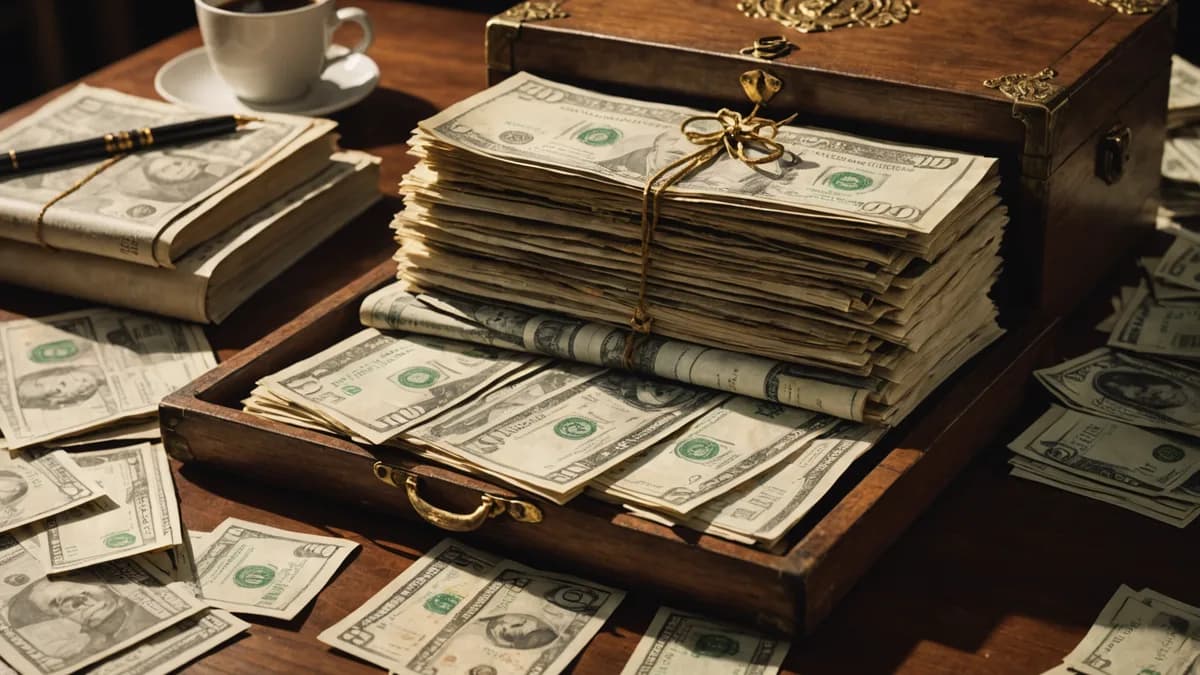
President Donald Trump has given three aides cash gifts totaling $135,000, payments first reported by Guardian World and now the subject of a formal ethics complaint. The $45,000 paid to each of his close aide Natalie Harp, deputy director of Oval Office operations Chamberlain Harris, and communications adviser Margo Martin amounts to a 30% bonus on their $150,000 salaries, delivered as a "cash gift for holiday." For an executive branch where loyalty is already intensely scrutinized, these payments represent an unprecedented financial test of the line between personal reward and illicit compensation.
XOOMAR Intelligence
Analyst Take
$45,000 Buys You 30% of a White House Salary
The math is arresting. An annual government salary of $150,000 is a matter of public record. A $45,000 cash transfer from the president himself, delivered outside the payroll system and labeled as a gift, is not. That figure is the crux of the controversy. It suggests the payment was not a trivial token but a substantial supplement to income.
Natalie Harp, Chamberlain Harris, and Margo Martin each reported the payment. A fourth aide, Walt Nauta, director of Oval Office operations with a $175,000 salary, reported a $20,000 gift. The White House statement frames this as a personal holiday tradition, but the scale and selectivity puncture that narrative. No other White House staffers among the dozens listed, including First Lady Melania Trump's top advisors, reported similar gifts. The recipients form a clear constellation: individuals known for their intense personal loyalty and proximity to Trump, not government functionaries serving in a purely bureaucratic capacity.
“We’re not talking about some small gift or minor trinket, but about large sums,” said Norm Eisen, former Obama administration ethics counsel.
This follows a pattern of Trump's political style, where large, direct financial pledges are used as a tool of engagement, as seen in his $5,000 cash pledge to every U.S. adult. But using that style inside the government payroll system is a different beast entirely.
The Federal Statute That Makes This a Potential Crime
The central legal threat comes from 18 USC 209, a federal conflict-of-interest statute. It plainly prohibits executive branch employees from receiving "any salary, or any contribution to or supplementation of salary, as compensation for his services... from any source other than the government of the United States."
The White House defense hinges on intent: these were personal gifts, unrelated to official duties. But proving that $45,000 to 30% of an employee's annual income, was given with no professional expectation strains credibility for ethics experts. The law places the burden on both the giver and the recipient to avoid the "appearance" of impropriety, a standard these payments seem engineered to flout.
Penalties for violation can include fines or imprisonment, depending on whether the breach is found to be deliberate. The Campaign Legal Center's complaint argues the sheer size of the gifts creates a presumption that demands investigation. As former ethics czar Norm Eisen put it, this is "profoundly concerning" because the rules exist to ensure a government employee's "first loyalty [is] to the United States, and not to whoever happens to be its president."
Natalie Harp and the 'Cash-for-Loyalty' Conundrum
The story is inseparable from the profile of its primary recipient, Natalie Harp.
Her role: Described as Trump's "binky" or "comfort blanket," Harp is a special assistant known for printing his social media posts and reportedly leaving him "adoring letters." She was one of the few aides who accompanied him on a secretive plane swap from Turkey, a sign of extreme trust.
Why her profile matters: Her job blurs the line between professional assistant and personal confidante. When a superior's personal gratitude is expressed in sums this large, it monetizes that blurred line. It creates a powerful incentive for aides to prioritize the president's personal whims, which could range from social media management to oversight of pet projects like the White House ballroom, over detached, professional counsel.
The other recipients fit a similar mold. Margo Martin films Trump's daily life for social media, a role amplifying his personal brand. Chamberlain Harris, besides being an executive assistant, was appointed to the U.S. Commission of Fine Arts, which oversees Trump's aesthetic projects. Walt Nauta is a longtime valet and co-defendant in the dismissed classified documents case. The pattern suggests rewards for personal service, not institutional performance.
The Impending Bureaucratic Collision: Defense vs. Watchdogs
The battle lines are sharply drawn, with neither side likely to back down.
The Watchdog Case The Campaign Legal Center has filed a formal complaint. Its vice-president, Kedric Payne, stated: “Laws prohibiting government employees from receiving supplemental income are not arbitrary; they exist to ensure that public servants’ priorities remain focused on public service, not a wealthy benefactor who may have other objectives in mind. An investigation... is clearly warranted.”
Their argument is procedural and legalistic: the size and nature of the payment trigger a mandatory review under existing statutes.
The White House Defense The administration's statement is a study in framing: “The president has a longstanding practice of giving Christmas gifts to people in his orbit... The gifts at issue here have nothing to do with any of these individuals' official government duties, and are entirely permissible under relevant legal and ethical standards.”
This defense rests on normalizing the action as a private custom, ignoring its public-sector context. It mirrors Trump's broader approach to governance, where the trappings of the office are often treated as extensions of his personal business.
The Expert Verdict Ethics specialists are sounding alarms. Norm Eisen calls it a potential "serious" violation. James Thurber, an ethics specialist at American University, labeled it "legal but totally unethical," adding, “This is nothing new for Trump.” Cassandra Burke Robertson, a law professor, told the BBC the gifts "add to a generalised perception of really rampant conflicts of interest."
The Unwritten Precedent: When a 'Thank You' Looks Like a Payroll
History offers little direct comparison. Presidents have gifted mementos, Barack Obama gave a framed tie, but not five-figure cash. The scale is novel. It introduces a direct, financial patronage system into the White House staff structure.
In the corporate world, large discretionary bonuses are common but are processed through payroll, taxed, and disclosed as compensation. This was cash, labeled a gift. In government, the standards are stricter precisely to avoid the corrosion of impartiality. The episode feels like a collision between a private sector mindset, where the boss can reward his favorites from his own pocket, and a public ethics regime designed to prevent exactly that.
This style of operating has previously caused international friction, such as the $1 billion trade threat over Bombardier jets. Applying that same unilateral, loyalty-driven approach to internal staff compensation creates a new kind of diplomatic incident, a domestic one.
What Happens When Cash Crosses the West Wing Threshold?
The immediate aftermath will be a test of institutions.
The Investigation Pathway The complaint now sits with the U.S. Office of Government Ethics (OGE). Will it open a formal inquiry? The OGE is a relatively small agency; pursuing a case against the sitting president who appointed its leadership requires formidable independence. A decision to not investigate could be portrayed as a political capitulation. A decision to investigate guarantees a firestorm, with Trump allies labeling it a partisan "witch hunt."
The Political Weaponization Opponents now have a concrete, dollar-denominated symbol to allege corruption. Expect to hear "$45,000 loyalty bonus" in congressional hearings and campaign ads. Defenders will dismiss it as a trivial story blown out of proportion, another attempt to criminalize Trump's unconventional style.
The Lasting Stain Even if no legal violation is found, the precedent is set. Future wealthy presidents could feel emboldened to materially reward staff from personal funds. It risks creating a two-tier staff: those who draw a government salary, and those who also enjoy the personal largesse of the president. That dynamic fundamentally alters the employer-employee relationship within the executive branch, tying financial well-being directly to personal favor in a way government salaries are meant to avoid.
The final question is one of trust. In an era where public faith in government ethics is fragile, does a president handing out stacks of cash to his closest aides restore it or shatter it? The answer will depend less on legal findings and more on whether voters view $45,000 as a generous holiday tip or a down payment on loyalty. The outcome could redefine the boundaries of presidential power for years to come, setting a new, and far more transactional, standard for what is acceptable within the people's house.
Impact Analysis
- This story tests the boundaries of ethical governance by blurring the line between personal presidential gifts and potential undisclosed supplemental compensation.
- It raises concerns about financial leverage and the potential for undue loyalty within the executive branch, setting a troubling precedent.
- The selective nature of the payments suggests a reward system based on personal allegiance rather than official duties, which undermines public trust in government integrity.
Staff Cash Gift Totals
Primary Sources & Disclosures

Written by
XOOMAR Insights Team
Research and Editorial Desk
The XOOMAR Insights Team pairs automated research with human editorial judgment. We track hundreds of sources across technology, fintech, trading, SaaS, and cybersecurity, cross-check the facts, and explain what happened, why it matters, and what to watch next. We do not just rewrite headlines. Every article is fact-checked and scored for reliability before it goes live, and we link back to the original sources so you can verify anything yourself.