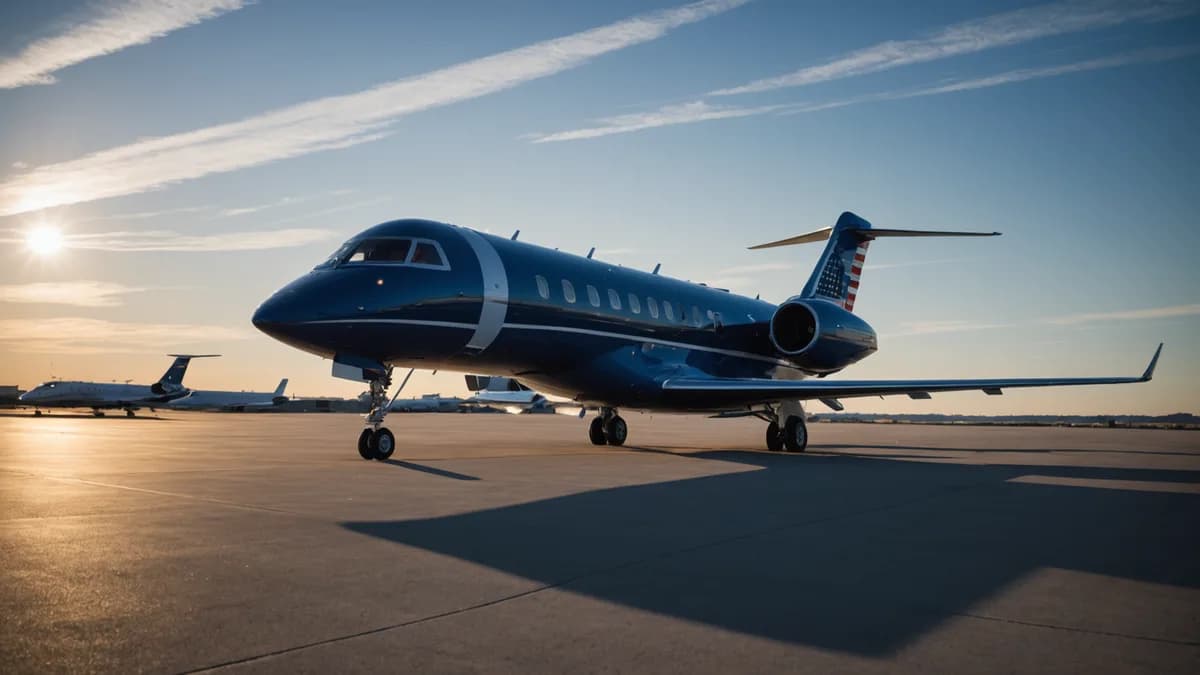
On Monday, September 7, 2026, hours before retaliatory Canadian tariffs were set to hit $20bn (£14.7bn) worth of US goods, President Donald Trump escalated a bilateral trade war by aiming a direct threat at a national symbol. His target: Bombardier, one of Canada’s largest companies. According to a report from BBC World, Trump warned the aircraft manufacturer it can no longer sell in the US unless it moves production there. This isn't a routine tariff dispute. It's a calculated political sledgehammer, wrapped in a trade war glove, designed to exert maximum pressure on Ottawa by targeting an iconic, strategic firm. The move signals that old rules for managing the US-Canada relationship are dead, replaced by policy-by-tweet targeting single corporations, a tactic reminiscent of his administration's earlier secret diplomacy with Russia.
XOOMAR Intelligence
Analyst Take
Why Bombardier is the Perfect Political Target
The threat arrives with precise timing and symbolism. Bombardier is not just any company. It is a C$7.4bn contributor to Canada’s GDP, a cornerstone of Quebec's aerospace sector, and employs 3,500 American workers directly. By focusing on a "flag of our economy," as Quebec Premier Christine Fréchette called it, Trump’s threat achieves several goals at once. It pressures the Canadian federal government, angers a politically significant province, and sends a stark message to every other Canadian exporter: your access to the US market is contingent on political favor, not just trade law. The threat, posted on Truth Social, came just as Canadian retaliatory tariffs on American dairy, lumber, and beauty products were set to activate. This positions the move as a direct counter-punch in an escalating cycle, making Bombardier a hostage in a wider negotiation, a dynamic familiar from the Loonie's recent quiet stability over jobs data landmines.
"NO MORE SELLING BOMBARDIER IN THE UNITED STATES!" Trump wrote. "If they want our Market, they must build here, and stop treating America like a 'piggybank'."
An Existential Threat With No Clear Path to Enforcement
The immediate question is how, exactly, Trump plans to execute this ban. The source material provides no specific legal mechanism, and that ambiguity is part of the threat’s power. Bombardier's jets are built in facilities in Canada, the US, and Mexico and comply with the USMCA/CUSMA free trade agreement. The company already has a significant American footprint, with a factory in Kansas building special mission military planes and sites in nine other states. About half of its fleet, 5,100 aircraft, is operated by US-based customers. A ban would disrupt these customers and hurt American partners and workers. The lack of a defined path creates a chilling fog of uncertainty, freezing potential deals and investment while Bombardier and its customers wait to see if the threat becomes reality. It’s a tactic that leverages uncertainty as a weapon.
Bombardier's US Presence:
| Aspect | Detail |
|---|---|
| American Workforce | 3,500 direct employees |
| Key US Facilities | Factory in Kansas (military planes); sites in TX, AZ, FL, CT, IL, DE, CA, DC, NJ |
| US Market Dependence | ~5,100 aircraft operated by US-based customers (half its fleet) |
| Current Trade Compliance | Produces under USMCA/CUSMA rules |
The Company's Precarious Position Between Two Governments
For Bombardier, this threat is more than a corporate headache. It’s an existential political risk layered on top of its business challenges. The company's statement on Monday strategically avoided addressing Trump directly, instead underscoring that its operations "create tens of thousands of US jobs" and that it values its American partnerships. This is a defensive posture, aiming to highlight the mutual damage of any action. However, the real impact is on confidence. As we've seen in other sectors, political risk is now a primary cost of doing cross-border business. Bombardier’s supply chain, workforce planning, and investor relations are immediately destabilized. The company becomes a stand-in for the entire Canadian export economy, demonstrating that even compliance with trade agreements is no shield from capricious policy shifts.
Ottawa, Quebec, and Washington: A Three-Way Standoff
The reaction from Canadian political leaders highlights the multi-layered tension. Federal Prime Minister Mark Carney accused the Trump administration of presenting "unfair" and "uneconomic" terms that led to the collapse of trade talks. His office, approached by the BBC, had not yet commented on the Bombardier-specific threat. The sharper, more immediate response came from Quebec Premier Christine Fréchette, who called the company "a source of pride" and "a flagship of our economy."
"I will not respond to provocation with provocation," Fréchette wrote on X. "Quebec will not allow anyone to dictate where our companies must produce in order to access a market."
Her stance underscores a critical dynamic: provincial economies have massive stakes in this fight, and their political responses may not always align with federal strategy. Meanwhile, the perspective of US companies reliant on smooth cross-border trade is notably absent from the public debate, but they are caught in the middle, facing higher costs and supply chain disruptions from the broader tariff war, as detailed in our coverage of Canada Slams Trump With 50% Tariffs on $20 Billion in U.S. Imports.
Escalation Beyond Softwood Lumber and Steel
This confrontation feels familiar, yet different. US-Canada trade spats over softwood lumber, dairy, and steel are cyclical. The use of national security tariffs on Canadian steel and aluminum under Trump's first term set a precedent for using extraordinary measures against an ally. However, publicly targeting a single, named company with a sales ban via social media marks a clear escalation in tactics. It personalizes the dispute and moves it from the realm of commodity sectors to high-value, advanced manufacturing, echoing the symbolic nature of recent events like the Google Maps renaming of Lake Ontario. It asks whether the old diplomatic playbook, which often ended in managed settlements, is now obsolete. This action deliberately undermines the USMCA's dispute settlement mechanisms before the updated agreement has even been fully stress-tested.
The Chilling Effect on Every Cross-Border CEO's Desk
The broader implication for business is profound. For CEOs, the lesson is that long-term investment and supply chain plans with the US are now subject to volatile political whims, not just agreed-upon rules. This threat, even if not implemented, will force companies to:
- Factor in political risk premiums when calculating the cost of US market access.
- Reconsider investment locations, potentially diverting capital away from integrated North American production.
- Prepare for legal chaos, as any attempt to ban a compliant company would trigger years of litigation under USMCA and WTO frameworks.
The uncertainty alone can reroute investment. As Canada looks to diversify trade partnerships, this episode will be cited as a prime reason why over-reliance on the US market is a strategic vulnerability. This shift mirrors the defensive calculus seen in other pressured trade relationships, such as the strategic reevaluations happening amid the Virginia County Trade Shakes Amid $70 Billion Data Center Boom.
The Endgame: Legal Mazes and a Forced Pivot
Canada's immediate response will likely involve framing this threat within its broader retaliatory tariff strategy, which is already set to impact US goods. The more complex response will be legal and strategic. If Trump formalizes the ban, Bombardier and its US partners would face a labyrinth of lawsuits. A WTO challenge is certain, but those processes are slow. More immediately, Canada would be forced to accelerate its trade diversification efforts, seeking stronger ties with Europe, Asia, and other partners. The real, enduring cost is measured in eroded trust. When a treaty partner can threaten to ban a major company on a whim, the foundation of the trading relationship cracks. The alliance is weakened, not just on trade but on broader geopolitical cooperation, at a time when Western unity is already under strain, as seen in the latest US-Ukraine-Russia peace talks collapse. For Bombardier, the coming days are about damage control and waiting. For Canada, it's about crafting a response that defends its economic sovereignty without escalating further into a lose-lose economic conflict. The world will be watching to see if provocation is indeed met with provocation, or if a more calculated, firm defense of the rules-based order prevails.
Impact Analysis
- It escalates a trade war, putting $20 billion of U.S. goods at immediate risk from retaliatory Canadian tariffs.
- It targets Bombardier, a company that contributes C$7.4 billion to Canada's GDP and employs 3,500 American workers, threatening bilateral economic stability.
- It signals a fundamental shift in U.S.-Canada trade relations, where market access is now tied to political favor rather than established law, creating uncertainty for all exporters under an administration whose economic focus is clearly shifting, much like the Fed's current disregard for jobs data in its inflation battle.
Primary Sources & Disclosures

Written by
XOOMAR Insights Team
Research and Editorial Desk
The XOOMAR Insights Team pairs automated research with human editorial judgment. We track hundreds of sources across technology, fintech, trading, SaaS, and cybersecurity, cross-check the facts, and explain what happened, why it matters, and what to watch next. We do not just rewrite headlines. Every article is fact-checked and scored for reliability before it goes live, and we link back to the original sources so you can verify anything yourself.