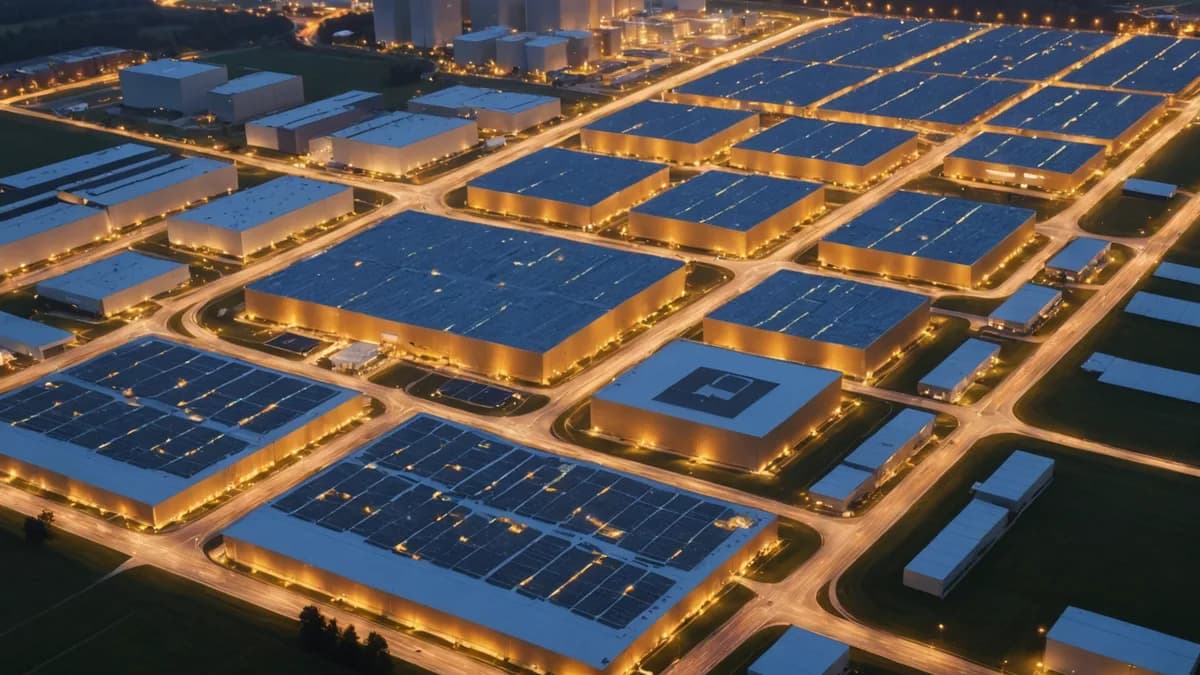
The same county collecting a $35 million budget surplus from its data centers is the one where women battle over tea as county officials grapple to control a boom they can no longer stop. Loudoun County, Virginia, isn't just the world's densest cluster of data centers; it's a two-decade experiment in trading community serenity for server-fueled prosperity. Now, as the generative AI boom supercharges a nationwide buildout, the intense backlash in Loudoun offers a proven blueprint for the conflict headed to hundreds of American towns.
XOOMAR Intelligence
Analyst Take
The county's story, according to The Verge, is a warning written in tax receipts and transmission line maps: the physics of powering AI will eventually override the politics of hosting it.
From .com Carcasses to AI Engine Room: The $70 Billion Pivot
The foundation for Data Center Alley was laid by failure. After the dot-com bubble burst, Loudoun was left with hollowed-out AOL headquarters and miles of abandoned fiber optic cable. In 2007, with over 80 percent of county revenue tied to a collapsing residential real estate market, economic developer Buddy Rizer saw those carcasses as salvation.
He repurposed the county's legacy assets: proximity to Washington D.C., pre-laid fiber, and a major internet exchange point. A critical, quiet decision in 2000 had already set the stage. Because data centers resembled offices, a local zoning administrator classified them as “office parks.” This meant they could be built “by right” on any land zoned for office space, bypassing intensive public review.
The bet paid off on a staggering scale. From a trickle of permits, the county now hosts roughly 250 data centers in its 515 square miles. Rizer estimates he's done $70 billion of deals. What began as a plan to lift the commercial tax base from 19% to 23% of revenue succeeded beyond imagination: today, just over half of Loudoun's tax revenue comes from commercial sources. The data center tax revenue alone exceeded the county's operational budget by $35 million in 2024.
The AI Acceleration: The current buildout is no longer about filling empty AOL buildings. As The Verge notes, generative AI's insatiable need for “compute” is driving a national construction frenzy, with 3,000 US data centers already operating and 1,500 more in development. Loudoun transformed from a secondary market panel topic to the main event.
The Prosperity Paradox: Plunging Taxes Versus a Backyard Power Grid
The financial benefits for residents are direct and substantial.
- Property Taxes: The real property tax rate fell from about $1.29 to 80 cents per $100 in assessed value since 2008.
- Public Investment: The county built 22 new schools in the last 15 years, plus recreation centers and athletic fields.
- Property Values: County officials note property values in some communities rose as much as 182 percent in the last decade, even near data centers.
Yet, the infrastructure required to power this prosperity now threatens the very homes it enriched. Resident Vicky Hu's story embodies the paradox. After a Dominion Energy call informed her a new transmission line with 185-foot towers would cut through her backyard, her dream home became a battlefront.
“You’re thinking, ‘You work your whole life, you own something.’ But you actually don’t own it, because a power company can say, ‘I like your house. I want to take it.’”
Hu is engaged in a year-long legal fight, a scenario playing out near schools and green spaces. The money is undeniable, but the physical encroachment, the threat of eminent domain for power infrastructure, forces a visceral question: what is the prosperity for if it seizes the property it promised to enrich? This tension mirrors broader infrastructure challenges, like those explored in our report on how Nations Hose Out $878 Billion Fighting Disasters They Ignore.
The Never-Ending Hum: Noise as a Permanent Policy Failure
If the transmission towers are a sporadic threat, the noise is a constant grievance. The complaints are not about occasional construction, but a perpetual, invasive presence.
The Vantage Case Study: The Vantage VA2 data center was forced to rely on on-site natural gas turbines when the grid couldn't support it. For nearby residents, this created an ongoing nuisance.
- Lindsay Shaw describes a high-pitched squeal from the turbines and constant light pollution into her bedroom.
- Jessica Medeiros laments that on some days, the diesel generators emit a "lawn mower" whir, obscuring birdsong.
- Jason Mello hears a "low-frequency drone" from HVAC systems. "Planes come and go," he says. "The data center hum never stops."
Residents are spending personal funds to mitigate the public nuisance. Mello spent $2,600 on window inserts and was quoted $15,000 for new siding. The noise represents a fundamental policy failure: zoning that allowed industrial-scale infrastructure to operate "by right" next to homes, without adequate buffers for its acoustic footprint.
Four Unpopular Truths: Why Local Governments Feel Powerless
At a packed July town hall, Board of Supervisors Chair Phyllis Randall presented a slide titled “4 Things That Are Unpopular But True,” capturing the political bind.
- Residents Preferred Data Centers to Housing. Randall cited a 2021 proposal for 779 housing units that faced fierce resident opposition over traffic. The developer withdrew and built a by-right data center instead. “One of my worst days was January 5th, 2023, when the applicant called me and said, ‘Forget it. I’m going to go build a data center,’” Randall said.
- A Local Moratorium Isn't Legal. Virginia law preempts the county from unilaterally halting by-right development.
- AI Buildout is a Bipartisan National Priority. Both the Biden and Trump administrations have signaled support, making a federal policy reversal unlikely.
- The Alternative to Negotiation is Worse. When data centers request zoning exceptions, the county can negotiate for concessions (like larger setbacks). If denied, they can often build a less-optimal version "by right" with no concessions.
This framework reveals a brutal pragmatism. The fight isn't to stop data centers, but to shape them within narrow legal confines. As one resident summarized the industry's stance to advocate Julie Bolthouse: “we just need to explain to the communities the benefits.” Bolthouse counters: “But what they’re really up against is physics.”
Physics, Not Politics: The Inescapable Math of AI Compute
The core conflict in Loudoun, and the coming conflict nationwide, is material, not ideological. The opposition is not to technology, but to its tangible, local burdens.
| The Promise (As Sold) | The Physical Reality (As Lived) |
|---|---|
| Tax Revenue & Prosperity | Grid Strain & Eminent Domain |
| "Clean" Cloud Infrastructure | Diesel Plumes & Gas Turbine Noise |
| "Office Park" Zoning | Industrial-Scale Power & Water Use |
| Few On-Site Jobs | Skyrocketing Commercial Real Estate Prices |
Small business owner Jenny Marza felt this reality. A warehouse she considered for $5 million two years ago now costs $10 million, as every commercial landlord eyes data center deep pockets willing to pay an average of $3.76 million per acre. The financial benefits for residents, she says, are "a drop in the ocean of what they’re getting in return."
This shift from abstract benefit to concrete impact is why Bolthouse’s advocacy group, the Piedmont Environmental Council, shifted from explaining data centers to fighting their unchecked sprawl. The industry is “embedded” in Loudoun’s government and zoning, making reform a slow, piecemeal clean-up of past permissiveness.
The Godfather’s Regret and Loudoun’s Scramble for a Stop Button
The most telling sign Loudoun has hit a limit comes from its architect. Buddy Rizer, the so-called “godfather of data centers,” now says, “We don’t want more data centers here.” His role has shifted from salesman to consultant for other towns, advising them to ask: “How many do you want? And under what conditions would you take them?”
The county is scrambling to rewrite the rules that enabled its own boom.
- Ending By-Right Zoning: Moving to remove data centers from "office park" classification.
- Considering a Permit Pause: Weighing a moratorium on new reviews while drafting new zoning.
- Relying on Finite Geography: With developable land shrinking, there is a natural endgame in sight.
The goal, as Bolthouse frames it, is to transition from a national cautionary tale to a model. “I don’t want to be the example of what not to do,” she says. “I want to be the example of what to do.”
The National Reckoning: Loudoun's Present is America's Near Future
Loudoun is not an anomaly. It is a time machine. The “vitriol” Rizer now sees is the product of 15 years of quiet accumulation meeting the acute demands of the AI era. Every community now being courted, from New York to Texas, will face the same sequence: enticing fiscal models followed by inescapable physical compromises.
The critical lesson for these towns is to negotiate before the first cable is laid. They must:
- Reject "Office Park" Analogies: Zone data centers explicitly as the high-impact industrial utilities they are.
- Map the Infrastructure Footprint: Demand clear plans for power and water sourcing before approval, not as an afterthought.
- Legislate Buffers and Standards: Enforce meaningful setbacks from homes and schools and set binding noise/emission standards.
- Price in the Externalities: Ensure tax structures account for grid upgrades, environmental monitoring, and property value protections.
The final verdict from Data Center Alley is clear. The data centers will be built; the AI compute demand is real, as seen in the strategic expansions of supporting industries like U.S. Bank Deploys Business Bankers to Sun Belt for First Time. But American communities are done being silent partners. They now know to ask not if they should host, but how, and more importantly, on whose terms. The companies that learn from Loudoun’s friction will find willing hosts. Those that don't will inherit its rage.
Impact Analysis
- It demonstrates how communities can be economically transformed, for better or worse, by a single shifting industry, raising fundamental questions about local control.
- It provides a concrete case study of the trade-offs between rapid technological expansion and community character, a conflict spreading nationwide with the AI boom.
- It highlights how past zoning decisions, often made quietly, can lock in future development paths with massive economic and social consequences.
County Revenue Source Shift: Data Centers vs. Residential Real Estate
| Era | Primary Revenue Source | Market Condition | Tax Revenue Contribution |
|---|---|---|---|
| Pre-2007 | Residential Real Estate | Collapsing | Over 80% of county revenue |
| Post-2007 | Data Centers | Booming | Generates $35M surplus, now half of county revenue |
Loudoun County Data Center Growth & Revenue Impact
Primary Sources & Disclosures

Written by
XOOMAR Insights Team
Research and Editorial Desk
The XOOMAR Insights Team pairs automated research with human editorial judgment. We track hundreds of sources across technology, fintech, trading, SaaS, and cybersecurity, cross-check the facts, and explain what happened, why it matters, and what to watch next. We do not just rewrite headlines. Every article is fact-checked and scored for reliability before it goes live, and we link back to the original sources so you can verify anything yourself.