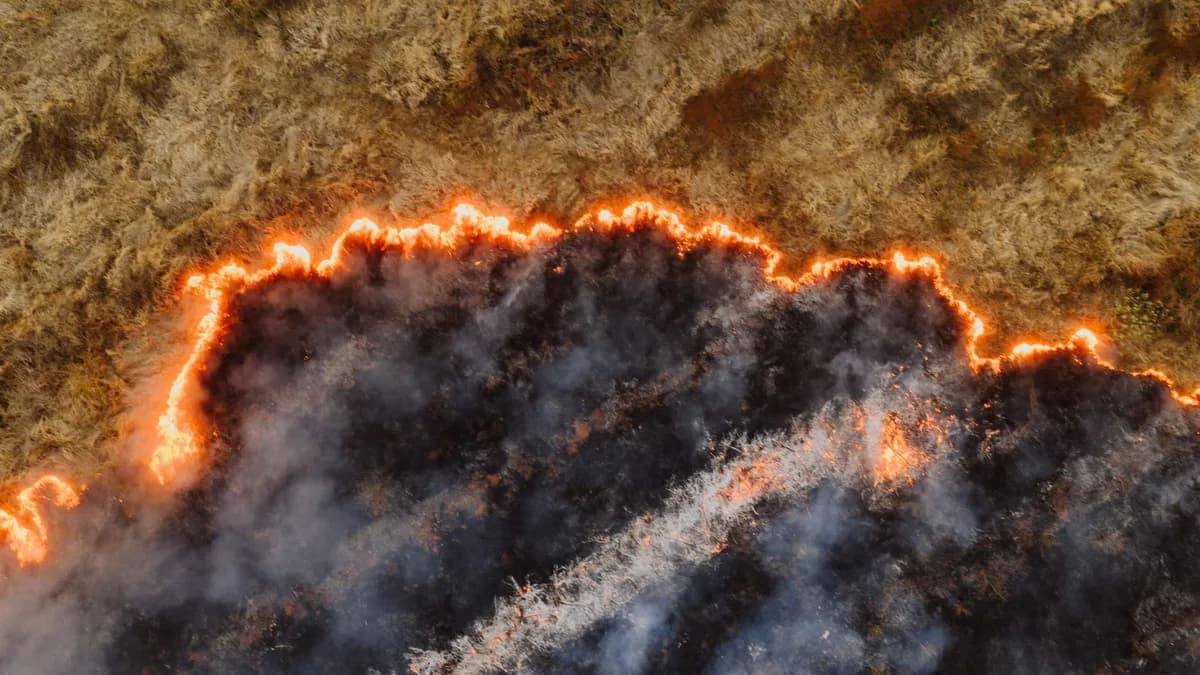
Governments and businesses now face an annual, multi-billion dollar bill for drought and wildfire response. Yet we categorically refuse to fund the primary asset that would lower that bill.
XOOMAR Intelligence
Analyst Take
Our approach is economically backwards. We treat floods, fires, and droughts as costly surprises to be managed, while relegating the health of the land that could mitigate them to vague environmental policy. The data, according to Time, is unequivocal. The UNCCD puts the combined cost of land degradation, drought, and desertification at a staggering $878 billion annually. Governments then spend billions more on suppression and relief. It is a ruinous cycle of paying for disasters while underfunding their prevention. We must start treating land restoration as the frontline economic infrastructure it is.
Forest Restoration Is Infrastructure, And We're Not Funding It Like One
We readily understand ports, roads, and power grids as capital investments. They require upfront spending, long-term maintenance, and deliver predictable economic returns. By contrast, we have framed healthy forests and stable rangelands as a "nice to have," a line item for environmental departments. This is a profound category error with trillion-dollar consequences.
Healthy land is not simply an environmental asset. It is economic infrastructure.
The argument isn't abstract. $44 trillion of global GDP, about half of all economic output, is moderately to highly dependent on natural capital. When that capital erodes, supply chains buckle, commodity prices spike, and rural economies collapse. The result is not an environmental cost. It is a direct hit to national balance sheets and corporate profitability. Investing in restoration isn't charity. It's asset management.
The True Cost of a Burned and Parched Economy
The reactive model delivers a cascade of predictable, expensive failures. Look beyond the suppression costs to the secondary tremors.
Agriculture: Drought has already reduced output, forcing up food-import bills and squeezing public budgets, especially in developing nations. In advanced economies like the American Southwest, water restrictions are forcing farmers to fallow fields. The economic dominoes fall quickly.
Insurance and Real Estate: Markets are already repricing risk in real-time. As noted in related reports, homeowners insurance rates in states like Colorado have surged 58% since 2018, driven predominantly by wildfire risk. This isn't a market adjustment. It's a market failure, where the underlying asset, the land, is being degraded by systemic underinvestment.
Supply Chains: The events of the last few years, from the Panama Canal crisis to European wildfires, prove that climate shocks are business shocks. When healthy land fails, it doesn't just burn trees, it burns through just-in-time logistics and stable input costs.
In this context, the UNCCD's estimate that drought-induced losses alone cost $307 billion annually is a measure of our annual failure to invest. It is a massive, hidden subsidy to a reactive economic model that is draining public and private capital.
How Restoration Projects Build a More Durable Balance Sheet
The alternative economics are compelling, and they're not theoretical. The financial logic pivots from paying for loss to investing in function.
The ROI of Resilience: Every dollar invested in landscape restoration can create between $7 and $30 in local economic benefits. The UNCCD estimates that financing land conservation and restoration could generate up to $1.8 trillion annually in value from strengthened agriculture, new revenue, and mitigated physical risks. It could also generate net employment for 37 million people by 2030.
Mechanics of a Natural Asset: A restored watershed acts as a natural reservoir, regulating water flow and reducing the need for costly urban infrastructure projects. Healthy forests with managed fuel loads become natural firebreaks, lowering suppression costs and protecting downstream assets. The asset is working for the economy.
This isn't just environmentalism. It's the ultimate in pragmatic, risk-adjusted investing. We’ve seen how droughts disrupt global trade, as we reported during the Panama Canal transit cuts. Proactive land management is a direct hedge against that volatility.
The Counterargument: We Can't Afford This Kind of Up-Front Spending
The most common retort is fiscal realism. Governments are strained. Competing priorities are legion. The initial outlay for landscape-scale restoration is significant.
This view is a textbook example of a false economy. We are already paying the bill. The $878 billion annual cost of land degradation and drought is the finance charge on our inaction. It’s the equivalent of refusing to fix a leaking roof because the repair is expensive, while simultaneously paying for ruined furniture, mold remediation, and higher heating bills every year. The money is already being spent, just destructively and reactively.
The budgetary question isn't "Can we afford to invest?" It's "Can we afford to keep paying more for a broken system?" The data says we cannot.
A Call for Public and Private Capital to Follow the Logic
Shifting the paradigm requires treating the land as an asset class. Public finance must lead by de-risking projects and creating investable frameworks.
Policy Alignment: Fragmented policies hold investment back. A coherent, stable policy environment that values land health as an economic output is a prerequisite. This means agricultural subsidies that incentivize soil health, not just crop yield. It means insurance frameworks that offer lower premiums for verifiable land stewardship.
Innovative Financing: Mechanisms like the Riyadh Action Agenda show it's possible, having already mobilized $2.9 billion and setting goals for over $130 billion by 2030. Public and concessional finance can crowd in private capital by proving the business case. Resilience bonds, where investor returns are tied to measurable ecological outcomes like reduced fire risk or improved water retention, should move from pilot to scale.
The goal must be to make healthy land a bankable, institutional-grade asset. The market is already signaling readiness, with business investment in regenerative landscapes seeing a fourfold increase between 2023 and 2025.
Stop Funding Fires and Start Funding the Future
The path forward is not a mystery. It is a choice. We can continue to fund the escalating cycle of disaster response, watching as three in four people worldwide are projected to be affected by drought by 2050. Or we can fund the underlying asset.
This week’s UNCCD COP17 in Ulaanbaatar is a pressure point. The focus on rangelands, which cover over half the Earth's land surface and support up to 500 million pastoralists, is the perfect test case. These are not remote environmental issues. They are the bedrock of global food security and economic stability in a warming world.
The question is no longer one of technical capability or even of cost. It is one of economic categorization. Until finance ministers and corporate boards see a restored watershed with the same strategic urgency as a new highway or a server farm, we will remain trapped in a fiscally irresponsible loop. The call is simple. Reclassify ecological health as core economic infrastructure. Our financial resilience depends on it.
Impact Analysis
- It exposes a trillion-dollar economic blind spot where half of global GDP depends on natural capital we systematically underfund.
- It frames the choice as between paying ruinous annual disaster bills or investing in land restoration as preventative economic infrastructure.
- It challenges readers to rethink national and corporate balance sheets, where environmental health directly translates to financial stability and profitability.
Reactive vs. Proactive Economic Approaches to Land Management
| Approach | Economic Treatment | Cost Outcome |
|---|---|---|
| Disaster Response (Floods, Fires, Droughts) | Treated as costly surprises to be managed | Multi-billion dollar annual bills, plus $878B in land degradation costs |
| Land/Restoration Investment | Relegated to 'vague environmental policy' | Trillion-dollar GDP dependency at risk; cycle of suppression spending |
The Staggering Costs of Land Degradation and Disaster Management
Primary Sources & Disclosures

Written by
XOOMAR Insights Team
Research and Editorial Desk
The XOOMAR Insights Team pairs automated research with human editorial judgment. We track hundreds of sources across technology, fintech, trading, SaaS, and cybersecurity, cross-check the facts, and explain what happened, why it matters, and what to watch next. We do not just rewrite headlines. Every article is fact-checked and scored for reliability before it goes live, and we link back to the original sources so you can verify anything yourself.