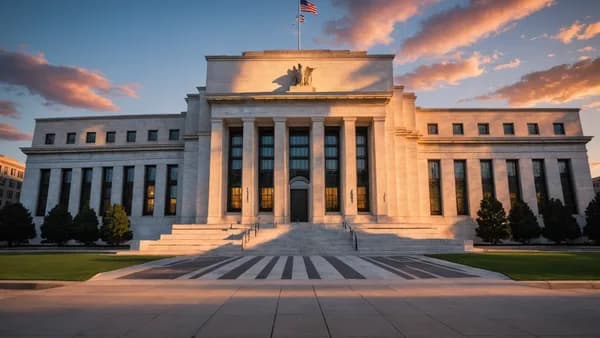
The U.S. economy added 162,000 jobs last month, nearly triple what analysts expected and a sharp rebound from July's flop. For markets, it was a definitive all-clear on economic health. For the Federal Reserve, it was a footnote. All eyes, instead, are laser-locked on next week's consumer price index report according to American Banker. The labor market rebound no longer moves the needle for policy; inflation's last mile is the only race left.
XOOMAR Intelligence
Analyst Take
This pivot in focus isn't just a subtle shift. It signifies the Fed's formal transition from a dual-mandate crisis mode to executing a pure inflation-targeting mission. The strong jobs number wasn't debated or dissected by officials. It was simply noted as "satisfactory shape" and filed away. The real question for investors is simple: how does a central bank behave when employment is strong, but inflation remains its sole obsession?
Why a Slight Dip in Hiring Can't Hide the Fed's Inflation Obsession
The Bureau of Labor Statistics report wasn't just strong; it was a wholesale revision of the recent economic narrative. The bureau didn't just report the August gain. It revised July's surprising net loss of 23,000 jobs into a gain of 21,000 and tacked on another 11,000 to June's total. Over three months, the economy has added more than 200,000 jobs. By any historical measure outside a boom, that's solid growth.
Yet, the market's reaction was muted, and Fed commentary was dismissive. Officials have been quick to explain away "tepid" labor market activity, blaming demographic trends like retirements and restricted immigration growth. As Fed Chair Kevin Warsh put it, "When labor supply is barely growing, monthly job gains are naturally going to run low." The message is clear: don't expect the roaring job numbers of past decades, and don't panic when you don't see them. The labor market's health is now being assessed through a different lens one where stability trumps explosive growth, and where its primary importance is as a backdrop for inflation.
This creates a unique tension for Main Street versus Wall Street. For most Americans, a 4.1% unemployment rate and steady hiring feel like markers of a robust economy. For the Fed and for markets, these numbers are merely the setting for the main drama: the stubborn, high cost of living that has yet to be tamed. The labor data isn't driving the bus; it's just confirming the bus is on the road, allowing the driver to focus entirely on the inflation detour ahead, as illustrated by recent volatility in commodity prices covered in our analysis of Diesel Hits Historic High in U.S., Vetoing Iran War Message.
How the Fed Views a Job Market Number Through an Inflation Lens
The Federal Reserve's dual mandate is price stability and maximum employment. For most of the post-pandemic period, these goals were in conflict, requiring rapid rate hikes to cool an overheating economy. Now, the conflict has ended, and a hierarchy has emerged. Maximum employment is seen as achieved. Price stability is the unfinished business.
The mechanics of this are precise. Fed Governor Christopher Waller laid out the new prioritization explicitly:
"With economic activity and the labor market in good shape, they are not a large factor in my determination of the appropriate setting of monetary policy. But they are an important backdrop for the part of the outlook that is my focus right now, inflation, and my judgment about how much the current stance of policy is working to return inflation to 2%."
The "backdrop" matters because a strong labor market supports consumer spending, which can feed into persistent service-sector inflation. The Fed isn't looking at the headline 162,000 jobs number. It's peering into the details: wage growth, average hours worked, and employment in services. The fear isn't that hiring will stop. It's that wage inflation could become embedded in business costs and consumer expectations, creating a self-fulfilling cycle of higher prices. As long as the jobs market provides a stable "backdrop," the Fed feels free to concentrate all its analytical firepower on the inflation data itself.
This marks a profound shift from a few years ago, when every jobs report could swing market odds for a rate hike or cut. Today, the jobs report is context. The inflation report is the catalyst.
The Mechanics of an Interest Rate Decision Beyond a Single Jobs Report
So what would move the Fed? The process is now a narrow funnel, with next week's Consumer Price Index (CPI) for August as the final filter. The "higher-for-longer" stance isn't just a slogan; it's a operational framework that changes the decision calculus.
XOOMAR Analysis: In the 2023 playbook, each hot data point could trigger an automatic response. Today, the Fed is judging whether the current policy level is restrictive enough. A single month of data is less about triggering a new action and more about confirming or challenging their baseline assessment.
The internal debate is laid bare in the source material. On one side, officials like New York Fed President John Williams point to positive trends: "I am actually seeing the trend in inflation moving slowly down as some of the effects of the tariffs kind of move into the rearview mirror." He advocates for patience, wanting to "see the data" before moving.
On the other side, Cleveland Fed President Beth Hammack, who voted for a hike in July, argues for action: "I believe that we've been in an inflationary situation for more than five years. It's been running well above our target. I don't see any restriction in policy when I look at financial conditions."
| Scenario | Likely Fed Action | Market Implication |
|---|---|---|
| Aug CPI shows clear cooling | Firm hold in September. Dovish tone. | Rally in rate-sensitive growth stocks, bonds. |
| Aug CPI is hot, confirms stickiness | Strong case for a hike. Hawkish tone. | Sell-off in equities, stronger dollar, higher yields. |
| Aug CPI is mixed, inconclusive | "Wait-and-see" hold. Data-dependent messaging. | Heightened volatility heading into October meeting. |
The decision window is narrow. A strong inflation report likely locks in a hold, allowing the Fed to appear patient. A very weak one creates limited room for a dovish shift, as the specter of entrenched inflation would demand a response. The robust jobs report simply removes one potential excuse for inaction on inflation.
Navigating Market Headlines When the Main Event is the Consumer Price Index
For investors and business leaders, this new paradigm demands a recalibration of what news matters. The monthly employment report should be scanned for signs of abrupt, catastrophic weakening a surge in unemployment or mass layoffs, like those seen in other sectors we've covered, such as Volkswagen Slashes 50,000 Jobs as China Takes Its Profit Engine. Barring that, its impact is secondary.
The primary signal is now, overwhelmingly, the inflation data. Specifically:
- Core CPI vs. Headline CPI: The core number (excluding food and energy) is the Fed's preferred gauge of underlying pressure.
- Services Inflation: This is where wage pressures manifest and is the stickiest component.
- Supercore Measures: The Fed watches certain service categories even more closely, like shelter and non-energy services.
Practical Takeaway: For the next two weeks, tune out the noise. Treat any analysis of jobs, consumer sentiment, or manufacturing data as interesting context, but not market-moving. The only economic release that will definitively shift expectations for the September 20 Federal Open Market Committee meeting is the August CPI, released on September 11. Everything else is commentary.
The current market reality is that monthly employment figures have been demoted. They provide the "important backdrop," in Governor Waller's words. The slower-moving, grinding battle against inflation is the only front-page story for the Fed. Until the CPI consistently signals a return to the 2% target, even a labor market rebound will be met with a nod and a quick turn of the page. The central bank's mission is singular, and the data it cares about has been whittled down to one, stubborn number.
Impact Analysis
- The Fed's singular focus on inflation signals a major policy shift that could impact interest rates and investment decisions.
- Strong job growth being overlooked highlights that economic health is now secondary to controlling inflation in Fed priorities.
- Investors need to understand that future market moves will be driven by inflation data, not employment numbers.
Job Gains Revision Comparison
| Month | Original Job Gain/Loss | Revised Job Gain | Net Change |
|---|---|---|---|
| July | -23,000 | +21,000 | +44,000 |
| June | N/A | +11,000 | +11,000 |
| 3-month total | N/A | >200,000 | N/A |
Monthly Job Gains
Primary Sources & Disclosures

Written by
XOOMAR Insights Team
Research and Editorial Desk
The XOOMAR Insights Team pairs automated research with human editorial judgment. We track hundreds of sources across technology, fintech, trading, SaaS, and cybersecurity, cross-check the facts, and explain what happened, why it matters, and what to watch next. We do not just rewrite headlines. Every article is fact-checked and scored for reliability before it goes live, and we link back to the original sources so you can verify anything yourself.