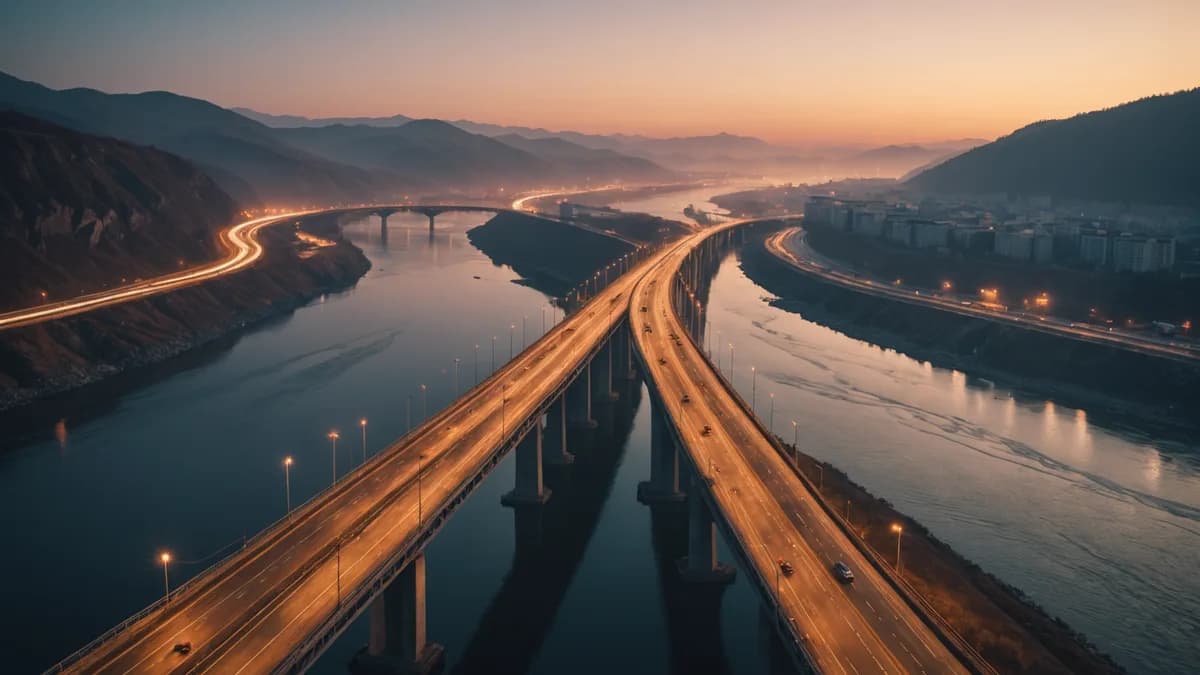
What does a one-kilometer road bridge spanning the Tumen River carry aside from trucks?
XOOMAR Intelligence
Analyst Take
It carries the indelible signature of a war-driven alliance. The opening of Russia and North Korea's first road border bridge is not a bureaucratic infrastructure project. It is a permanent, physical link solidifying a military partnership that directly fuels the conflict in Ukraine according to Guardian World.
Named for a Soviet officer who saved Kim Il-sung, the Yakov Novichenko Bridge connects Khasan, Russia to Tumangang, North Korea. Russian Prime Minister Mikhail Mishustin called it an impetus for "trade, economic, scientific, technological and cultural cooperation." The reality is starker. This bridge formalizes a sanctions-evasion and munitions-supply corridor, binding two nuclear-armed pariahs on a remote stretch of the Pacific coast.
Who Does This Bridge Really Serve?
On paper, the one-kilometre bridge aids regional development and tourism. In practice, its cargo is military necessity.
This bridge provides Russia with a land-based pipeline insulated from maritime interception. Ukrainian human rights group Truth Hounds has explicitly warned the crossing is a future corridor for moving North Korean troops, construction brigades and military officials into Russia, while allowing Russian technology and resources to travel in the opposite direction. This assessment is supported by confirmed facts: North Korea has already sent "thousands of troops" to Russia's Kursk region, and Russia has provided North Korea with advanced military technology. The bridge makes this lethal barter system more efficient, discreet, and resilient.
For Moscow, the bridge is a high-yield, low-cost investment. It secures a steady flow of North Korean artillery shells and missiles. It also grants Putin a lever to project power in Northeast Asia, creating a persistent nuisance for the U.S., South Korea, and Japan. For Pyongyang, it delivers an economic lifeline of fuel, food, and hard currency, alongside critical military tech like air-defence missiles, electronic warfare equipment, drones and spy-satellite technology. Each truck that crosses reinforces Kim Jong Un's regime security against international pressure.
Why Build It Now, Not Thirty Years Ago?
Plans for enhanced border crossings have existed since the 1990s. They languished for decades, victims of cost, North Korea's crippling isolation, and a lack of compelling Russian political will. The war in Ukraine changed everything.
The "rapidly deepening ties" cited by the Guardian began in February 2022. Since then, geopolitical desperation has acted as a catalyst, accelerating glacial plans into a tangible, functional bridge in roughly four years. This speed contrasts sharply with the now-stalled inter-Korean projects of the past, marking a definitive pivot in Pyongyang's external alignment from South Korea to its northern neighbor, Russia.
The bridge's construction timeline is a direct proxy for the intensity of this new alliance. It was not built for a peacetime economy. It was built for war.
How Does This Reshape the Regional Security Map?
The bridge is a geopolitical earthquake for Northeast Asia, physically binding two states operating outside the U.S.-led security order.
For South Korea and Japan, the crossing creates a unified, contiguous threat axis. Military supplies can now move directly from Pyongyang's factories to the Russian Far East without touching international waters, complicating monitoring and interdiction efforts by Seoul, Tokyo, or Washington.
For the United States, it represents the consolidation of a rival bloc. As Russia turns to its "two allies, North Korea and Iran," in the words of an RBC reporter to Sergei Lavrov, it signals a willingness to forge partnerships with other sanctioned states, diminishing the deterrent power of Western economic isolation. Lavrov's retort that there was "nothing wrong" with such company underscores Moscow's defiant posture.
The bridge also alienates Russia from some traditional partners. Kazakhstan's President Kassym-Jomart Tokayev told Putin that many leaders question "why Russia was still waging the war," calling its nature "not entirely clear." This infrastructure project makes Russia's strategic priorities and chosen company brutally clear, likely deepening that rift as we previously explored in the context of Peace Talks Collide With Ukraine's Winter Fight Reality.
What Are the Concrete Consequences for Global Security?
The implications extend far beyond a remote river crossing.
First, it enables a real-time war economy for Russia. A steady, overland supply of North Korean munitions directly impacts the battlefield in Ukraine, potentially prolonging the conflict. This isn't theoretical. North Korean artillery shells are already being fired at Ukrainian positions.
Second, it sets a dangerous precedent. The bridge legitimizes and facilitates a full-spectrum partnership between two heavily sanctioned, nuclear-armed states. It demonstrates a model for creating a sanctions-proof economic and security bloc, offering a visible alternative to nations in the Global South wary of Western pressure.
I am convinced that the expansion of cross-border transport infrastructure will provide a powerful impetus for the further development of trade, economic, scientific, technological and cultural cooperation.
Third, it erodes the non-proliferation regime. Moscow's provision of advanced missile and satellite technology to Pyongyang, eased by this new transport link, directly enhances North Korea's military capabilities, raising the threat level for its neighbors and complicating any future diplomatic efforts.
Where Does This Axis Go from Here?
The Yakov Novichenko Bridge is not an endpoint. It is a starting point.
Expect more infrastructure. Watch for upgrades to the parallel railway bridge and announcements of Special Economic Zones along the border, designed to facilitate barter trade under the guise of commercial development. Russian tourists, already visiting North Korean resorts since 2024, will become a more common sight.
Forecast an intensifying barter system. The flow of North Korean laborers to Russian-occupied territories in Ukraine, or to critical infrastructure projects in the Russian Far East, is a distinct possibility. In return, the quantity and sophistication of Russian military tech transfers will likely increase.
Project a gradual dismantling of sanctions pressure. With Russia's political backing and technical support, North Korea gains a powerful shield against UN sanctions. Russia, holding a permanent UN Security Council veto, can neuter any new punitive measures. This dynamic fundamentally weakens the international sanctions architecture.
The ultimate test will be what crosses this bridge next. Will it be civilian buses, or tank transporters? The opening ceremony featured truck convoys. The coming months will reveal their true cargo, as the front lines in Ukraine and diplomatic fronts worldwide feel the impact of this new, tangible link between Moscow and Pyongyang. This hardening of alliances echoes the high-stakes geopolitical maneuvering seen in other theaters, such as the secret missions detailed in Trump's Envoys Stunned Putin with Secret Moscow Mission. The bridge is now open. The direction of travel is unmistakable.
Impact Analysis
- The bridge creates a permanent, land-based sanctions-evasion corridor between two nuclear-armed pariah states.
- It directly fuels the conflict in Ukraine by making North Korean munitions transfers to Russia more efficient, discreet, and resilient.
- It formalizes a dangerous military alliance, potentially allowing the exchange of troops and advanced technology, reshaping regional security dynamics in Northeast Asia.
Primary Sources & Disclosures

Written by
XOOMAR Insights Team
Research and Editorial Desk
The XOOMAR Insights Team pairs automated research with human editorial judgment. We track hundreds of sources across technology, fintech, trading, SaaS, and cybersecurity, cross-check the facts, and explain what happened, why it matters, and what to watch next. We do not just rewrite headlines. Every article is fact-checked and scored for reliability before it goes live, and we link back to the original sources so you can verify anything yourself.