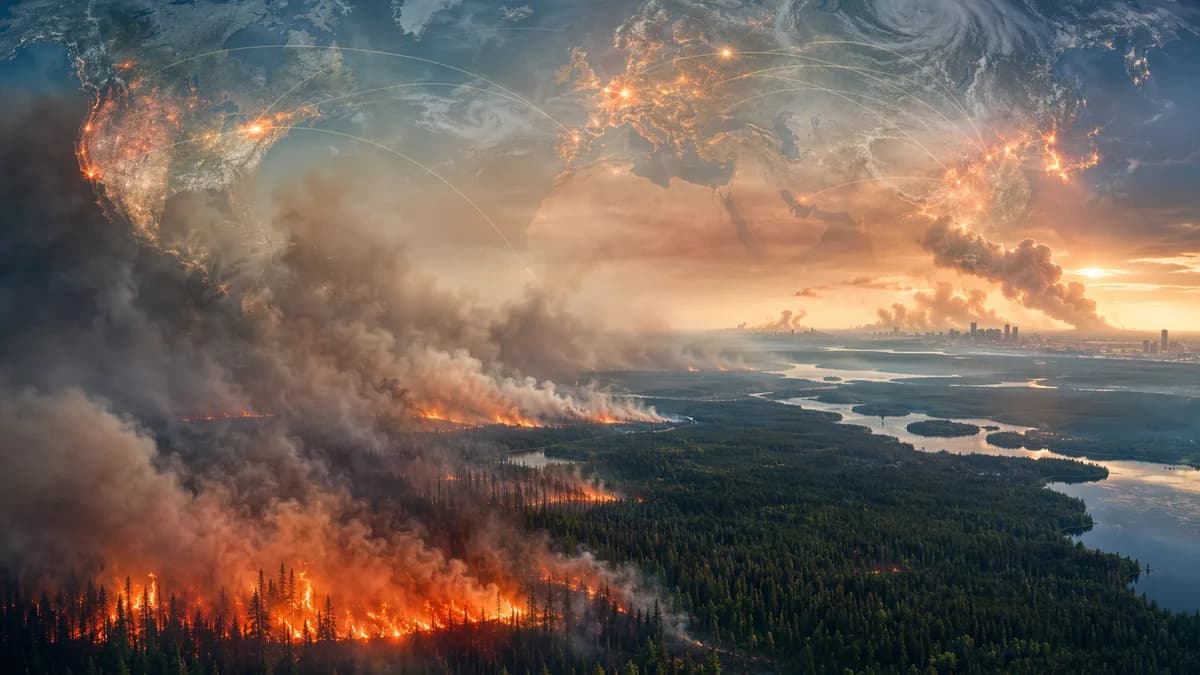
More than 900 Canada wildfires are burning at once, smoke has crossed into the US and northern Europe, and Argentina has just logged a winter night warmer than its usual summer records.
XOOMAR Intelligence
Analyst Take
That is the thread tying this weather roundup together: extremes are no longer staying local. Hot, dry weather is feeding fire risk in Canada, while atmospheric patterns are pushing abnormal heat and storm risk into other regions, according to Guardian World.
“As of Wednesday, more than 900 were burning, scorching about 3m hectares of land.”
Canada wildfires now cover a national-scale fire map
Recent hot, dry weather has triggered hundreds of fires across Canada. The source puts the scale at more than 900 active fires and about 3m hectares scorched.
This is not a single-front disaster. Fires have broken out in several provinces, with the most serious concern centered on the Northwest Territories and Ontario, where several remain out of control.
The practical problem is simple: dry vegetation burns faster, and wind can turn a manageable ignition into a moving fire front. The Guardian source does not give evacuation totals, infrastructure losses, or firefighting deployment figures, so the verified picture is narrower but still severe: many fires, large burned area, poor air quality, and peak season still ahead.
Canada’s national monitoring system matters here. The Canadian Wildland Fire Information System uses weather data from more than 2500 weather stations across Canada and the United States, remote sensing satellite data, and reported fire locations from provinces, territories, and national parks, according to Natural Resources Canada. That mix gives authorities and the public a national view, even when the fires themselves are scattered.
Northwest Territories and Ontario carry the hardest uncontrolled fire risk
The most urgent fire fronts are in the Northwest Territories and Ontario. The source says several fires there remain out of control, which means the situation can shift quickly when wind, heat, and dry fuels align.
An out-of-control fire is not just a label. It signals that crews have not contained the spread. That raises the stakes for nearby communities and for any response planning that depends on stable fire perimeters.
The source does not name specific towns under threat, road closures, or evacuation orders. That gap matters. Without those details, the cleanest read is that the hazard is confirmed, while the local consequences still need more reporting.
This follows a broader fire-risk theme XOOMAR has tracked in previous coverage of wildfire smoke planning failures, Madrid wildfire evacuations, and France wildfire evacuations. The common pattern is not identical geography. It is the speed at which fire conditions can overrun plans built for calmer seasons.
Smoke turns Canada’s fire season into a cross-border air-quality event
The fires are not only burning Canadian land. Smoke has already moved across affected regions, into the US, and even across the Atlantic to northern Europe, according to the source.
That makes the Canada wildfires a hemispheric pollution event, not only a domestic emergency. Air quality can deteriorate far from flames, which complicates public warnings because the visible fire risk and the breathable-air risk no longer share the same map.
The supplied source confirms poor air quality but does not provide hospital data, particulate readings, or health impacts by age group. That should keep the analysis disciplined. The verified point is still consequential: wildfire smoke is mobile, and wind can export the effects of Canadian fire weather across borders.
Peak fire season means the risk curve is still rising
North America is entering peak fire season, so the current fire count should not be treated as a late-stage snapshot. The source says the risk of further blazes remains high.
That is the central prognosis for Canada wildfires: more ignition risk sits ahead if hot, dry conditions persist. Low moisture, dry fuels, and shifting winds are the combination emergency planners watch closely, because small starts can become large incidents before containment catches up.
For readers, the useful signal is not a prediction of exactly where the next fire will start. It is the operating condition. Fire bans, alerts, air-quality warnings, and evacuation readiness can change fast when the weather is doing the loading.
Argentina’s winter night heat breaks the seasonal script
While Canada burns, Salta in Argentina recorded its warmest-ever overnight minimum temperature on Saturday. The mercury did not fall below 26C (79F).
That number is striking because Argentina is in the middle of winter. Salta’s average night-time minimum is about 3C, according to the source. The previous warmest night at that weather station was 22.2C, recorded in January 1953, during the height of summer.
The driver was the Zonda wind, which forms when westerly airflow crosses the Andes, then descends, warms, and dries near ground level. The process is known as the Foehn effect, a mountain-downslope warming pattern seen in different parts of the world.
The unusual part is intensity. The source says one contributing factor may have been the rapidly developing El Niño in the eastern Pacific, which would have left the incoming air mass warmer than average before it descended on Salta.
El Niño also sharpens the western Pacific storm signal
The same strengthening El Niño pattern is expected to increase typhoon activity in the western Pacific, according to the source.
Tropical Depression 11 formed on Tuesday and became Tropical Storm Noul north of the Philippines on Thursday night. It is forecast to strengthen into a typhoon as it tracks between the Philippines and Taiwan, before making landfall on China’s south-east coast on Sunday morning local time as a category 1 storm.
The Canada, Argentina, and western Pacific stories are different weather events. The link is the atmosphere’s ability to translate heat and circulation shifts into distinct hazards: fire, smoke, hot nights, and tropical cyclone risk.
| Region | Event | Verified signal |
|---|---|---|
| Canada | More than 900 wildfires | About 3m hectares scorched, smoke reaching the US and northern Europe |
| Argentina | Salta record warm night | Minimum temperature did not fall below 26C (79F) in winter |
| Western Pacific | Tropical Storm Noul | Forecast to intensify and make landfall on China’s south-east coast as category 1 |
The bigger picture
The clearest lesson from this roundup is that weather risk is spreading through systems faster than borders can contain it. Canada’s fires are producing smoke impacts far beyond the burn zones. Argentina’s hot night shows how winter can still deliver heat stress when the atmospheric setup is extreme. The western Pacific is watching a tropical system strengthen as El Niño builds.
Emergency response remains essential, but response alone is a thin shield if hotter and drier conditions keep raising the baseline risk. The next watch item is not just the fire count in Canada. It is whether air-quality warnings, fire monitoring, heat alerts, and storm forecasts can move quickly enough as these events overlap.
The Stakes
- More than 900 active fires show Canada is facing a widespread national-scale wildfire event.
- Smoke crossing into the US and northern Europe highlights how local fire disasters can create international air-quality impacts.
- Hot, dry conditions and peak fire season ahead raise the risk that burned area and public health impacts could worsen.
Canada Active Wildfires
Primary Sources & Disclosures

Written by
XOOMAR Insights Team
Research and Editorial Desk
The XOOMAR Insights Team pairs automated research with human editorial judgment. We track hundreds of sources across technology, fintech, trading, SaaS, and cybersecurity, cross-check the facts, and explain what happened, why it matters, and what to watch next. We do not just rewrite headlines. Every article is fact-checked and scored for reliability before it goes live, and we link back to the original sources so you can verify anything yourself.