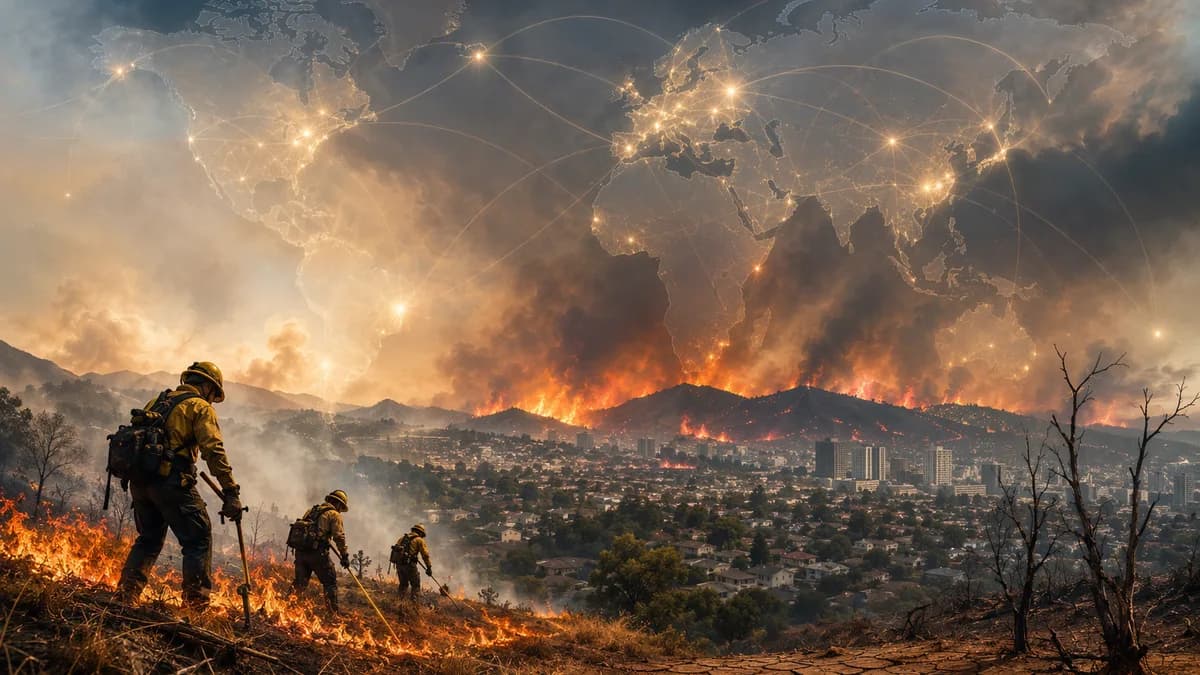
Wildfires are not just about the people and places reached by flames. Their smoke can turn a remote forest disaster into a city health problem. That gap is the real warning.
XOOMAR Intelligence
Analyst Take
The public still tends to picture wildfires as local disasters: flames, evacuations, burned homes, exhausted crews. The current fire pattern is broader. Fierce blazes after back-to-back heatwaves have pushed tens of thousands of people across southern Europe from their homes, including France wildfire evacuations, while fires in Canada and the US have sent thick smoke into major cities, according to Guardian World.
The hard lesson is that fire suppression alone can’t carry the load. Hotter, drier conditions are making old emergency playbooks look too narrow. The danger now travels through air, health systems under strain, evacuation networks, land-use choices, and climate policy.
Wildfire smoke has turned a forest threat into a city health problem
The old assumption was simple: if you didn’t live near trees, grassland, or scrub, wildfire risk was someone else’s problem.
The reality is uglier. Smoke moves. The Guardian’s reporting highlights how fire danger now extends beyond the burn zone, with smoke from major fires degrading air quality far from the flames and turning wildfire response into a public-health issue as well as an emergency-services challenge.
That changes the risk map. A fire can burn in a remote forest and still become a public-health event hundreds or thousands of miles away.
This is where the headline danger gets undercounted. Direct fire deaths are lower than deaths from floods or heatwaves, based on the Guardian’s summary. But smoke shifts the burden from the fire zone to everyone downwind, including people who never see flames.
For XOOMAR readers tracking the wider climate-stress file, this sits beside our related coverage of 140,000 Flee as Madrid Wildfires Outrun Fire Crews and €2bn Europe Heatwave Shreds Grain Harvest Forecast. Those internal links provide context on adjacent pressure points, but the analysis here is grounded in the Guardian and NASA source material.
The wildfire danger stack starts with heat, dry fuel, and wind
A spark does not automatically become a disaster. The spark matters, but the conditions decide the scale.
The Guardian lists several ignition sources: lightning, downed power lines, cigarette butts, abandoned campfires, and arson. Those are triggers. The deeper problem is what happens when they meet hot, dry fuel and strong winds.
Fossil fuel pollution has heated the planet by about 1.3C, according to the Guardian. That extra heat raises the risk of prolonged hot spells that dry forests and grasslands. In regions such as the Mediterranean, global heating is also feeding drought that dries vegetation which would otherwise be less flammable.
A useful way to read the shift:
| Old assumption | Current reality |
|---|---|
| Fires are mainly local emergencies | Smoke can travel far beyond the fire zone |
| Crews can contain most threats if they arrive fast | Heat, drought, and wind can overwhelm response |
| Burned area alone measures danger | Health damage can occur far from the burn scar |
| Forest management can solve the problem | Land management helps, but climate conditions are intensifying fire weather |
The key tension: climate change does not need to “cause” every ignition to worsen the outcome. It loads the background conditions. When vegetation dries, when heat persists, and when winds spread flames, a manageable fire can become a fast-moving emergency.
The numbers show a stranger picture than “everything is burning”
One of the most important details in the wildfire debate cuts against the easy narrative: burned area alone does not capture the full danger.
Land use, settlement patterns, farming, fire suppression, and climate change all push fire risk in different directions. In some places, human land-use changes can reduce the area that burns. In others, hotter and drier conditions can make the fires that do ignite more intense, harder to contain, and more damaging to health.
That does not mean wildfire danger is easing. It means a single global burned-area number is too blunt.
NASA makes the sharper point: extreme wildfire activity has “more than doubled worldwide,” based on Terra and Aqua satellite detections over a 21-year span, according to NASA Science. NASA says the biggest increases in extreme fire behavior occurred in temperate conifer forests of the Western U.S. and boreal forests of northern North America and Russia.
The emissions data also show why fires now belong in climate analysis, not just disaster response. NASA says carbon emissions from forest fires increased by 60% globally between 2001 and 2023. Fire emissions from boreal forests in Eurasia and North America nearly tripled over the same period. Canada’s 2023 fires released about 640 million metric tons of carbon, after the country saw its warmest and driest conditions since 1980.
So the contradiction is real: the total area burned is not the only measure that matters, while extreme fire behavior, smoke impacts, and rising fire emissions in key forest regions are becoming harder to ignore.
Today’s fires are harder to fight because the calendar has changed
The older fire model was seasonal. Fire crews prepared for a window, fought hard, then reset.
NASA says fire seasons are starting earlier in spring and extending later into autumn. Parts of the Western United States, Mexico, Brazil, and East Africa now have fire seasons more than a month longer than they were 35 years ago.
That changes everything for response capacity. Longer seasons mean less recovery time for crews, budgets, aircraft, and local emergency systems. The Guardian adds another pressure point: two separate fire-weather indices project a steady rise in days with high fire danger as temperatures climb.
Past land choices matter too. The Guardian says land abandonment and fire suppression have contributed to fuel buildup in parts of the US and the Mediterranean, helping some blazes explode into mega-fires. But that explanation does not travel everywhere. In Canada, much of the burning occurs in boreal forests that were never managed by humans.
That distinction matters. Better forest management can reduce risk in some regions. It cannot cancel the effect of rising global temperatures on severe fire weather.
NASA’s plain-language answer is blunt:
“Yes, unfortunately, they are. We’re seeing increases in the intensity and the severity, the overall burned area of wildfires and the duration of fire across the fire season.”
Firefighters need defensible land, not impossible promises
The firefighting assumption is that enough crews, aircraft, and equipment can hold the line.
The revealed reality is more conditional. When heat, dry fuel, and strong winds align, not every asset can be saved. The Guardian’s adaptation list points to the practical tools: fire breaks, limits on new settlement in fire-prone places, and vegetation control, including goats grazing abandoned farmland.
Prescribed burning is another tool. The Guardian notes that some firefighters are intentionally burning land to avoid fuel buildup, drawing on a long-running Indigenous practice in Australia and North America that European fire experts are beginning to adopt.
For residents, the useful guidance is concrete:
- Evacuation: Identify safe routes and nearby shelters before disaster strikes.
- Emergency bags: Pack before warnings arrive, not during panic.
- Defensible space: Keep leaves and flammable materials away from the home where fire services recommend it.
- Smoke protection: Keep windows closed and use respirator masks when smoke threatens.
- Decision timing: Leave immediately if authorities order evacuation, or if the home is at risk and warnings have not arrived.
For insurers, lenders, utilities, and municipal finance, the provided sources do not give pricing, claims, bond, or grid-cost data. XOOMAR analysis: those sectors still sit directly in the risk chain because wildfires threaten property, infrastructure, and public services. But the evidence here supports the physical and health risk more strongly than any specific financial-loss estimate.
The next wildfire decade will reward prevention before flames appear
The Guardian and NASA source material point to a clear forward risk: hotter conditions, longer fire seasons, more days with high fire danger, and more extreme fire behavior can make future wildfires harder to manage even before ignition happens.
That is the warning. The response cannot be limited to heroic last-minute firefighting.
The tools are known, though unevenly applied: cut carbon pollution, manage fuel, use prescribed burns where appropriate, protect homes with defensible space, avoid building in the most fire-prone places, improve evacuation planning, and treat smoke as a public-health threat that can hit cities far from forests.
The evidence that would confirm the worst thesis is clear: more days with high fire danger, more long-distance smoke episodes, rising boreal fire emissions, and more extreme fires detected by satellite. Evidence that would weaken it would look just as clear: sustained emissions cuts, fewer extreme fire-weather days, better fuel management in vulnerable regions, and lower smoke exposure over time.
Countries that treat wildfires as a combined climate, land, housing, infrastructure, and health problem will be better positioned than those still treating them as summer emergencies.
Impact Analysis
- Wildfire smoke can turn remote fires into urban public-health emergencies.
- Traditional fire-response strategies are becoming less effective under hotter, drier conditions.
- The growing risk affects evacuation planning, healthcare systems, land use, and climate policy.
Old Wildfire View vs. Current Risk Reality
| Old Assumption | Current Reality |
|---|---|
| Wildfires are mainly local disasters involving flames, evacuations, and burned homes. | Wildfire danger now spreads through smoke, air quality, health systems, and evacuation networks. |
| People outside forests, grasslands, or scrubland face limited risk. | Smoke can affect major cities hundreds or thousands of miles from the fire zone. |
| Fire suppression can carry most of the response burden. | Hotter, drier conditions require broader climate, land-use, and public-health planning. |
Primary Sources & Disclosures

Written by
XOOMAR Insights Team
Research and Editorial Desk
The XOOMAR Insights Team pairs automated research with human editorial judgment. We track hundreds of sources across technology, fintech, trading, SaaS, and cybersecurity, cross-check the facts, and explain what happened, why it matters, and what to watch next. We do not just rewrite headlines. Every article is fact-checked and scored for reliability before it goes live, and we link back to the original sources so you can verify anything yourself.