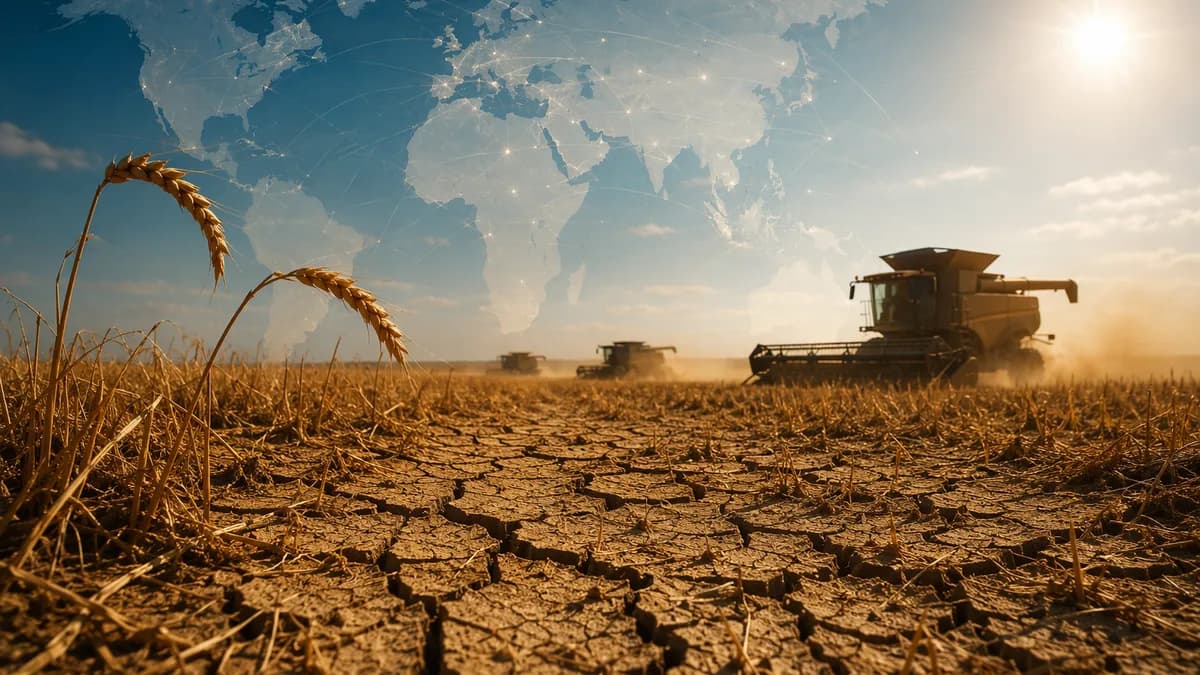
ARTICLE TITLE: Europe’s heatwave in June cost grain farmers €2bn in lost revenue and crop damage
XOOMAR Intelligence
Analyst Take
The Europe heatwave grain harvest hit is now large enough to read as an income shock, a supply shock, and a food-price warning at the same time.
June heat turned Europe’s grain belt into a €2bn climate stress test
The June heatwave is estimated to have cost Europe’s grain farmers €2bn (£1.7bn) and wiped out millions of tonnes of expected production, according to Guardian World. That is the hard number behind a broader problem: Europe’s grain system was hit during the exact biological window when crops are least able to absorb stress.
The crops involved are not niche. Wheat, barley, maize and oats sit inside food supply chains, animal feed markets, export flows, and farm cash flow. Coceral, the European cereals and oilseeds trade association, now expects the European harvest to be 9m tonnes smaller than it had forecast before the heatwave.
That matters because heat damage is not just about scorched fields. It can cut yield before the visible damage looks dramatic. Wheat was hit during grain fill, when cereals need moisture to build grain weight. Maize was hit during pollination, when extreme heat can reduce pollen viability and damage final yields.
XOOMAR analysis: the €2bn figure is best read as a stress test, not a final invoice. It excludes wider heatwave costs, including vegetable crops and livestock losses cited by the ECIU. It also lands before the full harvest picture is settled.
The crop math behind Europe’s 10m tonnes of heatwave damage
The headline numbers need careful handling. The Energy and Climate Intelligence Unit (ECIU) says the June heatwave destroyed 10m tonnes of forecast production, while the net European harvest forecast is now 9m tonnes lower after upward revisions in a few countries that escaped the worst heat, according to ECIU’s analysis.
That downgrade is bigger than the combined forecast grain production of Austria, Ireland and the Netherlands, using Coceral’s July forecast for those countries. It also leaves the 27 EU member states and the UK on course for their smallest harvest since 2018, based on the supplied analysis.
| Measure | Figure from supplied sources | Meaning |
|---|---|---|
| Gross forecast production hit | 10m tonnes | ECIU estimate of heatwave damage before offsets |
| Net harvest downgrade | 9m tonnes | Coceral-linked reduction after some country upgrades |
| Estimated value lost | about €2bn | Based on current grain prices |
| EU and UK corn forecast | 57.2m to 52.7m tonnes | Additional context from related market reporting |
The crops did not all respond to heat in the same way. Wheat depends heavily on moisture during grain fill. Maize is vulnerable during pollination. Other spring crops and winter cereals can also come under pressure when hot, dry weather arrives after limited rainfall, though the supplied material does not support a precise regional breakdown for every crop.
A 9m-tonne downgrade can move through markets quickly when buyers are already watching weather, stocks, and trade flows. The supplied material supports concern about food prices and grain availability, but it does not establish a specific import forecast or a precise global commodity-price path.
France, Hungary, Spain and the UK show how uneven the damage is
Europe did not suffer one uniform crop failure. The same June heatwave produced different outcomes depending on crop stage, regional weather, and whether later conditions can still help crops that were not already past repair.
France is one of the clearest examples in the supplied figures, with expected grain losses valued at €891m. Related reporting citing Coceral data puts France’s total grain forecast reduction at 4.1m tonnes, though the reviewed material does not support every crop-level claim sometimes attached to that figure.
Hungary is also listed among the larger named losses, followed by Spain. Germany is cited in additional context with losses valued at €233m. Bulgaria, Romania, Italy and Finland are described as partial offsets in related reporting, because their outlooks improved.
The country split matters because it shows why the European total is a net figure, not a simple map of uniform failure. Some areas suffered severe heat stress at the wrong point in the season, while others saw forecasts improve enough to offset part of the damage.
In the UK, the picture is still uncertain. British farmers have faced dry and hot conditions across parts of the country, and some harvesting has been brought forward. The supplied material supports a broad concern about heat stress, but not a precise ranking of the worst-hit English regions.
Farmers, traders and consumers are not looking at the same loss
For farmers, the immediate issue is revenue. A smaller crop means fewer tonnes to sell, while the work of harvesting, watering, and caring for livestock continues. The pressure is financial, practical and seasonal: by the time yield loss is visible, many of the costs of producing the crop have already been incurred.
For traders, the key issue is the changed balance sheet. Lower European grain output means more attention on stocks, quality, feed demand and cross-border purchasing. The supplied material supports a tighter market narrative, but it does not show a specific forecast that Europe will become more dependent on imports.
For consumers, the link is slower and less direct. Wheat and maize losses do not automatically mean an immediate jump in bread or grocery prices. But the supplied reporting explicitly raises concern about food prices, and related market reporting points to tighter corn supplies and feed-cost pressure.
XOOMAR analysis: food-price effects are likely to be uneven because the grain shock moves through several layers before reaching shelves: processors, feed users, retailers, and contracts. The source supports the direction of pressure, not the timing or size of any retail price move.
This is also part of a wider European resilience question. XOOMAR has tracked that theme in other sectors, including Europe’s Sovereign AI Fight Pulls In Microsoft Mistral AI and the security-budget pressure described in $37.5B Iran War Cost Corners Pentagon on $67B Ask. Grain now belongs in that same conversation because weather risk is becoming a direct constraint on strategic capacity.
Europe’s grain harvest is being repriced by heat at the wrong moment
The June heatwave was linked by Coceral to the hottest June on record in western Europe. ECIU’s release says the heatwave brought record-breaking temperatures across parts of the UK and Europe, without the supplied review material supporting a detailed list of national temperature records.
Tom Lancaster, ECIU’s land, food and farming analyst, framed the loss as both a farm-income hit and a food-security problem.
“This will hit farmers in the pockets, reducing their income and undermining European food security at the same time.”
The UK context sharpens the point in a more general way. The supplied material supports concern that recent heat has added pressure to British farmers, but it does not verify specific claims about the ranking of recent UK harvests or separate drought and flood impacts in earlier years.
XOOMAR analysis: the deeper signal is that European grain risk is becoming less about average seasonal conditions and more about timing. A heatwave during a critical growth window can do more damage than a longer dry spell at a less sensitive point in crop development.
Food prices, feed costs and farm investment now face a delayed pressure wave
The smaller harvest creates three pressure points.
- Food prices: The source material raises concern that grain losses may affect food prices, though the exact consumer impact remains unclear.
- Trade flows: Lower output means buyers will watch stocks, quality and cross-border purchasing needs more closely, but the supplied material does not quantify a new import dependency.
- Farm resilience: The figures underline the need to test which adaptation measures protect yields during grain fill and pollination, not just which ones perform in normal years.
The farm-investment implication is clear enough, even if the source does not quantify it. Growers facing repeated heat and drought stress will need to judge which measures actually protect yield during the most sensitive crop stages.
Insurers, lenders, and policymakers will also have to read this harvest carefully. That does not mean a specific policy change is already underway. The supplied material does not show that. It does mean the evidence base for climate-related farm risk just got more concrete: €2bn, 9m tonnes, and the smallest expected harvest since 2018.
Europe’s grain market now waits on harvest quality and import needs
The next confirmation point is the final harvest result. If late-season data confirms weak yields and poor quality in the worst-hit regions, the thesis strengthens: June heat was not a temporary weather scare, it materially cut European grain supply.
The thesis weakens if final harvest quality holds up better than current forecasts suggest, if partial gains in less affected countries offset more of the loss, or if later market data shows that trade and stock positions are less strained than feared.
For now, the Europe heatwave grain harvest story is already big enough to matter. One bad harvest can be managed. Repeated heat shocks during pollination and grain fill would force a harder redesign of how Europe grows, prices, trades, and protects its grain supply.
Impact Analysis
- The €2bn loss shows how extreme heat can quickly become a major income shock for farmers.
- Reduced wheat, barley, maize and oat output could ripple through food, feed and export markets.
- The damage hit crops during sensitive growth stages, highlighting Europe’s vulnerability to climate-driven harvest losses.
Europe Heatwave Grain Damage Estimates
| Source/Measure | Estimate | What It Captures |
|---|---|---|
| ECIU forecast production destroyed | 10m tonnes | Gross forecast crop production lost in the June heatwave |
| Coceral net harvest forecast cut | 9m tonnes | Lower European harvest forecast after some upward revisions in a few countries |
Estimated Grain Production Hit From Europe’s June Heatwave
Primary Sources & Disclosures

Written by
XOOMAR Insights Team
Research and Editorial Desk
The XOOMAR Insights Team pairs automated research with human editorial judgment. We track hundreds of sources across technology, fintech, trading, SaaS, and cybersecurity, cross-check the facts, and explain what happened, why it matters, and what to watch next. We do not just rewrite headlines. Every article is fact-checked and scored for reliability before it goes live, and we link back to the original sources so you can verify anything yourself.