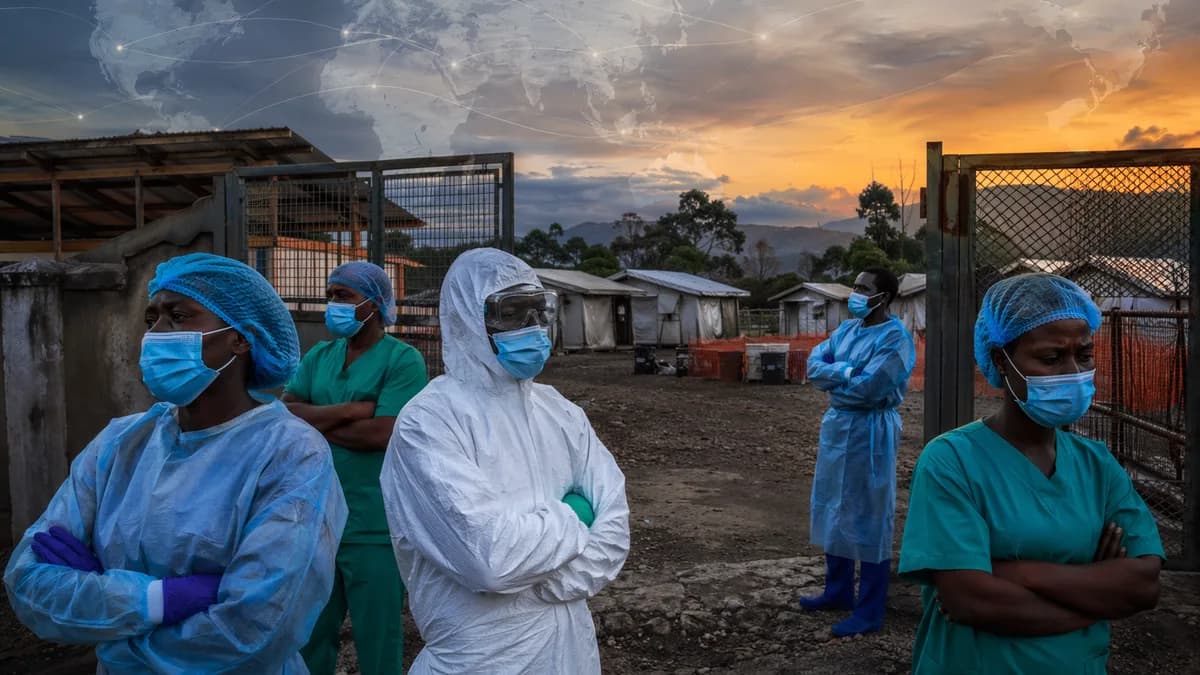
The Congo Ebola strike raises the question no response plan can dodge: can an outbreak be contained if the people doing the containing aren't being paid? Dozens of workers at an Ebola treatment center in northeast Congo stopped work over unpaid salaries and bonuses, according to ABC International, turning a payroll dispute into a direct test of outbreak control.
XOOMAR Intelligence
Analyst Take
The walkout at Rwampara General Hospital in Ituri province is not a side story to the medical emergency. It is part of the emergency. The staff involved include epidemiologists, case investigators, drivers, and gravediggers, the kinds of roles that keep an Ebola response moving from detection to isolation to burial. Protesters shuttered the hospital and blocked the road leading to the facility.
That matters because this outbreak already carries a hard constraint: it is caused by the rare Bundibugyo virus, which has no approved vaccine or treatment, according to the supplied Associated Press reporting. In that setting, human systems carry more weight. Surveillance, triage, transport, infection control, and safe burials become the practical line between containment and acceleration.
XOOMAR analysis: the strike signals that Congo's outbreak response is exposed at its most basic operating layer. Not the lab. Not the alert system. Payroll.
Can Congo contain Ebola if payroll fails before medicine does?
The obvious answer is no, at least not reliably. Ebola containment depends on discipline across thousands of small actions: identifying suspected cases, moving them safely, isolating them, cleaning exposed areas, tracing contacts, and maintaining public confidence that the treatment system is safer than staying home.
A pay failure cuts across all of that.
Some workers at the center and on the ground began striking last week, accusing authorities of failing to pay their wages since the outbreak began in May. Congolese authorities declared the fresh outbreak on May 15, after the disease had been transmitting for weeks without official detection, according to the World Health Organization.
That delay already narrowed the margin for error. Once a virus has moved for weeks before official detection, response teams have to make up time through speed and trust. A strike does the opposite. It creates visible disorder at the exact moment authorities need compliance from residents, patients, and frontline staff.
The staff categories named in the report show why the walkout is operationally serious:
- Epidemiologists: Track patterns, map spread, and guide response priorities.
- Case investigators: Help identify suspected infections and exposure chains.
- Drivers: Move patients, samples, supplies, and response teams.
- Gravediggers: Support safe burial practices in a high-risk setting.
None of these roles is ornamental. If one breaks, others slow. If several stop together, the center can lose its core function even before beds, gloves, or lab capacity run out.
Which numbers show whether the Congo Ebola strike is a staffing problem or a containment threat?
The headline figure is simple: dozens of workers walked out. The more alarming numbers sit around the outbreak itself.
AP reporting supplied with the prompt says Congo has recorded 1,926 confirmed cases and 702 deaths, according to Congolese authorities. A week earlier, a related AP report cited 1,561 cases and 506 deaths since the outbreak was declared. That does not prove any single cause of spread, and the sources do not attribute the increase to the strike. But the sequence shows why losing frontline capacity now is dangerous. The caseload is not static.
The Africa Centres for Disease Control and Prevention said last week that the outbreak is the “fastest-growing Ebola outbreak ever recorded on the continent.”
That claim is the context for the pay dispute. A stoppage inside a slow-moving outbreak would still be serious. A stoppage inside a fast-growing one is a different order of risk.
The numbers Congo's authorities have not provided publicly in the supplied material may matter even more for managing the strike:
- Arrears: How much money is owed to each worker category?
- Duration: Exactly how long have salaries and bonuses been delayed?
- Coverage: Which shifts, wards, transport routes, and burial teams lost staffing?
- Patients: How many confirmed, suspected, or exposed people rely on Rwampara General Hospital?
- Continuity: Was emergency staffing arranged after the hospital was shuttered?
- Funding chain: Did the delay come from central government, provincial administration, donor disbursement, payroll verification, or another bottleneck?
Those gaps should not be treated as administrative trivia. In outbreak response, payroll data is risk data.
The broader vulnerability is clear. Congo has deep Ebola experience, but this outbreak is caused by Bundibugyo, not the more common Zaire virus that accounted for most of Congo's past 16 outbreaks and for which a vaccine exists, according to the supplied AP material. That shifts more pressure onto case management, isolation, contact tracing, and local compliance.
XOOMAR analysis: when medical countermeasures are limited, management quality becomes a substitute defense. Late pay weakens that defense.
How does unpaid outbreak work become a trust crisis?
A strike first hits mechanics. Then it hits belief.
Mechanically, a closed treatment center can disrupt triage, nursing care, cleaning, waste handling, case movement, surveillance, and safe burials. The source says protesting staff shuttered the hospital and blocked the road leading to the medical facility. That is not a symbolic slowdown. It can physically interrupt access.
Trust erodes next. If residents see health workers leaving posts, blocking roads, or accusing authorities of failing to pay wages, they may question whether official guidance is competent or honest. The supplied reporting from July 6 said workers were already facing attacks from angry residents and widespread skepticism about the virus. In that environment, a payroll dispute gives rumor and fear more room to spread.
There is also a psychological bargain in high-risk health work. Staff accept exposure risk when the system offers protection, pay, equipment, rest, and respect. The July 6 AP material said workers complained not only of unpaid benefits but also poor working conditions, inadequate supplies, poor salaries, the "arrogance" of teams sent from Kinshasa, and the “excessive” use of labor from other provinces without prioritizing local labor in Ituri.
Those complaints point to more than money. They suggest a breakdown in legitimacy between the local workforce and the authorities managing the response.
A short strike can end quickly on paper and still leave damage behind. Residents remember that the center closed. Workers remember that pressure was needed to get attention. Officials remember that the response can be disrupted from inside. The next payment delay, even a smaller one, may trigger a faster reaction because the trust account is already overdrawn.
For XOOMAR readers, the governance angle is familiar across sectors. Weak controls show up differently in public health, banking, and technology, but the failure pattern can rhyme. We recently covered how supervisory pressure can follow weak financial controls in Fed Squeezes TS Banking Group Over Weak Bank Capital. In both cases, the issue is not a lack of mission statements. It is whether the operating machinery works under stress.
Who has the most to lose if the pay dispute drags on?
Different groups see the strike through different risks. None of those risks cancel the others.
| Stakeholder | Immediate concern | Deeper risk |
|---|---|---|
| Frontline workers | Unpaid salaries, unpaid bonuses, poor working conditions | Exposure to a deadly disease without credible institutional support |
| Patients and families | Interrupted care and blocked access to the facility | Fear that official treatment pathways are unstable or unsafe |
| Congolese authorities | Keeping the center running and avoiding panic | Proving response funds and payroll systems are accountable |
| International partners and donors | Continuity of outbreak operations | Whether emergency money reaches the people doing the work |
Workers have the clearest grievance. The source says they claim Congolese authorities have not paid them. In a Bundibugyo outbreak with no approved vaccine or treatment, the human risk of the job is not theoretical. Staff are being asked to perform difficult work in a deadly disease setting.
Patients and families face the cruel trade-off. They need uninterrupted care, but they may also understand the anger if public institutions have failed workers. That sympathy can become dangerous if it weakens confidence in referrals, isolation, or official advice.
Government officials face a compressed timeline. They have to verify claims, settle arrears if owed, keep the facility open, and avoid feeding panic. They also have to show that response resources are not trapped in opaque administration. The supplied material does not identify the exact payment bottleneck, so assigning blame beyond the workers' stated claim would go beyond the record.
Donors and aid organizations are not described in detail in the ABC report. Still, XOOMAR analysis is straightforward: any delay in paying frontline staff raises questions about coordination, safeguards, cash flow, and accountability. Emergency funding can look adequate at the pledge level and fail at the last mile, where a driver, gravedigger, or case investigator is waiting for money that was promised.
This is where public health begins to look like any other high-risk operating system. The controls are only as strong as the point where responsibility meets execution. That same accountability problem runs through other sectors we track, including platform governance cases such as Meta EU Fine Case Threatens $12B Over Addictive Feeds, where the central question is whether institutions can enforce rules before harm compounds.
Why does Congo's Ebola experience still leave the response exposed?
Congo has experience with Ebola. The supplied AP material says most of the country's past 16 outbreaks were caused by the Zaire virus, for which there is a vaccine. That history matters, but it does not erase structural weakness.
This outbreak is different in a crucial way. The rare Bundibugyo virus has no approved vaccine or treatment. That makes response execution more important, not less. If authorities cannot rely on approved medical countermeasures, they need tighter performance from the parts of the system they do control: staff scheduling, supplies, transport, data, compensation, and public messaging.
The July 6 AP material added more pressure points. The outbreak had been confirmed in three eastern provinces, including North Kivu and South Kivu. Officials had not yet identified patient zero and still needed to trace possibly tens of thousands of contacts. Clinical trial enrollment had started days before the strike threat, raising concern that a labor dispute could interfere with response activity at the epicenter.
Those facts describe a response already stretched across geography, science, and community trust. A payroll failure adds a fourth strain.
Historical experience can even create a false sense of readiness. A country can know Ebola clinically and still stumble administratively. It can have trained staff and still fail to pay them. It can set up a treatment center and still lose access because workers block the road.
XOOMAR analysis: the science of Ebola control has advanced, but the politics and administration of outbreak response remain fragile. That gap is where this strike lives.
Should payroll be treated like outbreak infrastructure?
Yes. Payroll should sit in the same planning category as protective equipment, lab testing, transport, and isolation capacity.
That does not mean every pay claim is automatically valid or that emergency spending should bypass controls. It means payment reliability must be designed before the crisis, not improvised after workers threaten to walk out.
Practical reforms follow from the failure points visible in this strike:
- Pre-approved hazard pay: High-risk roles need agreed compensation rules before deployment.
- Digital wage tracking: Workers should be able to see whether payments are approved, pending, delayed, or disputed.
- Independent grievance channels: Staff need a way to escalate nonpayment without closing a treatment center.
- Emergency staffing reserves: Authorities need backup staffing plans when labor disputes or insecurity interrupt operations.
- Public reporting on response funds: Authorities should disclose enough to show that money is moving to frontline teams.
The goal is not paperwork for its own sake. It is continuity. If workers believe the system will pay them on time, they are less likely to use the most disruptive form of leverage available: stopping work at the center itself.
Global health security plans often look strong at the level of strategy. The stress test comes at the point where a person doing dangerous work checks whether the promised pay arrived. If that point fails, the plan becomes thinner than it looked.
Which path does the northeast Congo pay dispute take from here?
Three scenarios now matter.
Scenario one: fast settlement. Congolese authorities settle arrears quickly, workers return, and Rwampara General Hospital resumes operations. That would make the strike an embarrassing but manageable reminder that payroll weakness can threaten containment. The confirming signal would be a clear payment timetable, reopened access to the facility, and no repeat stoppage.
Scenario two: partial payment and lingering mistrust. Authorities make some payments or promises, but workers remain skeptical. That risks repeated stoppages, especially if bonuses, supplies, or staffing complaints remain unresolved. In an outbreak described by Africa CDC as the fastest-growing ever recorded on the continent, intermittent disruption could slow surveillance and care even if the center technically reopens.
Scenario three: scrutiny forces a compensation reset. The dispute draws national and donor attention, forcing tighter financial controls and a more durable model for paying Ebola response teams. That would be the most useful outcome, but it requires transparency about how the payment failure happened.
The evidence that matters next is concrete: whether workers are paid, whether the hospital stays open, whether contact tracing and patient movement continue without interruption, and whether authorities publish enough payroll information to rebuild trust.
If Congo and its partners don't fix payment reliability, the next outbreak response will face the same failure point. Better medical tools would help. They won't compensate for a system that asks frontline workers to absorb the danger while waiting for a paycheck.
Impact Analysis
- The strike threatens core Ebola containment work, including surveillance, isolation, transport, and safe burials.
- The Bundibugyo virus has no approved vaccine or treatment, making reliable frontline operations especially critical.
- Unpaid health workers can weaken public trust and slow the response at a moment when delays can fuel spread.
Primary Sources & Disclosures

Written by
XOOMAR Insights Team
Research and Editorial Desk
The XOOMAR Insights Team pairs automated research with human editorial judgment. We track hundreds of sources across technology, fintech, trading, SaaS, and cybersecurity, cross-check the facts, and explain what happened, why it matters, and what to watch next. We do not just rewrite headlines. Every article is fact-checked and scored for reliability before it goes live, and we link back to the original sources so you can verify anything yourself.