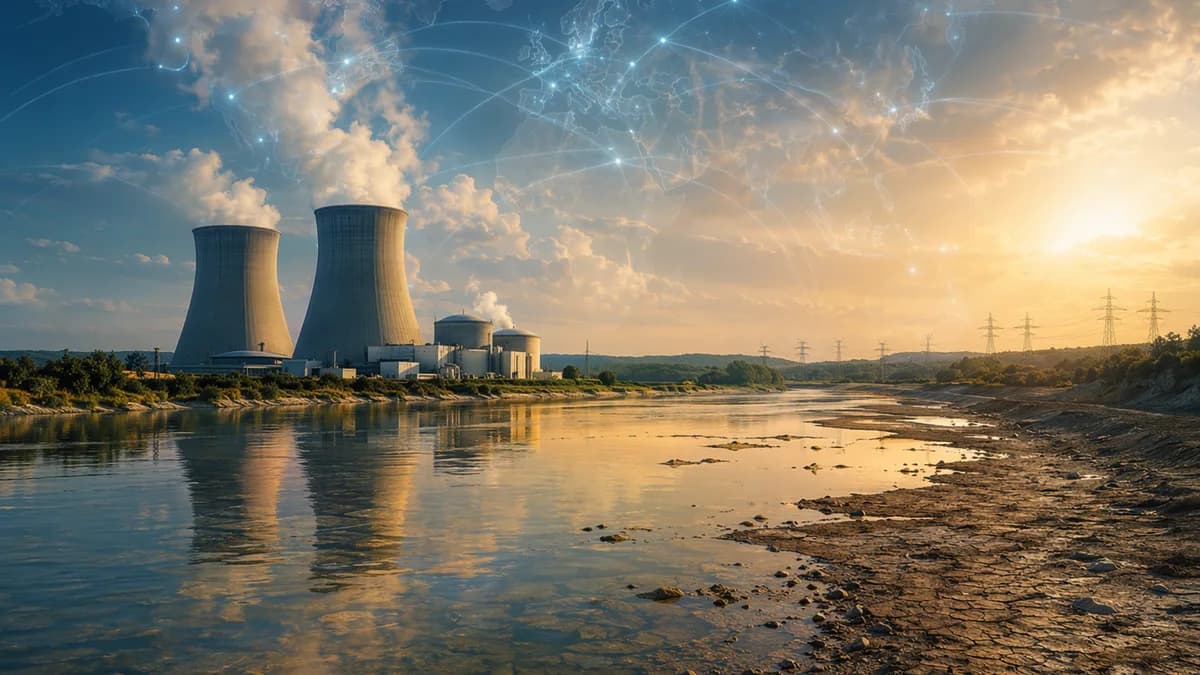
French nuclear power plants are now being constrained by the temperature of the rivers that cool them, with EDF temporarily shutting a reactor at Golfech after the Garonne River approached an environmental discharge threshold, according to Guardian World.
XOOMAR Intelligence
Analyst Take
That lands first on EDF and grid operators. But the wider signal is sharper: France’s nuclear strength depends not only on reactor performance, but on rivers staying cool enough and full enough to absorb waste heat without damaging aquatic life.
EDF’s cooling constraint: French nuclear power plants now answer to river temperature
France built much of its electricity system around nuclear output that is meant to be steady. The current heat episode shows the weak point in that model. Reactors can be technically capable of running, yet still face output cuts because the river they use for cooling is already too warm.
Under French environmental regulations, operators must limit how much heat they discharge back into rivers. When water temperatures rise, that rule can force nuclear plants to reduce production or stop a unit temporarily.
The practical question for EDF is blunt: how much generation can it keep online when the cooling source is part of the heat problem?
The Guardian reported that EDF temporarily shut a reactor at the Golfech nuclear power station in south-west France after the Garonne River approached its environmental discharge threshold. It also said production restrictions were expected at the Nogent nuclear power station from 14 July if the river reached its forecast temperature.
This is not a conventional plant failure. It is a weather-driven operating limit. That distinction matters because it shifts the risk from machinery alone to hydrology, river rules and seasonal heat.
For related power-system context, XOOMAR has covered how heat can tighten electricity systems in Heatwave Forces Neso Power Warning as Grid Runs Tight.
Weather systems created the reactor problem before the reactors felt it
The pressure began upstream, in the atmosphere. Across much of western and central Europe, above average temperatures combined with below average rainfall during June and the first half of July, according to the Guardian.
Persistent high pressure brought long sunshine hours, suppressed rainfall and stronger evaporation. That pushed river levels lower and water temperatures higher.
For nuclear operators, that chain is critical:
- Heat: Warmer air raises river temperatures.
- Low rainfall: Less water reduces river flow.
- Evaporation: More water is lost before it can support river levels.
- Cooling limits: Warm, shallow rivers have less capacity to absorb discharged heat.
Several French nuclear power plants rely on river water for cooling. So the weather does not just increase electricity demand through air-conditioning. It can also reduce available supply by limiting how reactors discharge heated water.
That is the squeeze: heat raises demand while reducing some dispatchable output.
Grid managers face a narrower margin when cooling demand rises
The current river-temperature problem is occurring as prolonged heat has increased electricity demand across much of Europe because air-conditioning use has risen, the Guardian reported.
That creates a timing problem for grid managers. They need predictable capacity during heatwaves, but heat can make part of the power fleet less predictable.
A recent MIT Technology Review report on Europe’s heat stress said Unit two at Golfech shut down at about 11:45 p.m. on June 22 when the river used to cool the plant got too hot. The report said the Garonne water was expected to reach 28 °C, or about 82 °F, forcing the operator to act because French rules limit the temperature of the return stream.
The same report said EDF was limiting output at other reactors, including one at Nogent-sur-Seine, and cited Ember Energy data showing at least seven gigawatts of French nuclear energy was forced offline during a heatwave in July 2025.
That comparison gives scale without overstating the present episode. The latest Guardian report identifies Golfech and expected Nogent restrictions, but does not quantify total capacity affected in July.
“France has sufficient generation capacity to meet electricity demand, including in the event of outages at certain production facilities.”
That was RTE’s position in a related Euronews report on the June heatwave. It suggests the near-term system risk is manageable. XOOMAR analysis: manageable does not mean irrelevant. If weather-driven curtailments become a routine summer assumption, planners will price them into maintenance schedules, reserve needs and demand-response planning.
River protection is now part of nuclear reliability, not a side issue
EDF’s operating problem is also an environmental protection problem. Nuclear plants take in river water, use it to cool equipment, then return most of it at a higher temperature. During a heatwave, the river may already be close to regulatory limits before the plant adds any extra heat.
Euronews quoted EDF saying Nogent-sur-Seine had scaled back production on one reactor:
“to limit the temperature increase between the water withdrawn from the Seine and the water discharged back into it, thereby protecting aquatic plant and animal life,” EDF said.
That sentence captures the trade-off. The reactor may be available. The river may not be.
The public angle is uncomfortable. Voters want reliable, low-carbon electricity during heatwaves. They also expect rivers to be protected when heat and low flows are already stressing fish and plant life.
This is where French nuclear power plants are facing a new kind of scrutiny. Not safety scrutiny in the narrow reactor sense, but climate resilience scrutiny. Can the plant operate within environmental limits under hotter, drier conditions?
The answer may vary by site, river and weather pattern. The Guardian’s reporting does not provide a full site-by-site map. That remains a key gap.
Spain’s fires and China’s floods show the same system stress from different directions
The European heat pattern is not only an electricity story. The Guardian reported that the same persistent weather setup produced dangerous wildfires across the Iberian peninsula, with Spain seeing several significant fires last week.
One of the largest occurred in Almería province, prompting evacuations and extensive firefighting operations. The drivers were familiar: prolonged heat, exceptionally dry vegetation, very limited rainfall, low relative humidity and periods of gusty winds.
This matters for power readers because it shows how heat stresses infrastructure through multiple channels at once. Rivers warm. Demand rises. Vegetation dries. Emergency services face pressure.
XOOMAR has also tracked the human side of heat exposure in Germany's 99 Drowning Deaths Expose Heatwave's Deadly Pull, a reminder that extreme temperatures do not stay inside energy-market models.
Outside Europe, Typhoon Bavi weakened to a severe tropical storm after two landfalls along China’s eastern coast, but the Guardian reported it still poses a significant flooding threat as it moves inland. More than 2 million residents were evacuated before the storm reached China, while hundreds of flights, rail services and ferry operations were suspended.
The common thread is water in the wrong state at the wrong time: too warm and scarce for French reactor cooling, too absent for Spanish vegetation, too concentrated for eastern China flood risk.
The market signal: summer nuclear risk is becoming a planning variable
The strongest conclusion supported by the supplied reporting is not that France’s nuclear model is failing. It is that warm rivers are becoming a more visible operating constraint for French nuclear power plants during heatwaves.
MIT Technology Review cited several adaptation paths from Simone Tagliapietra, senior fellow at Bruegel: planning for summer peaks, making cooling demand more flexible, reinforcing grids for high temperatures, deploying batteries and demand response, and climate-proofing power plants’ cooling systems.
Those changes cost money. The same report said EDF’s climate-change vulnerability assessment expects upgrades to cost about €600 million per year over the next 15 years.
XOOMAR analysis: that figure is the clearest signal for investors and policymakers. River heat is no longer just a temporary operational nuisance. It is becoming a capex line, a summer forecasting input and a constraint on how reliable “always-on” nuclear capacity looks under hotter weather.
The next evidence to watch is specific and measurable: whether Nogent restrictions from 14 July materialize as forecast, whether more EDF sites face output limits, whether RTE continues to see sufficient capacity, and whether warmer-than-average conditions persist across southern Europe with little widespread rainfall.
If those indicators ease, this episode looks like a contained heatwave disruption. If they repeat through the summer, France’s hot rivers will move from weather note to power-market risk.
Impact Analysis
- France’s nuclear output can be limited even when reactors are technically functional.
- Warmer rivers are turning climate conditions into a direct constraint on electricity supply.
- Environmental rules protecting aquatic life may increasingly affect grid planning during heat episodes.
French Nuclear Plants Facing River-Temperature Constraints
| Plant | River/Trigger | Reported Impact |
|---|---|---|
| Golfech nuclear power station | Garonne River approached environmental discharge threshold | EDF temporarily shut a reactor |
| Nogent nuclear power station | River forecast to reach temperature threshold | Production restrictions expected from 14 July |
Primary Sources & Disclosures

Written by
XOOMAR Insights Team
Research and Editorial Desk
The XOOMAR Insights Team pairs automated research with human editorial judgment. We track hundreds of sources across technology, fintech, trading, SaaS, and cybersecurity, cross-check the facts, and explain what happened, why it matters, and what to watch next. We do not just rewrite headlines. Every article is fact-checked and scored for reliability before it goes live, and we link back to the original sources so you can verify anything yourself.