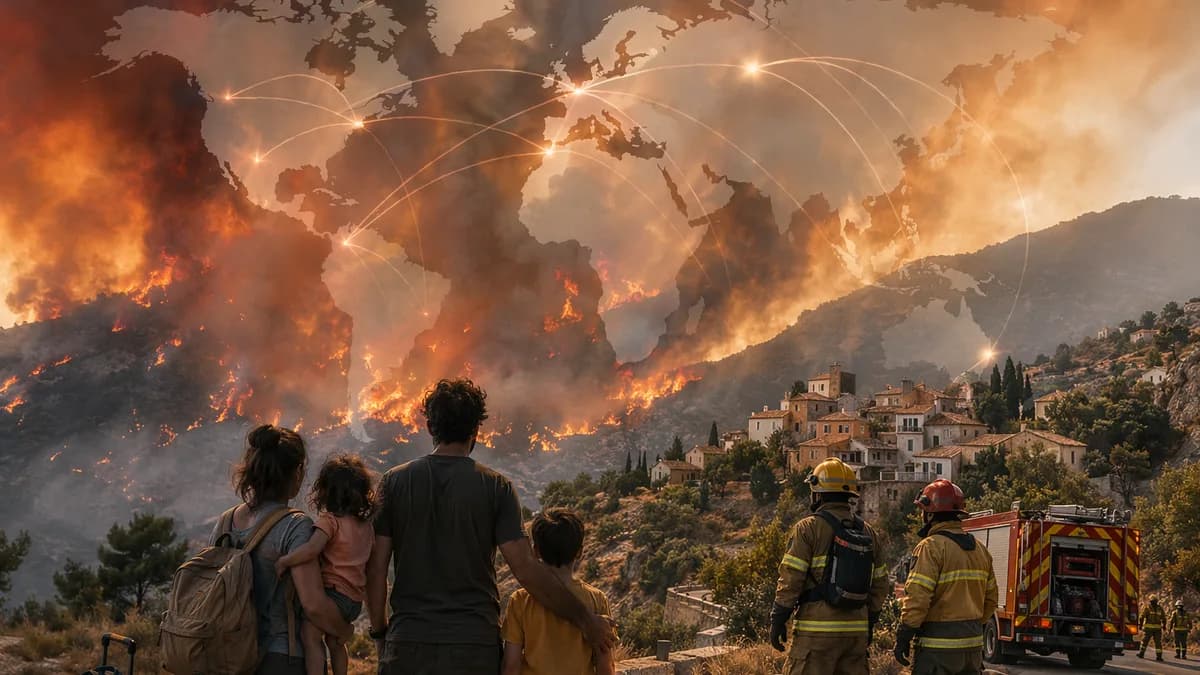
On Thursday, a British family arrived in Bedar for a holiday and instead drove into the edge of one of Spain’s deadliest wildfires, a timing detail that captures the core danger: in southern Spain, ordinary travel can turn into evacuation within hours.
XOOMAR Intelligence
Analyst Take
Lucinda Curtois, who was in Spain with her partner Riyaz Cheytan and their teenage children, described escaping a “terrifying” fire near Bedar, according to BBC World. Spanish authorities say 12 people were killed in the village, including four Britons, while 23 people are still missing.
“They left their home on foot, I don't know why,” Curtois said. “I can only presume it was probably because their road was cut off because they live out in the countryside.”
That quote is the story’s hard center. The Spanish wildfire was not only a firefront. It was a race between evacuation guidance, rural access, wind, heat, and human decision-making under panic. XOOMAR analysis: the key issue now is not whether Spain can send firefighters once flames are visible. It’s whether residents and visitors can get clear before the fire removes their choices.
Thursday’s arrival in Bedar became a fight to escape the Spanish wildfire
Curtois said the family had arrived in Spain on Thursday and were not “expecting to hit a wall of fire.” They later learned that close family friends had died.
The BBC’s wider reporting says emergency services were deployed around Bedar, near Los Gallardos in Almería, after a fire spread rapidly on Thursday afternoon. Hundreds of firefighters were still battling pockets of flames in the south east, with local officials warning the death toll could rise.
The conditions were brutal. A sustained heatwave had pushed temperatures to around 40C (104F) across parts of southern Europe, with wildfires also affecting France, Portugal, and Spain. In the Almería wildfires, the BBC reported that soaring temperatures, very dry ground, and powerful winds helped the blaze spread quickly.
That sequence matters, as another emergency involving trapped travelers shows in the Missouri flooding camp airlift. A family arrives. A fire accelerates. Roads may become unusable. A recommended evacuation route exists, but officials in Bedar said some of those who died had not taken it. The BBC also reports that it is not clear how well that guidance was conveyed.
That is where the story moves from tragedy to public-safety analysis. When a fire moves fast enough, the margin for misunderstanding collapses.
By Saturday, officials said 6,600 hectares had burned
By Saturday, Antonio Sanz, Andalusia’s health and emergencies minister, said the fire had burned across 6,600 hectares (16,300 acres). He also said weather conditions had improved overnight, giving responders a better chance to attack the fire directly.
“This is the first day we will be able to mount a direct attack on the fire. Until now, weather conditions and the behaviour of the blaze only allowed us to work defensively,” Sanz said.
That distinction is crucial. Defensive firefighting means crews are trying to protect lives and property while the fire dictates terms. A direct attack means responders can more actively confront the flames. The shift tells readers how difficult the first phase was.
CNN, citing Spanish officials, reported that more than 460 emergency workers had been deployed near Los Gallardos, at least 1,405 residents had been evacuated, and at least eight people were injured, four seriously. CNN also reported that Sanz said some victims tried to escape through a dry river bed that became a deadly “trap.”
The reported figures show the scale, but they don’t capture the worst parts: families unable to reach relatives, tourists who may not know local routes, residents deciding whether to flee by car or on foot, and emergency crews operating in heat, smoke, and shifting wind.
| Reported measure | Figure in source material |
|---|---|
| People killed | 12 |
| Britons among dead | 4 |
| People still missing, per BBC citing Spanish authorities | 23 |
| Land burned, per Antonio Sanz | 6,600 hectares (16,300 acres) |
| Residents evacuated, per CNN citing regional officials | 1,405 |
| Emergency workers deployed, per CNN citing Spain’s interior minister | More than 460 |
The victims’ choices point to a brutal evacuation problem
The most painful detail is that some people appear to have been trying to escape when they died.
The BBC says four people were found dead in a burnt-out car. Sanz previously said they were believed to be “of British origin” and that the car had a steering wheel on the right. CNN reported that four people died in a vehicle and seven others were killed while trying to get away from the fire on foot.
Officials have not identified the deceased. The BBC says neither Spanish authorities nor the Foreign Office in London have revealed their identities. Belgian Foreign Minister Maxime Prévot said many Belgians had second homes in the area and consular services were trying to contact “Belgians with whom they have not been able to get in touch.”
XOOMAR analysis: this is a warning for holiday regions with large foreign communities. Visitors and second-home owners may not have the same local knowledge as permanent residents. They may not know which roads stay passable, where dry river beds lead, or how quickly wind can turn a safe route into a trap.
This is separate from other Spain-related public-safety issues we track, such as our report on an FBI tip triggering a Russian hacktivist arrest in Spain. The wildfire case is different in cause and consequence, but it shows the same basic pressure on authorities: warnings only work if people receive them, trust them, and understand what to do next.
Heat, wind, and dry ground turned a rural fire into a mass-casualty event
The cause of the fire has been put down to a fallen power line, the BBC reports, but local electricity companies have denied this. That leaves a major factual gap. The ignition source still needs firmer public explanation.
The fire’s behavior is clearer. Heat near 40C, dry ground, and powerful winds helped it move quickly. Those are the conditions that shrink evacuation windows and limit firefighting options. They also increase the chance that people make fatal choices under stress.
The BBC reports that Europe is the fastest-warming continent, heating at twice the global average, according to the Copernicus climate service. It also reports that climate change is driving up temperatures around the world, increasing summer heatwaves, pressure on water supply, and more intense wildfires.
That does not mean climate change alone explains this specific fire. It means the background conditions that make fires more dangerous are worsening. Planning choices still decide who is most exposed: where homes sit, how evacuation routes are marked, how alerts are sent, and how prepared visitors are before smoke appears.
Residents, tourists, and officials face different versions of the same emergency
For residents, the question is immediate: leave early or risk being trapped. For tourists, it is even harder. A holiday area can feel safe because it is familiar, scenic, or busy. That feeling does not matter when wind shifts.
For firefighters, the first hours appear to have been defined by constraint. Sanz said conditions and fire behavior initially allowed only defensive work. That means crews were dealing with a fire they could not yet fully confront.
For officials, the hard questions are now unavoidable:
- Evacuation routes: Were recommended routes clear, realistic, and understood by residents and visitors?
- Alert delivery: Did people in rural homes receive warnings quickly enough?
- Foreign nationals: Were messages available and actionable for non-Spanish residents and tourists?
- Fire access: Could emergency crews reach the most vulnerable homes before roads became unsafe?
- Ignition source: Was a fallen power line involved, or is that explanation unsupported?
None of those questions should be answered before investigations do their work. But they should define the investigation.
The next decision point is prevention before ignition
Spain has seen deadlier wildfire disasters before. The BBC notes that 20 people died in a fire on the Canary Island of La Gomera in 1984, while 21 people, including nine children, died in a forest fire near Lloret de Mar in north-eastern Spain in 1979. With at least 12 dead, the Los Gallardos fire is already among the deadliest in Spanish history.
The next test is whether this disaster changes preparation before the next extreme fire day.
Residents in fire-prone areas need evacuation plans that assume roads may fail. Travelers should treat wildfire risk as a real safety factor, checking local alerts, exit routes, and accommodation procedures before and during a trip. Officials need to prove that warnings are not just issued, but understood by people who may be elderly, foreign, offline, asleep, or unfamiliar with the area.
The evidence that would confirm progress is concrete: faster alerts, clearer multilingual evacuation instructions, better route planning for rural homes, and fewer people forced to choose between a car, a footpath, and smoke. The evidence that would weaken it is just as stark: another fast-moving Spanish wildfire where victims die while trying to work out which way to run.
Impact Analysis
- The deaths show how quickly wildfires can trap residents and tourists in rural areas.
- Missing-person figures suggest the full human toll may still rise.
- Extreme heat across southern Europe is turning ordinary travel and local life into urgent evacuation risks.
Reported Human Toll in Bedar Wildfire
Primary Sources & Disclosures

Written by
XOOMAR Insights Team
Research and Editorial Desk
The XOOMAR Insights Team pairs automated research with human editorial judgment. We track hundreds of sources across technology, fintech, trading, SaaS, and cybersecurity, cross-check the facts, and explain what happened, why it matters, and what to watch next. We do not just rewrite headlines. Every article is fact-checked and scored for reliability before it goes live, and we link back to the original sources so you can verify anything yourself.