More than 100 UK businesses using Facewatch facial recognition are about to become part of a system that can alert police in an average of four seconds when a serious offender triggers a live match.
XOOMAR Intelligence
Analyst Take
The new feature, due to launch in autumn, marks a sharp escalation in retail surveillance: a tool sold to shops as protection against repeat theft, abuse, and violence is moving closer to real-time policing, according to Guardian World. Civil liberties groups say the change risks normalising police attention before a crime has happened in the store.
That is the core tension. Retailers are under pressure. The Office for National Statistics recorded 509,566 shoplifting offences in England and Wales in the year ending December 2025, and the British Retail Consortium has warned that violence, abuse, and theft is “spiralling out of control”. But the question now is not only whether shops can identify repeat offenders. It is whether ordinary customers should be scanned by default when they walk into Sainsbury’s, B&M, Spar, or another participating retailer.
Facewatch facial recognition turns more than 100 retail users into a police alert network
Facewatch facial recognition already monitors stores for people retailers classify as known repeat offenders. The new feature adds a state-backed layer: when the system says one of the “most serious offenders” has triggered a live facial recognition match, police would be alerted instantly.
Facewatch chief executive Nick Fisher described it as a “unique technical development” that would warn police in an average of four seconds when the “worst offenders” are flagged on its network.
Facewatch said it was launching a UK-first feature to “alert police instantly when the most serious offenders trigger a live facial recognition match”.
That distinction matters. A retail-only alert stays inside the shop’s security process. A police-linked alert turns a private watchlist match into a trigger for potential law enforcement response. The move shifts power inside everyday retail spaces, from loss prevention teams and private security guards toward automated suspicion backed by the state.
XOOMAR analysis: the most consequential part of the launch is not the camera. Cameras are already familiar in shops. The consequential part is the pipeline: private biometric matching, private categorisation of risk, then near-instant police notification.
Four seconds is the number that changes the Facewatch debate
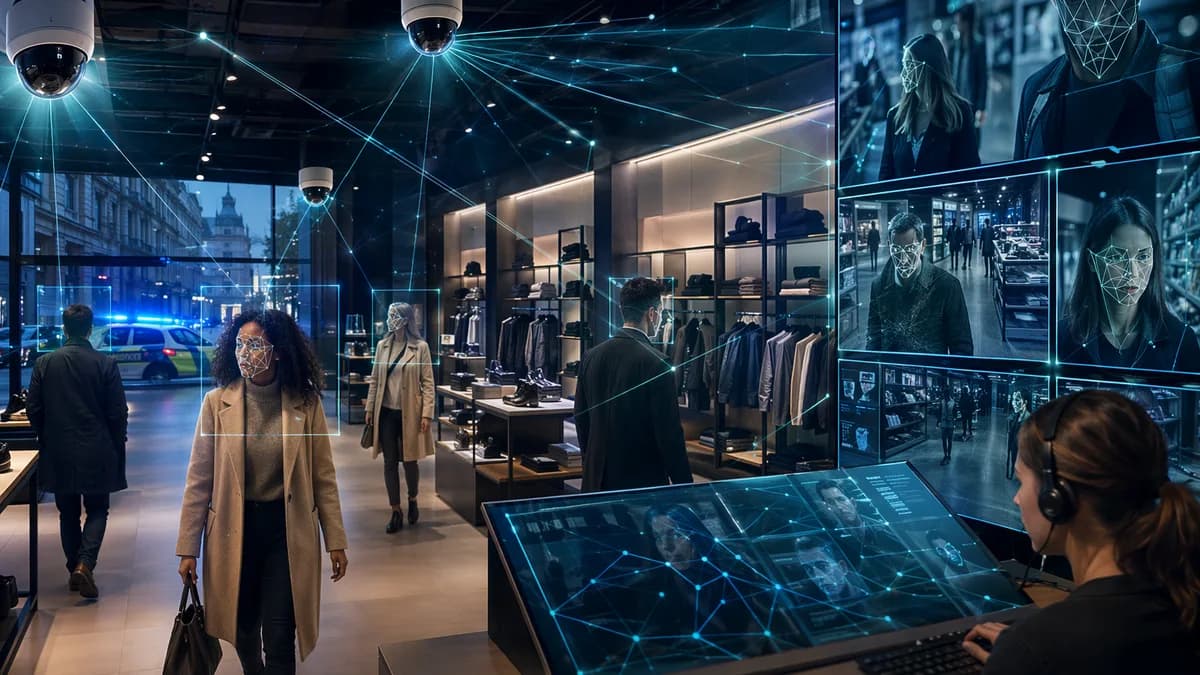
In plain terms, the system works like this: cameras scan faces in participating stores, compare images against a database, and generate alerts when there is a match. Facewatch says its new platform will combine live facial recognition, incident reporting, case management, and evidence workflows for police use in one system.
The company has said its alerting process checks each match with two algorithms before a human verification stage, producing 99.98% operational accuracy before an alert is sent to a retailer. It has also said the police warning system would notify officers within an average of four seconds when the most serious offenders are identified.
Still, the operational grey zone is large:
- Classification: Who decides someone belongs in the “most serious offenders” group?
- Duration: How long does a person remain on a watchlist?
- Evidence: What record is required before police are notified?
- Appeal: How does a wrongly matched person challenge the alert?
- Deletion: What happens to biometric data after a non-match or a disputed match?
| Feature | Retail-only Facewatch alert | Police-linked Facewatch alert |
|---|---|---|
| Primary recipient | Store staff or security teams | Police |
| Trigger | Live match against a retailer-linked watchlist | Live match involving a “serious offender” category |
| Immediate consequence | Staff intervention or monitoring | Possible police response |
| Core controversy | Private surveillance in shops | Private surveillance feeding live policing |
That last column is why campaigners are reacting so strongly.
Almost 300,000 alerts in six months shows the system is already operating at scale
Facewatch said it alerted retailers almost 300,000 times that a “known repeat offender” had entered a store during the first six months of 2026. SecurityBrief’s account of the company’s launch said Facewatch currently sends more than 50,000 positive alerts a month to thousands of UK stores, generated more than 500,000 real-time alerts in 2025, and reached 55,462 positive alerts in May 2026.
Scale changes the civil liberties calculation. A system used in high-footfall chains does not only affect the small group of people who trigger matches. It scans large numbers of shoppers who have done nothing wrong.
The demographic risk is not abstract. The Guardian source states that evidence suggests black and Asian people are more likely to be incorrectly identified than white people. Courthouse News also reported that the Metropolitan Police said its live facial recognition system produced false alerts for 10 people, eight of whom were Black, while claiming it had not led to wrongful arrests.
That does not prove the same error pattern in every retail deployment. But it does make the burden of proof heavier for any system that sends police toward a person during an ordinary shop.
For wider context on how public safety tech can run ahead of operating rules, see XOOMAR’s coverage of Knife Grab Forces Police Drone Disarmament Reckoning. The technologies differ, but the governance problem is similar: once police tools move into live environments, rules written after deployment are already late.
Sainsbury’s expansion from 55 stores to more than 200 raises the stakes
The retail argument is straightforward. Staff face theft, abuse, and violence. Repeat offenders can be known to stores before they walk in. Faster alerts may let staff intervene “before theft, abuse or violence could occur or escalate”, as Facewatch has argued.
Sainsbury’s recently announced plans to increase its use of Facewatch from 55 stores to more than 200 by the end of the year. In earlier BBC reporting, Sainsbury’s chief executive Simon Roberts said: “The retail sector is at a crossroads, facing rising abuse, anti-social behaviour and violence. We must put safety first.”
Campaigners see the same facts differently. Charlie Whelton, policy and campaigns officer at Liberty, called the development “untested” and “opaque”, warning that facial recognition has been allowed to “proliferate without anything to govern it”.
“It’s not against the law to walk into a shop even if you’ve committed crimes in the past,” Whelton said. “The idea of calling the police on somebody who hasn’t committed a crime, but there’s a concern they might, is really upending the way we do things.”
Sarah Lasoye, pre-crime programme manager at Open Rights Group, said the technology is “entrenching a climate of surveillance across public life” and warned that “the speed which it’s now possible for someone to encounter the police force in the middle of their daily shop is a really dangerous escalation.”
Shoppers sit between those positions. Many want safer stores. Fewer expect biometric scanning to become the entry cost for buying groceries or household goods.
CCTV records a scene, live facial recognition identifies the person in it
The UK debate is shifting from passive recording to active identification. CCTV shows where someone went. Live facial recognition tries to identify who they are in real time, then prompt action.
That difference is the heart of the proportionality fight. Nuala Polo, UK public policy lead at the Ada Lovelace Institute, said: “There are other, much less intrusive means that you can use to catch shoplifters where you don’t need to be scanning millions of faces every day, virtually without consent.”
She also warned that government plans for a legal framework for facial recognition technology would not apply to the private sector.
“If we agree this technology poses significant risks in police use, but we continue to let it be used unchecked in the private sector, there’s a discrepancy there,” Polo said.
XOOMAR analysis: that discrepancy is now the fault line. Police use may face one set of safeguards, while private retailers build the matching infrastructure that can still connect to police response. If that gap remains, police-linked Facewatch alerts could become a route around stricter public-sector rules.
A similar pattern appears across AI deployment: operational efficiency arrives first, governance catches up later. For a non-policing example, see Enterprise AI Agents Turn Safe Pilots Into Cost Traps, where the risk is not surveillance but control failure after scale.
The next fight will be over watchlists, audits, and who gets to say “serious offender”
If police alerts are added to private facial recognition, the burden should sit with retailers, Facewatch, and authorities to prove necessity, accuracy, and proportionality before rollout widens. “It reduces theft” is not enough when the system scans the faces of ordinary shoppers and can trigger police contact within seconds.
The practical safeguards are not optional details. They are the system.
- Watchlist rules: Clear criteria for adding, ranking, and removing people.
- Audit trails: Records of every match, verification, alert, and police notification.
- Appeal routes: A way for misidentified people to challenge records quickly.
- Deletion policies: Strict handling of non-matches and expired records.
- Store transparency: Clear notice when customers enter scanned premises.
The next phase will likely be fought across regulators, courts, Parliament, campaign groups, and checkout aisles. Evidence that would strengthen Facewatch’s case includes independently audited accuracy, public watchlist standards, transparent deletion rules, and proof that police-linked alerts reduce serious harm without producing wrongful interventions.
Evidence that would weaken it is just as clear: false matches, unclear watchlist governance, customer backlash, or police reliance on private databases that are not held to equivalent public-sector standards.
Retail facial recognition is unlikely to disappear. Police-linked alerts are the harder question. Britain now has to decide whether everyday shopping should remain an ordinary commercial act, or become an identity-checked activity watched in real time.
Impact Analysis
- The system could expand police involvement in retail spaces before any in-store crime occurs.
- More than 100 UK businesses may become part of a real-time facial recognition alert network.
- The rollout intensifies the debate over public safety, shoplifting, and routine biometric surveillance.
Facewatch: Existing Retail Use vs New Police Alert Feature
| Aspect | Existing Facewatch Use | New Feature |
|---|---|---|
| Primary purpose | Helps retailers identify people classified as known repeat offenders | Alerts police when the system flags the most serious offenders |
| Response | Retailers receive live match alerts | Police are notified in an average of four seconds |
| Concern raised | Customer scanning in shops | Retail surveillance moving closer to real-time policing |
Shoplifting Offences in England and Wales
Primary Sources & Disclosures

Written by
XOOMAR Insights Team
Research and Editorial Desk
The XOOMAR Insights Team pairs automated research with human editorial judgment. We track hundreds of sources across technology, fintech, trading, SaaS, and cybersecurity, cross-check the facts, and explain what happened, why it matters, and what to watch next. We do not just rewrite headlines. Every article is fact-checked and scored for reliability before it goes live, and we link back to the original sources so you can verify anything yourself.