Police drone disarmament can save lives, but Sacramento County’s slick “nationwide first” video shows why drone policing needs rules before it becomes a highlight reel. The operation may have reduced risk in a tense weapons call. The marketing around it should worry everyone.
XOOMAR Intelligence
Analyst Take
The Sacramento County Sheriff’s Office promoted footage of a small quadcopter using a dangling magnet to remove a knife from the hand of a motionless suspect, according to Ars Technica. The video, posted to Facebook and Instagram on June 22, 2026, used the Mission: Impossible theme to dramatize an incident involving what the department described as a “felony suspect armed with a knife and a firearm” who “was not responding to negotiators.”
That is the problem. A serious public safety moment became a sales pitch for police technology. The right lesson isn’t “drones are bad.” It’s narrower and more urgent: if departments want drone as first responder systems, they need public rules, audits, and limits before these tools become ordinary emergency infrastructure.
Police drone disarmament should trigger rules before it becomes a sales pitch
The Sacramento case is exactly the kind of incident that can soften resistance to police drones. No officer rushed into a garage. No bystander appears to have been hurt in the footage. A machine handled a dangerous object from a distance. That’s persuasive.
But persuasive isn’t the same as sufficient.
The sheriff’s office praised the “incredible display of creativity, skill and precision by the drone pilot.” That may be fair on the narrow facts. Still, police drone disarmament sits in a different category from overhead observation. A drone didn’t just look. It entered a residence and manipulated a weapon in a live police operation.
That shift matters. Once a tool moves from seeing to touching, the policy frame has to move with it.
An incapacitated suspect, a weapon, and a perfect police tech narrative
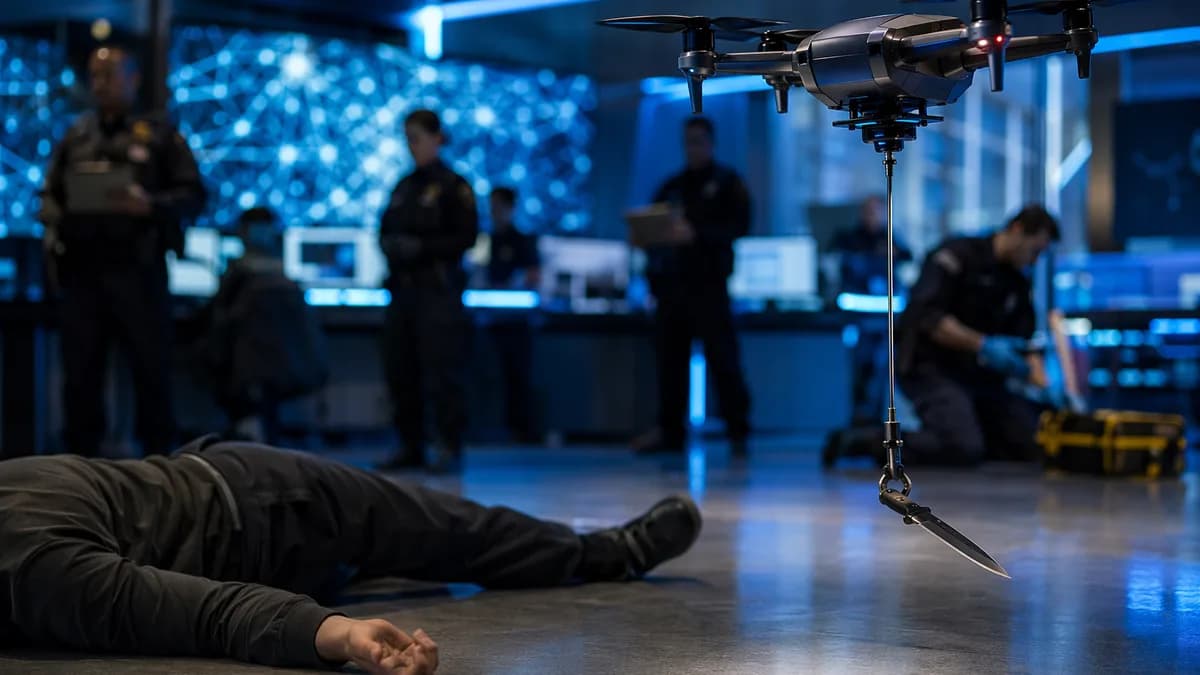
The facts are unusual. Police said a SWAT team surrounded the suspect’s residence after the “known felon and parolee-at-large was seen earlier with a firearm.” A first drone found the suspect hiding in a garage corner, motionless, with a knife in one outstretched arm. A second small drone, flown by an officer wearing first-person view goggles, carried a magnet on a cable and pulled the knife away.
The most important detail is also the least cinematic: the suspect appeared unresponsive.
Vic Moss, CEO and cofounder of the Drone Service Providers Alliance, put the skepticism bluntly in a Facebook comment:
“The dude was comatose. You could’ve disarmed him with a marshmallow. But congrats on good use of the drone.”
That doesn’t prove the tactic was staged or unnecessary. It does puncture the hero edit. Jim Cooper, head of the Sacramento County Sheriff’s Office, told The Hill on NewsNation that the suspect “may have overdosed” after initially responding to law enforcement. He also said the magnet idea “possibly saved someone’s life, preventing us from taking a life.”
Both can be true. The drone may have helped. The video can still be propaganda for a broader drone-first future.
Drone first responders turn emergency calls into aerial surveillance by default
The Sacramento Sheriff’s Office is not operating in isolation. The Electronic Frontier Foundation’s Atlas of Surveillance lists more than 1,800 police departments and sheriff’s offices as having operated drones in the United States. Ars Technica also reports that the nonprofit highlighted a rise in drone as first responder programs in 2025, with companies pitching police drones with enhanced surveillance capabilities.
The operational appeal is obvious. Cooper said his officers use drones “all the time to fly into houses, through a garage door, doggy doors.” Drones can give officers eyes inside a scene before humans enter. In a weapons call, that can buy time and reduce blind decision-making.
The civil-liberties risk is just as obvious. Beryl Lipton, a senior investigative researcher at the Electronic Frontier Foundation, warned:
“Flying cameras are bad enough. They can see and record footage from a special vantage point, capturing video of your home, your backyard, and your movements that should require clear policies around retention, audits, and use, including when the cameras shouldn’t be recording.”
That quote goes to the heart of the issue. A drone launched for an emergency call can also collect footage of private spaces and neighborhood activity. Readers who follow surveillance debates outside policing will recognize the same governance question in XOOMAR’s coverage of World Cup Surveillance May Outlive the Final Whistle: temporary security tools need rules before they become permanent habits.
A flying camera is not the same as a flying hand
The Sacramento incident exposes a gap between surveillance policy and use-of-force policy. A drone that observes a suspect is one thing. A drone that removes a knife is another.
Here’s the distinction cities should write into policy:
| Drone role | What it does | Policy question |
|---|---|---|
| Observation | Records, streams, scouts, tracks movement | Who can view footage, how long it’s kept, when recording is barred |
| Physical intervention | Touches, moves, distracts, disables, or removes objects | Who authorizes contact, what risks are allowed, how force is reviewed |
Police departments should not blur that line because one magnet trick worked on one apparently unresisting person. Written rules should define when a drone may touch a weapon, move an object, distract a person, enter a home, or support a tactical entry. The policy should also say who gives approval, what medical risks must be considered, how evidence is preserved, and when an after-action review is mandatory.
The strongest counterargument is real: a drone may be safer than sending an officer into a weapons call. That’s especially true when a suspect may be armed, intoxicated, unconscious, or medically distressed. Remote tools can slow a scene down.
But safety benefits don’t erase oversight. They make oversight more important, because effective tools spread fast.
Public audits matter more than “nationwide first” videos
Sacramento County already had a significant drone footprint before this video. The sheriff’s office listed 18 drones in its 2025 annual report, including commercial multirotor drones from DJI and Autel, plus a fixed-wing Event 38 drone capable of vertical takeoffs and landings. In September 2025, county supervisors unanimously approved buying another 27 drones with a starting price of $5,000 per drone, as part of a larger $1 million package that also included a robot, a Bearcat armored vehicle, and other military-style equipment.
Those details matter more than the soundtrack. Procurement creates momentum. Once hardware is bought, trained on, and normalized, restraint depends less on good intentions and more on rules people can inspect.
At minimum, police drone programs should disclose:
- Call type: Why the drone launched.
- Location category: Residence, business, street, school, public event, or other setting.
- Flight duration: How long the drone was active.
- Footage handling: Whether video was retained, deleted, or shared.
- Outcome: Whether the flight led to arrest, force, search, or evidence collection.
- Intervention status: Whether the drone merely observed or physically affected the scene.
That kind of reporting would also test my critique. If public records showed rare use, tight retention, independent review, and few deployments outside urgent threats, the case for alarm would weaken. If records showed routine launches, broad retention, and mission creep into low-level calls, the “public safety” pitch would look much thinner.
For a separate public-accountability lens on security spending, see XOOMAR’s £4.7bn Gap Traps Starmer Defence Plan in PMQs Fire. Different arena, same basic demand: officials who buy powerful tools should be able to justify the cost, the limits, and the oversight.
Cities should set drone rules before police departments set the precedent
City councils, county supervisors, mayors, civilian oversight boards, and state lawmakers should move before the next “nationwide first” arrives with better music and a cleaner edit. The immediate agenda is simple: public hearings, deployment limits, use-of-force classifications, footage retention rules, independent review, and penalties for policy violations.
Sacramento’s drone may have helped end one dangerous incident safely. Good. Nobody should dismiss that.
But trust won’t come from promotional clips. It will come from enforceable limits that tell residents when police drones can watch, when they can enter, when they can touch, and who answers when they go too far. If police want the public to accept drone first responders, they should welcome rules that prove the technology serves the public rather than watching it.
Impact Analysis
- The incident shows drones may reduce immediate danger in high-risk police calls.
- Using a drone to physically manipulate a weapon raises stronger oversight concerns than simple aerial surveillance.
- The department’s promotional framing highlights the need for public rules before drone policing becomes routine.
Primary Sources & Disclosures

Written by
XOOMAR Insights Team
Research and Editorial Desk
The XOOMAR Insights Team pairs automated research with human editorial judgment. We track hundreds of sources across technology, fintech, trading, SaaS, and cybersecurity, cross-check the facts, and explain what happened, why it matters, and what to watch next. We do not just rewrite headlines. Every article is fact-checked and scored for reliability before it goes live, and we link back to the original sources so you can verify anything yourself.