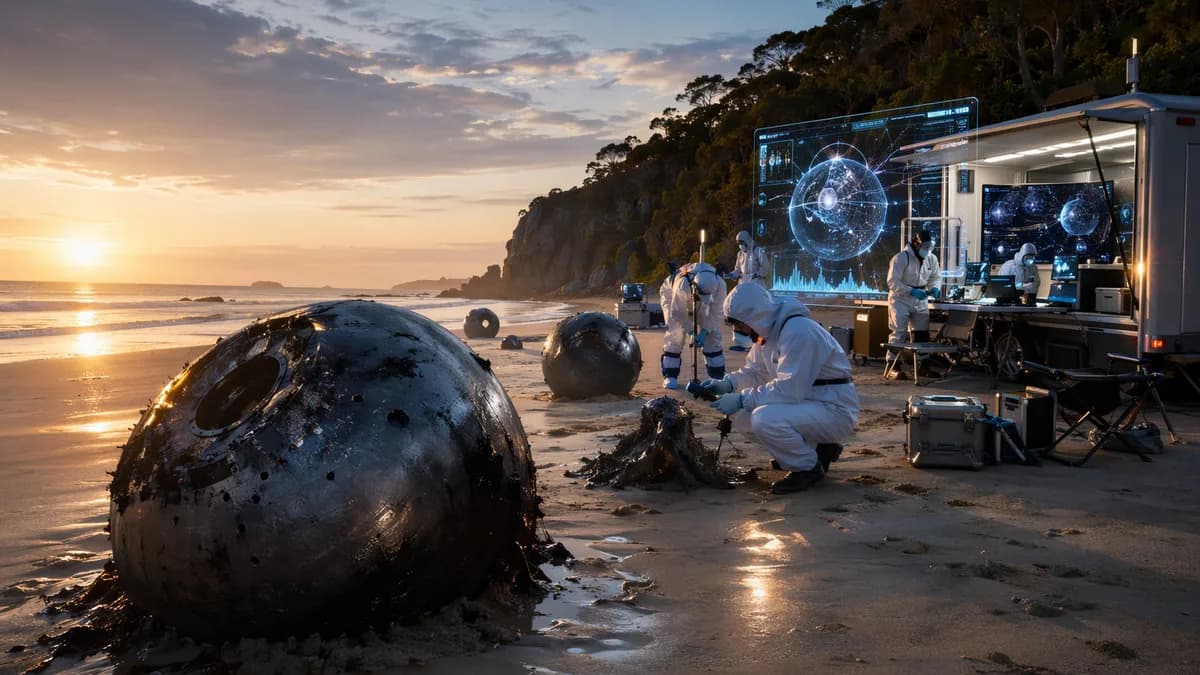
The Queensland space balls that looked like an odd beach mystery are now being treated as likely debris from a foreign rocket body that recently re-entered the atmosphere from orbit.
XOOMAR Intelligence
Analyst Take
The Australian Space Agency said six objects found near Forrest Beach, north of Townsville, “appear to be pressure vessels from a space launch vehicle,” according to Guardian World. Members of the public found the spheres washed ashore on Friday, Saturday and Sunday, triggering police and fire department responses over possible hazardous chemicals.
Australian Space Agency says Queensland space balls match foreign rocket debris
Authorities have not named the rocket, the launch vehicle, or the country responsible. But the agency’s current assessment points away from ordinary marine junk and toward orbital hardware that survived re-entry.
“The Agency has identified the likely source. The objects’ location and characteristics are consistent with debris from a foreign rocket body that recently re-entered the atmosphere from orbit.”
That wording matters. The agency is saying the Queensland space balls fit a specific class of space debris, not simply that they look unusual.
The recovered objects were described as likely pressure vessels, which are used in rocket fuel systems. Associate Prof Alice Gorman, a space archaeologist and space junk expert at Flinders University, told Guardian World that these are commonly nicknamed “space balls” and are among the most frequent types of rocket debris found after launches.
The tension is simple:
- Initial assumption: Strange spheres washing onto a Queensland beach could be marine debris or industrial waste.
- Agency assessment: Their location and characteristics are consistent with debris from a foreign rocket body.
- Remaining gap: The launch vehicle and launching state have not been formally confirmed.
The agency said it is “continuing to engage with international authorities to formally confirm the launch vehicle and launching state.”
Separate from this Queensland case, XOOMAR has covered the higher-stakes side of orbital activity in Space Force Lets Private Satellites Stalk Targets in Orbit and the satellite business fight in Rocket Lab's $8B Iridium Grab Targets SpaceX's Moat. The Forrest Beach incident adds the blunt terrestrial version: space hardware can come back, and sometimes it comes back where people can touch it.
Forrest Beach responders treated the debris as hazardous, not harmless beach junk
Police and fire authorities examined the objects over the weekend and enforced 50-metre exclusion zones around them. The caution was not cosmetic. The objects were suspected of containing hazardous chemicals, and Queensland authorities warned locals not to handle anything similar.
The Australian Space Agency later said Queensland authorities had determined the recovered objects were safe. That did not end the warning.
“Never touch, move or recover suspected space debris and assume it to be hazardous until advised otherwise. Move away and contact emergency services,” the agency said.
That is the practical message for Forrest Beach residents and beachgoers: don’t collect a souvenir, don’t roll it over for a better look, and don’t assume a metal sphere is inert just because it washed up with the tide.
The likely pressure vessels are significant because dense rocket components can survive the intense heat of re-entry. Gorman said pressure vessels are made of titanium alloy and can withstand very high temperatures. She also said their survival does not necessarily mean anything went wrong with the launch.
In other words, the fact that the Queensland space balls reached the beach is not itself evidence of a failed mission. It may be evidence of ordinary rocket hardware returning to Earth in a way that became visible, and inconvenient, once ocean currents and coastline lined up.
The local reaction was predictable. ABC reported that Forrest Beach became the centre of a multi-agency investigation over the weekend, with firefighters in hazmat suits and residents watching speculation spread through local social media pages. One local, Trevor Kyle, told ABC the situation escalated as police reported the first object to superiors.
“It could have been serious and it was treated like that, I’d say they’ll get a lot of lessons out of it. I’m impressed with the police and all of the responders.”
The launching state may still own the debris
The next fight may be less about chemistry and more about jurisdiction.
Gorman said falling space debris can be governed by the 1967 United Nations Outer Space Treaty, to which Australia is a signatory. Under that framework, the launching state retains ownership of the launch material.
“It’s the most widely accepted space treaty where the launching state retains ownership of the launch material. This means the nation that launched them owns those pressure vessels,” she said.
That means Australia may not simply dispose of the objects as local debris. Gorman said Australia would need to enter negotiations with the launching state, which would decide whether it wanted the material returned.
She pointed to a 2023 case in Western Australia, when part of an old Indian rocket washed ashore. In that case, the Indian government did not request the material, according to the Guardian World report.
The agency has not said whether the Forrest Beach objects contain markings, whether the launching state has been contacted directly, or when formal confirmation might come. The only confirmed next step is international engagement to identify the launch vehicle and launching state.
More debris may wash ashore before the rocket is named
The most immediate risk is not diplomatic. It is practical.
The Australian Space Agency warned that “further debris may be found.” Queensland authorities have already dealt with six objects, and the agency’s guidance tells the public to assume any similar object is hazardous until told otherwise.
Gorman said only one person has ever been struck by falling space debris. Lottie Williams was unhurt after being hit on the shoulder by a piece of fibreglass in Tulsa in 1997, from a US-made Delta II rocket.
That statistic should calm panic, not lower caution. The Forrest Beach objects were found by the public, close enough to shore and community activity to require exclusion zones and emergency response.
The watch item now is narrow and concrete: whether more fragments appear along the north Queensland coast, and whether the Australian Space Agency can match the debris to a specific rocket body and launching state. Until then, the safest read on the Queensland space balls is also the official one: likely space debris, still not fully identified, and not something the public should handle.
Impact Analysis
- The discovery highlights the growing real-world impact of orbital debris returning to Earth.
- Emergency responses show that unidentified space hardware can create public safety concerns even after landing.
- The unnamed source raises accountability questions for countries and operators behind re-entering rocket bodies.
Explanations for the Queensland beach objects
| Possible explanation | What the article says |
|---|---|
| Marine debris or industrial waste | This was an initial concern when the spheres washed ashore and triggered emergency responses. |
| Foreign rocket body debris | The Australian Space Agency says the objects’ location and characteristics are consistent with debris from a foreign rocket body that recently re-entered from orbit. |
| Unknown launch source | Authorities have not named the rocket, launch vehicle, or country responsible. |
Primary Sources & Disclosures

Written by
XOOMAR Insights Team
Research and Editorial Desk
The XOOMAR Insights Team pairs automated research with human editorial judgment. We track hundreds of sources across technology, fintech, trading, SaaS, and cybersecurity, cross-check the facts, and explain what happened, why it matters, and what to watch next. We do not just rewrite headlines. Every article is fact-checked and scored for reliability before it goes live, and we link back to the original sources so you can verify anything yourself.