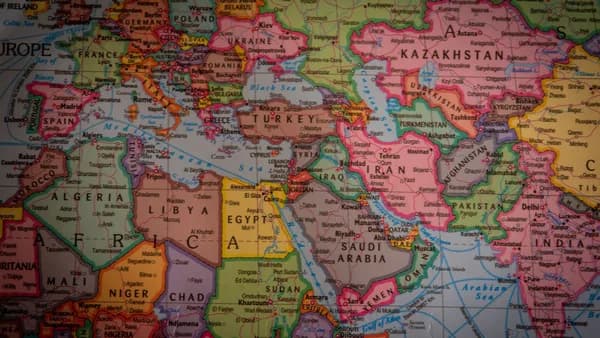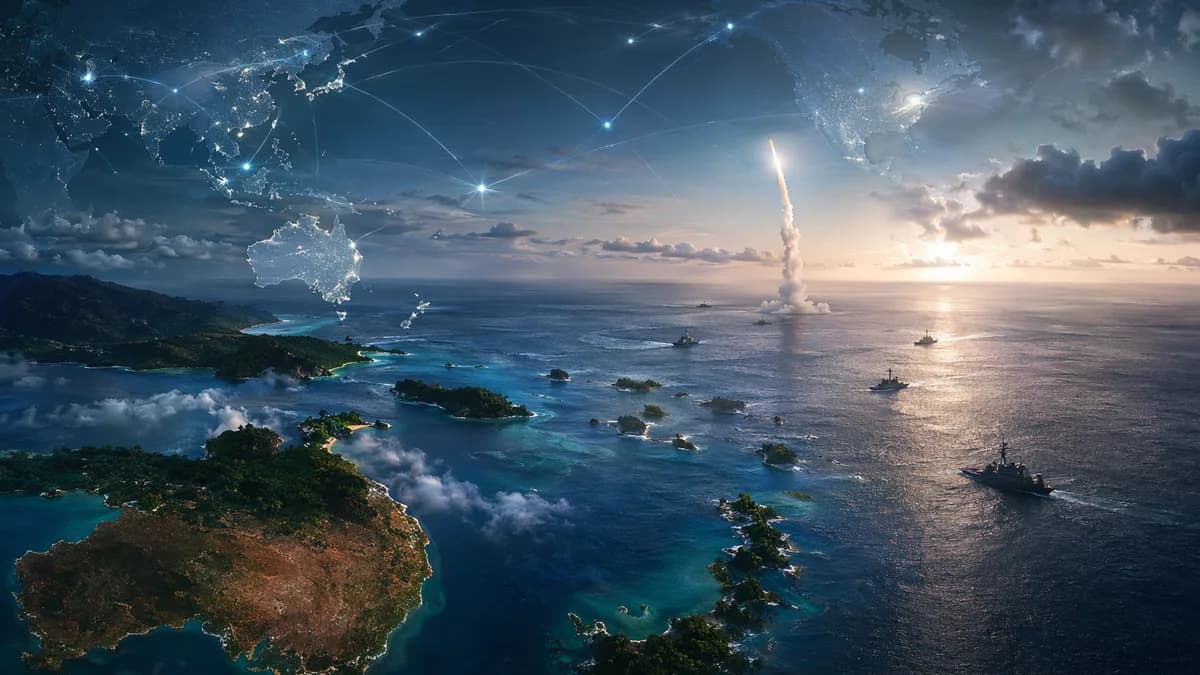
China’s missile test in the South Pacific signals a harder phase of regional security politics: Beijing called it routine training, but Australia, New Zealand and Japan treated the launch as a warning shot for the Pacific order. The China Pacific missile test involved a long-range missile carrying a dummy warhead, which landed in “designated waters” of the Pacific, according to Guardian World.
XOOMAR Intelligence
Analyst Take
China’s state news agency Xinhua described the launch as a “routine arrangement” in annual military training and said relevant countries had been notified in advance. Canberra did not accept that framing. Australian foreign minister Penny Wong said Australia regarded the proposed test as “destabilising to the region,” while acting prime minister Richard Marles said Australia was “very concerned about any actions which undermine the stability, the peace, and security of the Pacific.”
The tension is not just about process. It is about geography, timing and intent.
Beijing moved missile signaling into Australia’s Pacific neighborhood
XOOMAR analysis: advance notification lowers accident risk, but it does not make a long-range missile launch politically neutral. Beijing told regional governments before the test. That matters. But Australia’s reaction shows the dispute is not whether China followed a notification procedure. The dispute is whether a long-range missile test into the South Pacific should become normal military behavior.
The launch came on the same day Australia and Fiji signed a major defence alliance, committing each country to come to the other’s aid in the event of an attack. Australian assistant foreign minister Matt Thistlethwaite told the ABC the government did not believe there was a link between the alliance and the test. A federal government source told the Guardian they believed the events were linked.
That split matters. It shows Canberra is still managing two narratives at once: avoiding an unsupported public claim of coordination by Beijing, while reading the launch through a wider strategic pattern.
“This is a long-range missile test, and we are very concerned about any actions which undermine the stability, the peace, and security of the Pacific,” Richard Marles said.
Beijing’s counterpoint is clear. Xinhua said the test was routine annual training, complied with international law and practice, and was not directed at any country or target. If China releases more detailed information on the test zone, trajectory and notification process, that would strengthen its argument that the launch was operational rather than coercive.
For now, the public facts leave room for suspicion. The exact location of the test remains unknown.
The China missile test details that matter: dummy warhead, designated waters, prior notice
The known details are narrow but important. China launched a long-range missile on Monday. Xinhua said it carried a dummy warhead and landed “precisely within the designated waters.” The missile was launched from a strategic nuclear submarine, according to Xinhua’s account cited in the Guardian.
Each phrase does work.
| Detail | What it supports | What it does not prove |
|---|---|---|
| Dummy warhead | This was a test, not an attack | It does not remove concern about nuclear-capable systems |
| Designated waters | The launch was planned | It does not identify the public splashdown location |
| Prior notification | Beijing sought to reduce immediate risk | It does not settle whether the act was destabilising |
| Submarine launch | China tested sea-based strategic capability | Public reporting does not confirm the full missile model or range |
The strongest factual restraint here is the absence of core technical data. Public reporting has not confirmed the missile model, exact range, flight path or splashdown coordinates. Wong also would not confirm whether Australia had been informed about the missile’s potential nuclear capability.
That uncertainty is part of the story. When a state conducts a long-range launch into a region whose leaders call the Pacific an “Ocean of Peace,” vague public information can amplify diplomatic damage rather than contain it.
Numbers behind the South Pacific missile alarm
The data points available are sparse, but they sharpen the risk picture. Xinhua said the missile was launched at 12:01 p.m. and carried a dummy warhead. China last conducted a Pacific missile test two years ago, firing an intercontinental ballistic missile with a dummy warhead. AP reported that the previous launch in international waters was the first in decades, since 1980.
The nuclear-free-zone issue adds another layer. New Zealand said it was informed only hours before the planned launch and noted that the missile was fired into the South Pacific Nuclear Free Zone. That zone was established by the 1986 Treaty of Rarotonga, and China in 1987 ratified protocols pledging not to test nuclear weapons within the zone or threaten their use against signatories with territory in the region.
New Zealand foreign minister Winston Peters made the concern explicit:
“It appears that despite our long-standing concerns about this type of activity, China carried out the test within hours of informing us.”
There were also signs of pre-positioned tracking activity. Starboard Maritime Intelligence, a New Zealand ship-tracking company, said three Chinese satellite-tracking vessels were positioned throughout the Pacific. Two departed China around June 25 and were near the Federated States of Micronesia. A third departed in early May and was at harbour in Suva, Fiji’s capital.
Mark Douglas, an analyst for Starboard, said those vessels carry large satellite dishes used to track missile launches and other space activity. His conclusion was blunt: “This test has been planned well in advance.”
Canberra, Wellington, Tokyo and Beijing are reading the launch differently
Australia’s position is that notification did not cure the strategic problem. Wong said Australia had been aware of a Chinese task group in the region “for some time,” and placed the test in the context of “a rapid military build-up by China, which is lacking in the transparency and reassurance as to intent, that the region expects.”
New Zealand’s framing was sharper on timing. Peters said China carried out the test within hours of informing Wellington. Japan said it had tried to convince China not to proceed and had “expressed serious concerns over China’s increasing military activity.”
Beijing’s defense is procedural and legalistic: routine training, prior notice, no specific target. That argument may persuade countries already comfortable with expanded Chinese military operations. It did not persuade the governments named in the reporting.
XOOMAR analysis: the diplomatic test is becoming as important as the missile test. Beijing is not only proving hardware performance. It is also testing how much strategic activity regional governments will absorb before they coordinate criticism in public.
For readers tracking China across different policy arenas, this is a security story first. It should not be flattened into trade or domestic governance coverage. Still, it sits beside a broader XOOMAR China file that includes state power at home in China Ethnic Unity Law Turns Minority Identity into a Test and economic friction abroad in €360B China Gap Forces EU Steel, E-Commerce Crackdown. The relevant link is not causation. It is how other governments respond when Chinese policy choices spill beyond bilateral channels.
The launch raises the cost of Pacific security choices
The immediate practical effect is pressure on monitoring. Missile warning, satellite tracking, maritime domain awareness and crisis communication all become more important when long-range launches move into the South Pacific.
Australia will face a familiar policy problem: how to condemn Chinese military behavior without turning every incident into escalation. The Fiji alliance already showed Canberra deepening regional defense ties. The China missile test will make those ties look less theoretical.
Pacific island states face the harder dilemma. They may want the Pacific treated as an “Ocean of Peace,” but they are also being pulled into questions about military access, notification rules and environmental reassurance. A launch into “designated waters” may satisfy the launching state’s process requirements. It does not answer every regional concern about confidence, sovereignty or public trust.
The counterpoint is that militaries test missiles. China can argue that other major powers conduct strategic tests too. But the regional reaction shows the South Pacific is no longer treated as empty strategic space.
More tests would harden the new Pacific security map
The next evidence to watch is not one press statement. It is the pattern.
If China provides fuller details, extends notification windows and avoids repeat launches into politically sensitive waters, Beijing’s “routine training” argument becomes easier to defend. If future tests arrive with short notice, limited transparency and tracking vessels already positioned across the Pacific, Australia, New Zealand and Japan will read that as normalization by pressure.
Canberra’s likely path is diplomatic first: sharper public language, more coordination with Pacific capitals and heavier emphasis on monitoring rather than immediate military retaliation. Pacific governments, meanwhile, will have reason to demand clearer rules before their waters and airspace become regular venues for great-power signaling.
The China missile test will not start a crisis by itself. But it strengthens a harder assumption now forming around the South Pacific: deterrence is setting the tempo faster than reassurance can catch up.
Impact Analysis
- The test expands China’s missile signalling into a Pacific region Australia views as strategically sensitive.
- Advance notification reduced accident risk but did not ease concerns about normalising long-range missile launches in the South Pacific.
- The timing alongside an Australia-Fiji defence alliance highlights rising security competition across the Pacific.
Regional reactions to China’s South Pacific missile test
| Actor | Position |
|---|---|
| China | Called the launch a routine annual training arrangement and said relevant countries were notified in advance. |
| Australia | Condemned the proposed test as destabilising and said it undermined Pacific peace, stability and security. |
| New Zealand and Japan | Treated the launch as a serious regional security signal rather than routine military activity. |
Primary Sources & Disclosures

Written by
XOOMAR Insights Team
Research and Editorial Desk
The XOOMAR Insights Team pairs automated research with human editorial judgment. We track hundreds of sources across technology, fintech, trading, SaaS, and cybersecurity, cross-check the facts, and explain what happened, why it matters, and what to watch next. We do not just rewrite headlines. Every article is fact-checked and scored for reliability before it goes live, and we link back to the original sources so you can verify anything yourself.