
Can the Australia Vanuatu military base deal keep foreign forces out of Port Vila without making Vanuatu look like it has traded one dependency for another?
Global TrendsJune 29, 2026· 8 min read· By XOOMAR Insights Team
Australia Vanuatu Military Deal Boxes Out China in Pacific
Updated on June 29, 2026
XOOMAR Intelligence
Analyst Take
59/ 100
4 sources analyzedLow confidenceTrend20Freshness95Source Trust85Factual Grounding90Signal Cluster20
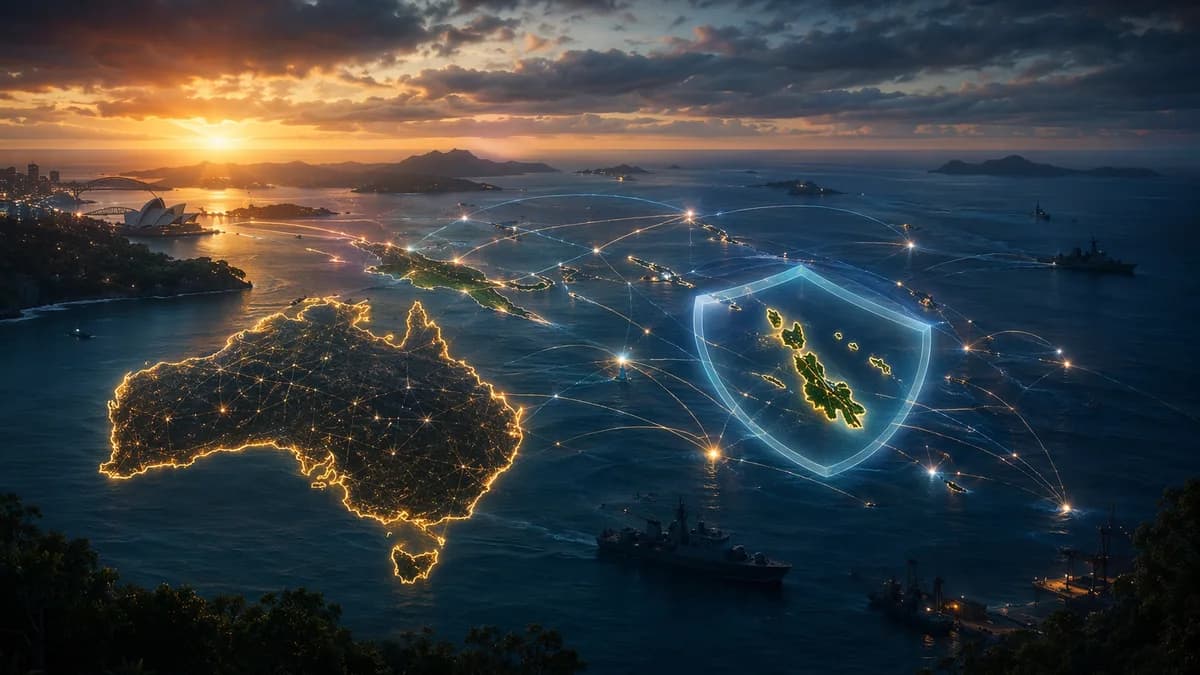
Australia and Vanuatu signed the Nakamal Agreement in Canberra on June 29, 2026, barring foreign military bases or infrastructure on the Pacific island nation, according to Al Jazeera. The pact was signed by Australian Prime Minister Anthony Albanese and Vanuatu Prime Minister Jotham Napat, with China immediately warning that regional cooperation should not target a third party.
XOOMAR analysis: the deal is less about one base that exists today than about preventing a future bargaining shock. Australia is trying to lock in a security ceiling before infrastructure finance, policing ties, port access, and disaster response harden into something harder to unwind.
Can Canberra block a foreign base without saying the deal is aimed at China?
Australia is not hiding the core purpose of the Australia Vanuatu military base deal. Albanese put it plainly after the signing.
“What this does do is to provide certainty for Australia that there will be no foreign military base,” Albanese told reporters.
He added that the agreement would “protect our collective and individual security and our sovereignty”.
That is the sharp edge of a pact framed as economic and security cooperation. Australia committed to increased economic support for Vanuatu. Vanuatu, in turn, agreed to bar foreign military bases or infrastructure and to consult Australia on third-party investment in critical infrastructure.
China read the signal.
“We hope that cooperation between relevant countries and Pacific Island countries will contribute to the development and stability of the island region, not target any third party or be used as a tool for geopolitical rivalry,” said Guo Jiakun, a spokesperson for China’s Ministry of Foreign Affairs.
The diplomatic wording matters. Australia calls it certainty. China calls it potential targeting. Vanuatu calls it sovereignty and partnership.
Napat said Vanuatu had already passed domestic legislation against militarisation of critical infrastructure.
“As a country, we have in fact passed an act in parliament not to allow any militarisation to actually be used for our critical infrastructure,” Napat said.
That line gives Port Vila political cover. The ban is not only something Australia demanded. It is presented as consistent with Vanuatu’s own law.
Why did Vanuatu accept this version after rejecting an earlier one?
Vanuatu rejected an earlier version of the deal in September because of concerns that it would limit the country’s ability to attract infrastructure investment. That earlier draft, according to the source material, had included an Australian proposal to provide 500 million Australian dollars ($345m) over 10 years.
The final agreement appears to soften one sensitive point. Vanuatu will consult Australia over third-party engagement in critical infrastructure, but there is no longer any Australian power of veto, which had previously been floated.
That distinction is central.
| Issue | Earlier concern | Signed deal |
|---|---|---|
| Foreign military bases | Vanuatu did not want limits that looked too restrictive | Vanuatu bars foreign military bases or infrastructure |
| Critical infrastructure | Concern over constraints on investment | Vanuatu consults Australia on third-party investment |
| Australian veto | A veto had been floated | No veto in the signed version |
| Economic support | A$500m over 10 years was proposed earlier | Albanese said the latest figure will be shared in the year-end budget update |
XOOMAR analysis: this is how small-state bargaining works when infrastructure and security overlap. Vanuatu did not simply take the first offer. It pushed back on terms that could have looked like Canberra controlling its investment pipeline, then accepted language that still gives Australia warning and influence.
That makes the Nakamal Agreement more durable than a blunt prohibition would have been. It lets Australia claim a base-denial win while letting Vanuatu argue it preserved room to deal with other partners.
How does aid become a security shield in the Australia Vanuatu military base deal?
The pact links several categories that used to be easier to separate: development finance, policing, maritime security, cyber security, intelligence cooperation, infrastructure, and disaster response.
The agreement states that Australia is Vanuatu’s “longstanding primary policing partner”, AFP reported through the source material. The two countries will increase cooperation in:
- Police training: deeper Australian role in law enforcement capacity.
- Maritime security: greater coordination in surrounding waters.
- Cybersecurity: cooperation in a domain tied to both government systems and critical infrastructure.
- Intelligence cooperation: a sensitive category that signals trust.
- Infrastructure: the arena where commercial deals can acquire strategic meaning.
Vanuatu has also agreed to turn first to Australia, New Zealand or France in the event of a major natural disaster. That clause does not make those countries parties to the deal, but it shows how emergency response has become part of regional alignment.
Separate from this foreign policy story, XOOMAR has tracked Australia’s domestic policy fights in Australia Social Media Fines Corner Meta on Child Accounts and Australia Social Media Ban Dares Meta to Prove Teens Are Out. The contrast is useful: at home, the instrument is regulation. In Vanuatu, the instrument is treaty language around bases, policing, and infrastructure.
Why does China’s existing role in Vanuatu make the pact more sensitive?
China already has economic and security links with Vanuatu. The source material says Vanuatu is due to sign a separate economic agreement with China, which has provided loans to finance Chinese contractors building infrastructure and buildings there.
China has also built roads and buildings across the South Pacific over the past decade through its Belt and Road initiative. In Vanuatu specifically, China’s navy has made port calls, and Beijing funded the expansion of a wharf in Luganville, Vanuatu’s second-largest city.
Policing is another friction point. China and Vanuatu established policing ties in 2023, with Beijing donating drones, patrol boats and vehicles to the island’s police force. Euronews also reported that China is Vanuatu’s largest external creditor and that Australia has expressed concern about Beijing seeking a permanent security presence in the region, according to Euronews.
The signed agreement does not say “China”. It does not need to. The structure answers the question Canberra cares about: can outside-backed infrastructure or policing links become the basis for a military presence later?
XOOMAR analysis: Australia is not trying to eject China from Vanuatu’s economy. The source material says Vanuatu is still pursuing a separate economic agreement with Beijing. The real objective is narrower and harder: draw a legal line between Chinese-funded development and any future foreign military footprint.
Is this a reaction to Solomon Islands, or a new Australian playbook?
The source material places the Vanuatu pact inside a broader Australian effort to secure, or work toward securing, agreements with Pacific island states to curb China’s influence.
The clearest comparison is Solomon Islands. Euronews reports that Chinese police have maintained a presence there since a secret security pact in 2022. The Vanuatu deal looks like a preventive answer to that model.
There is a tactical shift here.
Australia is not waiting for a security arrangement to emerge and then objecting from the outside. It is embedding base-denial language, policing primacy, disaster-response pathways, and critical infrastructure consultation into a bilateral framework before a rival presence becomes entrenched.
That does not end Vanuatu’s non-alignment. A former Australian diplomat in the Pacific, James Batley, told AFP that the contest would continue.
“Vanuatu's long tradition of non-alignment means that it won't simply abandon its relationship with China. Nor will China abandon its attempts to undermine Australia's interests in Vanuatu,” Batley said.
That is the most realistic reading. The pact narrows the military lane. It does not close the economic road.
Which parts of the deal will prove whether it has real force?
The next test is not the signing ceremony. It is implementation.
Australia has not yet disclosed the latest economic support figure. Albanese said that number would be shared in the budget update at the end of the year. That will show how much Canberra is willing to pay for the certainty it says the deal provides.
The second test is Vanuatu’s separate economic agreement with China. If Port Vila can continue taking Chinese-backed infrastructure support while observing the military-base ban and consultation process with Australia, the deal will look like managed non-alignment. If disputes break out over what counts as critical infrastructure or militarisation, the pact will start to feel much more restrictive.
The third test is whether Australia uses similar clauses elsewhere in the Pacific. The source material says Canberra has secured, or is in the process of securing, multiple agreements with Pacific island states as part of a push to curb China’s influence. If base-denial language becomes standard, the Australia Vanuatu military base deal may be remembered as a template.
For now, the evidence supports one clear thesis: the Pacific security contest is moving into the fine print. Bases still matter. But so do wharves, police equipment, disaster clauses, cyber cooperation, and consultation rights buried inside development agreements.
Impact Analysis
- The agreement gives Australia a formal safeguard against future foreign military basing in Vanuatu.
- Vanuatu gains more Australian economic support while facing scrutiny over its strategic independence.
- China’s reaction shows Pacific security deals are increasingly tied to broader regional rivalry.
Sources

Written by
XOOMAR Insights Team
Research and Editorial Desk
The XOOMAR Insights Team pairs automated research with human editorial judgment. We track hundreds of sources across technology, fintech, trading, SaaS, and cybersecurity, cross-check the facts, and explain what happened, why it matters, and what to watch next. We do not just rewrite headlines. Every article is fact-checked and scored for reliability before it goes live, and we link back to the original sources so you can verify anything yourself.
Explore More Topics
Related Articles
 Global Trends
Major Parties Cut Weak Gambling Deal Gutting Reforms
Labor and the Coalition have struck a deal to pass a watered-down gambling ad bill, directly rejecting core recommendations from a landmark parliamentary review
Aug 18, 20267 min
 Global Trends
Australia Hunts Quarter-Million Guns After Massacre
New South Wales will start a $1,000-per-firearm buyback on November 2, targeting 274,000 weapons to reduce a record private arsenal after the Bondi Beach massac
Aug 16, 20266 min
 Global Trends
Australia to Confiscate 274,000 Guns After Knife Attack
Australia's New South Wales is launching a massive gun buyback targeting 274,000 firearms, a response to a mass stabbing that didn't involve guns, setting a con
Aug 15, 20266 min
 Global Trends
Hero's Assault Charges Scrapped in Deferred Prosecution Deal
Australian hero Ahmed al-Ahmed will not face assault charges after agreeing to a court order, as the prosecution withdrew its case following the alleged victim'
Aug 13, 20265 min
 Global Trends
Typhoon Dolphin Unloads Beijing's Annual Rainfall in a Day
Typhoon Dolphin is delivering over a third of Beijing's annual rainfall in just 24 hours, forcing thousands to evacuate and testing the inland capital's flood d
Aug 13, 20268 min
 Technology
Anthro Energy Breaks Ground on Solid State Battery Breakthrough
Anthro Energy is building a U.S. factory dedicated solely to producing a polymer electrolyte for solid-state batteries, aiming to solve the battery industry's b
Aug 18, 20267 min
 Fintech
Banks Pour Millions Into AI Fraud Detection That's Still Too Late
A new Plaid study reveals that 47% of firms cannot detect fraud in real time, proving that faster payments have completely outrun traditional security checks.
Aug 19, 20266 min
 Cybersecurity
U.S. Charges Iran in Multi-Billion Dollar Hacking Heist
U.S. prosecutors charged 17 Iranians with stealing over $3 billion in intellectual property from American universities and companies for Iran's Revolutionary Gu
Aug 19, 20265 min
 Technology
Hyperscaler Bets Millions on Hollow-Core Fiber for AI
Relativity Networks secured a vendor's bet with a $40 million order for its hollow-core fiber, bringing a 30% speed boost for sprawling AI data centers from the
Aug 19, 20264 min
 Global Trends
Erin Patterson Appeal Hinges on Catastrophic Hotel Receipt
Erin Patterson's life sentence for murdering three people with a toxic mushroom lunch could be overturned because a hotel booking receipt may have wrongly place
Aug 19, 20268 min
Don't miss the signal
Get our weekly roundup of the stories that matter across tech, fintech, and trading. No noise, just signal.
Free forever. No spam. Unsubscribe anytime.